Seamus Heaney could turn a moment’s thought into a naturalistic poem of pure joy. He may be an acquired taste but he’s worth it.
Oysters
by Seamus Heaney/
Our shells clacked on the plates,
My tongue was a filling estuary,
My palate hung with starlight:
As I tasted the salty Pleiades
Orion dipped his foot into the water.
Alive and violated,
They lay on their bed of ice:
Bivalves: the split bulb
And philandering sigh of ocean
Millions of them ripped and
Shucked and scattered.

We had driven to that coast
Through flowers and limestone
And there we were, toasting friendship,
Laying down a perfect memory
In the cool of thatch and crockery.
Over the Alps, packed deep in hay and snow,
The Roman's hauled their oysters south to Rome:
I saw damp panniers disgorge
The frond-lipped, brine-stung
Glut of privilege

And was angry that my trust could not repose
In the clear light, like poetry or freedom
Leaning in fom the sea. I ate the day
Deliberately, that its tang
Might quicken me all into verb,
Pure verb.
We meet many people on our journey through life – most are the type we meet every day: neighbours; local business people; fellow shoppers (not so many in the last 18 months); local sports personalities; or national personalities.
As a journalist it is possible I have met more people, no matter how fleetingly or for what reason, than the average person. If I had got the signature of every celebrity I have met so far I would have had a wall full of shelves laden down with volume after volume of autograph books.
Those volumes could have been worth a fortune. When I see tv antiques and collectibles shows, such as Bargain Hunt, Antiques Roadshow, Flog it, etc. I find it amazing how much people are prepared to pay for the signatures of people that others have collected.
In reality I have only ever asked one person for their autograph and there are only two others who I might have considered asking.
Obviously there are people you would never dream of asking for a signature. The Queen, for example, or a notorious criminal who has just been sentenced to life in prison (and I have crossed paths with the odd one or two of those in my lifetime).
On the entertainment celebrity front I’ve mentioned some of those I met in Rhyl, or who came into Dad’s shop and it was in Rhyl that I got the one and only autograph I ever asked for.
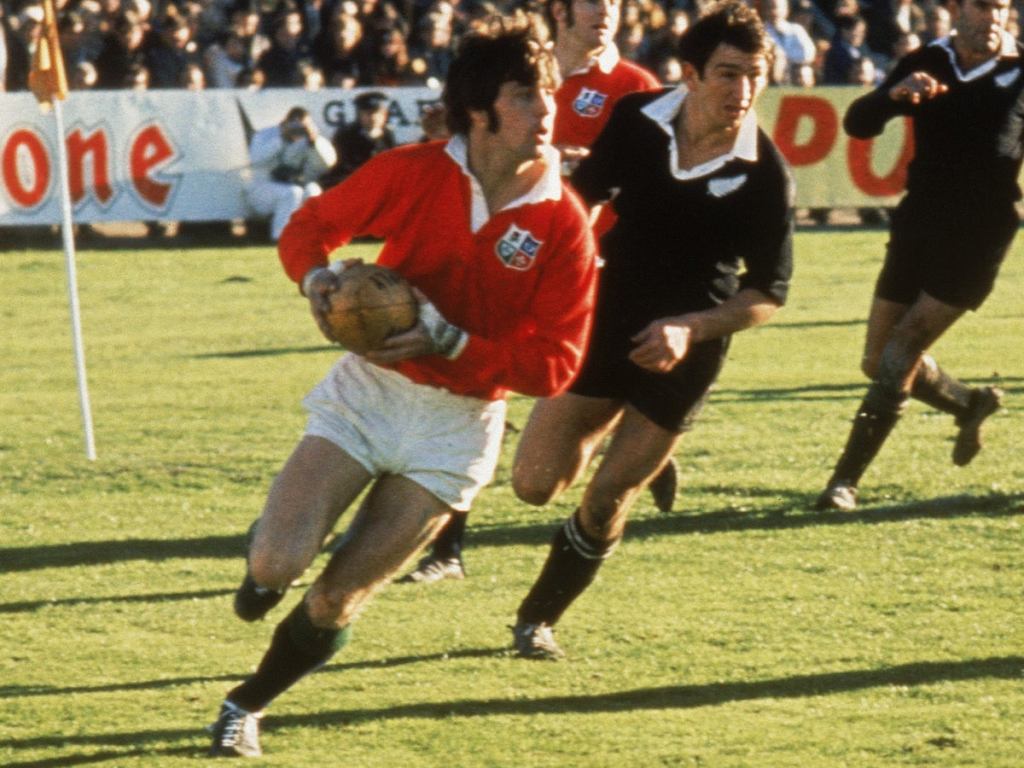
King of the pitch – the mighty Barry John
As a junior reporter, I attended the opening of the new Rhyl Rugby Union Club sports pavilion. The ceremony was carried out by the man they call King John, fly-half Barry John who played for Llanelli, Cardiff, the British Lions and, of course, his national side at the beginning of Wales’ new Golden Age in the late 60s and early 70s.
After the opening ceremony I talked with him for quite a while without displaying the fact that I was awestruck at meeting one of the two best rugby players the world had ever seen as a pair – Barry John and Gareth Edwards.
Just before he left, without thinking twice, I said: “Could I have your autograph?” and, again without thinking twice, he obliged, using my notebook to sign his name.
That was the first and last time I ever used my role as a journalist to get an autograph.
When I moved on to Basildon I started to do more and more reviews of events at the the local arts centre. Knowing the manager (a Rhyl lad himself) was useful when it came to meeting the artistes after the show.
I have mentioned the Mersey Poets, Basildon was also my first introduction to an up and coming folk rock group Magna Carta who have been part of my personal music collection for many years now.
Then we came to the longer-established artistes, such as Acker Bilk, the trad jazz maestro who even offered me a glass of scrumpy from his personal supply.
After the concert, when the bar was closed to the public, Malcolm had invited me up to meet Acker and the boys in the Paramount Jazz Band. The lads were supping pints of what looked like bitter, but I noticed Acker’s glass was somewhat cloudier than the others.
When Malcolm asked me what I would like to drink Acker broke in before I could answer. “I’m sure the lad’d like a drop of scrumpy.”
At that he took an empty half-pint glass and poured me a drink from a flagon which had the same cloudy appearance as his own drink.
This wasn’t my first taste of scrumpy. In my teens my father and I had a week’s boating holiday on the Norfolk Broads (there’s a few good stories out of that) and one lunchtime we moored by a pub which had lawn running down to the waterside.
To go with our ploughman’s lunch we decided to taste the local scrumpy. I had two half pint glasses. When we got back to the boat Dad said he’d have a half-hour nap before we set off again. I chose to listen to Radio One which had launched the previous year.
I remember the DJ saying it’s just coming up to 2pm and before the time-check we’ll listen to . . . . The next thing I knew the song was coming to an end, except it was not 2pm it was now 3pm. I must have fallen asleep half-way through the song and woken up when they were playing the same song an hour later.
Anyway, remembering the soporific effect, I treated Acker Bilk’s brew with caution. Just as well because one sip[ made me believe it was ag least twice as strong as the Norfolk brew.
It was only after they had gone that Malcolm told me Acker Bilk always carried his own flagon of scrumpy with him, the genuine product from Somerset, and that he never, never, let anyone else have a drop.
As I said, I met a number of up-and-coming artistes as well as many who had made the big time but still liked to take in small venues when on tour. It appeared that Basildon had become a bit of a hotspot for jazz, because I can also remember Kenny Ball and his group and a few lesser-known jazz combos playing there.
The marvelous Cleo Laine with husband Johnny Dankworth
The peak moment of my career as a reviewer, however, was when I went to the arts centre to see and hear Cleo Laine with Johnny Dankworth’s band.
I had always appreciated this brilliant singer and her musically gifted husband but this was the first time I had heard her live.
After a musical intro by Johnny and the band he welcomed Cleo to the stage and for the first set, right up to the interval (a good hour) she sang her heart out and when she finished the whole audience rose as one to applaud her.
The second set began the same way, an instrumental number followed by Cleo. As she began her second hour she looked as fresh as she had done at the start of the concert and had even changed her dress in the interval.
During this second set her microphone failed. Without missing a note she moved toward the wings, holding her microphone out, as her hand disappeared she continued singing as, out of sight, a stagehand took the dud mike, replaced it with a good one and allowed her to return to centre stage.
When she finished that number she looked off to the wings and very clearly and politely said: “Thanks for that, I don’t think the audience noticed a thing.” The audience just erupted again.
At the end of the concert she curtsied to the ecstatic audience and left the stage, only to return to sing an encore because the applause just went on and on. This happened six times before Johnny took her by the hand and, after saying: “If you don’t stop she’ll still be singing at 3am. Thank you all, but goodnight.” the couple left together and did not return.
As I was leaving Malcolm stopped me and asked if I would like to go backstage and meet Cleo. He didn’t have to ask twice.
When we entered her dressing room she was wearing an elegant robe and was standing behind an ironing board pressing out the creases in the outfit she had just been wearing. The outfit from the first set was hanging up looking as though it had just come back from the cleaner. She took my hand and then said: “If you’re not in a rush why don’t you go out front with Malcolm and Johnny and I will join you for a coffee before we leave.”
It was about 11.30pm by now and within 10 minutes the couple joined us and we sat drinking coffee and talking until 2am. The time had flown and Miss Laine still looked as fresh as a daisy.
It is because of such moments, the scrumpy and the midnight coffee, that I now realise I did not need autographs to remind me of these moments because I would always have the memories.
Those memories I made at the Basildon Arts Centre were really just the beginning of a store of special moments that will be with me for the rest of my life.
If I was to have asked for just two other autographs after that Barry John moment then it would have been Cleo Laines and – Harry Secombe (but he was in my future and halfway across the world).
I have a large collection of books, even some going back to the 1800s. and amid them are many poetry books. Some I inherited from my father, school prizes won by him and by his sister, Dorothy, who died very young.
There is Longfellow, Yeats, Elizabeth Barrett Browning – running on to Rossetti, to which I have added many more of my own poetry books such as Dylan Thomas, McGough, Lawrence, Hughes and Heaney.
Much as I love them all my current favourite is my latest addition – Poetry Please The Nation’s Favourite Poems, an anthology of poems requested on the Radio 4 programme hosted by Liverpudlian Roger McGough, which was given to me on Father’s Day this year by my dear daughter Jacqueline.
Today I decided to pick a poem from the book at random.
Here goes:
Snow in the suburbs
by Thomas Hardy
Every branch big with it,
Bent every twig with it;
Every fork like a white web-foot;
Every street and pavement mute:
Some flakes have lost their way, and grope back upward when
Meeting those meandering down they turn and descend again.
The palings are glued together like a wall,
and there is no waft of wind with the fleecy fall.

A sparrow enters the tree,
Whereon immediately
A snow-lump thrice his own slight size
Descends on him and showers his head and eye
And overturns him
And near inurns him,
And lights on a nether twig, when its brush
Starts off a volley of other lodging lumps with a rush.

The steps are a blanched slope,
Up which, with feeble hope,
A black cat comes, wide-eyed and thin
And we take him in.
We’ve all seen it when our gardens and the road beyond are transformed under a blanket of snow, which hides the defects as it layers them with that glistening white layer.
I remember one house where we lived and it was not just a shallow slope created from the steps, instead the snow was so deep that it came to the top step and actually hid a steeper slope beneath it where the drive ran down to meet the road.
Hardy’s wintry scene came decades before that crisp white snow that hid our garden and covered the branches of our trees with its white magic, yet that poem takes me instantly to that winter when my son was born.
I am sure you all have your favourite poems, well Liverpool poet Roger McGough has collected many of my favourites in this volume: Poetry Please.
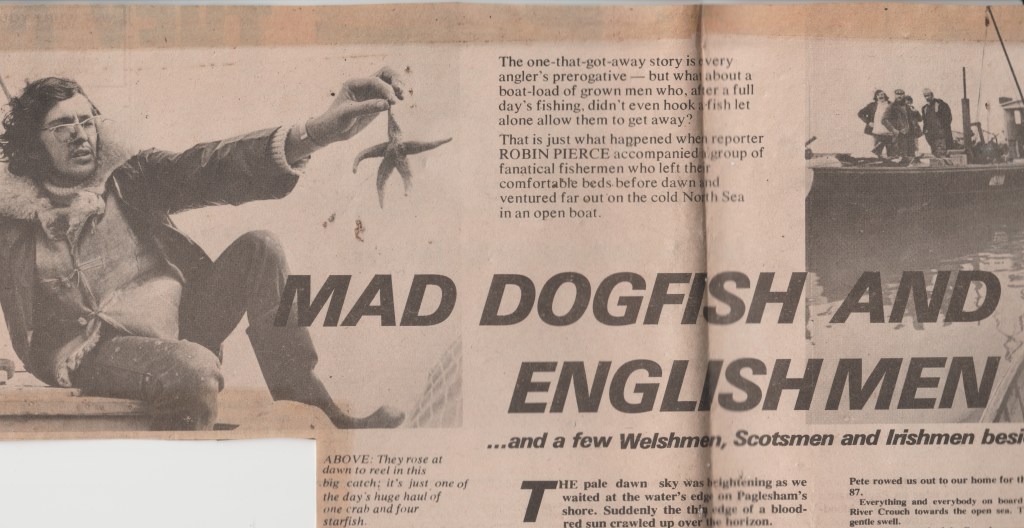
Dressed to meet the travails of the North Sea and holding up what was the best part of a meagre catch
On my path through life I have met many people – at school, at work and in my leisure time. Some have entered my life and after a few years exited it again. Some school friendships ended when I left school (although there were a few which lasted longer – my dear departed friend Roger Steele, for instance) and other friends came into my life and out again when I moved to take up a new job.
Some of those friends went on to make their mark on the world while others stayed put and made their mark on their own locality.
Then there were those who I only met because they had made their mark in life. Even in my teens in Rhyl I met a lot of entertainers who came to my father’s shop while they were doing weekend shows at the Pavilion, or other entertainment spots in town, some of them doing a full week.
Surprisingly there are the ones you meet again under completely different circumstances. People like Heinz Burt, or just Heinz as he was known professionally, who made a hit on the pop scene in the 60s beginning with an instrumental hit Telstar as part of the Tornados.
Heinz playing bass guitar with the Tornados on the 1962 hit Telstar
Heinz appeared more than once in Rhyl and was known for his clean-cut Germanic look with his peroxide blonde hair. The peroxide touch came from his manager, Joe Meek, who thought it a class idea. A view not shared by my father who once, when Heinz came in to our chemist shop to get some hydrogen peroxide, told the up and coming pop star: “You shouldn’t use it too often, it’ll ruin your hair eventually.”
Although Meek got him on tours with some of the big names of the time Heinz’s only real touch of fame came with the Tornados and briefly in 1963 as a solo vocalist with Just Like Eddie, an homage to Eddie Cochrane, one of the best-known American rock’n’roll pioneers.
Little did I know that I was going to meet Heinz again under very different circumstances.
As well as news features Tony Blandford, my editor, thought it a good idea to try out different sports on behalf of the readers.
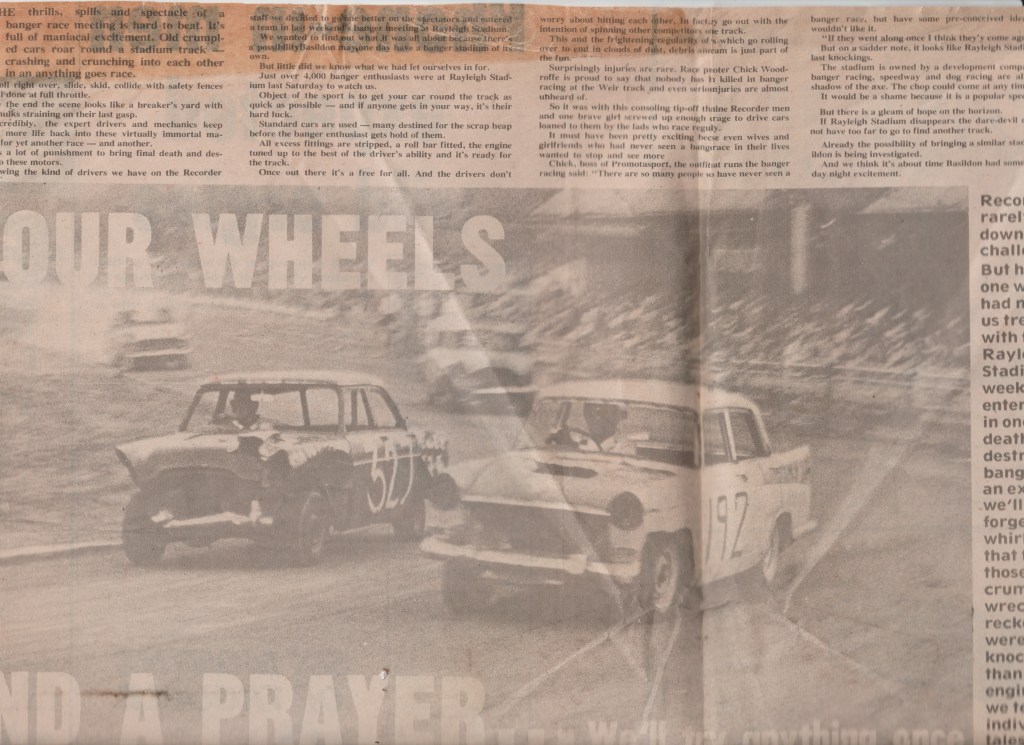
One of these involved members of the editorial team, and a token representative from the advertising department, who at the time was also our “token female” (this was a period when women were only just beginning to be treated as equals by many), taking part in a “Banger racing” event at the nearby track in Rayleigh.
The Basildon Standard Recorder crazy crew taking part in the thrills and spills of banger racing
I wrote the introductory article for the report but then we all wrote about our particular experiences on the race track which were somewhat hairy to say the least.
Tony also knew that having been raised by the sea I had also been on a number of sea-fishing trips in my life. He said there was an advertising rep on one of our sister papers in Essex (we were part of the Westminster Press Group) who also enjoyed sea-fishing and belonged to a small group who made regular trips. The editor suggested I join them on an early-morning trip out from the Essex coast.
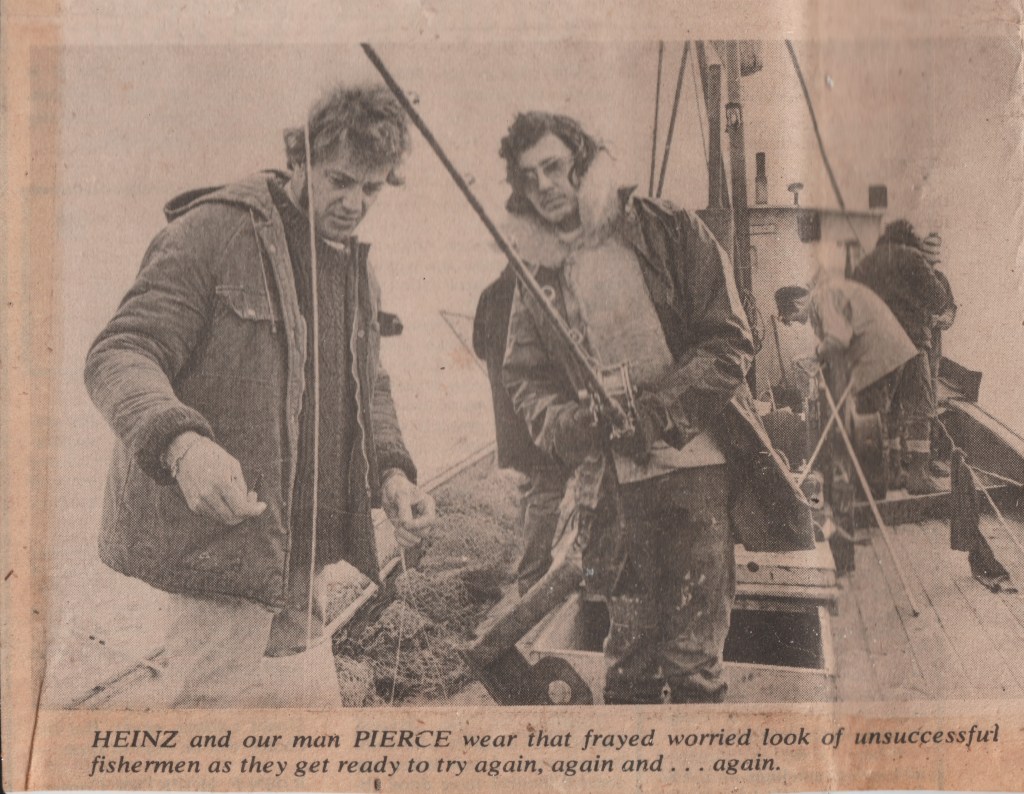
The advertising rep proved to be – Heinz Burt.
He was taking a break from the pop world and it appeared to be doing him good, at this stage his hair was more of a light brown than the peroxide blond he had become so well known for.
The original caption r4om almost 50 years ago says it all. Me and my fishing “buddy” Heinz Burt/
The more regular life seemed to suit him, I doubt if you would have seen many pop stars in those days bright and breezy at six am on a Sunday and looking forward to heading out to sea in an old wooden fishing boat.
The trip was entertaining, if not exactly successful, and once I brought up the Rhyl connection Heinz and I got on like two old pals. The fishing was less productive.
When I joined the team at the Basildon Standard Recorder I believe my editor, Tony Blandford, saw a chance to inject some fresh blood into features about the new town.
What was even better, as far as he was concerned, was that I was not just not from Basildon but I was not even from Essex and, better still, I was not even from England.
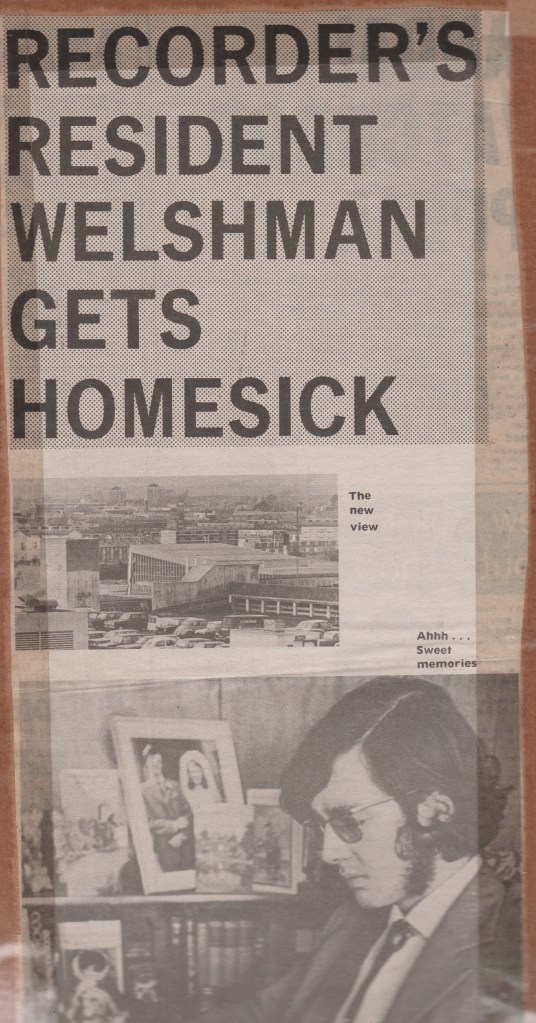
I became the Basildon Standard Recorder‘s resident Welshman, highly opinionated; seeing the English descendants of the Anglo Saxons and the Danes as incomers; and forever yearning for the valleys (although that was South Wales and I was raised in the more mountainous North).
The strange thing was that during my time in Wales I was more often taken for English thanks to my early childhood being spent in Buckinghamshire, one of the Home Counties. That is where I had learned to talk and had taken on the somewhat plummier accent of that region.
Of course not all my feature assignments required the Welsh background.
Take, for example, the advance piece I did on the opening of a zoo and ecology centre as a major attraction not just for the people of Basildon but for the wider area as well.
Part of the feature I wrote about an ecology centre and zoo
The whole piece was written as though the photographer and I had gone on safari into the heart of Africa. Considering the zoo was to be home to lions, leopards, chimpanzees, spoonbills and ibis, as well as tropical insects and crocodiles, the safari theme worked well. Of course we played down the fact that there would also be wallabies (Australia) and puma (the Americas) as well as other non-African animals, birds, reptiles and aquatic residents.
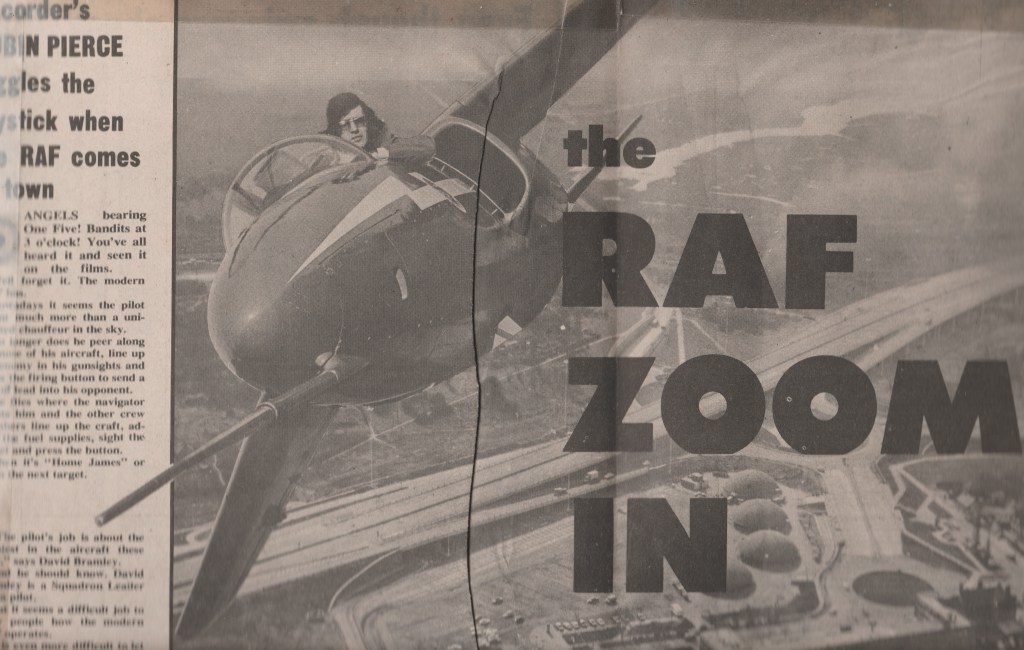
Another feature virtually fell into my lap when the RAF set up an exhibition on a plot of green land directly opposite the office.
A crafty bit of trickery before Photoshop came into being had me flying high over Basildon
The display including a jet trainer, genuine not a mock-up, as well as all the general recruiting posters and material, and a flight simulator to give visitors the chance to pilot a plane. The RAF had sent along a squadron leader to head the team in charge of the display.
Not only did he give me the ins and outs of RAF life and training but he also allowed me into the Gnat trainer for our photographer to get a shot of me as a flying ace. Fortunately I could not do any harm as it was a static display and it wouldn’t matter what button I pushed.
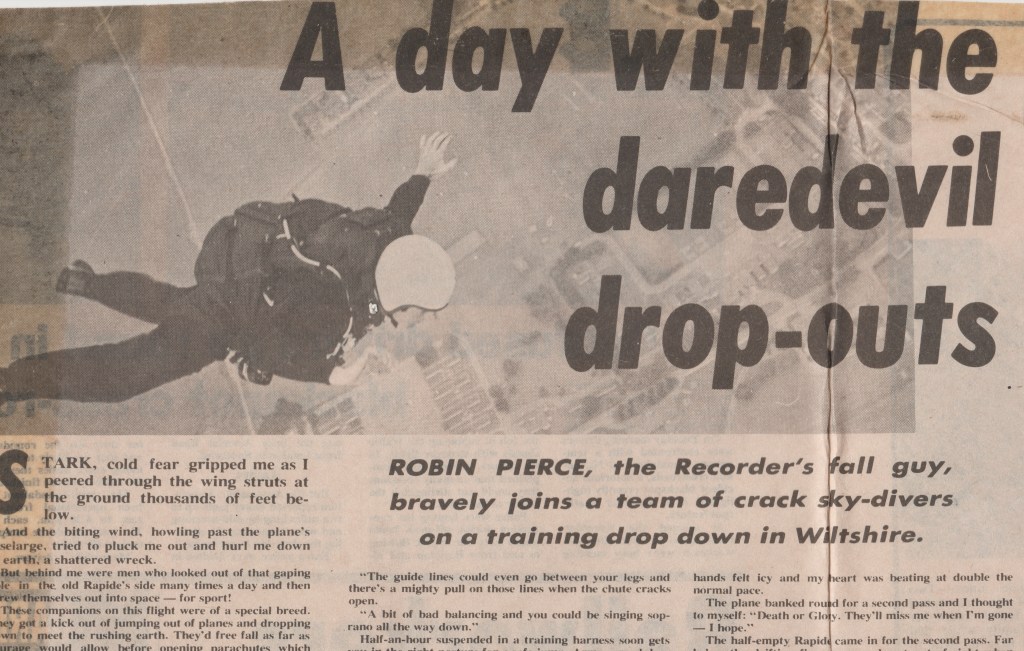
On another feature expedition I did actually get to go up in an military plane accompanied by some of the hardest men in the UK Armed Forces – the Parachute Regiment’s crack sky-diving team The Black Knights.
A day out with the sky divers – but that’s not me
It involved a trip to Salisbury Plain and being shown around the training area seeing how the regular members of the Regiment are trained before going into details of the extra training needed to become a sky diver.
At this time, early 70s, skydiving as a sport was still in its infancy and the average newspaper reader did not know how much training and work went into doing an ordinary parachute jump, let alone sky-diving.
Most films showing non-military parachute drops (spies parachuting in to occupied France for instance) made it appear that a couple of static drops was all it took to prepare you for a night drop over unknown landing sites.
This is probably how I was able to get away with writing about parachute packing, practice drops and then what to do when I jumped out of the plane. It was only at the end that I explained how much training was really needed and made it clear that I would never have been allowed to jump after just a day with the team.
I did get to go up in the plane, however, and it really did have just a space where a door would normally be. Because we were going up I had to wear a flying suit like the rest of the team and did have a parachute attached to me in case anything went wrong and I did have to parachute to safety.
There was one feature in which my Welshness was really brought to the fore and it is the closest I possibly came to getting lynched by the readership.
It was March, St David’s Day had just gone and I had just celebrated my first birthday away from home. Tony Blandford saw it as the perfect chance to get a good look at Basildon, warts and all, from an “unbiased” outsider.
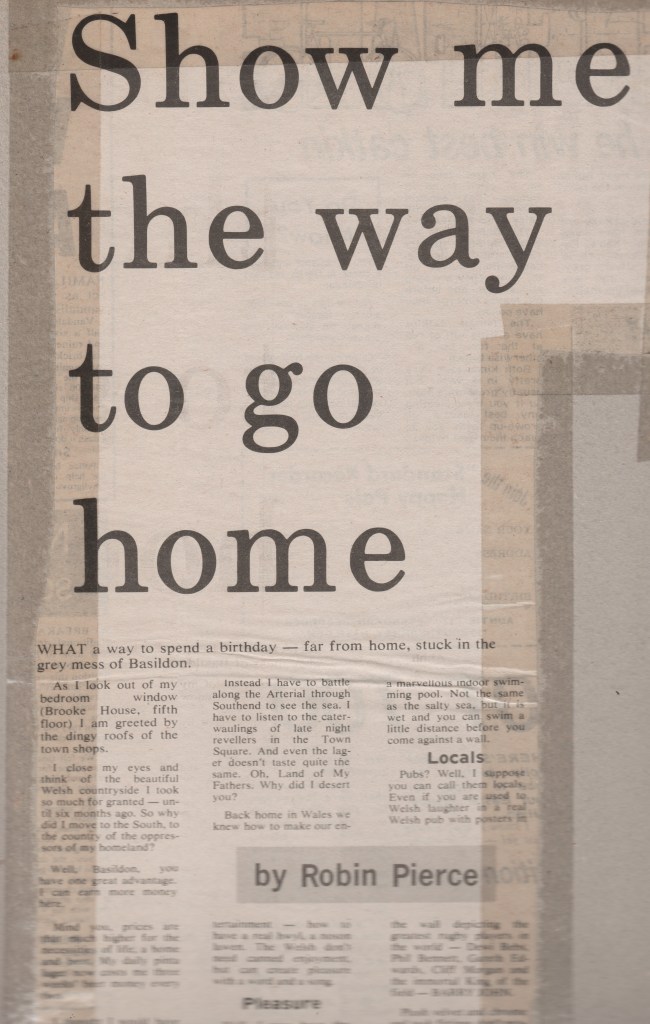
The article in which I brutally attacked the Brutal architecture of Basildon
I certainly laid it on thick as I attacked the Brutalism (yes that is the proper architectural name for the style of buildings in Basildon) as I viewed the town centre from the fifth floor flat I now rented from the corporation in Brooke House, the towering apartment block slap bang in the middle of Basildon New Town.
I expressed my longing for the sounds of Welsh voices singing in harmony in a friendly country hostelry in my native Wales, as opposed to the late night caterwauling of drinkers staggering home from the plush velvet and chrome pubs of the new town.
It was a hard-hitting piece and was a centrespread in that week’s Recorder. Right up to the penultimate paragraph I was as brutal with my criticisms of Basildon as the builders had been with their architectural style.
In a bid to put reins on what I was sure would be the gathering lynch mob heading to the office on Friday I said that I was looking for the pros of the town as opposed to all the cons I had already described.
I think my final paragraph saved my life:
“Maybe the people – people here are comparable to the nice folk in Wales. So I guess that’s a very big plus. Better to have pleasant inhabitants and a crummy town rather than vice versa. But it’s a pity Basildon hasn’t got both.“
My landlords, the Basildon Development Corporation, may not have seen my parting shot as a saving grace but I think I had the majority of the population on my side.
NB: while I was still in Basildon a new block of flats was opened with the different levels each set back in a similar way to Aztec pyramids seen in the jungles of South America. Within weeks of the first residents moved it the development was dubbed “Alcatraz” by the people of Basildon.
Love is a very personal thing and is not always full of sweet moments.
Three poets can look at love and even if they are close, with similar backgrounds, each will have had a different experience.
If you lose the love of your life, no matter what the reason, it can be painful but the pain can be greater or lesser depending on whether you lost that love because it was taken from you – which can totally destroy your life leaving it without order or meaning – or if you were careless and let that love slip away.
You can even believe your love remains because you do not know it is lost, or because you see love in everything around you.
The great Liverpool poet Adrian Henri is possibly best known for being one of the trio of poets who became known for The Mersey Sound – no not THAT Mersey sound – poets who depending on the rhythm of their words to provide structure rather than the rhythm of strings and drums.
Henri appeared to be cynical yet in this poem he brings love down to the simple things in life – not caviare and champagne rather fish and chips and warm beer.
Love is …
Love is...

Love is feeling cold in the back of vans

Love is a fanclub with only two fans

Love is walking holding paintstained hands

Love is.

Love is fish and chips on winter nights

Love is blankets full of strange delights

Love is when you don't put out the light

Love is

Love is the presents in Christmas shops
Love is when you're feeling Top of the Pops

Love is what happens when the music stops

Love is

Love is white panties lying all forlorn

Love is pink nightdresses still slightly warm

Love is when you have to leave at dawn

Love is

Love is you and love is me

Love is prison and love is free

Love's what's there when you are away from me

Love is...
Adrian Henri
Henri’s fellow Liverpool poet, Roger McGough has a completely different take on love. In some ways he seems selfish and arrogant, which those who know this former member of Scaffold is not the real McGough.
In this relationship – which to many appears to be on the rocks – the same action is seen in different ways, based on which of the protagonists is interpreting it.
I project my voice
You hear me shout
I have an inquiring mind
You are nosy
This style of “conversation” (really two monologues rather than a dialogue) can involve two or more people, although the more people you have the more likely they will form alliances and still end up as two mindsets.
You and I
I explain quietly. You
hear me shouting. You
try a new tack. I
feel old wounds reopen.

You see both sides. I
see your blinkers. I
am placatory. You
sense a new selfishness.
I am a dove. You
recognize the hawk. You
offer an olive branch. I
feel the thorns.

You bleed. I
see crocodile tears. I
withdraw. You
reel from the impact.
Roger McGough
In the third poem we meet Brian Patten, the third part of The Mersey Sound, who differs from his colleagues in as many ways as he is similar.
This time we can see a love that is ending more through neglect than antipathy. The voice of the poet is that of one who has neglected or ignored a love and only now sees the possible ugliness of a life apart which would be just as ugly now as if they stayed together.
This is recognition of what you have lost only when you have lost it.
You cannot repair that which cannot be repaired.
And Nothing Is Ever As You Want It To Be
You lose your love for her and then
It is her who is lost
And then it is both who are lost
And nothing is as perfect as you want it to be.

In a very ordinary world
A most extraordinary pain mingles with the small routines,
The loss seems huge and yet
Nothing can be pinned down or fully explained.

You are afraid
If you ever found the perfect love
It would scald your hands
Rip the skin from your nerves,
Cause havoc with a computered heart.

You lose your love for her and then it is her who is lost
You tried not to hurt and yet
Everything you touched became a wound
You tried to mend what cannot be mended.

You tried, neither foolish or clumsy,
To rescue what cannot be rescued.

You failed,
And now she is elsewhere
And her night and your night
Are both utterly drained.

How easy it would be
If love could be brought home like a lost kitten
Or gathered in like strawberries,
How lovely it would be
But nothing is ever as you want it to be.
Brian Patten
I have had the privilege of seeing these three great poets in performance not once, but twice. The first was in the early 70s and was a chance to hear the poems I had begun to love in the 60s actually spoken by the poets.
The second time was late in the 90s and the performance was as different as it was the same. The three characters I had seen at the Basildon Arts Centre had the same easy relationship when I saw them 15 years later in Lowestoft.
It was the content that changed, the words were the same as they had always used – just in a different order.
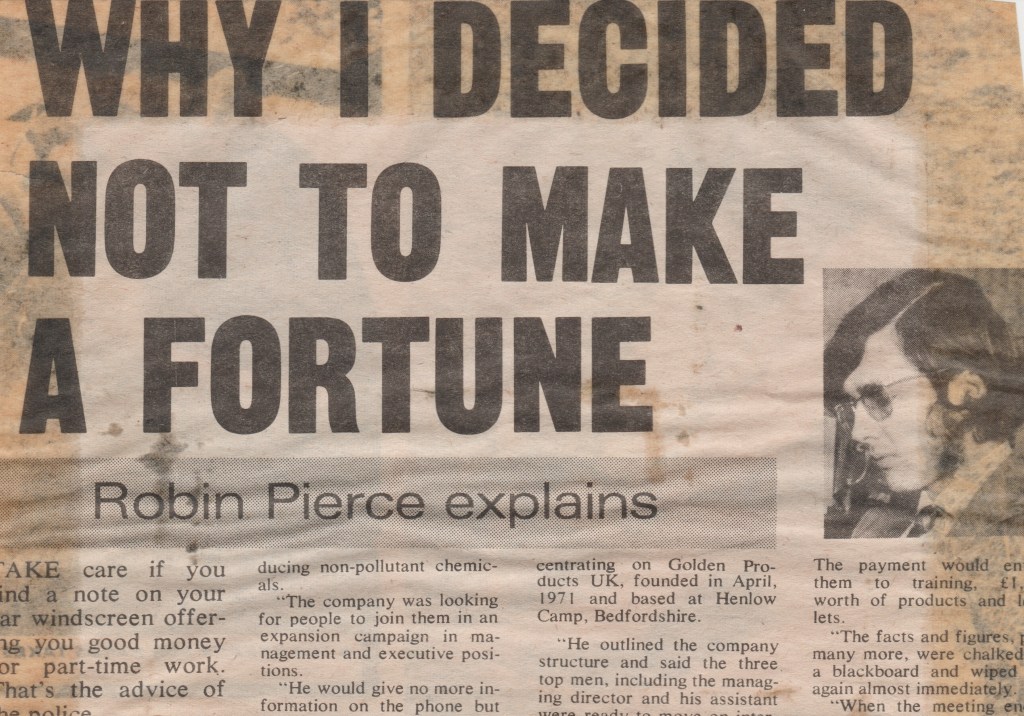
As I have said before a general news reporter has to handle a wide variety of news from golden wedding anniversaries to major fires, even murder. Sometimes feature work might just concentrate on a new attraction opening in town, at others it could be a piece of serious investigative journalism.
An opportunity for the latter came when I found a flyer on the windscreen of my car, which had been parked in a town centre car park backing onto the office. Just about all the cars had a leaflet under their windscreen wipers.
It offered people a chance to work part-time, earning £40 to £70 a week, while still carrying on with the normal day job. This was a time when the average weekly wage for a manual worker, male, was £38 and for a female just over £19.
I took the leaflet into the office and asked my editor, Tony Blandford, what he thought about it and whether or not it would be worth looking into it. He gave me the go ahead.
I spoke to the police first and they said they could see nothing illegal in the information provided but warned anyone thinking about following the lead and making contact would be advised to take legal advice.
A call to the phone number on the leaflet got me through to a man who said he represented Golden Products International. Without telling him what my daytime job was I expressed an interest and was invited to attend a meeting at the Hilton Hotel in London.
On arrival I was met by the man I had spoken to on the phone, he said I should call him Alan, all nice and friendly. I then sat down with others who had also shown interest, there were about 50 of us altogether.
Another young man with the gift of the gab then began the presentation.
We were told Golden Power had been set up just two years previously and the three men who started it had done so well that they were moving on to the international business scene but needed to ensure the UK arm had a good standing which meant people at local, area and district level.
At the end of the day it was a direct sales system which would be built on people buying the product from an area supplier and selling them on for a percentage of the profit. The area supplier got the goods from a district supplier who took a slightly bigger cut and so on up to the top.
It was made clear that most people taking up the offer would start off as local salespeople earning possibly £25 a month until they had built up their clientele but figures were put up on the board (and as quickly wiped off) showing how moving up the sales leader to area, district and above could lead to rewards of five-figure sums per year for those who proved their worth.
It was similar to the Tupperware company which relied on individuals running Tupperware parties and getting supplies from an area manager and so on. This had been going on successfully in the UK since 1960 and had gained a good reputation.
Tupperware from the 1960s and 1970s is still going strong in many UK households
Selling cleaning products would not seem quite so opportunistic as the Tupperware scheme but the attraction to people on a poor wage could be quite tempting.
Just before the meeting ended came the final touch when we were told that anyone who signed on within 24 hours would, on the payment of £850, be given training, over £1000 worth of sales goods (based on sales prices) and a prime sales area.
There was the catch – sign on without getting any proper legal advice and find yourself with a cleaning product people knew nothing about and would take a lot of convincing to swap it for their usual branded product.
There was one final touch when Alan and his colleague asked three or four of us to stay back and, when the others had gone, told us that we had been selected because of our “keen interest” in the scheme, We were told that we could get the very best areas if we signed on immediately and it would only cost us £750.
As the Fleet Street reporters who had been working undercover used to say: “At that point I made my excuses and left.”
Before we ran the story I made a final check with the police and was told there had been reports from their own area and other police districts of similar leafletting schemes, sometimes with a different phone number and a different company name but all basically the same.
When the story was printed we were very careful not to say this was a scam – but after reading the piece anyone who took up the offer would appear to be very gullible.
PS: My expenses for going up to London on a Sunday evening to attend the presentation probably gave my pay packet a bigger boost than I would have had from signing up to sell cleaning products.
NB – a company called Golden Power International Ltd was incorporated in 1972 in Hong Kong. That company mainly deals in batteries and chargers and, as far as I am aware, has nothing to do with the cleaning products company referred to in this story.
In the early 1970s Basildon New Town (officially Basildon but as it was just over 20 years old people still added the New Town tag) control was in the hands of two organisations – Basildon Development Corporation and Basildon Urban District Council.
By the time I arrived in 1972 the council was the civil administrator of the district but at the same time the Development Corporation, which had been formed to create the town, was still involved in buying land, building houses and handling the industrial area where new factories were going up as the government gave favourable grants to businesses to move to the newly developed area.
Among the big names opening factories in the first two decades were Marconi, Ford Motor Company, Carreras Tobacco Company and Yardley of London.
The Corporation had begun development at the very end of the 1940s and the first residents moved in to their new corporation homes in 1951 from the less salubrious premises. These people were known as the first generation and when I arrived in the very early 70s their children had grown up and were considered the second generation who had a choice between being corporation tenants or council tenants.
They might have been first generation in the sense of the new town but when it came to Basildon they were very much newcomers as the first generation of old Basildon had been “weekending” there sine the late 19th century and early 20th.
The area was built on London clay which meant it was really not suitable for farming and when the railways opened up the route from London to Southend people started buying plots of land to build weekend chalets along the way, mainly near the stations of Laindon and Pitsea.
After the First World War, however, the land developers starting selling off very small plots of land, big enough for a three-room building and a small garden. These were still meant to be weekend sites but in the 1920s more and more people were finding the need to live there all year round even though there were no made-up roads and no sanitation.
After the Second War plans were put in hand to provide new housing and workplaces for the families bombed out of London.
To obtain land for building houses and industry the Corporation was given the right to enforce Compulsory Purchase Orders if the current owners were unwilling to sell. This meant in the early days owners of these varying-sized temporary dwellings would bargain with the Corporation to get the best price they could, not always what the land was worth, and only if they failed to agree a price would the CPO be brought to bear.
Part of the price might include a flat or house with rent paid to the corporation.
Even by the 1970s there were still pockets of land where the owners had held out against any sale of their land because they wanted to stay. This meant we had regular stories about the “little man” standing firm against “big business” and, as nearly always happens, the big boys tended to win in the end.
One of the many stories we ran about people who had CPOs slapped on their properties by the Basildon Development Corporation
In the early days the only properties for rent were those built by the Corporation. As Basildon grew, however, the Billericay Council which included the New Town in its area, gained permission to change its name to Basildon Urban District Council and as well as handling the civil administration for the area the council also started building houses for rent.
By 1972 the council and corporation both had their housing lists as the young residents grew up, married and needed to move out of their parents’ homes and set up homes for themselves.
Despite two housing lists there were still complaints from those who felt others were leapfrogging others.
One row that broke out was when a second-generation group protested that couples on the corporation housing list were jumping ahead of others when the wife got pregnant.
A row over couples leapfrogging the housing list by starting a family instead of “being prudent”
The normal way onto a housing list was when young couples got married and they moved up the list as houses were allocated and new ones built. The second generation group said young couples should not jump the queue because of pregnancy and should be more prudent especially as there were numerous family planning clinics in the area.
Although it would still be a good few years before Maggie Thatcher brought in her right to buy for council house tenants the corporation had started selling off its housing stock to its sitting tenants.
The prices were set quite reasonably and there was a discount of 20 per cent to 33 per cent which would need to be repaid if the property was sold within five years.
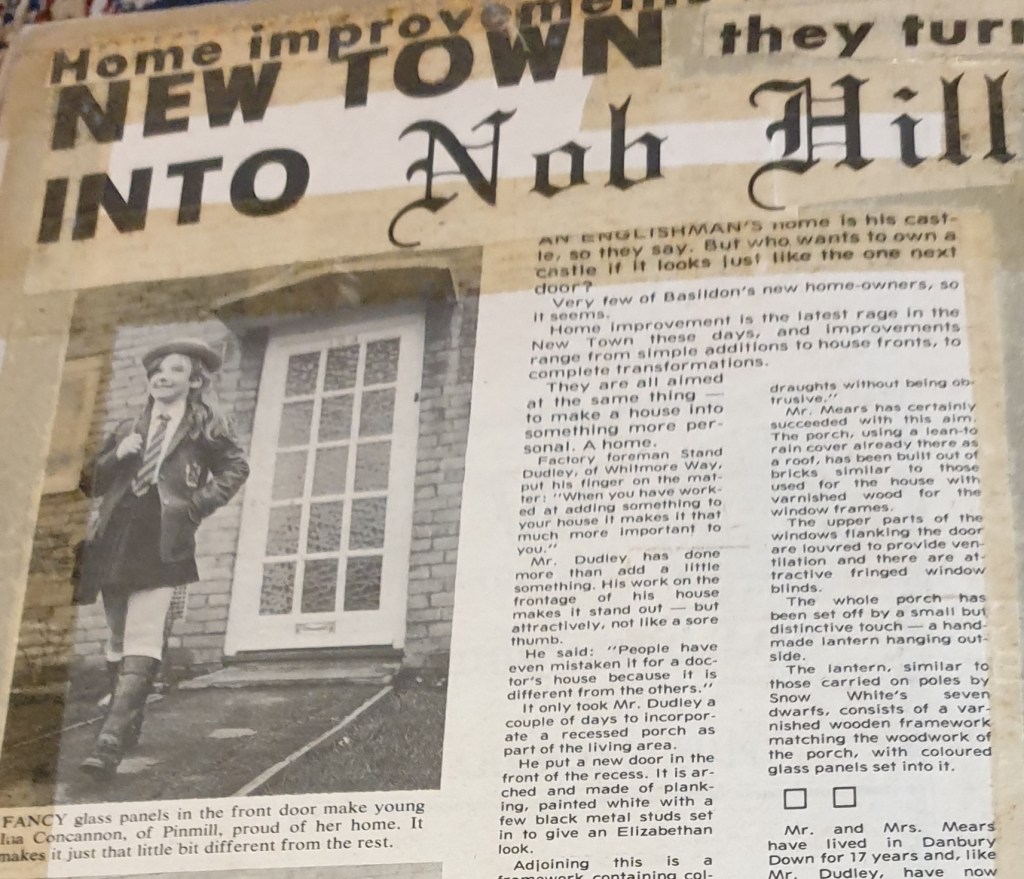
As these sales started it was soon clear that owners wanted to make their homes look different to those of tenants. With this in mind they began to make small changes: building a porch; having a proper fence around their front garden whereas before the boundaries had been defined by step-over wooden boundaries; there were fancy wooden doors; and even the simplest of house names differentiated them from those of their neighbours.
As the corporation sold houses to sitting tenants it would still be a good few years before Thatch
Of course this set my editor off on one of his feature ideas and I was sent to drive around the districts looking for places that had been upgraded in one way or another. If the owners were happy to talk about the changes I would then arrange for the photographer to go round later for a picture.
I felt at times that Tony Blandford leaned towards standing up for the “little man” and homeowners did not come into this category which is why a bit of ribbing was allowed.
Although they were busy selling off houses at cut-price the corporation was also continuing its development plans and continued until almost the end of the 1980s when it was wound up and the housing stock was mostly transferred to the Basildon Council.
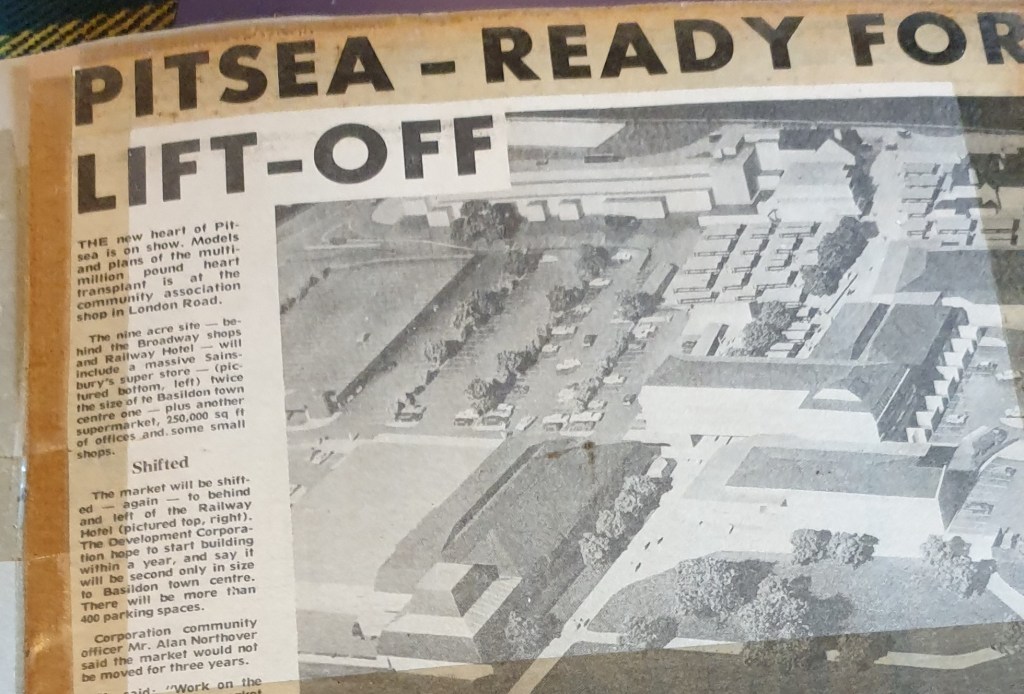
Even in the 1970s the development corporation was planning for many years in the future.
Nowadays people no longer call Basildon a new town – it is, after all, 70 years old now and from what I have been told it is as far from the booming new town full of old London families and their children that I moved to in 1972 as that was from the shanty town of the 1920s and 1930s.
Despite the tone of some of the features Tony got me to write, as his resident Welshman in exile, I quite liked the place and the people.
Living in Burnham-on-Crouch (until my boss could arrange a Corporation flat for me) could be a bit wearisome – it meant early rises and late nights if I had an evening job, council or arts review and a long drive to work to wake me up. The return journey was always in the dark.
During this time I still remained alert during working hours and always checked my copy against what actually appeared in the paper, or I should say papers because a number of my stories were picked up by our big sister newspaper the Evening Echo.
It was interesting to compare the subbing and headline style of our in-office sub for the weekly as compared to those at head office concentrating on the need to meet daily deadlines and ensure readers wanted to buy the newspapers.
Sometimes I preferred the way our sub had handled the copy and headline and at others the head office sub had a better grasp.
Take the story of the young widowed mum who lost her husband when he went out with his mates for the first time in months and ended up dead at the foot of concrete stairs leading up to a dance hall.
Our sub kept my copy pretty well much as it was written and headed it:
Widowed at 18
In this he had concentrated very much on the young widow facing life without her first love – which was a very important part of the story. Yet I had not written so much about her as given her story of her sport-loving husband.
The Evening Echo sub went more on the sporting lad with his cosy home life:
Home-loving
man’s night
of tragedy
The copy had been adjusted (no I don’t mean rewritten) by the sub to give more attention to the dead man and the description of his lifestyle given by his widow, than on the ones left behind.
Another example of the different ways stories are handled involved an 18-year-old who claimed in court that he had turned to crime because he was depressed. He didn’t get any sympathy from the magistrate as highlighted in the Evening Echo‘s headline:
Twaddle! JP raps
‘immature’ youth
Whereas our in-house sub headed it:
Burglar’s
excuse
didn’t
impress
Not exactly an attention-grabbing headline.
Another story, again involving a court case, reversed the methods of the subs, however, with both headings being in the same size font and used as page leads in the respective newspapers.
The basic court story, a man charged with careless driving, was fleshed out with information on previous incidents at the same spot. Some of this had been referred to in the court case but I also checked on statistics from the past five years.
The Echo sub went for:
Court plea as
lights bring
danger boom to
crash junction
The Standard Recorder gave the story as much prominence and grabbed the attention far more with a heading of just three lines and only half the number of words used by his Echo opposite number:
Death road
lights are
slammed
That “Death road” first line was far ounchier/ than the somewhat mundane first two lines “Court plea as lights bring”.
Mind you even in those days I believed I could have made a better job (as many of my old colleagues will attest – I was always cocky) and in this case I would have gone for a bigger, yet shorter, heading:
Death junction
lights slammed
Because I always checked my original against what appeared I was still on my learning curve. In hard news stories I could instantly see if a sub had picked up on any unnecessary verbiage which might shroud the facts.
At the same time in feature work there were pieces where I should not have been quite so clipped in my work.
All in all I provided a wide range of good local stories for my paper and our big sister the Echo. Looking back at my scrap books I am quite amazed at just how much I did write, and I could see my style developing.
Tonight at noon
Supermarkets will advertise 3p EXTRA on everything
Tonight at noon
Children from happy families will be sent to live in a home
Elephants will tell each other human jokes
America will declare peace on Russia
World War 1 generals will sell poppies in the streets on November 11th
The first daffodils of Autumn will appear
When the leaves fall upward to the trees

Tonight at noon
Pigeons will hunt cats through city backyards
Hitler will tell us to fight on the beaches and on the landing fields
A tunnel full of water will be built under Liverpool
Pigs will be sighted flying in formation over Woolton
and Nelson will get not only his eye back but his arm as well
White Americans will demonstrate for equal rights
in front of the Black House
and the Monster has just created Dr Frankenstein

Girls in bikinis are moonbathing
Folksongs are being sung by real folk
Artgalleries are closed to people over 21
Poets get their poems in the Top 20
Politicians are elected to insane asylums
There's jobs for everyone and nobody wants them
In back alleys everywhere teenage lovers are kissing in broad daylight
In forgotten graveyards everywhere the dead will quietly bury the living
and
You will tell me you love me
Tonight at noon






 Robin's Nest