A poet who speaks to all ages

I adore poetry and cannot remember a time when I didn’t.

I suppose my parents must have read to me when I was very young, possibly nursery rhymes. It is amazing how many of those I know without actually remembering reading them myself.

As I got older I was introduced to more “serious” poetry. The works of Keats, Wordsworth, Browning, and more were on the bookshelves in the hall and lounge. Quite a few of them, including the Shakespeare, were school prizes won by my father and his sister.

I loved the flow of words, and even devoured the nonsense poems of Edward Lear and later Spike Milligan.

The older I got the wider my net was cast and I left Lear behind me as I embraced Wilde, Thomas and Hughes (both Ted and Frieda as it happened).

I do remember in later life my brother talking of a great poetical story book he had bought for his grandchildren all about a bear hunt by a children’s poet called Michael Rosen.

I didn’t pay too much attention as my own children were, I thought, beyond children’s poetry and I didn’t have any grandchildren at that time.

Later I did read odd bits of poetry by Michael Rosen but it was not until Covid hit and I spent a bit more time online with Twitter that he really came to my attention.

People I followed and who followed me were talking about Michael Rosen being seriously ill in hospital with Covid and there were references and links to Emma-Louise Williams @Underthecranes with daily updates on his condition.

It was later that I discovered Emma-Louise Williams is Michael Rosen’s wife and the family were using her Twitter account to keep his friends and fans informed as to his condition.

All those who know and love Michael Rosen are aware that thanks to the dedicated care he, and thousands of other NHS patients, received he pulled through, although he has been left with Long Covid.

Once he got back on Twitter himself I began following him as his Tweets were both hilarious and incisive as he related his ongoing recovery.

I still thought of him as a children’s poet (he had been Children’s Poet Laureate after all) but found his Tweets went further than children’s poetry. He also has a political conscience.

Late last year I found out that he had written political poetry as well as his children’s work and I decided to put Fighters for Life, selected poems by Michael Rosen on my Christmas list (along with CDs by Bix Beiderbecke, a black on red Guevara Tshirt and the final seven books in Andrea Camilleri’s Montalbano series).

When Christmas Day dawned my wish list was fulfilled.

I have been dipping in and out of Fighters for Life over the past week and want to introduce you to one that really struck a chord with me. I hope you enjoy it as much as I do:

A family arrived and said that they had papers
to prove that his house was theirs
-- No, no, said the man, my people have always lived here.
   My father, grandfather . . . and look in the garden,
   my great-grandfather planted that.
-- No, no, said the family, look at the documents.

There was a stack of them.

-- Where do I start? said the man.
-- No need to read the beginning, they said,
   Turn to the page marked 'Promised Land',
-- Are they legal? he said. Who wrote them?
-- God, they said, God wrote them, look,
   here come His tanks.

I love Michael Rosen. He doesn't need many words to make his point.


A brand New Year and a new me? We’ll just have to wait and see

It’s now 2022 – not 1 January but 2 January.

So why am I starting a day later than most to set my plans for the New Year?

Because many of us wake up on New Year’s Day with a determination to GET THINGS DONE. Mind you, if we shout it out loud like that it might hurt, especially if you welcomed in the New Year a little bit too well.

To be honest it is quite some time since my Muse and I welcomed the New Year in with alcoholic refreshment. If it wasn’t for Jools Holland and his annual Hootenanny we might not even have welcomed the New Year until it was about eight hours old.

But I digress.

The first day of the New Year should not be a time to make promises, it should be a time to evaluate the previous year and then decide whether to lay out a plan, only to be disappointed by failure within a few days, a fortnight at the latest, or establish a “take it as it happens” attitude and muddle our way through the rest of the year.

I am not saying that in one day I can examine everything that I have done in the previous 365 days. What I can do is consider what I hoped to achieve in that time and judge whether or not I achieved any part of it.

As it happens my Muse and I have succeeded in doing what we hoped to do in 2021 – we lived. We certainly lived to see in 2022.

That was not our aim at the start of 2020. We had all sorts of good things to look forward to: having days out to the seaside with our grandchildren; working on my Muse’s garden (well she would do the horticultural work and I would dig holes, make raised beds and perform other manual labour); lazing in the garden in the sunshine; visiting family in North Wales . . .

As we know now all these plans went to hell in a handcart thanks to Covid.

From March 2020 through to now we have just been grateful to wake up each day and survive to go to bed that night.

Thanks to the speedy work of scientists to come up with vaccines to help fight Covid our hopes of survival on 1 January 2021 were stronger than they had been in the middle of March 2020. On that New Year’s Day we had hopes that Covid would be over and done with before Christmas.

Thanks to the incompetence of the Boris Johnson government (and I’m not including Chris Whitty in that) we find ourselves entering another year with the threat of a new variant hanging over us, and who knows whether there will be another variant this year and in years to come.

That is why I am not making great plans for this year. Instead I will get up in the morning and decide day by day which jobs I will do around the house and garden; whether I’ll read a novel, a political volume or some poetry; maybe I’ll bake some bread or make cakes or sausage rolls; possibly work on the novels I have been working on for five years now; or maybe just write.

One thing I do plan to do (but cannot guarantee) is to put something of interest on this site at least once a day. Just don’t have a go if I fail. After all I’m only human.

PS: I spent yesterday knocking out a baker’s dozen of bread rolls.

Red ’til I’m dead and I’ll keep that banner flying all my life

That great creator of quotable quotes, A Non, is once alleged to have said “if you’re not a socialist at 20 you’ve got no heart, if you’re still one at 40 you’ve got no head.”

I definitely have a heart (it belongs to my Muse but she lets me have a free rein with it when it comes to politics and rugby) and believe that I was a socialist by the time I was 15.

I also definitely have a head, within which is the house called Mind wherein I store all the information I have accrued in more than 70 years, and here I must disappoint A Non, because let alone being a socialist at 20 and 40 I am still one at 71 and will still be one at 100 (if Mind hasn’t burst at the seams by then with that ever-expanding store of information).

In fact I became a socialist before I found a home within the Labour Party. Indeed, I became a socialist before I found my spiritual home (can I use that term without believing in God, can I have spirit without religion?) within the union movement.

Socialism is a political, social, and economic philosophy encompassing a range of economic and social systems characterised by social ownership of the means of production. It includes the political theories and movements associated with such systems. 

The above definition of socialism is one that most people will recognise but to me it is very simplistic. Yes, it does talk about social ownership, which many see as an all-embracing nationalisation of everything, which would, of course, be complete nationalisation with control in the hands of the government of the day.

I have always considered socialism to be far more than just control of production and the products of that process.

To me socialism grew as I saw what went on around me.

My models were my parents who cared about our family: myself and my siblings; the broader group of blood relatives, grandparents, aunts and uncles, cousins; and a wider group who were not blood relatives but considered family by ties of marriage.

It went beyond this, however, because they both cared about others, their friends, acquaintances, those in need.

This is how I became concerned with the rights and the plight of others.

I learned that my actions, no matter how small, could affect people I might never have met and how their actions could affect me as well as people on the other side of the world.

I was never going to be a historian but, after English (literature and language), my favourite subject was history and once my interest was piqued by a reference to an event in the past I would go and research that event and that period.

This is how I really discovered the ancient Egyptian civilisation, and the Greek civilisation and the Roman empire.

Not that I was overawed by the idea that the Egyptians had an ideal society with great monuments to show what they had done; or that the Greeks came up with what they called democracy; or that the Romans took civilisation to vast areas of the globe.

The Egyptian monuments were built by slaves; the so-called democracy of Greece did not give the vote to slaves, or women, just to male citizens; Roman civilisation was what the Romans considered right and proper and they brought it at the point of the gladius and the javelin.

Throughout history we, the people, have discovered amazing things, but far too often the discoveries are not used for good but for evil.

The Romans may have colonised Britain but when they ran to defend the remnants of their empire they left behind a civilisation based on hierarchy which existed only because they had slaves to do the work.

The slaves became serfs (another form of slavery) and eventually the serfs became freemen and women, although they were never free.

Many of them tilled the land, not for their own benefit, but for the benefit of the landowners; others toiled in the towns and the cities, again, not for their own benefit but for the benefit of those who employed them and paid them a pittance for their efforts.

The shoemaker who crafted a fine pair of leather boots for a customer never had the time or the money to craft a pair for personal use. The lady’s maid who dressed the hair of her mistress as well as dressing the body in silks and satins would never be able to afford such care or clothes for herself.

Over the centuries we have talked of society – by which we mean a group of people who live together and interact with each other, but society is not socialism and society retains its ranks, or, as it is often called, the class system.

This system divides us into working class, middle class and upper class and all too frequently the upper class look down on the middle class and do not even notice the working class. The middle class look up to the upper class and down at the working class (although that is where many of them started). This leaves the working class to get on producing the goods that make the world go round without having the benefit of many of those goods for themselves.

This is not socialism.

The socialism I see is where we all do our best, work to our abilities, and share the product of that work. For those unable to work or produce, the elderly, the sick and the young, we care for them and share the product of our labours with them.

It is for just such a society that I became a socialist.

It is for just such a society that I remain a socialist.

Red ’til I’m dead and I’ll be waving that red banner as they take me to my grave.

Sweet treat from big brother helped me over a birthday party disaster

When do we become aware and do we remember the moment or is it just another step along life’s highway when we take so many that we cannot recollect them all?

There are those who feel they became aware soon after birth (some even believe it happens in the womb) and they can “recall” things that happened when they were very young.

Are you aware of the moment you took your first step; or when you first liked, or disliked, certain foods or drinks; are you one of those who can “recall” the arrival of a new baby in the family, hot on your heels?

Most of these “memories” come from seeing pictures or being told stories.

I know that when I was a baby my older brother plonked a bowl of porridge on his head as though it was a soldier’s tin helmet. He might remember it because he is almost four years older than me but my memory has been created by members of the family telling me the story. I think my brother might have recounted it himself at times.

I do have some form of memory of my early years as a child in Chesham. I remember the nuns at the infant school my sister and I attended for about a year; I remember Joy, the girl across the road who was two or three years older than me but acted at times like a big sister, making me laugh, keeping me safe.

The only memory of my early years that made any impression on me (physically as well as mentally) was at my brother’s birthday party in our first year in Rhyl. The memory remains etched in my mind because it involved fire and my face.

We had all been sitting around the table having birthday tea and it came time for big brother to blow out the candles on his cake. We then all had a slice of cake on a plate in front of us and mine still had a candle in it.

Having seen big brother blowing out the candles I wanted my turn and someone, I don’t know who, lit the candle for me.

As I leaned forward to blow it out a gust of air wafted up the paper napkin tucked into my jumper and it caught the flame before continuing its upward rise to kiss my cheek, ever so gently – then came the pain because the burning paper was stuck to my cheek.

After that I remember very little. Apparently one of my mother’s friends had grabbed me and wrapped my head and upper body in her coat to extinguish the flames. Her actions almost certainly saved my charming good looks but at the time it was just pain.

I don’t know if our doctor, a family friend, was present or arrived within minutes but I was given some form of sedative which knocked me out for a few hours. When I came round, lying on the settee with a travel rug over me, the first person I saw was my big brother. The rest of the family was almost certainly there but it was his face imprinted on mind.

It was not his words but his action that gave me the strongest memory.

He had saved me the last Iced Gem which, as birthday boy, it would have been his right to claim for himself, and proffered it to me.

I tend to associate birthday candles with danger but Iced Gems always make me think of my big brother.

For some weeks after that my mother had to regularly change the dressing on my cheek to ensure it healed properly. I remember the dressings well, They were lint squares soaked in some form of gelatinous ointment. She had to remove the old dressing carefully so as to pull nothing away with it, then bathe my cheek with cotton wool and some form of disinfectant (probably Dettol as we seemed to use that for everything) before applying a new dressing.

She did this two or three times a day for four or five weeks and I can still see the flat square tin those dressings were kept in – the lid was blue and the tin the same grey as our pots and pans.

I suppose it was lucky Dad was a chemist and had all the things needed to treat my wound.

I don’t know if they make Iced Gems any more but they will always remind me of the kindness of my big brother.

North South East West – which direction will be the best?

When you reach a point on your travels through life where the track diverges and none of the paths is a direct route to your objective you have to decide which way to go.

The moment I discovered my Muse was mother to a six-month-old baby, with the strong possibility that Daddy was still around, I had to make a decision as to which way I would go.

This was not a case of Go West Young Man or taking the Road to Mandalay – the choices were far wider than that.

I could just turn round and retrace my footsteps, but I had come too far in the last eight years to turn back now.

Going South has a sense of fatality and I intended to live a while longer.

This left one direction.

I once played the part of Laertes in a production of Hamlet. My stage father, Polonius, gave me what he believed to be sage advice. Most of it would not have helped Laertes get very far in life but the last part was sound:

This above all: to thine own self be true,
And it must follow, as the night the day,
Thou canst not then be false to any man.

“To thine own self be true” points to what is called True North, that natural direction finder within yourself which will take you where you want to go.

It was not the end of the decision-making, however.

True North would keep me in Basildon but should I continue with my am dram hopes (after all the Thalians were the best group in town) and keep my feelings for my Muse within, or forget the group which would thereby put me out of the way of temptation.

I decided I was strong enough to keep temptation at bay and I could at least befriend my Muse.

The Muse of comedy and bucolic poetry won – maybe Thalia loved a lover.

What I would need to do would be to find other matters to keep my mind busy beyond my work and the stage.

That was easily settled. Time to research politics and decide where my loyalties really lay.

I gained the right to vote on 1 January 1970 when an Act of Parliament to lower the age of voting from 21 to 18 came into force. I didn’t get the opportunity to exercise that right until June that year and unfortunately my vote was not enough to save the day and the Tories took back control from Labour and Edward Heath became PM.

My leaning had been towards Labour throughout my teens (except for a brief flirtation with Plaid Cymru which I put down to a charming redheaded young lady who was a Nationalist through and through) but I needed to know if my choice was right.

I knew my future lay in socialism and as far as I was aware at the time the only proper socialist party was Labour but there was socialism before Labour so I needed to dig into the past.

Let the research begin.

Love is . . .

or is it?

Maybe we should first ask: What is love?

Dolly Parton claims: Love is like a butterfly, as soft and gentle as a sigh.

Roy Orbison says: Love hurts, Love scars, Love wounds and mars any heart.

It takes a lifetime to learn the truth and in the end it appears they were both right. Dolly’s butterfly of love really does have satin wings like the multicolored moods of love. At the same time Roy is right when he says: Love is like a cloud, holds a lot of rain or even: Love is like a stone burns you when it’s hot.

Then again the dictionary tells us that love is a set of emotions and behaviours characterized by intimacy, passion, and commitment. It involves care, closeness, protectiveness, attraction, affection, and trust. Love can vary in intensity and can change over time.

Unlike a song that definition is stone cold.

Then again poor little Oliver! could only ask: Where is love? Does it fall from skies above.

In March 1973 I found that all the above were true.

It may not have fallen from the sky but that first sight of my Muse as Smeraldina was like a thunderbolt hitting me between the eyes. I know that is a bit of cliché, Mario Puzo used it in The Godfather when Michael Corleone saw Apollonia.

“. . . he found himself standing, his heart pounding in his chest; he felt a little dizzy. The blood was surging through his body, through all its extremities and pounding against the tips of his fingers, the tips of his toes. All the perfumes of the island came rushing in on the wind, orange, lemon blossoms, grapes, flowers. It seemed as if his body had sprung away from him out of himself. And then he heard the two shepherds laughing.
“You got hit by the thunderbolt, eh?” Fabrizzio said.”

Calo went on to tell Michael: “You can’t hide the thunderbolt. When it hits you, everybody can see it. Christ, man, don’t be ashamed of it, some men pray for the thunderbolt. You’re a lucky fellow.”

Mario Puzo was right – his book had been published four years previously, plus a couple of weeks, but he got the heartpounding, bloodsurging, aromatic moment as if my body had sprung away out of myself down to a T.

Many people might laugh at the concept but trying to explain that moment to someone who has never felt it is like describing the joy of swimming in the sea to someone born and raised on a mountain with only a gentle trickling stream as a comparison for the rolling oceans.

It is not surprising that most of the remainder of that week was spent in a daze which only started to become reality when a member of the Thalian Theatre Group invited me to the last night party.

On the Saturday night, just after 11pm, I approached the party address with trepidation. There were plenty of cars parked close by and I ended up parking by the garage of the house in question. I knew it was the right address because the number was painted in solid white numerals taking up most of the space on the up and over door.

I was greeted at the door by Jim, it was his wife Jean I had sp coloured lights in the hallway and when I went into the crowded living room the lights were reflected from crumpled tin foil on the ceilings.

The room was crowded and there was the standard fug of cigarette smoke you tended to get at parties in those days. The music was loud bu the chatter of those present could still be heard as Jim took me round introducing me to the members of the group.

Clearly Jean had successfully put over my version of the review layout as everyone seemed pleased to meet me and were apparently delighted with the review.

We had gone clockwise around the room as I was introduced to everyone and at some point a glass of red wine had appeared in my hand. Finally we came to the sofa under the window by the door and there was my Muse – and her companion.

When I was introduced I offered my hand and she shifted her companion to a more comfortable position as she reached out her own hand. I then proffered a finger to the companion, who gurgled and gripped it for a moment the way six-month-old babies do.

The rest of the evening (well it was drawing close to midnight) passed in a slight blur. After all I did have to consider the current situation with regard to the infant – and no, she wasn’t holding it for someone else.

I did get a chance to sit down on the sofa so managed a 10-minute chat with my Muse. She even asked if I wanted to hold the baby. As I already had a niece and nephews I was able to handle the situation perfectly. At least that was in my favour.

After a while I returned the infant and went to get a fresh drink.

They were a good crowd, most in their 20s, I think Jim and Jean might have been a bit older. They were also easy to talk to and we got on well. It was suggested that in a couple of weeks I could join them when they started to look at ideas for their next production. I had made it clear that I was interested in joining and had been onstage, backstage and front of house.

My Muse had departed, I think the little one needed to get to sleep in her own little cot, and I had not noticed if anyone left with her. There was no doubt a husband (the 70s weren’t quite so free and easy as everyone thinks) and she would not have been left to go home on her own with the baby.

When I finally wended my way home, after plenty of friendly goodbyes and “See you soon” or “See you at the reading”, I had a lot to think about.

Now as I have said I believed that this was the one, but the trouble is your ideal partner might not see you in the same light.

I had been attracted to girls before and with some it was clear they would just be friends (not always the situation if you “go out” with each other and then part). This time I would have to begin with friendship and then see if anything more came later. There could be no pressure.

I didn’t realise quite how rocky some parts of the path ahead would be. It certainly changed my life in a way I never expected.

A momentary muse upon a Muse meant soon I would meet my Muse

Once ensconced in my new abode high above Basildon town centre (was this a metaphor for the way I viewed the town, looking down on it and its inhabitants?) my next move was to make friends.

In my past where had I found friends?

At school – but those days were long gone.

At the Rhyl Yacht Club – but there was no such club in Basildon.

At the Little Theatre – that offered a greater possibility.

As I knew from six months of reviews, Basildon had a plethora of amateur dramatic societies. Most towns do. Many of these societies, whether they be drama groups, operatic groups, or a mix of both, such as musical comedy or pantomime societies, are quite pedestrian in the names they choose, not even checking the acronyms. It would tend to be “Chester Amateur Dramatic Society” commonly known as CADS; or “Malvern Operatic & Dramatic Society” – MODS; or “Shrewsbury Operatic & Dramatic Society”SODS.

The Basildon groups mainly followed this basic naming style: Basildon Players, Basildon Operatic Society; Basildon Amateur Dramatic Society.

This made one particular group stand out when I saw that a group called The Thalians were staging Carlo Goldoni’s The Servant of Two Masters at the Basildon Arts Centre.

My knowledge of Greek mythology is that of anyone who has read some of the Greek myths or even just seen some of the films from the 60s and 70s such as Jason and the Argonauts or Clash of the Titans or Helen of Troy.

My father was the classics scholar, at grammar school at any rate. He would have gone on to study classics at university if it hadn’t been for a family tragedy, but that is a tale for another time. Maybe I did pick up an interest and a love of Homer from him.

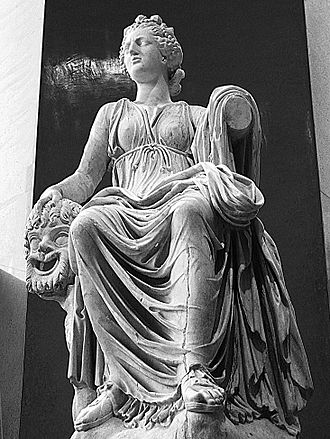
Thalia, one of the Greek Muses and goddess of comedy and idyllic poetry

Thalia was one of the Muses, daughters of Zeus (in Thalia’s case by Mnemosyne, goddess of memory and time).

Clearly a theatrical group that chose one of the Muses to represent them must be at least a touch ahead of the more plebeian groups. Especially as they chose the Muse of comedy and idyllic poetry.

Carlo Goldoni’s The Servant of Two Masters is an Italian classic in the style of the commedia del’arte, a forebear of our Punch and Judy.

On the Tuesday night I went along to watch what I hoped would be a classic piece of theatre. Little did I realise that far from just seeing a group who took one of the Muses as their patron I was to meet my own Muse.

The programme for this production was presented in the style of a mediaeval scroll, which I thought a cunning touch (although it was to come close to causing my downfall) and having studied it I sat back in my seat and prepared for an evening’s entertainment.

The evening was entertaining; the play was as funny as I anticipated it would be; the players, although young, were far better than other amateurs I had seen; but from the moment the curtain went up I was smitten by one character on that stage – the maid Smeraldina.

As a professional I managed to concentrate on the play itself but felt my heart drop every time she left the stage and it rose again each time she entered.

If I joined this group I would get to meet my Muse and if I met her I felt sure that, given time, she would get to know me well.

In a way that is what happened but it was a rocky road with many pitfalls.

I almost fell at the first twist, thanks in part to our somewhat overcocky sub.

As I said the Thalians had produced their programme in the form of a scroll and I made the mistake of mentioning this to our sub who always thought he could go one better.

The review which almost got me into trouble not because of its content but because of its style

He had suggested I write it in the style of “olden days” which would probably have been fine if it had not been for his cocky little sidebar which might just as well have said: “Anything you can do we can do better.”

It is not surprising, therefore, that on the Friday morning the review appeared in the paper I got a somewhat irate call from a member of the Thalians asking why I had virtually accused of them of seeing themselves as better than other groups.

It took me a good ten minutes to make my peace but I finally got my caller to realise that I had praised the production and considered them to be an exceptional amateur drama group and had copied their programme style as the sincerest form of flattery.

My sincerity must have shone through and before I knew it I was being invited to the after show party on Saturday night. I was given the address and told that it wouldn’t get properly underway until after 11pm as they would need to get their makeup off, change, and get round to the house.

I was overjoyed at the idea of meeting my Muse in person.

Of course life was never meant to be easy but I’ll tell you all about that later.

New home in a New Town – and it really is Brutal

I had been working on the Basildon newspaper for six months before I was actually offered a flat by the development corporation. Travelling to and from Burnham-on-Crouch every day did not make it easy to form new friendships outside work.

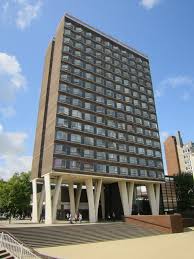
The keys to the flat, on the fifth floor of Brooke House in the middle of the new town, were handed over on a Friday in mid-March, very close to my 22nd birthday. The flat had a large living/dining room, a main bedroom and a small single bedroom, an ideal study, as well as the usual bathroom and toilet. The floors were parquet with underfloor heating.

Brooke House, Basildon, on the 27-foot high pillars

The flat was in the middle of the row of flats on the side looking out over the town centre and from my fifth floor in this Brutal tower block it was possible to see the Arts Centre and beyond that the parkland dividing the town from the industrial areas.

Calling it Brutal is not as brutal as it sounds.

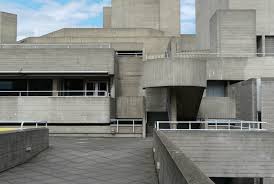
Brutalism, also known as Brutalist architecture, emerged as a style of building in the 1950s but it harked back to the early-20th century Modernist architecture which embraced the new methods of construction, steel, glass and reinforced concrete.

Many of the early Modernist buildings were, in fact, quite beautiful, with clean lines along with the functionality. Unfortunately the change to Brutalism led to buildings characterised by their massive, monolithic and ‘blocky’ look with a strong, rigid style following geometric lines and with an abundant use of poured concrete. Its name actually came from that part of the technique and in France was referred to as Béton brut which translates as raw concrete.

Brutalism at its best(?)0

Although born in the post war era it became even more popular in the 1960s as the austerity of the 1950s gave way to dynamism and self-confidence. It was frequently used for large scale government projects such as universities and car parks and was adopted by big developers for leisure and shopping centres, and, of course, high-rise blocks of flats and offices.

The movement began to decline in the 1970s, having been much criticised for being unwelcoming and inhuman, which, to be honest, was applicable to Brooke House. I didn’t let that put me off, however, as to me it was a place to live, close to my work and all the amenities, and could easily be made to look nice inside with the right decor and furnishings.

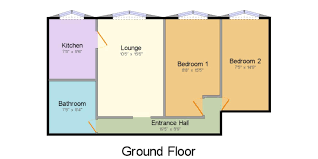
The (very) basic layout of my new flat0

The flat was basically a blank canvas. The kitchen had a fitted oven and the usual cupboards and work surfaces, the main bedroom had a built-in wardrobe including drawer space, the bathroom was what bathrooms are and the living/dining area was just a large square with massive windows on one side, a door to the kitchen and a door facing the windows to the hallway.

On the Friday night I left my car in the secure underground car park at Brooke House and drove a hired Transit van up to North Wales to collect some furniture that my parents had managed to accumulate for me. Mainly a three-piece cottage-style suite, a small dining table with four chairs, a couple of bookcases, an old wooden chest of drawers, and, of course, the stool I had made at Rhyl Grammar School, as well as a couple of rugs which I had made myself when I had a bit of a handicrafts moment.

My mate Roger

My old pal Roger helped me load the van, empty pockets of space amid the sparse furniture were filled with boxes of books and some basics in the way of crockery, pans and cutlery as well as bedclothes, pillows, and curtains which would help brighten the flat until I could get around to making my mark on it.

I drove back down to Basildon, leaving mid-afternoon, and Roger followed in his car to be there to help me unload at the other end and lug everything up to fifth floor. Fortunately I was able to get the van into the underground parking area and get it close to the lift.

We may have made life a little bit difficult for some of the other residents as we did hog the lift for a good couple of hours. There were times when we were heading up with the lift crammed when it stopped in the foyer for people heading up to their own flats. They could see there was no room but we promised to empty the lift quickly and then send it back down for them while we shifted my stuff down the long corridor to my flat.

It took us about three hours to get everything into the flat and spread around the various rooms. A lot of the boxed stuff was left in corners of rooms for me to go through in my own time.

Once the place looked moderately reasonable we headed off to the nearest café for a plate of eggs, sausage, and chips, washed down with a mug of tea, and then we repaired to the Arts Centre bar for a few drinks.

Roger kipped on the settee cushions spread out on the floor with the ones from the chairs as well, the following morning he headed home and I said I would see him next time I was up visiting family. That was the sort of relationship Roger and I had. Always there for one another but without having the need to hang out all the time.

Thus was I left in my Brutal home, my first home of my own.

I was in a position to invite friends round for a coffee, or even a party.

All I had to do now was find some friends.

Next time: Sighting a goddess and treading the boards once more.

We’re baby boomers ‘cos our parents went to war

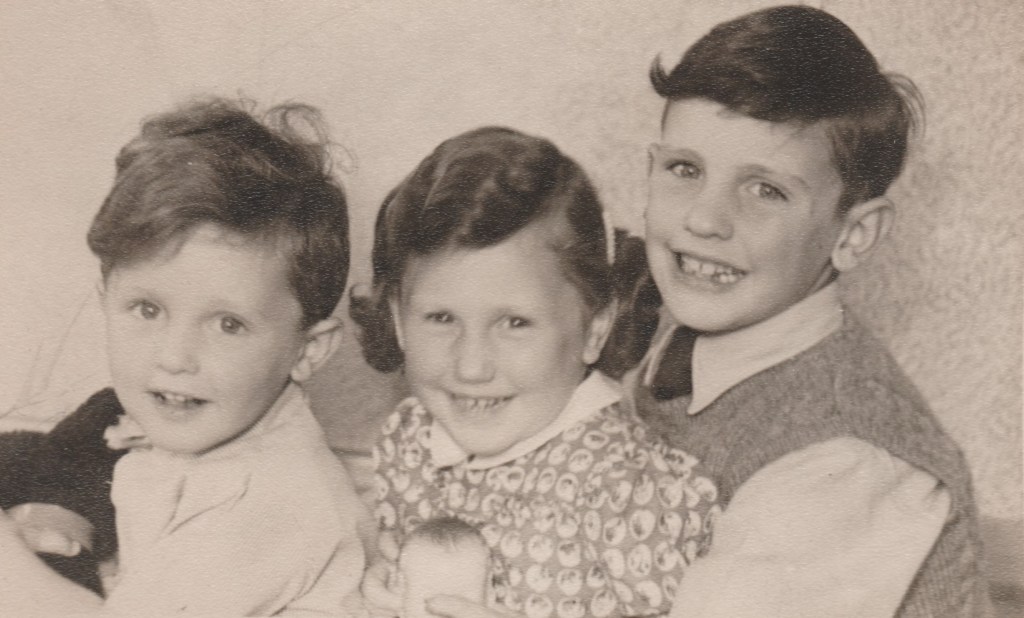
Baby boomers: (from left) Robin, Jacqueline and Nigel

Nowadays they talk about baby booms as occurring nine months after a specific incident – such as a national blackout – but the baby boomer generation refers to those born after the end of the Second World War.

In the US they give it a 20-year span with the first boomers born in 1946, based on the troops heading home in 1945. Statisticians (working out how many of us are left after 76 years) in the UK followed suit, giving the baby boomers generation a span from 1945 to 1965.

Personally I think they’ve got it wrong.

In the UK I see the baby boomers as born between 1946 and 1955. The age group that produced the first teenagers of the late 50s and early 60s and who can remember swing bands and rock’n’roll as well as the advent of the Beatles, Stones, etc.

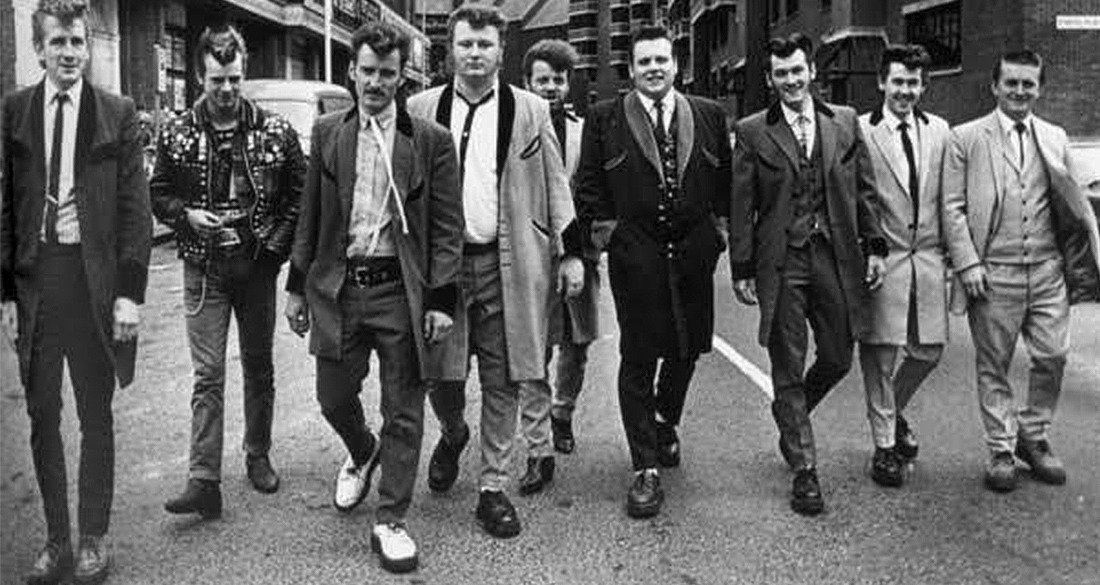
No doubt there will be cries of outrage from those born from 1956 to 1965, who will feel they are children of the 60s, and my seniors born at the beginning of the war who see the mid-50s as their time with Teddy boys, and their girls, along with the DA for the lads and the beehive for the girls, or as part of the Beat Generation who later morphed into hippies and also drew in early baby boomers.

I set the shorter age range based mainly on the culture of the era and the changes that nine-year cohort of babies grew up with.

Many of those born 1950 onwards are likely to have had older siblings in the baby boomer group who would have caught the changes in music and general culture as it happened, passing it on, almost by osmosis to their brothers and sisters.

My brother Nigel was in at the birth of the baby boom, he was born in July 1946, our father, David Pierce, had served with the RAMC in France and then North Africa and arrived home in mid-1945.

David Pierce and Ivy Lloyd on their wedding day in Liverpool , October 1939, three days before he was shipped out to France

He and our mother, Ivy, had got married in October 1939 and after a two-day honeymoon in London he had been shipped out with the BEF to France, was left behind at Dunkirk but got out two or three weeks later after a tortuous journey with a convoy of the sick and the wounded, and after a short leave headed off to Africa and spent the best part of the next five years providing medical attention for troops travelling from Durban to North Africa and then being stationed at a hospital in the north dealing with wounded soldiers from battles such as Tobruk and Alamein.

Ivy, meanwhile, remained in Liverpool but still helped the war effort as an assistant in the chief air warden’s department.

My sister Jacqueline arrived just over two years after Nigel, in September 1948, and I completed the trio with my arrival in March 1950.

In our early years the main influences on us were obviously from our parents and we could not have asked for a better, more loving set of parents than the ones we were lucky enough to have.

One of their major influences came in the form of music.

My early recollections are listening to my father playing Welsh songs on the piano – he had a a volume of Songs of Wales which even in the late 50s appeared well used. I later found out why.

My grandfather Edward had given it to his English wife Kate on her birthday, 16th March (same as mine) 1904. She must have played often and various songs are marked as favourites of her children. My father’s favourite, apparently, was Y Deryn PurThe Dove. I know this because the slightly tattered, but still usable, volume is now in my possession.

But I digress.

As with many baby boomers our early musical introduction would be in the music our parents listened to. We had a large radiogram, a solid piece of furniture which, once the valves warmed up, could be tuned in to the BBC radio programmes, such as the Light Programme and the Medium Wave.

It had a second purpose, however, and that was to play 78rpm records of which my parents had quite a lot. As well as classical music they had a large selection of dance bands and swing, such as Glenn Miller, Tommy Dorsey and Benny Goodman. They also had some fun records including White Christmas by Bing Crosby, The Laughing Policeman by Charles Jolly and Don Charles presents the Singing Dogs with Pat-A-Cake, Pat-A-Cake; Three Blind Mice; Jingle Bells; and Oh! Susanna.

I was still at primary school when my brother introduced me to the sounds of Radio Luxembourg. We shared a bedroom. He was now one of the original baby boomer teenagers – Bill Haley was the first to use the term in the UK in 1957 but any teenagers at that time were the wartime babies who had grown up to be Teddy Boys or beatniks with their girlfriends sporting beehive hairdos and skirts over layers of stiff petticoats or chunky jumpers, black Capri pants and not so stylish hairdos.

Teddy Boys on a London street in the 1950s and members of a beatnik community in Cornwall

The boomer teenagers reached that age in 1959 but it was still two or three years before they became the teenagers we know and love listening to rock, pop and blues.

In 1963, when I became a teenager, my parents bought a Dansette record player which could play the newfangled 45s and LPs and our first LP record came into the house, With the Beatles (November 1963), which is once again one of my prized possessions.

That was when my taste in music really broadened because Nigel would often bring the record player up to our room when Mum and Dad were watching TV, and sometimes I joined him and was introduced to Simon and Garfunkel, the Walker Brothers and Bob Dylan.

At the same time my sister Jacqueline was into more pop in the early 60s and from there I got a taste for the Animals, Alan Price and Georgie Fame.

In time, of course, I developed my own tastes and found myself enjoying a range from Lonnie Donegan and Tommy Steele, via the Troggs and to the Beatles, Cream, The Who, Rolling Stones – well I could go on but is a very broad taste in music.

This is what truly defines baby boomers as far as I am concerned. You had to have been introduced to the music of the 50s and early 60s at the time they were new, not secondhand. Those born in the second half of the 50s would have still been listening to nursery rhymes.

We ARE the baby boomers and later generations cannot take that away.

Love her or hate her you have to recognise Sylvia Plath’s poetry

Sylvia Plath, the tortured poet of the mid 20th century, has been dead for almost twice as long as she lived yet, almost 60 years after her death, the very mention of her name can start a literary war.

Plath is is as close to Marmite woman as you can get. There are very few poetry lovers who do not fall into either the pro-Plath camp or the anti-Plath camp.

Of these two groups one sees poet Ted Hughes, her husband, as anathema and the other as a man much maligned by his wife’s devotees.

Personally I do not take extreme sides such as this. I certainly see Plath as a woman with a great burden on her shoulders, beginning with her father’s death when she was just eight years old (in fact eight years and one and a half weeks old). He suffered from diabetes and died not long after the amputation of one of his feet because the diabetes had not been treated.

It is certainly something that sticks in a child’s mind and may have had a lot to do with her later depression and serious mental problems which came to a head with an attempted suicide (not her last) when she was just 20.

It was not much later than this that she met and fell in love with English poet Ted Hughes and the two wrote more than 80 poetic missives to each other in a very short space of time.

The marriage lasted until her death but by then they had been separated for more than a year.

One of her most controversial poems, Daddy, was written not long before she died, a suicide bid which, unlike so many previous ones, actually succeeded.

Whatever your view of the stormy relationship of two such brilliant poets, one American the other British, this poem may well provide an insight to her mind in the months before she died.

Daddy

by Sylvia Plath

1932-1963
You do not do, you do not do
Any more, black shoe
In which I have lived like a foot
For thirty years, poor and white,
Barely daring to breathe or Achoo.

Daddy, I have had to kill you,
You died before I had time --
Marble-heavy, a bag full of God,
Ghastly statue with one gray toe
Big as a Frisco seal

And a head in the freakish Atlantic
Where it pours green bean over blue
In the waters off beautiful Nauset.
I used to pray to recover you,
Ach, du.

In the German tongue, in the Polish town
Scraped flat by the roller
Of wars, wars, wars.
But the name of the town is common,
My Polack friend

Says there are a dozen or two,
So I could never tell where you
Put your foot, your root,
I never could talk to you,
The tongue stuck in my jaw.

It stuck in a barb wire snare.
Ich, ich, ich, ich,
I could hardly speak.
I thought every German was you,
And the language obscene.

An engine, an engine,
Chuffing me off like a Jew.
A Jew to Dachau, Auschwitz, Belsen.
I begin to talk like a Jew,
I think I may well be a Jew.

The snows of the Tyrol, the clear beer of Vienna
Are not very pure or true.
With my gypsy ancestress and my weird luck
And my Taroc pack and my Taroc pack
I may be a bit of a Jew.

I have always been scared of you,
With your Luftwaffe, your gobbledygoo,
And your neat mustache
And your Aryan eye, bright blue.
Panzer-man, panzer-man, O You--

Not God but a swastika
So black no sky could squeak through.
Every woman adores a Fascist
The boot in the face, the brute
Brute heart of a brute like you.

You stand at the blackboard, daddy.
In the picture I have of you.
A cleft in your chin instead of your foot
But no less a devil for that, no not
Any less the black man who

Bit my pretty red heart in two.
I was ten when they buried you.
At twenty I tried to die
And get back, back, back to you.
I thought even the bones would do.

But they pulled me out of the sack,
And they stuck me together with glue.
And then I knew what to do.
I made a model of you,
A man in black with a Meinkampf look

And a love of the rack and the screw.
And I said I do, I do.
So daddy, I'm finally through.
The black telephone's off at the root
The voices just can't worm through.

If I've killed one man, I've killed two--
The vampire who said he was you
And drank my blood for a year,
Seven years, if you want to know.
Daddy, you can lie back now.

There's a stake in your fat black heart
And the villagers never liked you.
They are dancing and stamping on you.
They always knew it was you.
Daddy, daddy you bastard, I'm through.