Some years are full of events, others can be very quiet.
For me 1973 was one of those busy years.
It was certainly a year which sticks in my mind.
The year began with the UK, along with the Republic of Ireland and Denmark, entering the European Economic Market. Not something which impinged on my life that much. It was also when the Open University awarded its first degrees. Again, at the time it didn.t mean a lot to me although it would in years to come.
On the first of March Pink Floyd released their album Dark Side of the Moon which did affect me very much because I bought it and found it to be one of the greatest rock albums to that date. I’ve still got it.
Two days later IRA bombers set off two explosions in London killing one and injuring 250 others. Ten people were arrested at Heathrow airport suspected of involvement in the bombings. Five days later two more IRA bombs went off in London, one in Whitehall and one at the Old Bailey.
At the end of May, Anne, the Princess Royal, got engaged to Captain Mark Phillips and it was announced they would be married in November. Didn’t seem important to me then but that would change later that year.
In September the IRA were at it again with bombs exploding at King’s Cross and Euston railway stations and two days later a further two bombs at Oxford Street and Sloane Square.
In November eight members of the Provisional IRA were convicted of the March bombings in London. On the same day Princess Anne and Mark Phillips were married at Westminster Abbey.
As a result of coal shortages, caused by industrial action, Conservative Prime Minister Edward Heath announced, on 17 December, that moves would be put into force to reduce electricity consumption. At midnight on 31 December, as we began New Year 1974, the three-day week came into force.
On a personal front it was the year I began my life in Basildon rather than just reporting what happened in the town; I got deeply involved with the union; took part in my first union action; spent a couple of weeks picketing my employers; met the love of my life; played an elderly CofE prelate; and began a journey which I am still on 49 years later.
"No water so still as the
dead fountains of Versailles." No swan,
with swart blind look askance
and gondoliering legs, so fine
as the chinz china one with fawn-
brown eyes and toothed gold
collar on to show whose bird it was.
Lodged in the Louis Fifteenth
candelabrum-tree of cockscomb-
tinted buttons, dahlias,
sea-urchins, and everlastings,
it perches on the branching foam
of polished sculptured
flowers-at ease and tall. The king is dead.
Are you a collector? I don’t mean someone who rattles a plastic box trying to get cash for charity; or someone who goes around on a big lorry in the early morning collecting the rubbish from our bins.
I’m talking about things like stamps; or coins; or teddy bears; or beermats.
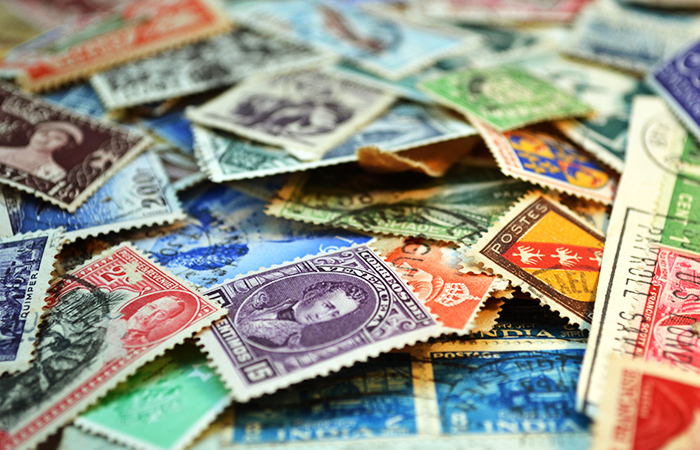
Remember collecting these and sticking them in an album? Maybe you still are a philatelist.
I am sure that most people at some time have collected something.
When I was young I did try stamp collecting but thought it too much hassle to sort them out, identify the country and then use those little bits of paper to stick them on the correct page of an album.
After that I didn’t really bother with collecting until I became a journalist and collected stories and news clippings.
Recently, however, I discovered I had become an accidental collector.
No, that doesn’t mean I collect accidents, or chase round looking for accidents and taking photographs.
The trouble is I don’t know what term describes me.
A stamp collector is a philatelist; a coin collector is a numismatist; a collector of teddy bears is an arctophile; even collectors of what appear to be odd things have names: fusilatelists collect phone cards issued by different phone companies; falerists or philarests study and collect medals, badges.
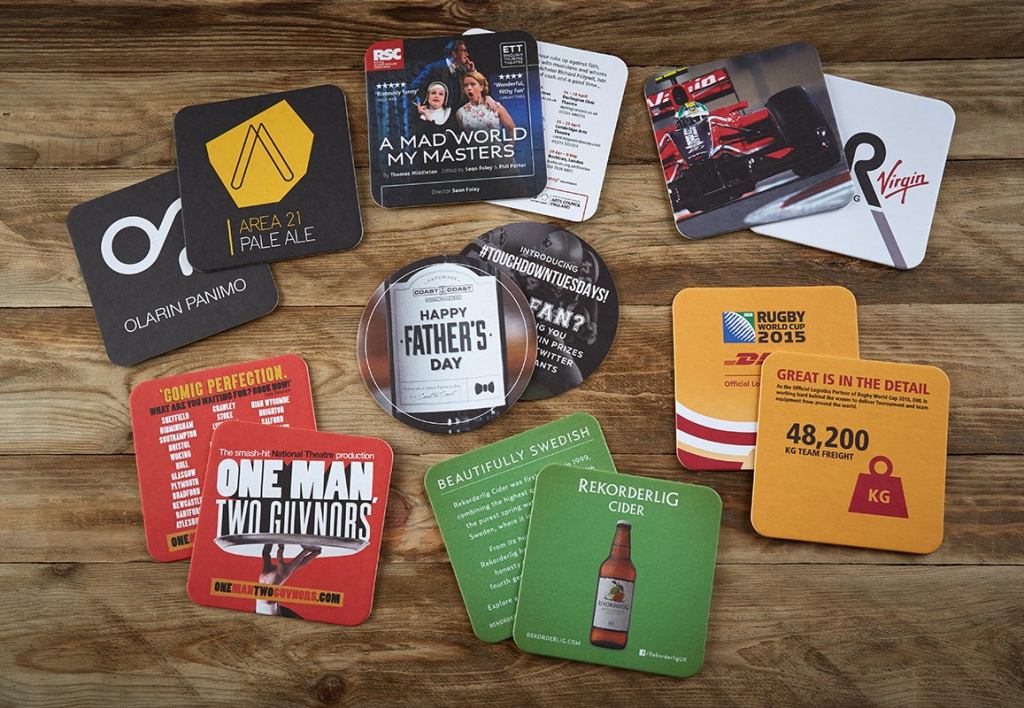
Even collectors of beermats have their own name – tegestologists.
A tegestologist would love these beermats
So what do I collect – tins.
Not empty soup tins, or chopped tomato tins – advertising tins. That is tins which once contained biscuits, or sweets or items such as OXO cubes.
Advertising tins such as these OXO ones are not just interesting designs they serve a useful purpose keeping the cubes fresh.
I didn’t buy these because I wanted the tins – when we bought them they were filled with OXO cubes and the price was the same as buying the cubes packaged in cardboard. It also means we can keep OXO beef, lamb, chicken and vegetable cubes separate, or even put other brand cubes in them.
In fact I have never bought a tin that didn’t have something in it and in the main the price has normally covered the contents with no extra charge for the tin.
Over the years we have bought many things that came in tins and then utilised the tins for other purposes. I don’t think of myself as a glass jar collector just because I keep various baking ingredients in glass jars.
So what made me realise I had become a tin collector?
Just a fraction of our Quality Street tins
I was taking down our Christmas decorations, ready to pack them away until December 2022, when I started to count the tins we use for the baubles, the beads and the small items we put on the boughs around the room.
We started buying a tin of Quality Street at Christmas when we settled back in North Wales in 1988 after two years in Oman. It became a new tradition (just as we had a tradition of Christmas stockings which could be opened first thing and presents under the tree which were only dished out after everyone was dressed and had eaten breakfast) and not many Christmases passed without a new tin.
We now have over 25 of them and I think that signifies a collection.
I have to admit that it doesn’t stop with the Quality Street tins and the OXO tins. I do have one or two others. Well maybe more than one or two.
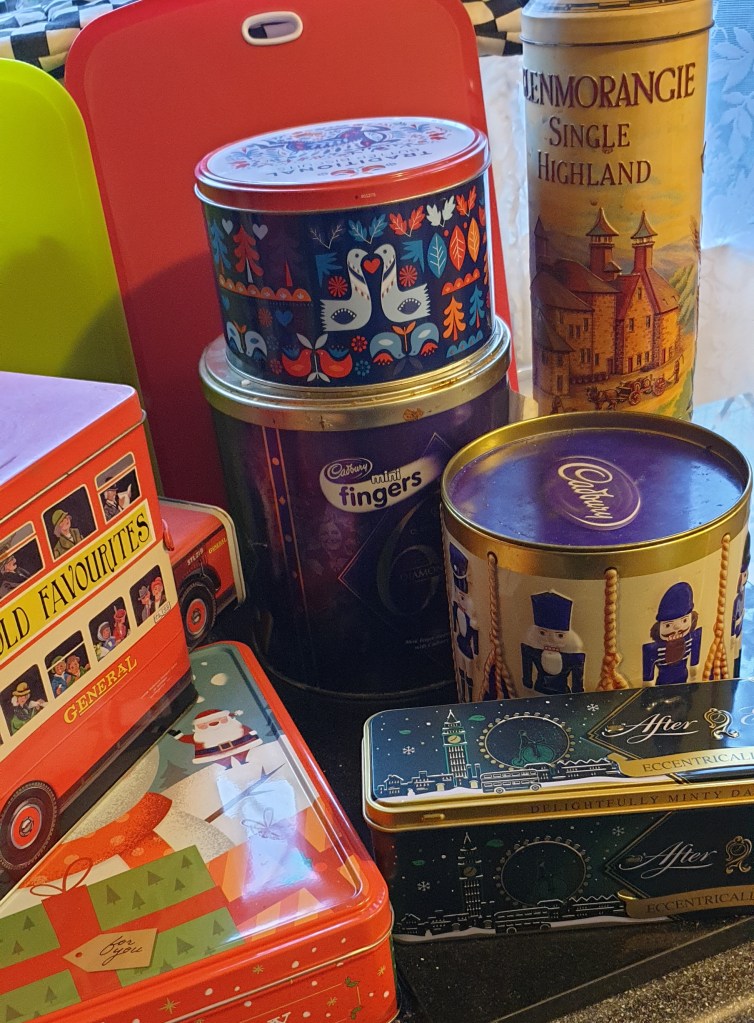
There are the Cadburys tins which once held Cadburys fingers. These include one shaped like a drum, four or five oblong tins with old-fashioned advertising images (even though the tins are late 20th century) and even a stacking set of three which held mini-fingers.
Then again there are shortbread biscuit tins and Christmas biscuit tins along with tins from bottles of single malt whiskey and even two different tins made to look like London buses.
A small selection showing Cadburys Fingers tins, single malt tins, even After Eight.
As I said I do utilise these tins for various baking goods, caster sugar, demerera, Muscovado sugar, icing sugar, rice flour . . .
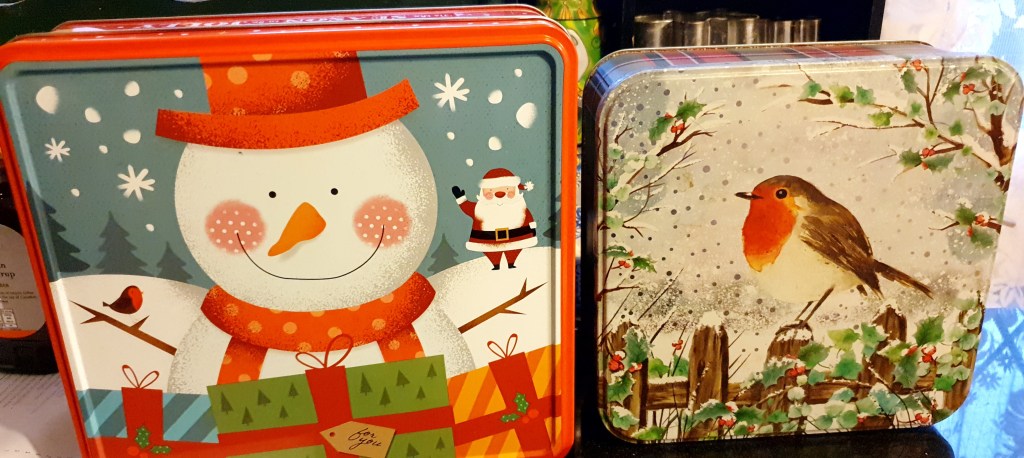
I also use seasonal biscuit tins for the purpose they were created – to store my home-baked biscuits.
Just two of a selection of 10 or more biscuit tins which still serve their original purpose.
I could show you more but I think I have confessed enough.
I did think back to where this all began. What was my first tin?
I lay it all at the feet of my Auntie Flo, mum’s aunt really as she was my grandmother’s sister. She and Uncle Bill (her husband and my grandfather’s cousin) had no children but they did have an old-fashioned sweet shop, run by Flo, and a newsagent’s shop, run by Uncle Bill, on opposite sides to West Derby Road in Liverpool. We used to visit them four or five times a year and there would be comics to read and sweets to be consumed.
I remember one Christmas in the 1950s when they sent my brother, my sister and myself a tin of sweets each. My tin, which contained toffees, was rectangular with a hinged lid, in silver (the colour not the metal) and blue with a raised decoration on the top showing a country scene.
Once I finished the toffees (probably Boxing Day knowing me) I used that tin to store my “treasures” (an interesting pebble, a shell from the beach, a fluffy feather from a baby bird) and later it became a place to keep pencils and pens. It’s still around, somewhere, but my study is all over the place at the moment and I’d have to carry out a major search.
I think I know how I came to like tins for keeping things in. My mother used to have a Quality Street tin, possibly from the 1930s, and a lot smaller than modern ones. she used it to keep buttons, snipped off old clothing, or a “spare” which you used to get with any clothes, although now it is mainly with shirts and trousers.
We used to use those buttons (some of which probably went back to the 1920s or even pre-WW1) as tokens when playing cards. As it happens that is something else people collect, buttons.
I just wish I knew what to call myself now that I know I am a collector.
I wanna be your vacuum cleaner
Breathing in your dust
I wanna be your Ford Cortina
I will never rust
If you like your coffee hot
Let me be your coffee pot
You call the shots
I wanna be yours
I wanna be your raincoat
For those frequent rainy days
I wanna be your dreamboat
When you want to sail away
Let me be your teddy bear
Take me with you anywhere
I don't care
I wanna be yours
I wanna be your electric meter
I will not run out
I wanna be the electric heater
You'll get cold without
I wanna be your setting lotion
Hold your hair in deep devotion
Deep as the deep Atlantic ocean
That's how deep is my devotion
by John Cooper Clarke
Sorry about yesterday but I got a bit behind myself and stuck into the early processes of de-decoration on Twelfth Night.
No matter how bad a time it is, and the last two Christmases have not actually been a ball of fun, I find the Yuletide season to be a special time, especially when it comes to decorations, parties and presents.
This year there were decorations and presents but definitely no parties.
Normally I put the decorations up in the middle of December. Last year I decided to do it on 1 December just to cheer things up a bit. Even then there were not as many as usual.
The Christmas tree was new.
When I still lived at home we had a real tree, as far as I remember, but over the years since then we gradually moved to an artificial one and in the late 1980s we got a fantastic tree over six foot tall and reduced to half-price.
Since then we have moved house a number of times and always put that tree up every year even if it was a little bit big for some of the living rooms.
Just over a year ago, however, we found the old tree was getting a bit tired and its branches were getting loose and droopy.
The new one is just five foot and sits nicely on the old mariner’s chest (one of the few relics I have which once belonged to my great-great grandfather) in our front room. The point is it does not need as many lights and decorations as we had in the past.
The trouble is I hate throwing things out which means the old tree is still up in the loft and we have more decorations than we really need.
This year I’m biting the bullet and the first thing to go is Christmas lights.
For one reason or another I tend to buy new lights every few years. Sometimes because I like what I see and sometimes because old ones stop working. The trouble is I kept hanging on to the old ones in the belief I could fix them
This year it looks as though four sets of old lights are going in the bin – well I can’t throw all of them out, I might be able to get some working again even if I have no room to put them up.
Maybe next year I can throw more away. I just have to make sure I don’t get tempted to buy any new ones.
I adore poetry and cannot remember a time when I didn’t.
I suppose my parents must have read to me when I was very young, possibly nursery rhymes. It is amazing how many of those I know without actually remembering reading them myself.
As I got older I was introduced to more “serious” poetry. The works of Keats, Wordsworth, Browning, and more were on the bookshelves in the hall and lounge. Quite a few of them, including the Shakespeare, were school prizes won by my father and his sister.
I loved the flow of words, and even devoured the nonsense poems of Edward Lear and later Spike Milligan.
The older I got the wider my net was cast and I left Lear behind me as I embraced Wilde, Thomas and Hughes (both Ted and Frieda as it happened).
I do remember in later life my brother talking of a great poetical story book he had bought for his grandchildren all about a bear hunt by a children’s poet called Michael Rosen.
I didn’t pay too much attention as my own children were, I thought, beyond children’s poetry and I didn’t have any grandchildren at that time.
Later I did read odd bits of poetry by Michael Rosen but it was not until Covid hit and I spent a bit more time online with Twitter that he really came to my attention.
People I followed and who followed me were talking about Michael Rosen being seriously ill in hospital with Covid and there were references and links to Emma-Louise Williams @Underthecranes with daily updates on his condition.
It was later that I discovered Emma-Louise Williams is Michael Rosen’s wife and the family were using her Twitter account to keep his friends and fans informed as to his condition.
All those who know and love Michael Rosen are aware that thanks to the dedicated care he, and thousands of other NHS patients, received he pulled through, although he has been left with Long Covid.
Once he got back on Twitter himself I began following him as his Tweets were both hilarious and incisive as he related his ongoing recovery.
I still thought of him as a children’s poet (he had been Children’s Poet Laureate after all) but found his Tweets went further than children’s poetry. He also has a political conscience.
Late last year I found out that he had written political poetry as well as his children’s work and I decided to put Fighters for Life, selected poems by Michael Rosen on my Christmas list (along with CDs by Bix Beiderbecke, a black on red Guevara Tshirt and the final seven books in Andrea Camilleri’s Montalbano series).
When Christmas Day dawned my wish list was fulfilled.
I have been dipping in and out of Fighters for Life over the past week and want to introduce you to one that really struck a chord with me. I hope you enjoy it as much as I do:
A family arrived and said that they had papers
to prove that his house was theirs
-- No, no, said the man, my people have always lived here.
My father, grandfather . . . and look in the garden,
my great-grandfather planted that.
-- No, no, said the family, look at the documents.
There was a stack of them.
-- Where do I start? said the man.
-- No need to read the beginning, they said,
Turn to the page marked 'Promised Land',
-- Are they legal? he said. Who wrote them?
-- God, they said, God wrote them, look,
here come His tanks.
I love Michael Rosen. He doesn't need many words to make his point.
So why am I starting a day later than most to set my plans for the New Year?
Because many of us wake up on New Year’s Day with a determination to GET THINGS DONE. Mind you, if we shout it out loud like that it might hurt, especially if you welcomed in the New Year a little bit too well.
To be honest it is quite some time since my Muse and I welcomed the New Year in with alcoholic refreshment. If it wasn’t for Jools Holland and his annual Hootenanny we might not even have welcomed the New Year until it was about eight hours old.
But I digress.
The first day of the New Year should not be a time to make promises, it should be a time to evaluate the previous year and then decide whether to lay out a plan, only to be disappointed by failure within a few days, a fortnight at the latest, or establish a “take it as it happens” attitude and muddle our way through the rest of the year.
I am not saying that in one day I can examine everything that I have done in the previous 365 days. What I can do is consider what I hoped to achieve in that time and judge whether or not I achieved any part of it.
As it happens my Muse and I have succeeded in doing what we hoped to do in 2021 – we lived. We certainly lived to see in 2022.
That was not our aim at the start of 2020. We had all sorts of good things to look forward to: having days out to the seaside with our grandchildren; working on my Muse’s garden (well she would do the horticultural work and I would dig holes, make raised beds and perform other manual labour); lazing in the garden in the sunshine; visiting family in North Wales . . .
As we know now all these plans went to hell in a handcart thanks to Covid.
From March 2020 through to now we have just been grateful to wake up each day and survive to go to bed that night.
Thanks to the speedy work of scientists to come up with vaccines to help fight Covid our hopes of survival on 1 January 2021 were stronger than they had been in the middle of March 2020. On that New Year’s Day we had hopes that Covid would be over and done with before Christmas.
Thanks to the incompetence of the Boris Johnson government (and I’m not including Chris Whitty in that) we find ourselves entering another year with the threat of a new variant hanging over us, and who knows whether there will be another variant this year and in years to come.
That is why I am not making great plans for this year. Instead I will get up in the morning and decide day by day which jobs I will do around the house and garden; whether I’ll read a novel, a political volume or some poetry; maybe I’ll bake some bread or make cakes or sausage rolls; possibly work on the novels I have been working on for five years now; or maybe just write.
One thing I do plan to do (but cannot guarantee) is to put something of interest on this site at least once a day. Just don’t have a go if I fail. After all I’m only human.
PS: I spent yesterday knocking out a baker’s dozen of bread rolls.
That great creator of quotable quotes, A Non, is once alleged to have said “if you’re not a socialist at 20 you’ve got no heart,if you’re still one at 40 you’ve got no head.”
I definitely have a heart (it belongs to my Muse but she lets me have a free rein with it when it comes to politics and rugby) and believe that I was a socialist by the time I was 15.
I also definitely have a head, within which is the house called Mind wherein I store all the information I have accrued in more than 70 years, and here I must disappoint A Non, because let alone being a socialist at 20 and 40 I am still one at 71 and will still be one at 100 (if Mind hasn’t burst at the seams by then with that ever-expanding store of information).
In fact I became a socialist before I found a home within the Labour Party. Indeed, I became a socialist before I found my spiritual home (can I use that term without believing in God, can I have spirit without religion?) within the union movement.
Socialism is a political, social, and economic philosophy encompassing a range of economic and social systems characterised by social ownership of the means of production. It includes the political theories and movements associated with such systems.
The above definition of socialism is one that most people will recognise but to me it is very simplistic. Yes, it does talk about social ownership, which many see as an all-embracing nationalisation of everything, which would, of course, be complete nationalisation with control in the hands of the government of the day.
I have always considered socialism to be far more than just control of production and the products of that process.
To me socialism grew as I saw what went on around me.
My models were my parents who cared about our family: myself and my siblings; the broader group of blood relatives, grandparents, aunts and uncles, cousins; and a wider group who were not blood relatives but considered family by ties of marriage.
It went beyond this, however, because they both cared about others, their friends, acquaintances, those in need.
This is how I became concerned with the rights and the plight of others.
I learned that my actions, no matter how small, could affect people I might never have met and how their actions could affect me as well as people on the other side of the world.
I was never going to be a historian but, after English (literature and language), my favourite subject was history and once my interest was piqued by a reference to an event in the past I would go and research that event and that period.
This is how I really discovered the ancient Egyptian civilisation, and the Greek civilisation and the Roman empire.
Not that I was overawed by the idea that the Egyptians had an ideal society with great monuments to show what they had done; or that the Greeks came up with what they called democracy; or that the Romans took civilisation to vast areas of the globe.
The Egyptian monuments were built by slaves; the so-called democracy of Greece did not give the vote to slaves, or women, just to male citizens; Roman civilisation was what the Romans considered right and proper and they brought it at the point of the gladius and the javelin.
Throughout history we, the people, have discovered amazing things, but far too often the discoveries are not used for good but for evil.
The Romans may have colonised Britain but when they ran to defend the remnants of their empire they left behind a civilisation based on hierarchy which existed only because they had slaves to do the work.
The slaves became serfs (another form of slavery) and eventually the serfs became freemen and women, although they were never free.
Many of them tilled the land, not for their own benefit, but for the benefit of the landowners; others toiled in the towns and the cities, again, not for their own benefit but for the benefit of those who employed them and paid them a pittance for their efforts.
The shoemaker who crafted a fine pair of leather boots for a customer never had the time or the money to craft a pair for personal use. The lady’s maid who dressed the hair of her mistress as well as dressing the body in silks and satins would never be able to afford such care or clothes for herself.
Over the centuries we have talked of society – by which we mean a group of people who live together and interact with each other, but society is not socialism and society retains its ranks, or, as it is often called, the class system.
This system divides us into working class, middle class and upper class and all too frequently the upper class look down on the middle class and do not even notice the working class. The middle class look up to the upper class and down at the working class (although that is where many of them started). This leaves the working class to get on producing the goods that make the world go round without having the benefit of many of those goods for themselves.
This is not socialism.
The socialism I see is where we all do our best, work to our abilities, and share the product of that work. For those unable to work or produce, the elderly, the sick and the young, we care for them and share the product of our labours with them.
It is for just such a society that I became a socialist.
It is for just such a society that I remain a socialist.
Red ’til I’m dead and I’ll be waving that red banner as they take me to my grave.
When do we become aware and do we remember the moment or is it just another step along life’s highway when we take so many that we cannot recollect them all?
There are those who feel they became aware soon after birth (some even believe it happens in the womb) and they can “recall” things that happened when they were very young.
Are you aware of the moment you took your first step; or when you first liked, or disliked, certain foods or drinks; are you one of those who can “recall” the arrival of a new baby in the family, hot on your heels?
Most of these “memories” come from seeing pictures or being told stories.
I know that when I was a baby my older brother plonked a bowl of porridge on his head as though it was a soldier’s tin helmet. He might remember it because he is almost four years older than me but my memory has been created by members of the family telling me the story. I think my brother might have recounted it himself at times.
I do have some form of memory of my early years as a child in Chesham. I remember the nuns at the infant school my sister and I attended for about a year; I remember Joy, the girl across the road who was two or three years older than me but acted at times like a big sister, making me laugh, keeping me safe.
The only memory of my early years that made any impression on me (physically as well as mentally) was at my brother’s birthday party in our first year in Rhyl. The memory remains etched in my mind because it involved fire and my face.
We had all been sitting around the table having birthday tea and it came time for big brother to blow out the candles on his cake. We then all had a slice of cake on a plate in front of us and mine still had a candle in it.
Having seen big brother blowing out the candles I wanted my turn and someone, I don’t know who, lit the candle for me.
As I leaned forward to blow it out a gust of air wafted up the paper napkin tucked into my jumper and it caught the flame before continuing its upward rise to kiss my cheek, ever so gently – then came the pain because the burning paper was stuck to my cheek.
After that I remember very little. Apparently one of my mother’s friends had grabbed me and wrapped my head and upper body in her coat to extinguish the flames. Her actions almost certainly saved my charming good looks but at the time it was just pain.
I don’t know if our doctor, a family friend, was present or arrived within minutes but I was given some form of sedative which knocked me out for a few hours. When I came round, lying on the settee with a travel rug over me, the first person I saw was my big brother. The rest of the family was almost certainly there but it was his face imprinted on mind.
It was not his words but his action that gave me the strongest memory.
He had saved me the last Iced Gem which, as birthday boy, it would have been his right to claim for himself, and proffered it to me.
I tend to associate birthday candles with danger but Iced Gems always make me think of my big brother.
For some weeks after that my mother had to regularly change the dressing on my cheek to ensure it healed properly. I remember the dressings well, They were lint squares soaked in some form of gelatinous ointment. She had to remove the old dressing carefully so as to pull nothing away with it, then bathe my cheek with cotton wool and some form of disinfectant (probably Dettol as we seemed to use that for everything) before applying a new dressing.
She did this two or three times a day for four or five weeks and I can still see the flat square tin those dressings were kept in – the lid was blue and the tin the same grey as our pots and pans.
I suppose it was lucky Dad was a chemist and had all the things needed to treat my wound.
I don’t know if they make Iced Gems any more but they will always remind me of the kindness of my big brother.