Strange Meeting

by Wilfred Owen

It seemed that out of battle I escaped
Down some profound dull tunnel, long since scooped
Through granites which titanic wars had groined.
Yet also there encumbered sleepers groaned,
Too fast in thought or death to be bestirred.
Then, as I probed them, one sprang up, and stared
With piteous recognition in fixed eyes,
Lifting distressful hands, as if to bless.
And by his smile, I knew that sullen hall, --
By his dead smile I knew we stood in Hell.

With a thousand fears that vision's face was grained;
Yet no blood reached there from the upper ground;
And no guns thumped, or down the flues made moan.
'Strange friend,' I said, 'here is no cause to mourn.'
'None,' said that other, 'save the undone years,
The hopelessness. Whatever hope is yours,
Was my life also; I went hunting wild
After the wildest beauty in the world,
Which lies not calm in eyes, or braided hair,
But mocks the steady running of the hour,
And if it grieves, grieves richlier than here.
For by my glee might many men have laughed,
And of my weeping something had been left,
Which must die now. I mean the truth untold,
The pity of war, the pity war distilled.
Now men will go content with what we spoiled.
Or, discontent, boil bloody, and be spilled.
They will be swift with swiftness of the tigress.
None will break ranks, though nations trek from progress.
Courage was mine, and I had mastery; 
To miss the march of this retreating world
Into vain citadels that are not walled.
Then, when much blood clogged their chariot-wheels,
I would go up and wash them from sweet wells,
Even with truths that lie too deep for taint.
I would have poured my spirit without stint
But not through wounds; not on the cess of war.
Foreheads of men have bled where no wounds were.

'I am the the enemy you killed, my friend.
I knew you in this dark; for so you frowned
Yesterday through me as you jabbed and killed.
I parried; but my hands were loath and cold.
Let us sleep now . . . .'

The Kiss

by Edith Nesbit

The snow is white on wood and wold,
The wind is in the firs,
So dead my heart is with the cold,
No pulse within it stirs,
Even to see your face, my dear,
Your face that was sun;
There is no spring this bitter year,
And summer's dreams are done.

The snakes that lie about my heart
Are in my wintry sleep;
Their fangs no more deal sting and smart,
No more they curl and creep.
Love with the summer ceased to be;
The frost is firm and fast.
God keep the summer far from me,
And let the snakes' sleep last!

Touch of your hand could not suffice
To waken them once more;
Nor could the sunshine of your eyes
A ruined spring restore.
But ah - your lips! You know the rest:
The snows are summer rain,
My eyes are wet, and in my breast
The snakes' fangs meet again.

All roads don’t lead to Rome – most of them end up at the seaside

Do you have a special place you love which is not real?

I don’t mean like Billy Liar with his imaginary country of Ambrosia where he is the benevolent, but brave, leader, guiding both his country’s development and armed forces.

I mean the sort of place Peter Pan would call a “happy place” where you could have your “happy thoughts”.

I have one and I could guide you there from any starting point in the country, because whichever road I take it always reaches a country crossroads, or the coast road, or the narrow path across the moors which take me to the bayside town.

Don’t get me wrong, I don’t spend vast swathes of time daydreaming about an imaginary town where I am the premier citizen. Although dreaming does come into it.

My town, I don’t even know what it is called, has grown a bit over the years, although my memories of its early days seem to indicate it was pretty well fully-formed in my mind. Maybe it is not growing, could it be that in my dreams I am exploring new turnings, alleys and lanes which were always there just never seen?

I frequently remember my dreams (some say they know they had a dream but never remember it) and although they may begin anywhere in time or space I always seem to end up in Dreamtown.

Sometimes my dream may be split with an early morning awakening and a need for a drink, or even a call of nature. I then tend to pick up where I left off, often still en route to my town, sometimes being somewhere completely different which still lands me in my seaside town.

I awoke very early this morning with a dry throat and remember distinctly that I had been dreaming about being in a balloon, well in the basket underneath one of those gaily-coloured monstrosities.

After assuaging my thirst I was aware of the balloon and at the same was aware that I was no longer in it. Instead I was walking up the beach to reach the promenade. This delightfully broad area stretches in a three-mile curve around Dreamtown Bay with the blue sea behind you and the crescent of old Victorian houses to the fore.

Beyond this frontage the town rises up behind it on a hillside. It is one of those quirky towns where you could enter a store on level ground and go up three floors to then exit the building on its other side and find yourself half way up the hill.

Somewhere in the middle of this sloping town (and don’t ask me how they managed it on a sloping site surrounded by other buildings) is a large open square with a fountain in its centre. If you stand with your back to the bay you are confronted with the massive red-brick municipal centre, while to your right is a toy shop bigger than Hamley’s in London – a store I visited with my mother when I was nine years old.

To the left, and this is probably the strangest of all when you consider this is half-way up one side of what is probably a hill, is a railway station from where you can travel to anywhere in the UK.

Then, when you turn your back on the grand Town Hall you find yourself looking out to a curved bay with the arms reaching up before dropping away as sheer cliffs. In the distance there are grand sailing ships (even though I generally arrive in a 20th century car).

If you do get to the edge of town at the top of what initially appeared to be a hill, you will find yourself on a broad road running from left to right and beyond it is wild moorland which rises and falls as far as the eye can see.

If you turn left you will find your way to a town, or city (rarely the same one twice) which is in the real world and from there you can find your way home.

If you turn right then you’re on your own. I have never travelled in that direction although there are rumours that it leads to a land of milk and honey, although it might actually be a desert with no food or drink.

You can, if you dare, head across the road to the moor beyond. I usually find at this point that there is a horse tethered to the branch of a small tree, which I then mount and ride off into the sunset, even though the sun never seems to finally set in this land of dreams.

It doesn’t matter how long I spend in this place out of time – I always get back to my bed in time to wake up.

If I didn’t I wouldn’t be here to tell tales about Dreamtown.
Us Two

by A. A. Milne

Wherever I am, there's always Pooh,
There's always Pooh and Me.
Whatever I do, he wants to do,
"Where are you going today?" says Pooh:
"Well, that's very odd 'cos I was too.
"Let's go together," says Pooh, says he.
"Let's go together," says Pooh.

"What's twice eleven?" I said to Pooh.
(Twice what?" said Pooh to me.)
"I think it ought to be twenty-two."
"Just what I think myself," said Pooh.
It wasn't an easy sum to do,
"But that's what it is," said Pooh, said he.
"That's what it is," said Pooh.

"Let's look for dragons," I said to Pooh.
"Yes, let's," said Pooh to Me.
We crossed the river and found a few -
"Yes, those are dragons all right," said Pooh.
"As soon as I saw their beaks I knew.
"That's what they are," said Pooh.

"Let's frighten the dragons," I said to Pooh.
"That's right," said Pooh to Me.
"I'm not afraid," I said to Pooh,
And I held his paw and I shouted 'Shoo!
Silly old dragons!" - and off they flew.

"I wasn't afraid," said Pooh, said he,
"I'm never afraid with you."

So wherever I am, there's always Pooh,
There's always Pooh and Me.
"What would I do?" I said to Pooh,
"If it wasn't for you," and Pooh said: "True,
It isn't much fun for One, but Two,
Can stick together, says Pooh, says he.
"That's how it is," says Pooh. 


Tiny Warrior

by Sharmagne Leland St. John

Nikolai 1982-1983
You never saw the spring my love
Or the red-tailed hawk circling high above
On feathered wings my love
You only knew the snow
You never saw the prairie grasses bend and blow
And undulate like the shimmering indigo sea
You never saw me
Your eyes were closed so tight
They say you put up quite a fight
Somehow your life was over before it had begun and
Gently did I touch and kiss your tiny-fingered hand
Born too soon
You never saw the silver moon
Or the light of a summer's day
Last night I dreamt a gathering of eagles
Had come
To spirit you away
Born too soon
Your tender heart
Could not beat
To the pulsing rhythm
Of life's taut drum

Fox-Hunting

by Rudyard Kipling

The Fox Meditates
When Samson set my brush afire,
To spoil the Timnites barley,
I made my point for Leicestershire
And left Philistia early.
Through Gath and Rankesborough Gorse I fled,
And took the Copslow Road, sir!
And was a Gentleman in Red
When all the Quorn wore woad, sir!

When Rome lay massed on Hadrian's wall,
And nothing much was doing,
Her bored Centurions heard my call
O' nights when I went wooing.
They raised a pack - they ran it well
(For I was there to run 'em)
From Aesica to Carter Fell,
And down North Tyne to Hunnum.

When William landed, hot for blood,
And Harold's hosts were smitten,
I lay at earth in Battle Wood
While Domesday Book was written.
Whatever harm he did to man,
I owe him pure affection;
For in his righteous reign began
The first of Game Protection.

When Charles, my namesake, lost his mask,
And Oliver dropped his'n,
I found those Northern Squires a task,
To keep 'em out of prison.
In boots as big as milking-pails,
With holsters on the pommel,
They chevied me across the Dales
Instead of fighting Cromwell.

When thrifty Walpole took the helm,
And hedging came in fashion,
The March of Progress gave my realm
Enclosure and Plantation.
'Twas then, to soothe their discontent,
I showed each pounded Master,
However fast the Commons went,
I went a little faster!

When Pigg and Jorrocks held the stage,
And Steam had linked the Shires,
I broke the staid Victorian age
To post, and rails, and wires.
Then fifty mile was none too far
To go by train to cover,
Till some dam' sutler pupped a car,
And decent sport was over.

When men grew shy of hunting stag,
For fear the Law might try 'em,
The Car put up an average 
Of twenty dead per diem.
Then every road was made a rink
For Coroners to sit on;
And so began, in skid and stink,
The real blood-sport of Britain!

Lucifer and his little devils take a load off the editor’s shoulders

In the beginning was the Word.

And the Word was spelt E-D-I-T-O-R.

Since the news sheets of the 17th century metamorphosed into the newspapers of the 19th and 20th centuries the editor, who might once have been reporter, typesetter and even printer all in one, grew to become the final arbiter regarding what appeared in the newspaper.

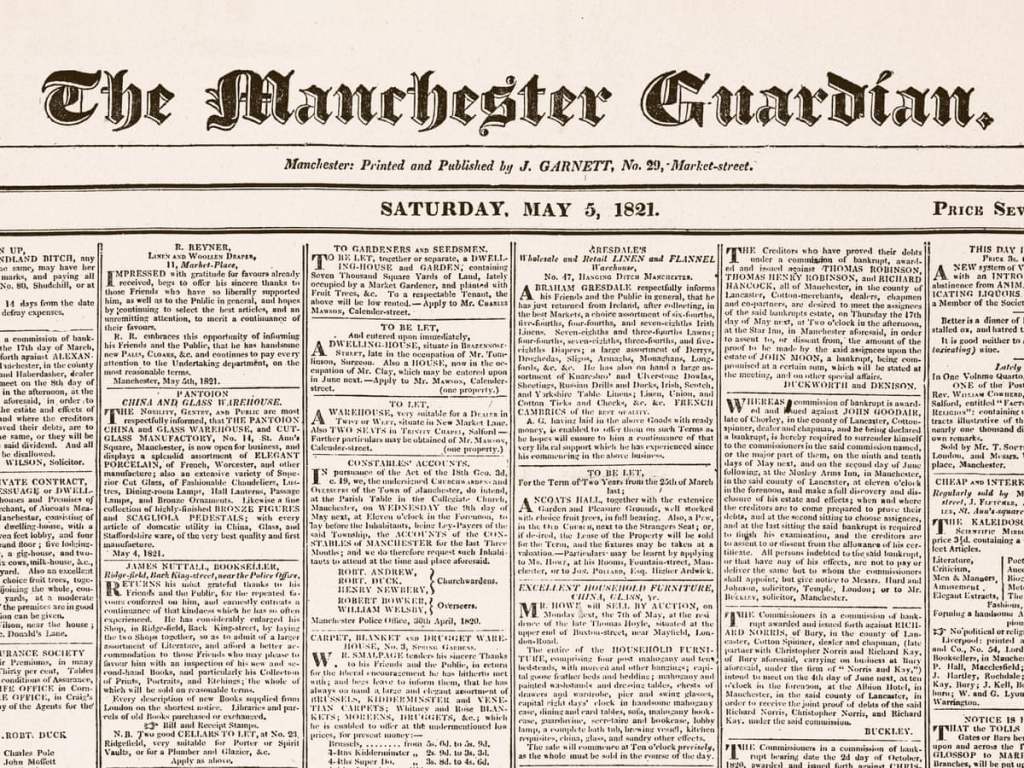
Throughout the 19th century the editor’s job was not exactly mind-stretching. Reports came in from far-of places, or just around a specific locality, and were typeset in 7pt (that is very small type) then run into the newspaper columns until the story ran out or the space ran out.

All this often appeared within the pages as the front page was given over to small advertisements: these would cover auctions; properties to let; public notices; share prices; even market prices for vegetables.

The first edition of the Manchester Guardian front page in 1821

Things changed in the 20th century when newspaper editors, and owners, realised that, rather than lengthy slabs of foreign news, or council reports, or other lengthy articles, the readers wanted more news items and stories and better direction to the content they wanted to read.

The editors could not handle alone the vast quantity of material that thus came in from reporters: the news reports; the crime reports; the foreign reports; the political reports.

This is why, in the early 20th century, a new role was created – a barrier between the reporters and the editor – if the editor was God then this new creation (the sub-editor) was Lucifer, or at least it seemed that way to the reporters.

Now, instead of copy going to the editor, it was the sub-editor (or on bigger newspapers the chief sub and his crew of devils) who decided which copy was fit to go through, which could be allowed through after some tidying up and which got spiked.

In fact the sub-editor was brought in to take a load off the editor’s shoulders and allowing him (not many women in the role at this point) to concentrate on the overall design of the newspaper and the most important stories.

The devilish reputation of the sub-editor came about when reporters felt their stories had been cut back too much; had been spiked; or had been rewritten to the extent that the reporter did not recognise the story as his or her own. Not that they dared speak out because after the EDITOR the sub’s word was law.

In fact rewriting a story was the last thing most subs wanted to do as it took greater time to do that than to just tidy up and check facts and grammar. If a sub rewrote a story then it was either the only way to save it (sign of a good sub) or the sub felt he or she could write a better version (not the sign of a good sub).

I was initiated into the dark arts of subbing in that glorious summer of 1973 when Tony Blandford, the editor, set me to work initially with the paper’s single sub one day a week to learn the ropes (although we had studied subbing on the NCTJ courses) and then gave me a general round-up page People in Close-up on a Wednesday, rather than the whole day I was allowed the afternoon for that, having to have cleared any stories on my notebook from the morning.

As most of my time was spent reporting at this stage I did not consider myself even a part-time sub at this stage. My love of editing and design was to come later, much later.

TO COME: what differentiates the sub from the reporter when it comes to words.

To An Absent Lover

by Helen Hunt Jackson

That so much change should come when thou dost go,
Is mystery that I cannot ravel quite.
The very house seems dark as when the light
Of lamps goes out. Each wonted thing doth grow
So altered, that I wander to and fro
Bewildered by the most familiar sight,
And feel like one who rouses in the night
From dream of ecstasy, and cannot know
At first if he be sleeping or awake.
My foolish heart so foolish for thy sake,
Hath grown, dear one!
Teach me to be more wise.
I blush for all my foolishness doth lack;
I fear to seem a coward in thine eyes.
Teach me, dear one, - but first thou must come back!
 

The Miner

by Henrik Ibsen

translated by Fydell Edmund Garrett
Beetling rock, with roar and smoke
Break before my hammer-stroke!
Deeper I must thrust and lower
Till I hear the ring of ore.

From the mountain's unplumbed night,
Deep amid the gold-veins bright,
Diamonds lure me, rubies beckon,
Treasure-hoard that none may reckon.

There is peace within the deep -
Peace and immemorial sleep;
Heavy hammer, burst as bidden,
To the heart-nook of the hidden!

Once I, too, as a careless lad,
Under starry heavens was glad,
Trod the primrose paths of summer,
Child-like knew not care nor cummer.

But I lost the sense of light
In the poring womb of night;
Woodland songs when earth rejoiced her,
Breathed not down my hollow cloister.

Fondly did I cry, when first
Into the dark place I burst:
"Answer spirits of the middle
Earth, my life's unending riddle!--"

Still the spirits of the deep
Unrevealed their answers keep;
Still no beam from out the gloomy
Cavern rises to illume me.

Have I erred? Does this way lead
Not to clarity indeed?
If above I seek to find it,
By the glare my eyes are blinded.

Downward, then, the depths are best;
There is immemorial rest.
Heavy hammer burst as bidden
To the heart-nook of the hidden!--

Hammer-blow on hammer-blow
Till the lamp of life is low,
Not a ray of hope's forewarning;
Not a glimmer of the morning.

Twice Shy

by Seamus Heaney

Her scarf a la Bardot,
In suede flats for the walk,
She came with me one evening
For air and friendly talk.
We crossed the quiet river,
Took the embankment walk.

Traffic holding its breath,
Sky a tense diaphragm:
Dusk hung like a backcloth
That shook where a swan swam,
Tremulous as a hawk
Hanging deadly, calm.

A vacuum of need
Collapsed each hunting heart
But tremulously we held
As hawk and prey apart,
Preserved classic decorum,
Deployed our talk with art.

Our Juvenilia
Had taught us both to wait,
Not to publish feeling
And regret it all too late -
Mushroom loves already,
Had puffed and burst in hate.

So, chary and excited,
As a thrush linked on a hawk,
We thrilled to the March twilight
With nervous childish talk:
Still waters running deep
Along the embankment walk.