Up in court on my first day in this Brave New Town

The bustling concrete jungle known as Basildon

At 8.30am on Monday, 9th October, 1972, I entered a Brave New World – Basildon.

Although that comparison to Aldous Huxley’s sci-fi classic would cast me in the role of the Savage whereas I felt I was the explorer in a concrete jungle.

The drive from Burnham-on-Crouch, where I was living in a rented caravan for two weeks, allowed me to see the gradual change from rural Essex to the urbanisation and mid-century Brutal architecture.

By the time I reached the centre of Basildon New Town I found myself longing for the company of others as I took on the role of Welsh journalist/explorer Henry Morton Stanley seeking Dr Livingstone.

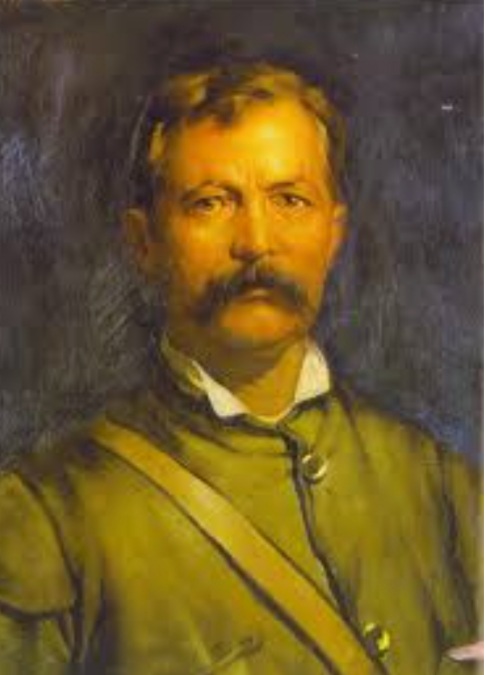
Henry Morton Stanley
Dr David Livingstone

I drove into the car park which lay behind Southernhay and positioned my car opposite the back door of the Recorder office.

Within minutes I saw a bearded figure heading for the back door and was 99 per cent certain I had seen him in the editorial room when I came for my interview.

I got out of the car, locked the door and followed him in.

The door opened onto a corridor with a kitchen to the right and what were probably toilets to the left. Ahead was an open door and I went in to the editorial room where I was to be working for the foreseeable future.

As I entered the man I had followed in turned and, with a smile on his face, said: “Ah Robin isn’t it? Welcome to Basildon and the Standard Recorder. I’m Barry Brennan the deputy editor. Tony won’t be in for a while, he’s at head office.”

After shaking my hand he introduced me to others in the office: Bobs Hurley, a slim, clean-shaven man in his 30s, the chief reporter; John Howard, a short bearded man, senior reporter; Peter Biscoe, about my age, slightly heavier in build, reporter; a man whose name I cannot remember to this day (even though he was to get me into trouble with my future wife and her friends), sub-editor; and a gray-haired woman, Elizabeth, who worked part-time and whose husband had been the staff photographer who had died a year or two before.

With introductions made I was shown my desk, an old-fashioned wooden table-size desk with two drawers to the right hand side, on it was an old sit-up-and-beg typewriter, a cream-coloured phone, and a wire filing basket.

It was in a corner which put my back to the partition between editorial and reception and had me facing across the other desks to where Bobs sat at his own desk keeping an eye on the reporters.

Barry showed me the stationery cupboard filled with all the paraphanalia a good journalist needed: notebooks, pens and pencils, copy paper, carbon paper, typewriter ribbons, paper clips and staplers and staples.

I was shown the kitchen which had all the makings for tea and coffee and the spare mugs for general use; the toilets, opposite, and the darkroom. I was told I would meet the photographer later.

After the general introduction Bobs gave me my first of many assignments – a trip over to Billericay to cover the local court.

Bobs told me there were two courts running that morning, a regular court and a juvenile, both starting at 10 and both having good cases running.

“You’ll meet Julian Barnes from the Billericay office there. He’ll cover the main court and you can deal with the juveniles. It’s alleged some young lads beat up a man and left him at the side of the road.

“Julian can fill you in on the magistrates, court officials etc. He’s a good lad and I’m sure you’ll get on.”

Driving from Basildon to Billericay was a reversal of the morning journey, taking me from the concrete jungle back to genteel civilisation in a proper little market town.

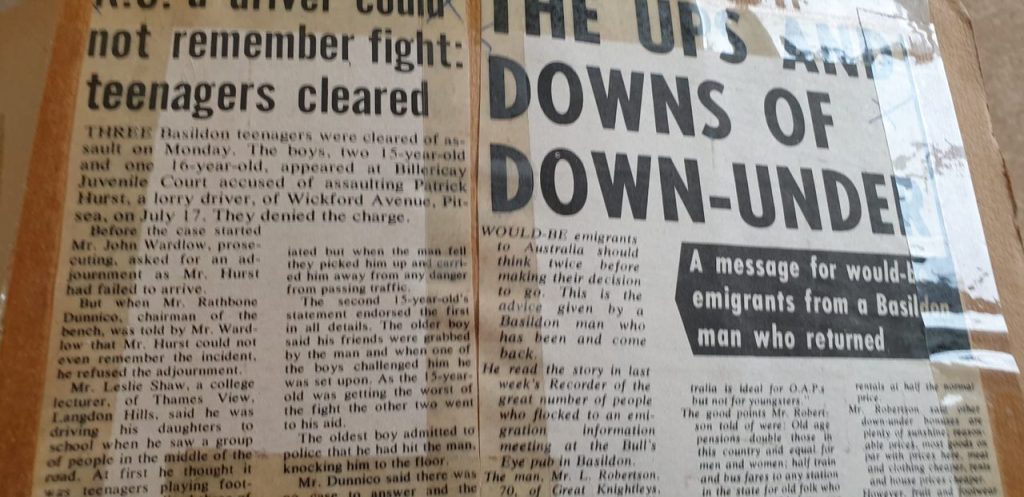
The juvenile court was straight forward and it turned out the lads before the court were more victim than aggressor.

Rather than setting on the man one of their number had actually been grabbed by the man, a lorry driver, and hit. Seeing their friend being beaten they went to his aid and eventually chased him off.

Also they had not dumped him at the side of the road, as claimed by a late-arriving witness, they had picked him up when he fell and took him to safety at the side of the road.

The “victim” failed to turn up at court and the magistrates were told he had no recollection of what had happened.

The magistrates decided there was no case to answer against the boys, two aged 15 and one 16, and the case was dismissed.

During that week I did the emergency rounds – police, fire and ambulance; sorted out and wrote up recollections of older townsfolk from the war (including the rector and his family who were unscathed when the rectory was hit by a bomb); wrote up my fist story on the battle between older residents and the Basildon Corporation over compulsory purchase orders; interviewed a businessman who had been dumping rubbish bags at the council offices because thy hadn’t put up proper signs to the tip and people were dumping rubbish in his boatyard; and even interviewed a 70-year-old man who had recently returned from Australia, where he had lived for five years, and said it wasn’t as good as it was cracked up to be (the previous week the paper had reported on the large number of people who had turned up at a meeting about emigration).

It was a good and varied first week in my new job but as I read the paper that Friday and checked off my contributions little did I know what would soon be coming my way.

A fine weekend in the country

Though I say it myself my memory is quite good, short-term and long-term.

The long-term memory, in particular, is normally excellent, even down to what I wore on a particular day.

There is one foggy area, however, and that deals with the weekend from Friday, 6 October, 1972, up to 8.30am on Monday, 9 0ctober, 1972.

I do know that at lunchtime on the Friday my colleagues at the Rhyl Journal took me to the nearby White Swan (affectionately known as The Dirty Duck) for a farewell drink.

The White Swan in Rhyl – a retreat for journalists

That evening was spent at the Rhyl Yacht Club where I had spent some happy times during the 60s and early 70s.

On the Saturday morning I spent time with friends and family before setting off for adventures new with my car packed full of cases, bedding and personal items.

This is where part of the fogginess occurs.

Over the decades I have had many cars – Morris Minor, Austin Cambridge, at least one Toyota, a Datsun, Volvos, couple of Meganes, even a Rover and a Chevrolet – but I cannot for the life of me remember the car which carried me off to a new life.

All I can remember is that it was a red hatchback with decent heating and a radio cassette player.

I took a cross country course towards Essex, intending to take my time and enjoy the drive.

I stopped overnight at a village pub (no point arriving on Saturday if the caravan wasn’t available), and to this day still cannot remember its name or the name of the village.

I was up with the lark after a refreshing night’s sleep and soon got back on the road for the final leg of my journey to a new life.

Even in October Burnham-on-Crouch was a pretty place and I soon found the home of the caravan and cottage owner.

The caravan was on a piece of land with three others next to the cottage which I would move into two weeks later.

It was better than the basic 1950s caravan I had expected although not quite up to the mark of a mobile home. The stove was on bottled gas and the caravan had been linked to the electricity. Quite cosy all round.

It didn’t take long to settle in, I didn’t have much with me and I intended going home for Christmas when I could fetch more stuff.

I popped into the local pub and had a traditional Sunday roast before heading back to the caravan for a nap.

Next morning I treated myself to a hearty breakfast and then headed for Basildon.

My new life had begun.

Rubaiyat of Omar Khayyam XXI-XL

by Omar Khayyam

translated by Edward Fitzgerald
XXI.
And this delightful Herb whose tender Green
Fledges the River's Lip on which we lean -
Ah, lean upon lightly! for who knows
From what once lovely Lip it springs unseen!

XXII.
Ah, my Beloved, fill the Cup that clears
To-day of past Regrets and future Fears -
To-morrow? - Why, To-morrow I may be
Myself with Yesterday's Sev'n Thousand Years.

XXIII.
Lo! some we loved, the loveliest and best
That Time and Fate of all their Vintage prest,
Have drunk their Cup a Round or two before,
And one by one crept silently to Rest.

XXIV.
And we, that now make merry in the Room
They left, and Summer dresses in new Bloom,
Ourselves must we beneath the Couch of Earth
Descend, ourselves to make a Couch - for Whom?

XXV.
Ah, make the most of what we may yet spend,
Before we too into the Dust descend;
Dust into Dust, and under Dust, to lie;
Sans Wine, sans Song, sans Singer, and - sans End!

XXVI.
Alike to those for who To-day prepare,
And those that after some To-morrow stare,
A Muezzin from the Tower of Darkness cries
'Fools! Your Reward is neither Here nor There!'

XXVII.
Why, all the Saints and Sages who discuss'd
Of the Two Worlds so learnedly, are thrust
Like foolish Prophets forth; their Works to Scorn
Are scatter'd, and their Mouths are stopt with Dust.

XXVIII.
Oh, come with old Khayyam, and leave the Wise
To talk; One thing is certain, that Life flies;
One thing is certain, and the Rest is Lies;
The Flower that once has blown forever dies.

XXIX.
Myself when Young did easily frequent
Doctor and Saint, and heard great Argument
About it and about; but evermore
Came out by the same Door as in I went.

XXX.
With them the Seed of Wisdom did I sow,
And with my own hand labour'd it to grow;
And this was all the Harvest that I reap'd -
'I came like Water and like Wind I go.

XXXI.
Into this Universe, and Why not knowing,
Nor Whence, like Water willy-nilly flowing;
And out of it, as Wind along the Waste,
I know not Whither, willy-nilly blowing.

XXXII.
Up from Earth's Centre through the Seventh Gate
I rose, and on the Throne of Saturn sate,
And many Knots unravel'd by the Road;
But not the Master-Knot of Human Fate.

XXXIII.
There was the door to which I found no Key:
There was the Veil through which I could not see:
Some little talk awhile of Me and Thee
There was - and then no more of Thee and Me.

XXXIV.
Then to the rolling Heav'n itself I cried,
Asking, 'What Lamp had Destiny to guide
Her little Children stumbling in the Dark?'
And - 'A blind Understanding!' Heav'n replied.

XXXV.
Then to the Lip of this poor earthen Urn
I lean'd, the secret Well of Life to learn:
And Lip to Lip it murmur'd - 'While you live,
Drink! - for, once dead, you never shall return.'

XXXVI.
I think the Vessel, that with fugitive
Articulation answer'd, once did live,
And merry-make, and the cold Lip I kiss'd,
How many Kisses might it take - and give!

XXXVII.
For in the Market-place, one Dusk of Day,
I watch'd the Potter thumping his wet Clay:
And with it's all obliterated Tongue
It murmur'd - 'Gently, Brother, gently, pray!'

XXXVIII.
And has not such a Story from of Old
Down Man's successive generations roll'd
Of such a clod of saturated Earth
Cast by the Maker into Human mould?

XXXIX.
Ah, fill the Cup:- what boots it to repeat
How Time is slipping underneath our Feet:
Unborn To-morrow, and dead Yesterday,
Why fret about them if To-day be sweet?

XL.
A Moment's Halt - a momentary taste
Of Being from the Well amid the Waste -
And Lo! The phantom Caravan has reach'd
The Nothing it set out from - Oh, make haste!


Time to take flight to the Lost Lands

Once I had got my breath back, following the phone call which set me on a new path, I realised I had a lot to do and just four weeks to get it done.

I got the call on Friday, 8 September and I was due to start on Monday, 9 October.

In between I had to give in my notice, continue working and find accommodation in reasonable reach of Basildon.

The first task was easy. I just had to go over to the office and let Brian know. I could sort out a formal letter of resignation over the weekend.

Other than finding accommodation there was not much else to do.

Which meant my work would continue as normal.

As well as copies of the Recorder Tony Blandford had given me two editions of the Southend Evening Echo which was also part of the Westminster Group.

Over the weekend I went over the small ads looking for anything suitable, even a B&B would have done, but could find nothing.

Eventually I was given a number by one estate agent for a holiday let company with a couple of cottages in – BURNHAM-ON-CROUCH.

Burnham-on-Crouch Hgh Street – unchanged for decades

By this time I was getting desperate, I had less than two weeks to find somewhere to live, and decided to try this last hope.

I knew a little bit about the town as it was a hotspot for sailing including small boats such as our family GP. The trouble is it was over 20 miles from Basildon and would be a good half-hour travelling via B roads to get to work, and the same to get back at night.

The woman who answered said they did do holiday lets and would be happy to rent out a small cottage at a reduced out-of-season rate for six months.

Sounded reasonable as Tony had said it could take a few months to sort out the corporation accommodation.

Unfortunately there was a problem. “Just a slight problem,” said the charming lady.

Th cottage wouldn’t be available until Sunday, 22 October.

My heart sank at the prospect of having to start my search all over again, but then that charming voice, which would have suited an angel, broke in: “We do have a caravan which is available from Sunday, 8 October. You could use that for two weeks until the cottage is available.”

A miracle. After all two weeks in a caravan couldn’t be that bad, even in October.

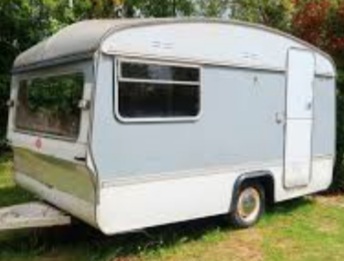
A simple little caravan like this would be OK for two weeks.
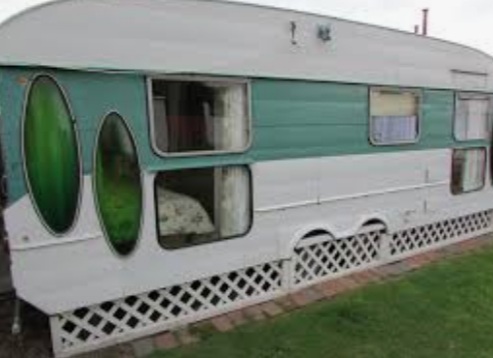
Although one like this would be better.

I sealed the deal then and there and said I would post a cheque as deposit and would see her on 8 October.

What a relief.

With everything settled I was able to relax and concentrate on my last couple of weeks working in my beloved North Wales before setting out to England – or Lloegr as it was once called, a reference to the Lost Lands stolen by the English more than a thousand years ago.

Looking ahead the only way is Essex

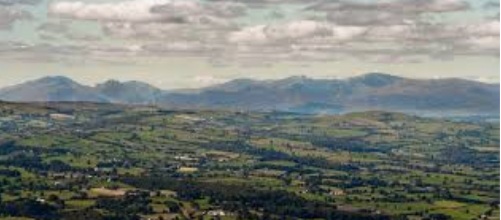
Snowdonia viewed from the Vale of Clwyd: This was the “back garden” I grew up in for 17 years.

Despite finding my desire to travel to foreign lands effectively blocked, I still had itchy feet and wanted to break out of my little bubble and see, at least, a new part of this country we call the United Kingdom.

Despite the myth that all journalists yearned to work on Fleet Street (a real street in London at that time but they all.moved out) for one of the daily newspapers, this had never been a great attraction to me.

Maybe if I had been brought up in London I might have got a job as a copy boy on one of the dailies and made my mark.

I lived far from the Street, in glorious North Wales, and got my grounding in journalism with reporters who were part of their community.

I kept an eye on the jobs section of the UK Press Gazette which, although a young publication (launched in 1965), was becoming a staple of the industry.

It wasn’t long before I spotted a tempting ad for a local paper in Essex seeking a newly-qualified senior reporter with NCTJ.

What made it especially interesting was that it was part of the Westminster Group which was a well-established group with roots in regional journalism.

The ad was for a weekly newspaper, with links to an evening newspaper, based in one of the still-growing new towns in Essex – Basildon.

I sent off my details, CV with accompanying letter, on the Saturday morning, and then just waited for a reply, which arrived the following Friday.

The letter was from the editor of the Basildon Standard Recorder, Tony Blandford, and invited me to come down for an interview on the following Thursday.

My editor, Brian Barratt, knew I was applying for jobs and as soon as I mentioned the interview he said I could have the day off and take the Friday as well as it would be a long day.

I telephoned the number on the letter and spoke to Mr Blandford’s secretary, confirming that I would be at the interview on Thurrsday.

On the Saturday I went out to get a new suit at Hepworths – it was there or Burton’s and my brother-in-law happened to work at Hepworths.

My current suit was a few years old – I’d had it long before I wore it to my brother’s wedding in 1969 – and I’d already set my mind on a new one.

I was torn between two of a similar style but in different colours. One was a sort of greyish-green with a fine stripe and the other in a medium-brown with a fine stripe.

In the end my brother-in-law suggested I get both and could have a third one free (I didn’t realise that his commission was so good that he would still be making some even with the three for two deal).

I took the three, the third was grey with a paler stripe. All were single-breasted, two-piece suits.

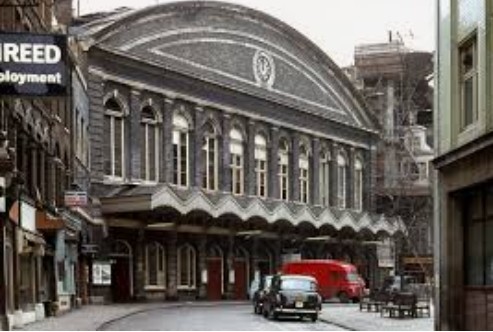
Fenchurch Street railway station: My gateway to the future

On the Thursday morning I took an early train from Rhyl and got to Euston in good time to get over to Fenchurch Street station to get a train to Pitsea station. There was no train station at Basildon itself.

I was wearing the brown suit with a lemon yellow shirt, a pure woollen green tie with a red dragon central motif (still got it) and brown Chelsea boots. Very smart.

As we neared Basildon I had the windows of my compartment open to get fresh air (well I had been smoking heavily) and flicked a cigarette end out only for it to be blown back in, catching on my trouser leg and leaving an unsightly burn.

Tragedy.

It was about 12.30. I had to get to Basildon town centre from Pitsea station, find out where the office was, have a bite of lunch and be cool and calm for my interview at 2pm.

On top of that I had to make myself presentable.

The first part was easy.

I got a taxi and asked to be taken to Basildon town centre.

The route took us through streets of houses all looking very much the same and all obviously post war.

It was quarter to one when I was dropped off at one end of the town centre (as it turned out the opposite end to where the newspaper office was located).

Locating the office would be easy and lunch could wait. My priority was to get the hole in my trousers fixed.

I was wearing a double-breasted car coat, three-quarters the length of a normal overcoat, so it covered the hole while I had it on but I would need to take it off in the office.

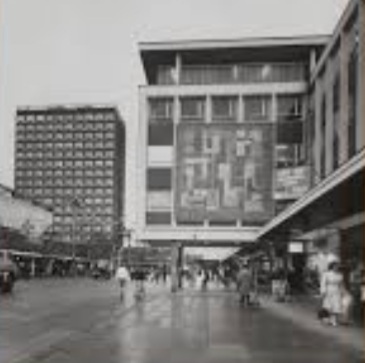
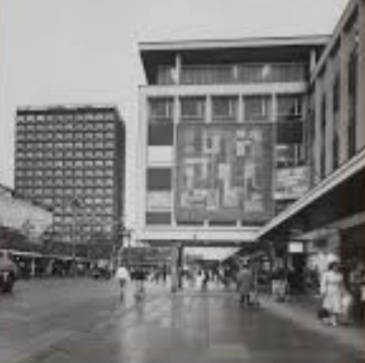
Basildon Town Centre 1972: A wide pedestrian area with plenty of light and a wide range of shops.

Where I stood gave me a good view down the central pedestrian area of Basildon with large stores on either side including, I was glad to see, a Woolworth store.

This was a store with promise and was certain to have a haberdashery counter where I could get needle and thread.

Having selected a thread that reasonably matched the suit colour, and a packet of sewing needles, I went off to find a suitable public convenience where I would have the privacy to do some running repairs.

I must admit this gave me one more good impression of the new town as the premises were clean and fresh and the cubicles also tidy.

A few minutes later I was all set for a public appearance. The thread was a reasonable match and would be almost invisible at a few feet away.

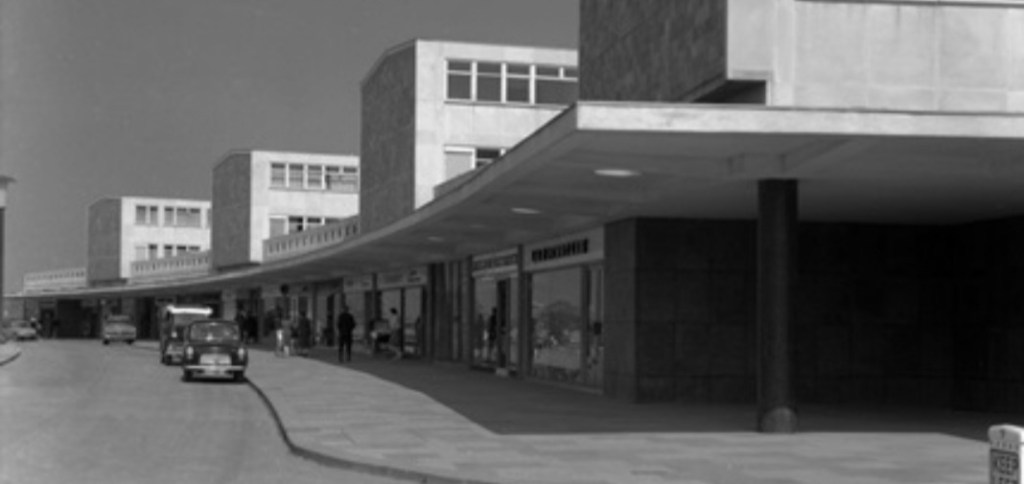
Finding the office was easy, it was set half way along a parade of smaller shops, including a gentlemen’s tailor, a betting shop, a newsagent and, fortunately, a small cafe where I was able to get a ham roll and a cup of coffee.

Southernhey, Basildon: A row of shops destined to be my new base on the next leg of my journalistic journey.

A few minutes before 2pm I paid for my lunch, having left a tip on the table, and headed for the Recorder office.

It was the standard front office seen at newspaper premises throughout the land, I would see many more in my lifetime. A friendly receptionist asked me to wait a moment while she checked to see if Mr Blandford was in his office.

When she came back to show me through it was bang on 2pm.

The editor’s office was an area partitioned off from what was clearly the editorial department. There were about eight desks, four with typewriters and telephones on them, but only three desks were occupied.

The editor’s office was roughly seven feet wide and 10 to 12 feet long. About four feet from the door at one end was a desk across the width, with enough space to one side to let someone pass.

As I entered the bearded man behind the desk stood up and extended his hand across the desk.

“You’ll be Robin, of course,” he said. “I’m Tony Blandford.”

I had my coat over my right arm and shifted it to the left as we shook hands – I was still conscious of the repair job on my trousers.

He indicated for me to sit and I laid my coat across my lap.

All this gave me time to assess the man before the interview began.

I already knew, by first sight, he was under six foot. He was in his shirt sleeves and looked slim and wiry, with a full head of dark hair and a full, but neatly-trimmed, beard and moustache to match.

At this time I still found it hard to judge a person’s age if they were over 30 and could only surmise that he was in his 30s.

As I took all this in he spoke.

“Well now, this is a very good CV you have provided and I see you have had a lot of experience in a relatively short space of time.

“Why do you want to join this newspaper?”

I had prepared myself well and Brian Barratt had also chatted with his editorial friends around the country so I had a good idea of what to say.

As it happened the majority was based on my feelings about what I wanted to be as a journalist – serving the community and providing them with news and information they could rely on.

I think I did most of the talking in that interview and before I realised it Tony was saying: “Well that sounds excellent. Now, tell me, if you were to be offered the job when would you be able to start?”

I had this one cracked because I had discussed it with Brian.

“Four weeks from the next Monday after I was offered the job. If I was offered it today then I could start four weeks on Monday.”

“Very good. I’ll be in touch, probably tomorrow, to let you know my decision.”

That was it.

I said thanks and told him I would be available on my home phone number as I had a day off on the Friday.

We shook hands and then I was on my way out.

The office now had six or seven people busy at the desks. Some looked up as I passed through and then I was outside and it was 3pm.

I went back to the cafe and had a cup of tea while I glanced through copies of the paper that Tony had given me.

I then headed back across the pedestrian centre to a taxi rank and was driven back to Pitsea station.

By 9pm I was home again. I had stopped off at a chippie on the way from the station and sat at the kitchen table having a late dinner while my parents bombarded me with the questions.

Despite the heavy day of travelling I felt too hyped up to sleep well that night.

The following morning I couldn’t settle and probably read the same page of my book three times without realising.

Because our phone was also used for the shop it would have been silly to jump up every time it rang – but I did.

Then, at 11am, the phone rang and I heard my father say: “I’ll just get him.”

I was there in a second and almost tore the phone out of my father’s hand.

“Hello,” I said.

“Good morning Robin. Tony here. I was very impressed by your knowledge and enthusiasm and I believe you would make an ideal addition to our editorial team.

“I think you said you would be able to start four weeks on Monday, that’s still OK?”

“Oh yes, definitely. I mean to say that’s fine.”

“Good. I’ll be sending you a letter today with the formal offer and all relevant information and pay will be based on the basic for a senior reporter with a review after three months. Oh, did I discuss accommodation at the interview yesterday?”

“No. I thought I’d have to find something and hoped you might send details of letting agents.”

“Right, well there’s good news and bad news. As you know the town still has the original Basildon Corporation handling a lot of the property rentals for local young people and those coming to the area to work.

“You would qualify for housing but not immediately. It could be up to six months before anything suitable is available. There will definitely be something for you.”

With that we closed the conversation after agreeing that we would see each other the following month.

I turned to my father and said: “I’ve got it, I’ve actually got it.”

The future lay wide open.

Not innocent but certainly naive

My father, Sergeant Dispenser David Pierce RAMC, who taught me consideration for others.

Looking back on my life I realise how naive I really was aged 22. I do mean naive because I certainly was not an innocent.

My naivety was more a lack of information on issues that maybe I should have been more aware of.

I had a lucky escape over South Africa because if I had gone out there I would have seen first hand how the white supremacist government treated the non-white citizens. At that stage I would have protested vociferously and would probably have spent time incarcerated in a South African prison (one for whites only of course).

Although there had been a growing anti-apartheid movement in this country since the early 50s it did not really make much of an impression in North Wales.

A lot of the reporting was based on demonstrations against South African sports teams visiting this country and vice versa.

At the time this would have been covered in the sports pages and, apart from rugby, sport did not really concern me at that time.

If it had been an issue over musicians boycotting SA, as happened in the late 1970s and the 80s (think Paul Simon and Graceland), I might have taken it more seriously.

As it was my views on people, whether black, white, yellow or brown, were mainly based on my father who saw everyone as equal.

When he talked about his wartime experiences in the RAMC, part of which included time on troop ships going from Dublin up the east coast of Africa, he talked about “the soldiers” or if he was talking about African troops then he did not say “African” but used their country as a form of differentiating between them.

Thus he talked about English, Senegalese, Kenyans, Sudanese or South Africans when talking about troops from that region.

He had a lot of time for these coloured troops and I never heard him use the term “black” or “nigger” or any of the other derogatory terms used to denigrate people who are not white.

He did not call himself a socialist and, as far as I am aware, he was never a member of any political party, yet his beliefs, which he demonstrated in his way of life and his attitude to others, made its mark on me and has remained with me ever since.

At this point my knowledge of Africa was mainly gleaned from books and stories by people such as H Rider Haggard.

His stories mainly covered the latter years of the 19th century and the pre-war years of the 20th century.

Many were based on his character Alan Quatermain who was a mixture of HM Stanley and the great white hunters of that era.

Quatermain was what would then be called “a good egg”. He treated native Africans, especially Zulus, as “noble savages” and would often side with them against the colonial government and the Boers.

Even to this day I am torn when watching Zulu between supporting Stanley Baker, Ivor Emmanuel and the South Wales Borderers (actually the 2nd Warwickshire) or the Zulus who just wanted these people out of their country.

I normally sing along with Ivor and Co. to the martial sounds of Men of Harlech but still have admiration for those men who ran towards the Briish lines wearing very little and carrying cattle-hide shields and a short stabbing assegai.

My reading of Haggard not only introduced me to Africa but also to that part of North Africa which has bewitched so many of us – Egypt.

After all Ayesha – or She* as the character is commonly known – was said to have been an Egptian princess who stepped into the Fountain of Youth and was condemned to live for eternity leaving her beloved behind as he would not face the dangers of the Fountain with her.

*Ayesha has come down to us as “She Must be Obeyed”, especially when Rumpole of the Bailey talks about his wife.

Having enjoyed so many adventure stories as I was growing up in North Wales I was about to start my own adventure by leaving home and heading for a foreign land – Essex.

The Rubaiyat of Omar Khayyam

by Omar Khayyam

1048-1131

trans. by Edward Fitzgerald 1859

I.
Awake! for Morning in the Bowl of Night
Has flung the Stone that puts the Stars to flight:
And Lo! the Hunter of the East has caught
The Sultan's Turret in a Noose of Light.

II.
Dreaming when Dawn's Left Hand was in the Sky
I heard a voice within the Tavern cry,
'Awake, my Little ones, and fill the Cup
Before Life's Liquor in its Cup be dry.'

III.
And, as the Cock crew, those who stood before
The Tavern shouted - 'Open then the Door!
You know how little while we have to stay,
And, once departed, may return no more.'

IV.
Now the New Year reviving old Desires,
The thoughtful Soul to Solitude retires,
Where the White Hand of Moses on the Bough
Puts out, and Jesus from the Ground suspires.

V.
Iram indeed is gone with all its Rose,
And Jamshyd's Sev'n-ring'd Cup where no-one Knows;
But still the Vine her ancient ruby yields,
And still a Garden by the Water blows.

VI.
And David's Lips are lock't; but in divine
High piping Pehlevi, with 'Wine! Wine! Wine!
Red Wine! - the Nightingale cries to the Rose
That yellow Cheek of hers to incardine.

VII.
Come, fill the Cup, and in the Fire of Spring
The Winter Garment of Repentance fling:
The Bird of Time has but a little way
To fly - and Lo! the Bird is on the Wing.

VIII.
Whether at Naishapur or Babylon,
Whether the Cup with sweet or bitter run,
The Wine of Life keeps oozing drop by drop,
The Leaves of Life keep falling one by one.

IX.
Morning a thousand Roses brings, you say;
Yes, but where leaves the Rose of Yesterday?
And this first summer month that brings the Rose
Shall take Jamshyd and Kaikobad away.

X.
But come with old Khayyam, and leave the Lot
Of Kaikobad and Kaikhosru forgot:
Let Rustum lay about him as he will,
Or Hatim Tai cry Supper - heed them not.

XI.
With me along the strip of Herbage strown
That just divides the desert from the sown,
Where name of Slave and Sultan is forgot -
And peace is Mahmud on his Golden Throne!

XII.
A Book of Verses underneath the Bough,
A Jug of Wine, a Loaf of Bread, - and Thou
Beside me singing in the Wilderness -
Oh, Wilderness were Paradise now!

XIII.
Some for the Glories of This World; and some
Sigh for the Prophet's Paradise to come;
Ah, take the Cash, and let the Promise go,
Nor heed the rumble of a distant Drum!

XIV.
Were it not Folly, Spider-like to spin
The Thread of present Life away to win -
What? for ourselves, who know not if we shall
Breathe out the very Breath we now breathe in!

XV.
Look to the Rose that blows about us - 'Lo,
Laughing,' she says, 'into the World I blow: 
At once the silken of my Purse
Tear, and its Treasure in the Garden throw.'

XVI.
The Worldly Hope men set their hearts upon
Turns Ashes - or it prospers; and anon,
Like Snow upon the Desert's dusty Face
Lighting a little Hour or two is gone.

XVII.
And those who husband the Golden Grain,
And those who flung it to the Winds like Rain,
Alike to no such aureate Earth are turn'd
As, buried once, Men want dug up again.

XVIII.
Think, in this batter'd Caravanserai
Whose Doorways are alternate Night and Day,
How Sultan after Sultan with his Pomp
Abode his Hour or two and went his way.

XIX.
They say the Lion and the Lizard keep
The Courts where Jamshyd gloried and drank deep:
And Bahram, that great Hunter - the Wild Ass
Stamps o'er his Head, but cannot break his Sleep.

XX.
I sometime think that never blows so red
The Rose as where some buried Caesar bled;
That every Hyacinth  the Garden wears
Dropt in its Lap from some once lovely head.

Never mind the boots – these feet were made for walking

I have said before that my musical tastes are eclectic – they range from Donovan to Debussy and Beautiful South to Beethoven.

Claude Debussy

In my teens I enjoyed the hits of the day and believe the 60s was one of the best decades ever for young people. It did not stop me also enjoying the sounds of Glenn Miller and that jazz wonder woman Billie Holiday.

Billie Holiday

One particular musical style that had me hooked in the 60s was country music, also known as country and western and not to be confused with folk music.

The “outlaw country” sound also had an appeal with so much of it based on travelling while longing for home; and on those born under a Wand’ring Star; or those who have the hankering to roam but never quite get round to doing anything about.

Outlaw country was rooted in blues and rockabilly music, and earned the “outlaw” tag with songs about the bad boys (and girls) who roamed the west, always one step ahead of the law.

It was said to have originated in the 1970s but that was just when they stuck a label on it.

Willie Nelson was an exponent of it in the 60s but at that time was better known for his songwriting than his singing.

Johnny Cash – Man in Black

Johnny Cash was the “Man in Black” and he was singing about prisons and lonesome cowboys in the 50s and 60s (even though, despite his reputation, he never spent more than one night in prison).

Both of them (along with Kris Kristofferson) joined up with Waylon Jennings (the man who gave up his seat on the flight which ended with the death of Buddy Holly and the Big Bopper) as The Highwaymen.

You may wonder where all this is leading – a discussion on country v classic or jazz v folk? No, this is taking me back to 1972 when I decided I needed a change after the best part of two decades in Rhyl.

My feet were starting to itch and I wanted to leave the nest and make my own way in the world.

In all those years I had never been more than ten days away from home at any one time. Only twice had I even been out of the country and, apart from Sunday trips to vist family in Liverpool, rarely even left Wales.

It was not that I didn’t enjoy working with my journalistic colleagues; or did not have a great social life; and I certainly loved my family.

I just needed to have a look on the other side of the fence.

The point is when I get an idea in my head I don’t just think of a small change – I think big.

Which is why not long after my 22nd birthday I was reading up on South Africa.

In fact not just reading (this was long before the worldwide web) but also writing off to the South African embassy for information and copies of their newspapers.

A 1970s South Africa advertising poster

South Africa was not chosen on a whim – two of my Liverpool cousins had gone to live out there and seemed to be getting on fine.

I studied the newspapers for style but also for the advertisements to get an idea of living costs out there.

Rather than saying I would get the equivalent of £XXX out there I checked out the prices of foodstuffs and general household products to work out how many hours or part thereof you would have to work to buy, for instance, a loaf of bread.

After all it is not much point in saying the pay is three times what you earn here if bread was four times the price of the UK equivalent.

After a month of research I had decided that it was worth taking a punt on emigration and I wrote to the embassy asking how I should go about applying for a job on a newspaper.

The fact that my politics leaned to the left and South Africa was a borderline fascist apartheid state did not seem like a problem. After all journalists knew how to out personal feelings aside when presenting a fair and unbiased report.

Oh boy was I naive.

It took over four weeks for the embassy to reply.

The letter was quite long and initially seemed quite positive until I realised the sender was couching the response in diplomatic language.

The reality of 1972 apartheid South Africa

What it amounted to was:

NO CHANCE.

In hindsight it was a lucky escape.

I decided to put this rejection behind me and rein in the distance I might be prepared to travel for a new job.

I found the UK Press Gazette (launched in the year I stated my first job in journalism) offered a decent range of jobs in the UK for young journalists seeking a job.

PS before the 70s were over both my cousins had moved to Auatralia.

NEXT TIME: My first real job interview.

The Travelling Post Office

by Banjo Paterson

1864-1941
The roving breezes come and go, the reed-beds sweep and sway,
The sleepy river murmers low, and loiters on its way,
It is the land of lots o' time along the Castlereagh.

The old man's son had left the farm, he found it full and slow,
He drifted to the great North-west, where all the rovers go,
"He's gone so long," the old man said, "he's dropped right out of mind
But if you'd write a line to him I'd take it very kind;
He's shearing here and fencing there, a kind of waif and stray -
He's driving now with Conroy's wheel along the Castlereagh.

"The sheep are travelling for the grass, and travelling very slow;
They may be at Mundaroon now or past the Overflow,
Or tramping down the black-soil flats across by Waddiwong;
But all those little country towns would send the letter wrong.
The mailman, if he's extra tired, would pass them in his sleep;
It's safest to address the note to 'Care of Conroy's sheep',
For five and twenty thousand head can scarcely go astray,
You write to 'Care of Conroy's sheep along the Castlereagh',"

By rock and ridge and riverside the western mail has gone
Across the great Blue Mountain Range to take the letter on.
A moment on the topmost grade, while open fire-doors glare,
She pauses like a living thing to breathe the mountain air,
Then launches down the other side across the plains away
To bear that note to "Conroy's sheep along the Castlereagh,"

And now by coach and mail man's bag it goes from town to town,
And Conroy's Gap and Conroy's Creek have marked it "Further down."
Beneath a sky of deepest blue, where never cloud abides,
A speck upon the waste of plain the lonely mail-man rides.
Where fierce hot winds have set the pine and myall boughs asweep.
He hails the shearers passing by for news of Conroy's sheep.
By big lagoons where wildfowl play and crested pigeons flock,
By camp-fires where the drivers ride around their restless stock,
And pass the teamster toiling down to fetch the wool away
My letter chases Conroy's sheep along the Castlereagh.

Ten years between tasty tipples

I don’t drink much alcohol these days, not that I was an inveterate boozer getting plastered every night even in my heyday.

I do know I never drank just for the sake of drinking, or to keep up with the crowd.

I also did not drink just anything on the basis that it was alcoholic.

I have never been a fan of gin, rum or whiskey but offer me a good vodka (not an oily one please) and I will be your friend for life.

Over the years I developed a taste for good wine, especially good red wine.

Maybe my taste for an ordinary white was spoiled for me by my introduction to it.

I was about 11, it was either while I was still at primary school or just after I started at the grammar school.

Dad’s brother sent him a special bottle of wine from a case of six, given to him by his father-in-law, as a Christmas present. It was a sweet white and therefore seemed appropriate as a pudding wine for Christmas Day.

I can still remember that first sip, it was sweet and fruity but still had a crisp aftertaste.

The wine was a pre-war Chateau d’Yquem and it was to be a decade before I would taste such sweet nectar again.

In between I tried beer (not really my scene); lager (much better than flat, warm beer); Chianti, Sauternes, Blue Nun; even Mateus Rosé.

Then towards the end of ’71 my editor, Brian Barratt, asked if I’d like to take his place on a press trip to London.

British Rail (as it was then) and Grand Metropolitan Hotels had got together to offer three-day package trips to London, staying at top quality hotels and dining out at some of the finest restaurants.

I didn’t have to think twice.

I joined the group at Rhyl and other journalists from North Wales were already on board – in a first class carriage of course.

Including our host and some partners, there were about 15 of us all together.

Our guide on this trip (a “freebie” as it was classed in journalistic jargon) told us that this was the last press trip of his financial year – it was September – and he had to spend the last of his budget otherwise it would be reduced the following year.

I think he knew a gang of journalists would ensure every penny was spent.

At this time Grand Met was a large company with a number of fine hotels and restaurants in London including the Mayfair Hotel (which was to feature in my life a few years later).

The Mayfair was our base and after leaving our luggage at the hotel we were whisked off to a restaurant in Half Moon Street where we dined and drank to our hearts’ content.

To show that this was a “working trip” and not just a “jolly for journos” we spent the afternoon being shown the workings of two of the hotels with visits behind the scenes including the kitchens and laundries.

That evening it was time for another big dining session, this time at an upmarket “Beachcomber Bar”.

After all the meals had been ordered our PR host asked four of us to pick out a wine and he would then order it.

I was no wine expert but I was one of those asked.

Two others both chose red wines of which he ordered three of each (most had professed a liking for red), another choice was a decent white and then I spotted it on the last – that magic name:

CHATEUA D’YQUEM.

I didn’t look at the price or check the year – if they bottle it with the Chateau label then it is a good vintage*.

Our host still just glanced at the list and ordered two of the other white and two d’Yquem.

Although it is a sweet wine I kidded myself that you really needed a white with gammon (I had ordered steak at the previous meal so had chosen grilled gammon this time round.

I think I polished off one bottle of the exceptional wine myself, a couple of others had also professed an interest. Most were on red, however, and our host ordered at least another six bottles to satisfy them.

The evening was rounded off with coffee and liqueurs.

To my mind it was the best evening of our stay and surprisingly the majority of the group were down for a hearty breakfast the next day.

Day two involved a tour of London sights with a professional guide, including a drop-off for a hearty lunch, and a roistering good evening at another GMH premises.

The last day was a morning questioning some of the team behind the London trip plans followed by a slap-up lunch at the Mayfair Hotel restaurant.

Most of the party had a good post-lunch nap on the train home, although some of us were still up to afternoon tea in the first-class dining car.

That trip remains etched in my mind half a century later and I have never tasted a better white wine since, which is why I concentrated on good reds after that.

*Any chateau-bottled Chateau d’Yquem is considered to be a good vintage.

Exceptional vintage years are labelled as such.

If a crop does not meet the high standards of the Chateau it is bottled under a different label as a table wine.

If you ever find out about one of these anonymous vintages then snap it up because a Chateau d’Yquem “reject” is still way ahead of most other labels.