Perhaps I was born kneeling,
born coughing on the long winter,
born expecting the kiss of mercy,
born with a passion for quickness
and yet, as things progressed,
I learned early about the stockade
or taken out, the fume of the enema.
By two or three I learned not to kneel,
not to expect, to plant my fires underground
where none but the dolls, perfect and awful,
could be whispered to or laid down to die.

Now that I have written many words,
and let out so many loves, for so many,
and been altogether what I always was --
a woman of excess, of zeal and greed,
I find the effort useless,
do I not look in the mirror, these days,
and see a drunken rat avert her eyes?
Do I not feel the hunger so acutely
that I would rather die than look
into its face?
I kneel once more,
in case mercy should come
in the nick of time.
I have been all men known to history,
Wondering at the world and at time passing;
I have seen evil, and light blessing
Innocent love under a spring sky.

I have been Merlin wandering in the woods
Of a far country, where the winds waken
Unnatural voices, my mind broken
By a sudden acquaintance with man's rage.

I have been Glyn Dwr set in the vast night,
Scanning the skies for the propitious omen,
A leader of men, yet cursed by the crazed woman
Mourning their dead under the same stars.

I have been Goronwy, forced from my own land
To taste the bitterness of the salt ocean;
I have known exile and a wild passion
Of longing changing to a cold ache.

King, beggar and fool, I have been all by turns,
Knowing the body's sweetness, the mind's treason;
Taliesin still, I show you a new world, risen,
Stubborn with beauty, out of the heart's need.
I wonder how many of us are aware of laws that affect our everyday lives and could get us into serious trouble, bearing in mind that ignorance of the law is no defence.
As of today (21 March 2022) it has become illegal in Wales for parents (or anyone acting in loco parentis) to smack or otherwise physically assault their children.
I was quite surprised because I thought this had become law in the United Kingdom some years ago. It turns out that Scotland brought this law in two years ago but England and Northern Ireland still allow smacking if it is considered to be “reasonable punishment”.
The Facebook post that brought the smacking rules to my attention*
Pictured above is the Facebook posting that brought the matter to my attention – and as I commented I was surprised because I thought it was a UK ruling.
When I checked up on it I discovered that it is just that Wales has adopted this stance as of today and that Scotland adopted it two years ago.
I was not only surprised – I was shocked. Shocked by the attitude of the person who posted it: “what nonsense!”
Now I may not have been the best dad in the world when I was in my 20s and there might have been a smack now and again, but I soon realised there are better ways to get children to behave.
The FB post was in a group aimed at people who grew up in the 1960s and I was expecting a lot of my peers would jump to defend the children and very speedily the responses came rolling in:
“never harmed me and we got the slipper at school”
“Bloody ridiculous.”
“I was brought up with belt and birch . . . made us tough as nails”
“I got smacked and it made me learn respect”
“World gone mad!”
“A quick wrist slap or back of legs never did mine any harm!”
“Chaos awaits”
These are some of the milder comments. I was amazed to find out how many people in this country still believe that a child should be smacked or slapped for being naughty.
The most common response, and the one that really had me concerned about ongoing violence, was that old adage: “My parents did it to me and I learned respect. I taught my children in the same way.”
My father and mother were wonderful people and taught us to respect others and to keep an eye out for those in need of care and protection. Neither of them gave us even an admonitory tap on the hand let alone the *posterior.
The response when I mentioned this was: “Well aren’t you a goody two shoes.”
My answer? “No.”
I was then asked if I had a silver spoon and again my response was: “No.”
Technically that was a lie because we have three silver spoons but they came from my wife’s family and I knew what the question really mount – born, mouth, silver spoon.
There were also those who talked about having the cane or slipper or belt when they were at school. Here I was on firmer ground because I knew what that felt like.
As I have mentioned before I was caned by the headmaster of my school in the 1960s and my response to my FB interrogator was: “I was caned at school and it made me more rebellious. It did not give me respect for the headmaster – it just increased my belief that he was an arrogant sadist. Six thwacks is not appropriate for not having my uniform cap at school.”
Within four hours of the original posting there were about 300 responses and the vast majority were against the ban.
I was especially surprised at the number of women who trotted out the old adage about “spare the rod and spoil the child”. I wonder what their attitude would be to husbands being allowed to beat their wives. It was not forbidden by law until well into the 20th century.
In the late 1800s it was considered acceptable for a man to beat his wife provided the stick or rod used was no thicker than his thumb.
In the early 1900s new laws were brought into force stating that a man could not beat his wife except during the hours from 7 am to 10 pm. This was not to protect women, it was to ensure others had a peaceful night’s sleep without being kept awake by the cries of wives being beaten.
In fact it was not until the 1970s when women got together and started their campaign about domestic abuse and general abuse with their Reclaim the Night marches and the opening of the first women’s refuge.
Considering this I was amazed at the number of women supporting the physical punishment of children.
It is only in the last 20 years or so that we have realised what happens to children in their formative years can cause problems in later years. Not all victims of child abuse fall into the sexual abuse category.
If these people really believe physical punishment makes children respect their elders then they are much mistaken. It teaches them to fear their elders and eventually they may seek revenge.
Drink to me, only with thine eyes,
And I will pledge with mine;
Or leave a kiss within the cup,
And I'll not look for wine.
The thirst that from the soul doth rise,
Doth ask a drink divine:
But might I if Jove's nectar sup,
I would not change for thine.

I sent thee late a rosy wreath,
Not so much honoring thee,
As giving it a hope, that there
It could not wither'd be.
But thou thereon didst only breathe,
And sent'st it back to me:
Since when it grows, and smells, I swear,
Not of itself, but thee.
A free bird leaps
on the back of the wind
and floats downstream
till the current ends
and dips his wing
in the orange sun rays
and dares to claim the sky.

But a bird that stalks
down his narrow cage
can seldom see through
his bars of rage
his wings are clipped
and his feet are tied
so he opens his throat to sing.

The caged bird sings
with a fearful trill
of things unknown
but longed for still
and his tune is heard
on the distant hill
for the caged bird
sings of freedom.

The free bird thinks of another breeze
and the trade winds soft through the sighing trees
and the fat worms waiting on a dawn-bright lawn
and he names the sky his own.

But a caged bird stands on the grave of dreams
his shadow shouts on a nightmare scream
his wings are clipped and his feet are tied
so he opens his throat to sing.

The caged bird sings
with a fearful trill
of things unknown
but longed for still
and his tune is heard
on the distant hill
for the caged bird
sings of freedom.
Over 450 years after the Romans left Britons to fend for themselves the people they left behind had gone West (no, I don’t mean they were all dead, they had literally gone into the West) and the Jutes, Angles, Saxons, Danes and other assorted “visitors” had taken over most of the area that is now known as England.
Alfred the Great (the one who burned the cakes) had finally pushed the Danes back into the small area of Danelaw and by 886 had finally become King of the Anglo Saxons.
Things went reasonably well while Alfred was in charge and on his death in 899. His son Edward then ruled for about 25 years to be succeeded by his son Aethelstan who styled himself King of England.
The reigns of the next few kings of England were often quite short and for some time it was brother succeeding brother (sometimes half-brother).
On the death of Aethelstan the north of England fell back into Viking hands but the dead king’s brother Edmund succeeded him in 939 and took the north back. He died young in 946 and his sons were considered too young to take over so his brother Eadred ruled for nine years. As he was unmarried he was succeeded by King Edmund’s son Eadwig who was 16 when he was crowned and a “bit of lad”. He was allegedly prised out of his bed on coronation day, taken from the arms of a “strumpet”. . . and her mother/.
He was dead by the age of 20 (causes unknown) and was succeeded by his younger brother Edgar who appears to have been less of a roisterer than his brother and who reigned for 16 years.
After his coronation he took an army north to Chester and met with “six kings of Britain” including the King of Scots, King of Strathclyde and princes of Welsh districts. They are alleged to have sworn allegiance to him by rowing him in his state barge across the River Dee.
I have a sneaking suspicion that if this was true then the Scots and Welsh would probably have dumped him into the water as the tide was going out and he would have been swept out to sea.
Still, the story made his successors happy.
Edgar’s eldest son Edward succeeded his father after 16 years. He was just 12 and there was a dispute about succession with followers of his much younger half-brother, Aethelred. Civil war was looming and then Edward was murdered and his step-mother claimed the throne for her boy.
At the age of 10 Aethelred didn’t really seem ready to rule – a problem highlighted by the fact that less than three years after becoming king he fled to Normandy as the Danes led by Sweyn Forkbeard invaded following the massacre of a large number of Danish settler.
Forkbeard was acclaimed as king following Aethelred’s departure but died five weeks later and the young English king returned but spent the remaining few years of his reign battling with Sweyn Forkbeard’s son Cnut.
When he died he was succeeded by Edmund (known as Ironside) who did a deal with Cnut by splitting the kingdom between them. Edmund got Wessex and Cnut got the rest.
The deal was that when one died the other would become King of England.
Soon afterwards Edmund died (what a surprise) and Cnut ruled England for almost 20 years. He also married Emma of Normandy, the widow of Aethelred.
There’s that Normandy cropping up again.
Cnut was succeeded in 1035 by his bastard son Harold the Harefoot (apparently he was a speedy and skilled hunter) when he stole the throne while his half-brother Harthacnut was busy fighting to save his Danish kingdom.
Harold ruled for five years and then died just as his brother Harthacnut was heading for England with a large invasion fleet.
Harthacnut was the last Danish king of England and had told his mother, Emma of Normandy, that her son by her first husband, Aethelred, would be king. The young Edward was allowed to return from exile in Normandy.
Within two years Harthacnut died and Edward (known as Edward the Confessor) became king, returning the Royal House of Wessex line to the throne of England.
So everybody was happy. The Vikings had mostly gone home, Edward ruled England and the Anglo-Saxons were top dog once more.
Well, not everybody was happy, but we’ll look at that next time.
Samson, grinding bread for widows and orphans,
Forgets he is wronged, and the answers
The Philistines wrangled out of him go back
Into the lion. The bitter and the sweet marry.
He himself wronged the lion. Now the wheat
Caresses the wind with its wifely tail; the donkey
Runs in the long grass; and having glimpsed heaven,
The fox's body saunters the tawny earth.

2
After death the soul returns to drinking milk
And honey in its sparse home. Broken lintels
Rejoin the sunshine gates, and bees sing
In the sour meat. Once more in the cradle his
Hair grows long and golden; Delilah's scissors
Turn back into two tiny and playful swords.
Samson, no longer haunted by sunset and shadows,
Sinks down in the eastern ocean and is born.
A little cloud swims to the sun,
With all her crimson borders trailing,
And beckons to the sun to sleep
And covers it with rosy veiling,
Cradled in the dark blue sea,
As a mother lulls her child ...
Lovely to the eyes ... And now
It seems the heart is still,
For one little hour of rest,
With God speaks quietly ...
Like an enemy, the mist
Falls upon the sea
And the little rosy cloud,
Darkness in its wake
The grey mist rolls and billows out,
And the silent dark
Throws its shroud upon the soul,
And you don't know where to wander,
Longing, longing for the light,
Like small children for their mother.
Up and lead the dance of Fate!
Lift the song that mortals hate!
Tell what rights are ours on earth,
Over all of human birth.
Swift of foot to avenge are we!
He whose hands are clean and pure,
Naught our wrath to dread hath he;
Calm his cloudless days endure.
But the man that seeks to hide
Like him, his gore-bedewèd hands,
Witnesses to them that died,
The blood avengers at his side,
The Furies' troop forever stands.

O'er our victim come begin!
Come the incantation sing,
Frantic all and maddening,
To the heart a brand of fire,
The Furies' hymn,
That which claims the senses dim,
Tuneless to the gentle lyre,
Withering the soul within.

The pride of all of human birth,
All glorious in the eye of day,
Dishonored slowly melts away,
Trod down and trampled to the earth,
Whene'er our dark-stole troop advances,
Whene'er our feet lead on the dismal dances.

For light our footsteps are,
And perfect is our might,
Awful remembrances of guilt and crime,
Implacable to mortal prayer,
Far from the gods, unhonored, and heaven's light,
We hold our voiceless dwellings dread,
All unapproached by living or by dead.

What mortal feels not awe,
Nor trembles at our name,
Feeling our fate-appointed power sublime,
Fixed by the eternal law.
For old our office, and our fame,
Might never yet of its due honors fail,
Though 'neath the earth our realm in unsunned regions pale.
A Sunday drive in late summer from North Wales to Dorset, in a 1950s green Morris Minor, is one of the most relaxing journeys I can think of. Well I found it relaxing on that sunny day in 1974.
It was just as well that I have always found driving myself from A to B to be more relaxing than being driven, or travelling by train or bus.
I was turning my back on a profession I had followed for nine years and starting a a new adventure in which I would be in a new town every Sunday for the next six months.
I arrived at Harry Corbett’s home in Child Okeford, not far from Blandford Forum, in the late afternoon and as I drew in to the large yard behind the house I could see Lawrence waiting to greet me, standing alongside a deep blue three-ton Luton van with The Sooty Show painted in bright yellow on the sides and the rear and images of Sooty on both sides alon%%%%with varying sized stars.
Not a vehicle designed to go unnoticed.
As I got out Lawrence came over, welcomed me and told me that Tobes had told him to bring me straight into the house for a cup of tea.
That was when I first discovered that Harry’s wife, Marjorie, who was also the voice and operator of Soo, was known as Tobes (as in Toby jug) to family and friends. I gather it was a name given to her by her sons, Matthew (actual name Peter) and David, when they were children.
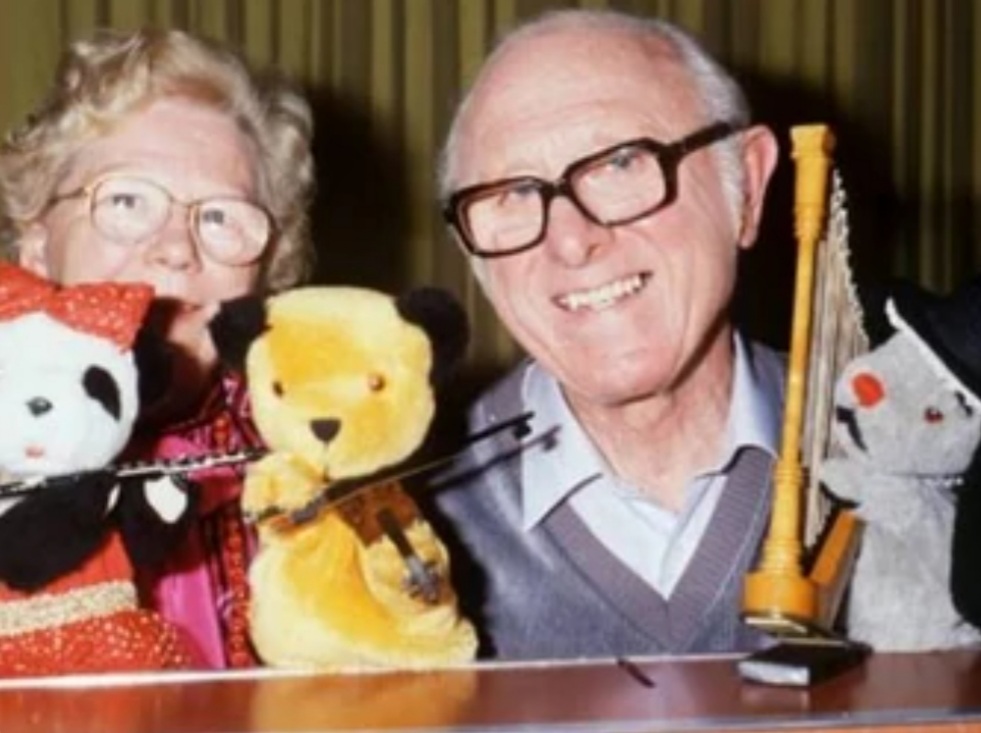
Harry Corbett with his wife Marjorie (known as Tobes) and their puppet family, Soo, Sooty and Sweep
Tobes greeted me as though I was a member of the family she hadn’t seen for a while and gave me a great big motherly hug. She told me to sit down while she brewed the tea and as she handed me a mug Harry came in and also gave me a friendly greeting.
We ate with Harry and Tobes that first night and then, tired from the drive, I retired to my bed in the caravan which Lawrence and I would be sharing for the tour.
When I woke the following morning at about 7.30 I had to think first as to where I was. My bed was at the dining end of the caravan and the table dropped down between the two seats to form a double bed. The cupboard door folded out to create a partition.
The other end was a sort of U-shaped seating area (a bit more squared off) and a part similar to the table slotted in to create another double bed.
Over the next few months those remained as beds for the tour and it gave Lawrence and myself our privacy.
After breakfast that first day I was shown around the set store and the workshop and soon realised how efficiently organised everything was.
There were three main sets which were about ten feet wide, but folded down for easy storage on the truck. I know there was a kitchen scene because Sooty baked a pie and I had to make sure the “dough” was ready in place.
Then there was the finale set which was a water garden in which Sooty produced a water fountain from his wand, Sweep’s head, Harry’s finger if I remember rightly, and various other props on the set including a potted plant.
Again this was an unseen role for me as I kept my head down behind the set, made sure the water tank was full, and ensured there was the right water pressure when Sooty “magically” switched the fountain to the other objects.
I think the other big set was a Haunted House. This sequence did not involve me as much as the water feature and I had my role as soundman to keep me occupied (same as with the kitchen scene).
In the fourth Sooty sequence we had a set which consisted of black drapes and a low piece of set at the front, cut to look like rocks or waves and painted in bright colours.
The colours were really bright because they were fluorescent and the whole scene was done with UV lighting. It was an Arabian nights setting and included the magical appearance of a genie.
The genie was controlled by the guest on the Sooty Show Tour, an escapologist called Howard (I don’t remember his surname) who joined us to rehearse his UV role a day or so before the first performance.
I went on a steep learning curve during the fortnight we were at Child Okeford and my first lesson involved providing Sweep’s voice.
Lawrence operated Sweep during the tour and required an “instrument” called a swazzle to make sure he got the right note for Sweep’s squeaks. If you listen you will realise it is like the Clangers and you can actually make out what was being said.
I used to make 20 swazzles a day at the beginning because each one had to be at exactly the right pitch and Lawrence would try them out. The ones that failed to pass the test were junked. Later in the tour I could make a few swazzles at the beginning of each week and one would last the week.
Each day was busy, preparing the sets; making sure all the lighting rigs worked; that the sound system was functioning properly; all the stage drapes were clean and folded neatly for storage on the Sooty van.
That was something else we practised during that fortnight – loading and unloading the van. Everything had to be placed in exactly the right position so that unloading was easier for ensuring the right things went in first.
I’ll give you an idea of how full that van was at a later date and you might be surprised about what we got into it.
I know at the end of the first day I was more worn out than I had been at any time in my journalistic career.
When we knocked off for the day Lawrence and I went to the nearby pub for a well-earned drink or two.
It was a fascinating little pub, really just the front room of a cottage. The serving hatch was in the back wall and the place was run by a little old lady who looked as though she had been there since the year Dot.
There were seats in the tap room with tables and there were benches outside as well to take advantage of the last of the summer weather.
One thing I did find out was that at 10pm the old lady went to bed and trusted regulars to draw their own pints, leave the correct money and turn everything off and lock the door when they left.
As far as I am aware nobody took advantage of this honesty system.

 Robin's Nest