Hostile takeover

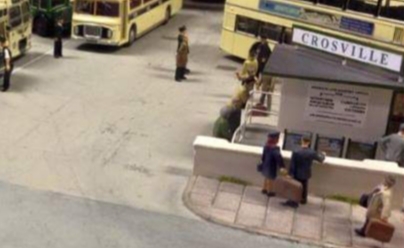
The Crosville coach station in Crescent Road. I used to sit on the wall while waiting for coaches to arrive.

I was doing quite well with my sources of income as the summer went on. I had my paper round, which I had got down to a fine art, and the casing was bringing in money.

All was fine and dandy. Holidaymakers always arrived on a Saturday morning and by 1pm business slackened off which meant I had the afternoon to see friends and just enjoy the summer.

That is until one fateful day in July, 1962.

Other young casers and myself were awaiting the first coach when we saw a newcomer arrive.

He was older than any of us and strongly built and was pushing a rickety pram chassis with a few boards laid across it. I had seen better carts consigned to the tip.

Somehow I knew this lad was trouble. Maybe my newsman’s nose for trouble was giving itself a trial run (even though I didn’t know myself that was the path that lay ahead).

I took in every detail of his build, his hair, his face and the clothes he wore.

The years have blurred the details but they were imprinted on my mind at the time.

He stopped and left his “cart” before walking right up to me. I was the tallest one there other than him and maybe he thought I was in charge. That was rubbish as each of us was there for their own benefit.

He stopped less than six inches from me and said: “Bugger off this is my patch.”

Now you thought I might have learned a lesson from when I was approached by a bully at school. I still trusted in the power of words.

“There’s plenty of business for all. Anyone who wants to come here is welcome.”

“You’re not. This is my patch.”

As he stopped talking I saw his arm was raised and a dirty fist was heading towards my nose.

I didn’t have time to take any action before he hit me smack on the nose and I fell back over my truck and ended sprawled on the ground with my nose feeling as though I had walked into a solid brick wall.

As I lay there I thought he was going to kick me but instead he jumped on my truck, then jumped off, kicked it over and proceeded to kick it in a bid to smash it.

Mr Massey had made a good job of the woodwork but my assailant still managed to break off the leg of the truck and bend one of the wheels.

As I got up he stood menacingly over me and said: “Bugger off.”

I appropriately buggered off, dragging my poor truck behind me, with blood pouring from my nose and reached our back gate in moments.

Once inside, and having bolted the gate behind me, I dropped the wreckage of my cart and went into the house to be greeted by my horrified mother.

As I tried to explain what had happened she got me into the bathroom, sat me on the edge of the bath and used a flannel and cold water to staunch the flow and hopefully clean up my face.

My father had been informed and had immediately phoned the police station, which was at the end of our road. Ten minutes later there was a burly police sergeant in the shop.

We sat in my father’s office while the sergeant asked me to tell him what happened. As I described my assailant and repeated our “conversation” a knowing look came into his eyes.

He got up and said to my father: “I reckon I know who did this. Will you let me deal with it?”

There must have been a general agreement between the police and local people at that time to let the police “deal with it”.

Some years later I discovered the name of my assailant. I also got to know his reputation.

I do remember the policeman laughing to my father about “casing wars”.

That incident ended my income from casing. I am not a coward but, like my father, I know when an action is futile and it comes down to commonsense.

Mr Massey had offered to repair the truck but I knew I would never use it again.

It didn’t stop my search for sources of income, however, and I came up with a good one.

What did some holidaymakers and a lot of daytrippers lack in those days? A camera.

My brother and I had both got a Coronet Flashmaster camera but Nigel had graduated to an Ilford Sportmaster 35mm camera with a good leather case.

His Flashmaster was now redundant. That gave me an idea.

The Coronet Flashmaster – a camera that used 120 roll film which produced square images.

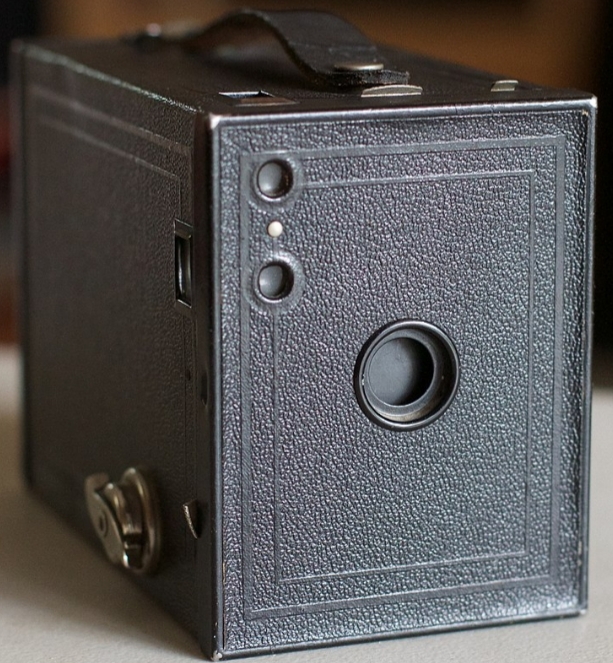
Amidst the old stock Dad took over with the shop were two old Box Brownie cameras, not much different to the old homemade pinhole cameras.

A Box Brownie. A basic camera also using 120 roll film.

I was about to enter the film industry. No, not as a photographer. I intended to fill a niche in the holiday trade. I would hire out cameras.

If any holidaymaker had forgotten their camera or couldn’t afford one they could hire one of “mine”.

Half-a- crown a day or 10 bob for the week with a 10-bob deposit. That was 12.5p and 50p in modern money. The cameras themselves were only worth 10 bob each but most holidaymakers would rather have that deposit money back than a camera they might never use again.

It was also a win-win situation for my father’s business as they would have to buy a roll of film from the shop.

Maybe this was why Dad was willing to deal with the customers himself, or at least via his shop assistant, Karen.

That business did well and it also benefited another local business – the firm that picked up used films from my father’s shop, developed and printed them, then returned them to us within 24 hours for the customer to collect.

Obviously daily hire was better for business but daily or weekly it still offered a good income and nobody was likely to make a hostile takeover bid.

Next time: An actor’s life for me.

Earning my pocket money

The Beatles played more than once in Rhyl in the early 60s but they influenced us throughout that decade.

The Beatles came into my father’s shop once, or at least one or two of them did. They had done a gig the previous night and had brought in a film to be developed and printed.

The point is that at that stage my father wouldn’t have known one of them from another so to this day I still don’t know which of them brought the film in and who collected it that afternoon before they played another gig in the evening.

At that time they were still an up and coming band and any of us with the slightest link to Liverpool claimed ownership.

My awarenss of the Beatles came at the same time as my awareness of money and what it could do for you – buy 45s for a start.

Just like the Beatles I had a mixed attitude to money. Remember one moment they were telling us that money “can’t buy me love” and the next it was “give me money – that’s what I want.”

Until 1960/61 I didn’t really bother much about money. My parents gave me pocket money which would buy me sweets at the tuck shop and other bits and bobs.

Things like presents for my mum and dad at birthdays or Christmas were often purchased by one parent for me to give to the other.

Now I was beginning to realise if I wanted anything more I would need to find a way of getting the money to pay for it.

My first move, as many another youngster had done before me, was to look for a job I could do that didn’t affect my school hours – at that time that usually meant getting a job with the milkman or getting a paper round.

I chose the paper round.

Just down Crescent Road, not far from our house, was a street called Abbey Street and this is where Mr and Mrs Cork ran a newsagents.

My need of money came at just the right time because that same week the Corks were recruiting and they recruited me to start the following week on a Monday. Fortunately it was a half-term break and I didn’t have to go to school after my round.

I was up good and early and down at the shop by 6am. Other boys (no girls at that shop) were already loading their bags and heading out.

Mr Cork gave me a list of names and addresses with newspaper names against them and then presented me with a pile of papers and a bag to sling over my shoulder and sent me off.

Three hours later I was back at the shop with an empty bag. I had cycled up and over the H bridge to start my round on the far side. Fortunately I had my list of addresses and the newspapers were sorted in order. It was just a matter of finding the right houses and then finding the letterbox.

Some were high, some were low and a few were in the middle. Almost all of them were fitted with a spring which made the snap of the flap a gamble with my fingers.

After three days I had halved the time of my round and still finished in good time despite having to mark up my own papers from day two.

Then came the end of the week when comics were published and the bag got heavier.

I coped.

My next obstacle came on Sunday when the newspapers got twice as thick and some people decided to have an extra paper.

At least I was getting paid.

By the time the summer came I really thought a bit of extra cash would come in handy and the answer lay over the road to our house.

The Crescent Road Crosville bus and coach station.

The coach and bus station was directly over the road. On Saturdays throughout the summer coachfuls of holidaymakers would disgorge at this spot and I could help them – at a price. I could walk out of our back gate and be at work. All I needed was a couple of wheels and some wood.

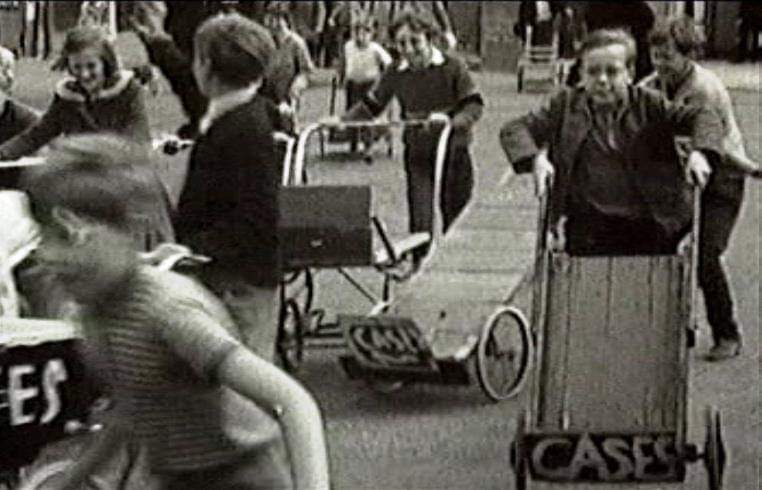
As many others growing up in Rhyl at that time will realise I am talking about the noble trade of casing.

Youngsters swarming to Rhyl railway station in the 60s offering to carry holidaymakers’ cases to their digs

The man who rented the flat from us was a handy man with a saw and a screwdriver. He knocked me up the Rolls Royce of casing trucks. It had two large rubber-tyred wheels. The flat body was made from an old door with an end piece to stop cases falling off and it had a metal tubular handle. The truck was painted bright green and the handle was glossy black.

On the first Saturday I took up my station at the bus depot I was the envy of the other six or seven youngsters who waited for the first coach of customers.

Most casing truck owners waited for their victims – sorry clients -at the railway station which meant more trade for fewer casers at our site.

As the holidaymakers stepped down from the coach we rushed forward. “Carry your case sir?”

I knew that some of these people would be heading for holiday camps. One was quite close but still a trek long enough to mean you would miss the next coach.

I don’t know if I had a knack of spotting those booked in to local B&Bs but in most cases I managed to get a short trip at a basic rate.

If they named a place too far away I would just state an exorbitant fee. If they agreed then at least the trip was well recompensed. Most times they turned me down and I picked up a quick trip to John Street, Butterton Road or even to the big places on West Parade at a sensible rate.

Sometimes a trip would be so short that I could get back and still find people from that first coach trying to get directions.

Start at 9am and by 1 o’clock I had a pocketful of cash and could take the afternoon off. After all I didn’t want to be too tired for my paper round and horse riding the next day.

Things were looking good.

Next time: Down to earth with a bang and a bloody nose.

I must go down to the sea again

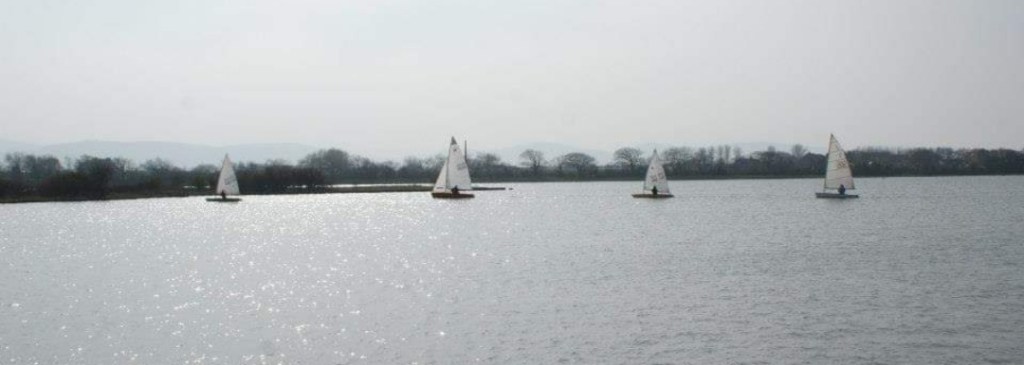
Not actually the sea but boats from Rhyl Yacht Club sailing on the Marine Lake at Rhyl.

I distinctly remember when the wide, wet, salty sea and I became acquainted. It was a May day in 1955 and the Pierce family had arrived in Rhyl.

I was five years old and would probably have got in the way of the men carrying our goods and chattels into the house.

My mother decided to take me to the beach. A concept I didn’t fully understand because I had been raised far from the sea (and North Wales) in the market town of Chesham in Buckinghamshire.

My brother and sister may well have joined us but I was mainly aware that my mother was taking me to see a wondrous thing called the beach, beyond which lay an even more exciting concept – the sea.

It literally took us five minutes to walk from our new home in Water Street, onto the promenade, past the massive domed structure I later discovered was called the Pavilion, and down the steps to the beach.

I took off my sandals and socks and wriggled my toes in the sand. It felt good.

Then my mother took me to the water’s edge where small wavelets were getting closer all the time. Just as well the tide was in and not long gone.

As I stood there I felt the wavelets wash over my feet and I knew that I loved this salty, wet, foamy water which had now passed beyond me and was heading further up the beach.

I knew I wanted to immerse myself in the sea, go under the surface, and travel across it.

All that was still in the future as at this stage I could not swim.

I don’t remember exactly when my parents bought a boat and joined the Rhyl Yacht Club, based at the Foryd Harbour, but I believe it was around 1960 when I was 10.

By now I could swim.

As a pharmacist my father tended to know the local doctors and through them the wider circle of “professional people” including other medical people (even dentists); accountants; teachers; lawyers and others.

In fact the first customer in my father’s chemist shop was Dr Peter Anderson who became a firm family friend. His wife Jane, also a doctor, was a keen sailor and I think she must have persuaded my mother to crew for her and led to the family purchase of a 14-foot sailing dinghy – a Jewel.

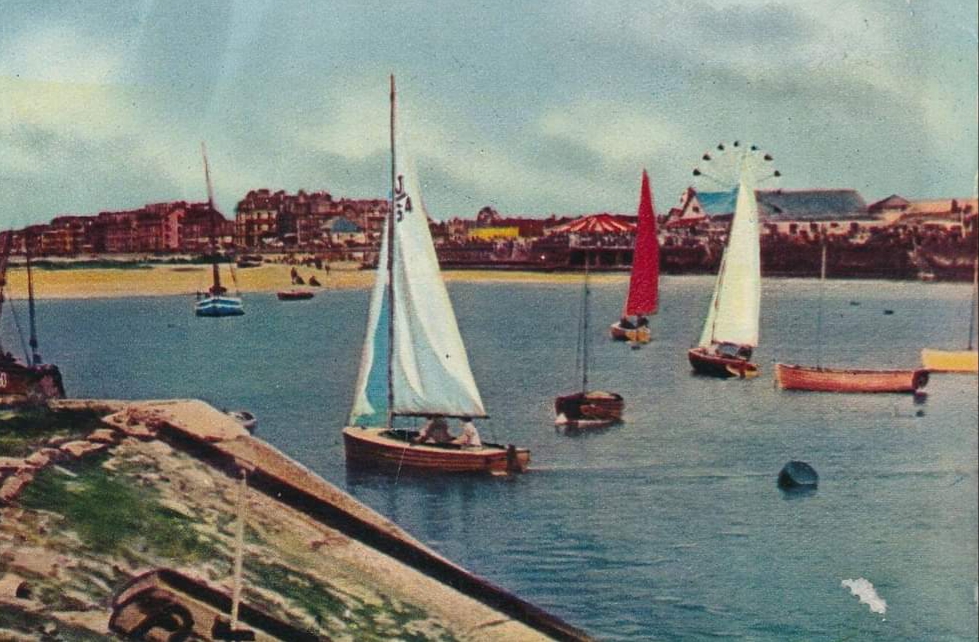
Foryd Harbour: the nearest sailing boat (J64) is a Jewel class dinghy. The other white-sailed boat certainly looks like a Jewel, as does the red-sailed boat although I can’t remember a Jewel with red sails.

The Jewel was a 14-foot, clinker-built, Bermuda-rigged sailing dinghy which at one time was the predominant class fleet in Rhyl Yacht Club.

In the early days my mother and brother mainly raced our boat J67 at sea and on the Marine Lake. Normally the boat was moored in the harbour and we also had a small rowing boat to get to and from the moorings.

When the racing was on the lake we took our rowing boat over and I used to spend my time rowing out to the island and round the lake. Good exercise.

I made many new friends at the RYC as well as there being a crossover with other areas of my life. The Anderson boys, Bruce and Alan, went to the Grammar School, as did Ian Cowx, son of Peter Cowx.

When I first got involved with club life I used to help crew the rescue launch which was skippered by Bert Lees and Fred Williams, both of whom had sons in the club Peter Lees known as Gus and Ray Williams who was in the merchant navy and drove a red open top Jag.

The Lees family cropped up again when I joined the Little Theatre.

It was on the launch I learned much of my yachting knowledge and flag lore. I was even allowed to fire the starting cannons for some races although most of the time I was raising and lowering the warning flags.

The Rhyl Yacht Club start launch and rescue boat with bare-chested Fred Williams, Peter Cowx in the dark glasses and a senior club member.

The RYC was to remain a major part of my life for many years in fact right until the time I left Rhyl and headed for Essex when I was 22.

Roger Steele joined me at the club and later, when I used to race our next boat, a GP14 carvel built, 14 foot sailing dinghy, he became my regular crew and when we didn’t race would help crew the launch.

We were part of a group of friends who were the yacht club crowd. Most were my brother’s and sister’s ages but Roger and I and a couple of others were included, especially when it came to the parties.

There were the Knowles brothers, Carlowe Cotton, the Cowx boys, Tom Edge junior, and others whose names I cannot remember.

The parties would often be spur of the moment. We would all chip in and a couple of the lads would go to the off-licence and get Party Sevens, cans of Wrexham Lager, Mateus Rosé and Liebfraumilch and we would then party at someone’s house through to 2am on a Sunday.

They were good days and happy days and I remember the friends with fondness.

There will be other tales of the racing, the coastal cruises and taking part in the Menai Straits regattas. That’s it for today.

If you have memories of the Rhyl Yacht Club in the 60s then please leave a comment.

Next time: the young entrepreneur.

School’s out

Most of the narrative here has been centred on school where friends (and a few foes) were made. Oddly enough my life outside school was just as busy, in fact more so.

From 1960 to the time I left Rhyl in 1972 my life outside school centred round horse-riding, sailing and treading the boards at Rhyl Little Theatre.

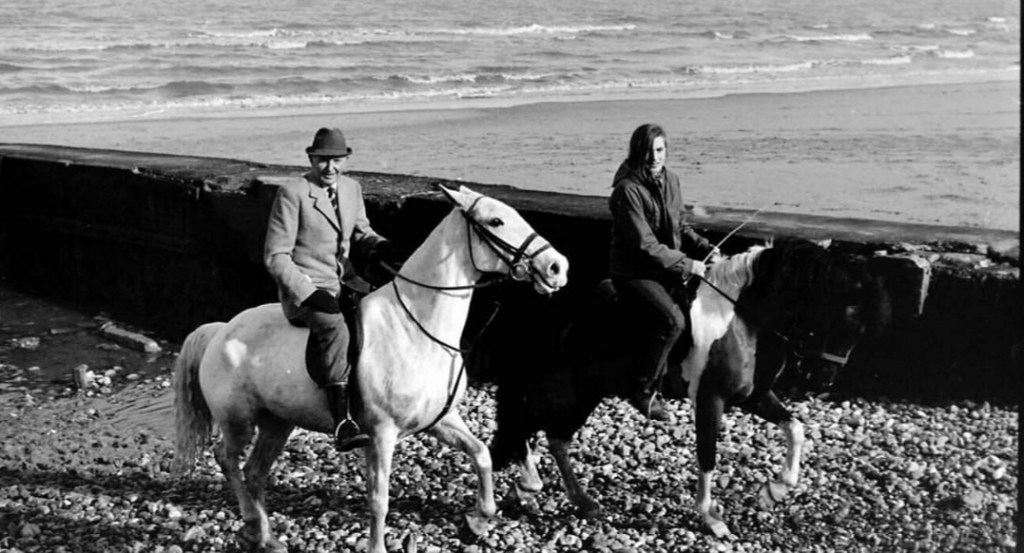
Initially, while still at primary school, I developed a love of horses and around 1960 I started Sunday morning riding lessons at the stables of Justin Roythorne (or Hawthorn).

Justin (Roythorne or Hawthorn) down on Rhyl beach with a young woman I believe was called Heather.

I remember going to the stables and being surrounded by the smell of horse sweat and leather. There were youngsters and older children, possibly 15-years-old or more.

Many of them seemed completely at ease with the horses and were bustling around putting bridles on horses and ponies before grabbing saddles and flinging them across the backs of the animals.

To this day I still cannot remember why I wanted to ride.

Could it have been images from Saturday morning cinema of the Lone Ranger and Tonto, or Roy Rogers?

I don’t know, but I do know when I first mounted a horse at Justin’s (well a pony actually, a very small pony called Gracie) I felt at home.

Before this, however, I had been shown how to check if the girth strap was just right: not too loose and not too tight.

I believe that first Sunday we trotted in single file to a nearby field where we newcomers were gradually schooled in horsemanship while older hands were being taken over jumps at the other end of the field.

This was to be my Sunday morning routine for almost three years.

I graduated from Gracie to a larger pony, a brown and white piebald, and towards the end of my time there a proper horse.

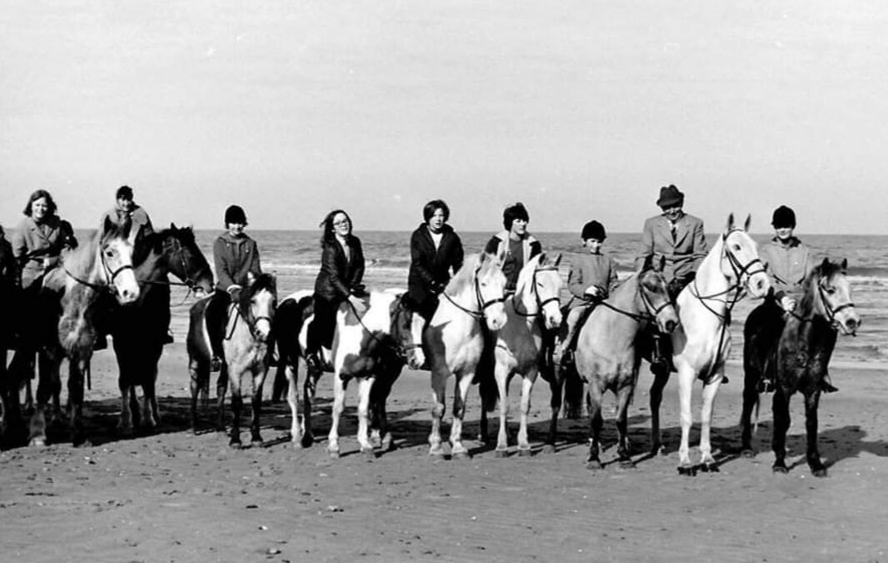
The high point, however, was when I joined the group who were taken down to the beach at low tide for a good, hard gallop.

A group of riders on the beach ready for a gallop.

Before this, however, I had started getting to the stables early and was allowed to check the tack, fitting the reins and halter and even saddling up.

It was valuable to learn all this if you are ever going to be even a half-decent rider.

The ponies and horses got to know me and trust me and I would even stay around after lessons and give a hand unsaddling horses which would get a break while others went out for the second session.

There was an extra thrill when I was told that if I arrived early enough the following Sunday I could go over with some of Justin’s regular riders to the field where the horses were kept overnight during good weather.

This wasn’t just a case of leading horses back to the stables. First we had to catch them. Six of us after about 18 horses took time.

I was left with the gentler horses my first time. Once caught we had to put the bridles on them making sure they got the bit properly in their mouths. Catch one: put on the bridle; loop the reins over a nearby fence rail; catch the next horse.

Once we had them all ready we would each mount our chosen steed – bareback – and take the reins of the other two horses in one hand while using the other and our knees to guide our horse back to the stables.

That was a wonderful moment when you could handle a horse with one hand and your knees. Even better was learning to take a low jump without the use of reins. That’s when you know you had really made it.

One thing we were warned about when going to the beach was that sometimes a horse would roll, dropping on its side and rolling in the sand. You had to know the precise moment to jump clear in order to prevent your leg being crushed. You then had to get it back up quickly and get back in the saddle.

Fortunately none of my horses ever rolled.

There was one day, however, that the early morning riders had to stifle their laughter.

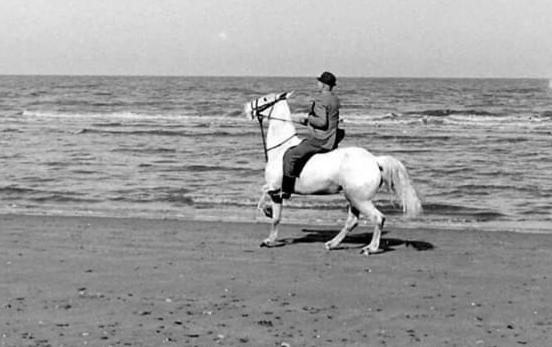
Justin was riding his big grey, called Sovereign (I think), and was wearing a new sheepskin jacket (it was a chilly day).

We had been on a gallop and then slowed down eventually to a walk. We were by a number of shallow pools of sea water. All of a sudden Sovereign decided to roll. Justin just got clear in time but he rolled straight into a salt water pool.

I don’t remember seeing him in that jacket again.

Justin sans sheepskin coat.

They were fun days but life got so busy that something had to go. It was the riding. Not that I didn’t ride again. During my sojourn in Australia in the 80s I took up riding again and it was as though I had never been away from horses.

Next time: All at sea.

Friend or foe?

My entry into the world of secondary education clearly brought me into touch with many new people, mostly my own age and it was a time of new friendships.

Some were casual and in the main based on presence in school. These especially came from science lessons as you were often partnered with someone to carry out experiments.

At times we were allowed to form natural pairings and I would work with Roger or another friend.

There were some teachers, however, who soon realised certain pairings would lead to trouble and decided to do their own mix and match.

I doubt we had any foes within our peer group but there were people you might not care to be paired with. It could be someone who took things too seriously and would have to dot every i and cross every t, while others would be exceptionally slapdash and make a joke of everything.

In the end you tended to put up with the hand you were dealt.

There were foes in the school – known as bullies, a term that did not just apply to pupils. There were bullies amongst the teachers as well.

My own nemesis, not exactly a rival more in the terms of an arch-foe, was at the highest point you could reach in school: the headmaster.

The headmaster of Rhyl Grammar School in the 60s, Mr A Ronald Davies, surrounded by some of his Praetorian Guard, the school prefects.

The first bully I met, however, was a pupil, in the year above me.

Now I was an easygoing youngster who always gave people the benefit of any doubt. I was also a peaceful child who would never willingly hit another person (I would have been useless as a boxer).

One day during the morning break I was meandering on the school field when approached by an older, taller and wider boy dressed in long trousers and a black blazer which clearly meant he was in the second year at least.

I happened to have a packet of Smith’s crisps in my hand (the kind that contained a portion of salt wrapped in blue waxed paper).

The boy approached me and demanded I hand over my crisps.

Being a polite child with the outlook that a soft word turneth away wrath I asked: “Why?”

The response was a punch on the nose that landed me on my back, with my bag of crisps parting company with my hand and the crisps parting company with the bag.

Apparently a soft answer does not turn away a bully.

I then found myself pinned to the ground with the boy on top of me apparently trying to stuff grass in my mouth as an exchange for the crisps.

It obviously amused the baying crowd who encircled us.

Just as I thought it was time for “lights out” and “Goodnight Vienna” I felt the weight being hauled off me and pairs of friendly hands helping me to my feet.

I stood and looked around and saw the crowd had disappeared, I was being held up by two classmates and my opponent was separated from me by three other classmates: Roger and the Parker twins.

As all bullies do he sloped off leaving me to thank my rescuers. By this time a couple of prefects had arrived on the scene and were asking what was going on.

It was Louis who stepped up to the mark and said: “We were just having a run around to burn off some energy and Robin tripped so we helped him up.”

Even at that early stage we were aware that you did not dob anyone in to the prefects.

That was the moment I realised that the most important thing you can ever have is friends.

Mind you I would never have expected justice from the school hierarchy whether it was a prefect, a teacher or the headmaster.

Later in that first school year we were in our woodworking class (our project was to make a wooden stool with a seagrass woven seat – I’ve still got mine).

The teacher would walk around the room guiding us in the correct practices. He always carried a long square stick (probably a yard measure) and insisted on no talking.

I was busy chiselling out one of 16 mortises in the legs of my stool when I felt a mighty thwack on my buttocks and heard the teacher say: “Stop talking Pierce.”

I think I was just too shocked to respond and he wandered off to find another victim.

When I got home I dropped my shorts and underpants and viewed my buttocks – there was a vivid purple weal right across them. It took 10 days for that bruise to fade but the memory of the injustice still burns fiercely.

It was another year before I felt the result of another injustice and this time it came from the very top.

I was now a second year and wore a black blazer and cap as well as long trousers. A group of us had been selected to go on some form of field trip which involved pupils from other schools.

I was waiting by the school gate with others for the bus that was to take us to the venue when I heard a bellow: “You boy, where’s your cap?”

I turned to see the headmaster Ron Davies bearing down on us with his gown billowing in his wake.

The school gate was set back from the pavement and the walls either side were not straight but came in at an angle. This meant some boys without caps on their heads were out of his sight. The boys in vision were wearing caps – except for me. As it happened I couldn’t quickly whip it out of my pocket and slap it on my head because I had left it at home.

“Sorry sir (I actually used the word at that time but have never called anyone “sir” since) I forgot it this morning as I got up late.”

“You are not going to represent my school improperly dressed. Go and wait outside my study.”

I did as I was told although inside I was seething that he had stopped me going on the trip for such a petty reason.

Having seen the bus off the head returned to the study and told me to come in.

He then gave me a good 10-minute oration (well it seemed like 10 minutes) before he told me to bend over with my hands on the desk.

That was when I realised I was being punished three times for a minor first offence – deprived of a school trip; ears assaulted by a boring lecture; and six of the best. Whoever came up with that term must have been a masochist.

My time would come.

Next time: Branching out.

PS: Had a reminder from an old pal that the stools were made in the second year of our woodwork classes.

That’s the joy of sharing – old friends can jog your memory.

Family history bonus

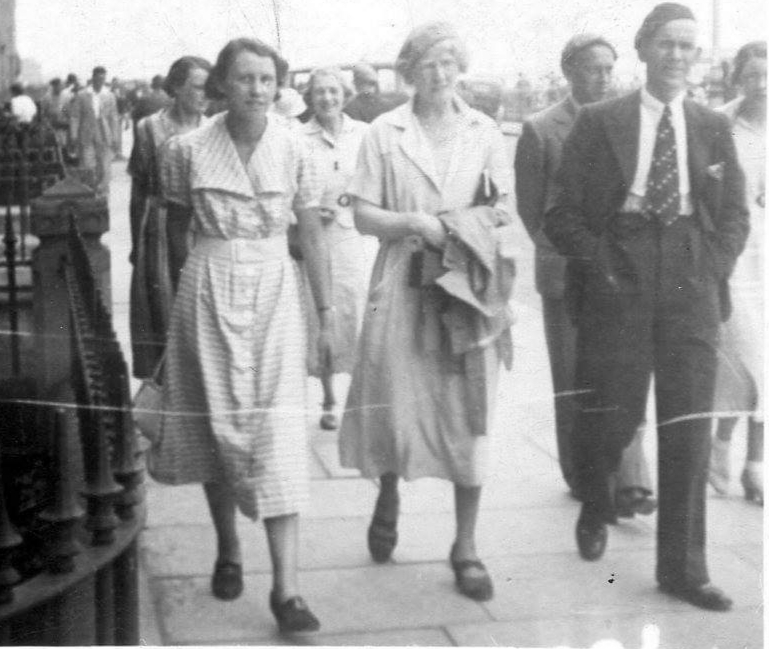
West Parade, Rhyl, summer 1937.
Ivy Lloyd (left) from Liverpool with her Auntie Em and Uncle Matt, also from Liverpool.

Although our family only moved to Rhyl in 1955 both my father and mother had history in the town. In fact it was in Rhyl they met for the first time.

My mother, a Liverpool Welsh girl, would visit Rhyl with her parents, Harry and Celia Lloyd, and other family members in the 1930s.

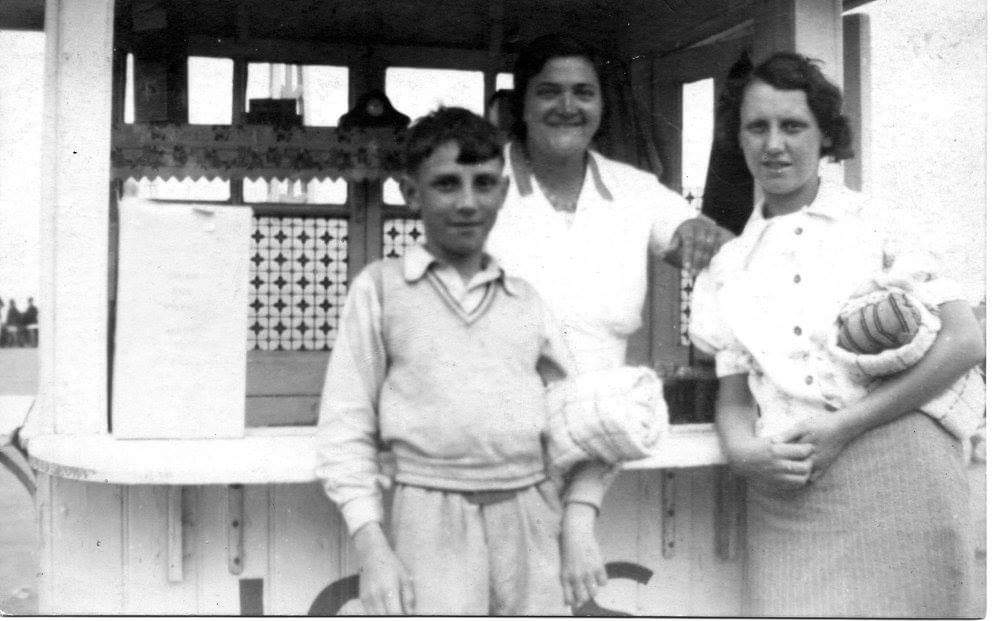
Ivy Lloyd and her young brother Harry at the Clwyd Cream Ices stall on Rhyl promenade, 1937.
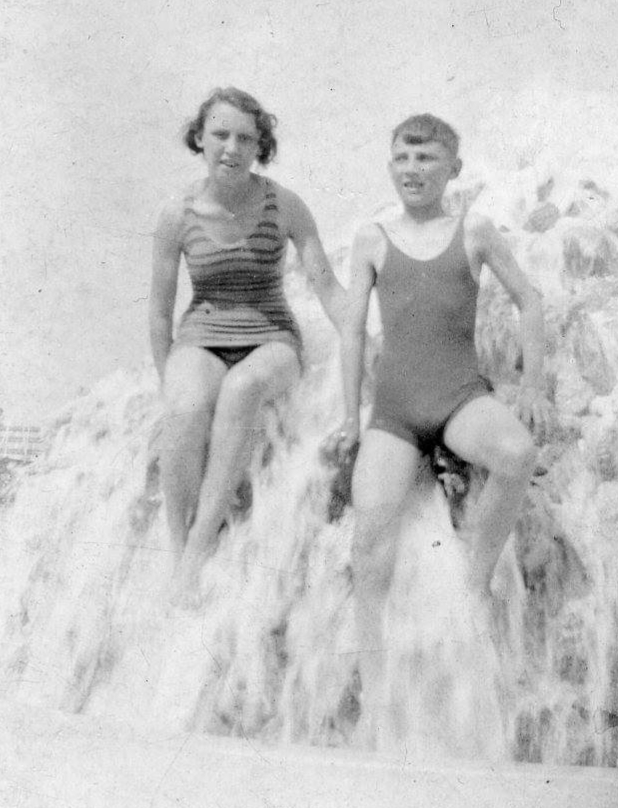
Ivy Lloyd and her young brother Harry at the rock fountain at Rhyl Swimming Baths, 1937.

Meanwhile my father, David Pierce, a Wrexham lad studying at the Liverpool School of Pharmacy, was helping out at a Rhyl pharmacy for the summer as were some of his fellow students at other local pharmacies. A chance of a seaside holiday combined with work experience.

David Pierce, right, with his arm around his new girlfriend Ivy Lloyd, and some of his student pals in Rhyl, 1937.

During that summer the couple met and dated. When they were both back in Liverpool Ivy, 17, and David, 22, continued to meet and got engaged.

By October 1939 they were married and Ivy was back home with her parents, David was finishing his training as an army medic ready to join the British Expeditionary Force in France.

Except for a couple of weeks after Dunkirk they did not spend any time together as a married couple until the war ended in 1945.

David had been posted to the Middle East.

If it hadn’t been for that damned war I could have been five years older.

Swinging Sixties – not quite yet

The 60s for me were a period of growing up. Nowadays they call it the Swinging Sixties but it didn’t swing from day one.

Sexual intercourse began in nineteen sixty-three
(Which was rather late for me)
– Between the end of the Chatterley ban
And the Beatles’ first LP.

From what I have gathered that is also when teenagers began, even though Bill Haley had tried to introduce the term six years earlier without much success, or so I have been told.

That is for later, however, and for now we will rejoin the young Robin on his Raleigh bike being escorted to Rhyl Grammar School by his elder siblings.

Nigel and I stopped at the first gate while our sister Jacqueline continued on to the girls’ entrance.

My brother looked me up and down, checking that my socks were pulled up; my tie was neatly knotted; and my cap was firmly on my head.

“Right, you wheel your bike up the drive and put it in the bike shed. I told you all about that. Don’t forget to lock it. Then wait until the prefects tell you to line up. You’re in 1W remember. After that you just do what the prefects tell you to do.”

With that he was gone.

I couldn’t blame him as I was a new boy and he was just starting in the fifth form.

I trudged up the drive, wheeling my bike, and crossed a covered way which had a rubber matting laid along it.

It didn’t take long to find a slot in the bike shed and chain it up and then I turned and looked out on a vast expanse of concrete covered by boys and girls in all sorts of sizes. Beyond it I could see the green playing fields.

Just as I was beginning to feel lonely in a crowd I heard a friendly familiar voice.

“Oi. Robin! Over here.”

It was my good pal Roger who had arrived before me. It wasn’t long before we had found a few other Christ Church boys, including Tony Roberts, Roy Poole, John Cliff and David Prandle.

Then a bell went and tall young men were ushering us into lines (the girls clearly lined up elsewhere). Once in order and quiet each line (a different form) was given instructions as to how to get to our form rooms at which point a whistle was blown and we headed to our first classroom.

We went through the quad and into the old building and ascended the first staircase we came to. At the top we found the girls who were to be our classmates and a short, sallow faced woman wearing a gown over her skirt and blouse.

She introduced herself as Miss Watson (we later learned her first name was Sally) and told us to go in and find ourselves a desk each.

The girls went first. Roger and I were near the front of the boys’ group and we got in and selected desks on the left hand side about three rows back. Not too near the front and the eagle eye of any teacher but not too far back to be seen as lurking.

In front of us were two boys, one with dark hair and one with short fair hair. They seemed to know each other.

We later found they were twins called Louis and Jimmy Parker.

They were to become very good friends and will earn frequent mentions in days and weeks to come.

The rest of the morning was a whirl of checking timetables, finding classrooms and eventually finding our way around this great edifice.

At the morning break we gathered outside in varying groups. Initially Roger and I chatted with old friends from our primary school but before the bell went our little group had grown to about 10 – including the Parker twins and others we did not know properly from 1W.

This was the start of a number of beautiful friendships.

Next time: Friends and foes

From big fish to little tiddlers

From timid little infants at Christ Church CP School Roger and I had come a long way to reach the pinnacle of Standard IV with Phyllis Owen as our main teacher.

Two things happened in the Spring of 1961 and they were both to have a big influence on my future. Roger was involved in both.

One was the annual school play, produced and directed by Phyllis Owen. More about this later.

The major event was, however, sitting the 11+ examination which would decide who went to Rhyl Grammar School that year and who (those who failed the exam) would go to Glyndwr Secondary School.

This is the first page of one of the papers in the 11+ examination. I don’t know if the Welsh Joint Education Committee used the same papers as their English equivalent but the style questions would be the same.

I don’t remember being that bothered about the exam, I still took that sort of thing in my stride. Anyway to my mind if my brother could pass the exam and my sister could pass the exam then I wasn’t likely to fail. Roger seemed pretty relaxed about it too.

It was many, many years later that I discovered not all the children in standard IV were entered for the exam. The headmaster would decide who sat it and who didn’t.

Obviously Roger and I were deemed likely to pass. As it happened we did with a quite a few more of those who sat in that room that day.

The only other major event was the annual school play. I know my brother had taken part four years earlier (Emil and the Detectives. I think he played Emil). Oddly I have no memory of my sister treading the boards.

I am sure the play I took part in was a wondrous play but I really can’t remember it.

All I do remember is that I played a soldier (as did David Prandle) and Roger was a goblin.

The soldiers all had black trousers, with light blue stripes down the side (sewn on specially), white shirts and black pill box hats with a black plastic chinstrap. Very smart (which oddly enough links to something in my family tree going back to the early 1800s but that is another matter).

Roger as a goblin was dressed all in black with black face makeup.

The only other thing I can tell you about that play is that I was eager to know if my mother was in the audience and Phyllis Owen told me off for peeking round the front curtain.

I still wasn’t old enough to understand stage etiquette. That would come later.

The school year ended soon after and ahead of us was a wonderful summer.

It didn’t seem long, however, before early in September, I was dressed in grey short trousers; a white shirt with a blue and yellow striped tie; grey socks with shiny black leather shoes; a blue blazer with the RGS badge on the pocket and all topped off with a blue school cap with a similar badge.

I mounted my new Raleigh bike (a reward for passing the 11+) and with my brother ahead and my sister behind (to make sure I didn’t get lost) I was heading off for my first day as a grammar school boy.

Next time: Loss of innocence

Friendship

As we moved up in primary school there was a subtle change in friendships as school friends and out of school friends began to merge.

Two things defined this change. One was Saturday morning cinema at the Odeon when you met your school friends on a weekend.

The other thing was learning to ride a bike. The old three-wheeler, which had originally belonged to my brother, was now consigned to the space under the outside steps which led up to the loft over the garage and warehouse in our back yard.

When I was eight my parents bought me a bike. Not a new bike but a secondhand two-wheeler. I didn’t care, it was mine.

The trouble is I couldn’t ride it without falling off. A tricycle is infinitely more stable but not the sort of transport for an eight-year-old seeking to explore Rhyl beyond the town centre.

My father came up with a plan. We would go up to the cycle track on the promenade on Sunday mornings. It was out of season so he didn’t have to open the shop and the track would be deserted.

Rhyl promenade cycle track in the season.

We wheeled my dark purple steed up to the track and Dad held on to the little rack behind the saddle while I mounted.

We must have gone round the track 10 times with Dad running along by my side firmly gripping the parcel rack keeping me upright.

It wasn’t until we were on the 11th circuit that I sensed he wasn’t there. I turned to look back, not a good idea for a learner because I fell off.

Dad came trotting up and helped me to my feet.

“You let go and I fell off.”

“No. I let go and you cycled half-way round the track while I stood and watched. You didn’t fall off until you realised I wasn’t there to hold you up.”

He was right.

I got the bike up, swung my leg over the crossbar and set off on my own. I did two circuits with ease before we headed home.

Dad took me to the cycle track twice more to let me practice and the following weekend I was allowed to cycle down the road on my own as far as the school and back.

By the time the summer holidays had started I was regularly cycling over to Roger’s on a Saturday and then we would head off on rambles down by the river and around the Marine Lake.

Our friendship had become much more than two little boys playing marbles in the school yard and then each going their own way when the school bell rang at the end of the day.

I think Pam had found a new playmate by now anyway.

Next time: Off to big school.

Blame the Glitch

There’s a change of pace today. As people may have noticed the latest update did not appear here magically at 9am today.

Personally I blame the Glitch.

The Glitch is a little gremlin hiding in our networks who now and then pops up and switches connections to make all your hard work disappear.

Service WILL resume as normal tomorrow.

In the meantime the last couple of days has produced some great responses including one from Tony Roberts (also known as Seymour Biz).

Tony is one of those Christ Church pals who moved on with Roger and myself to Rhyl Grammar.

He not only joined us there but was also part of another circle involving friends old and new.

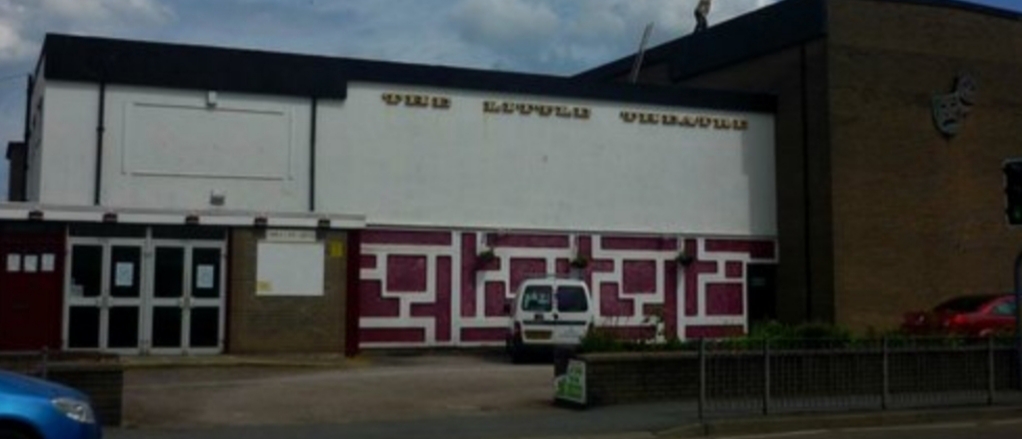
Rhyl Little Theatre.

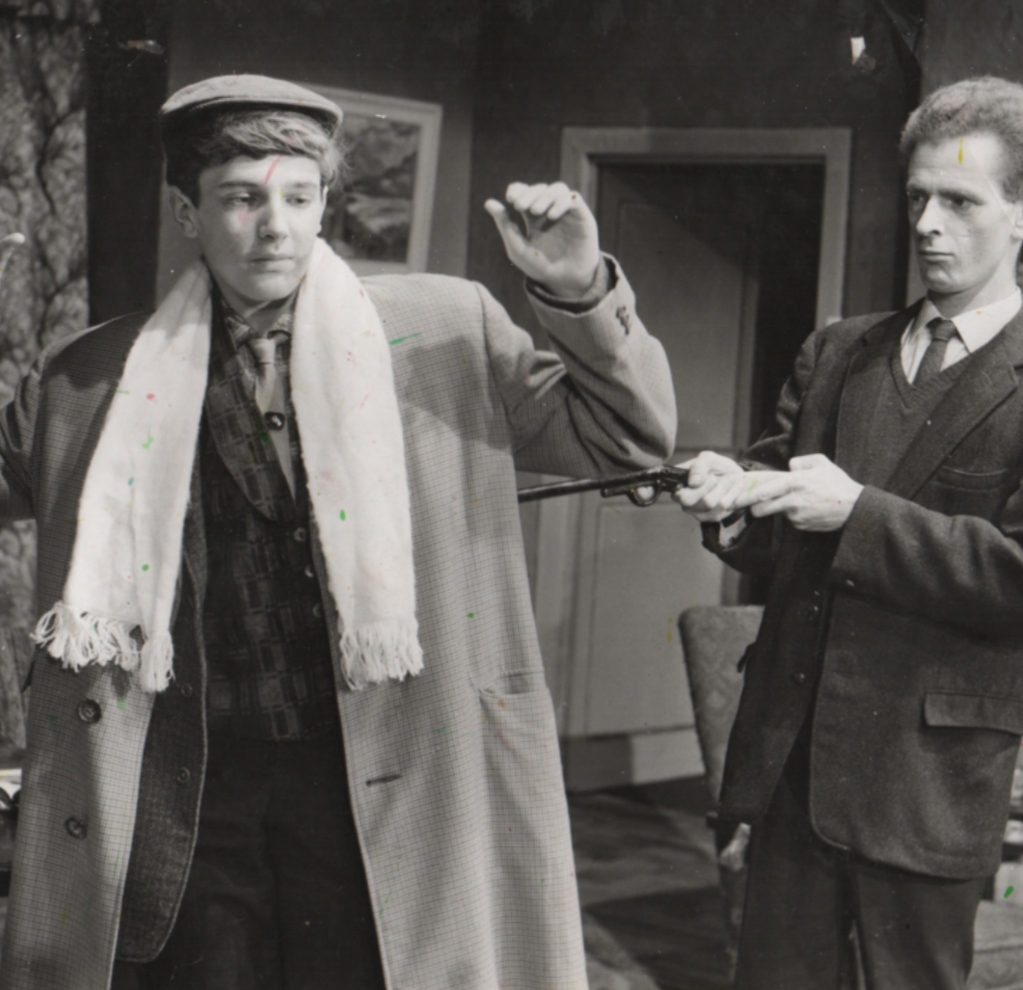
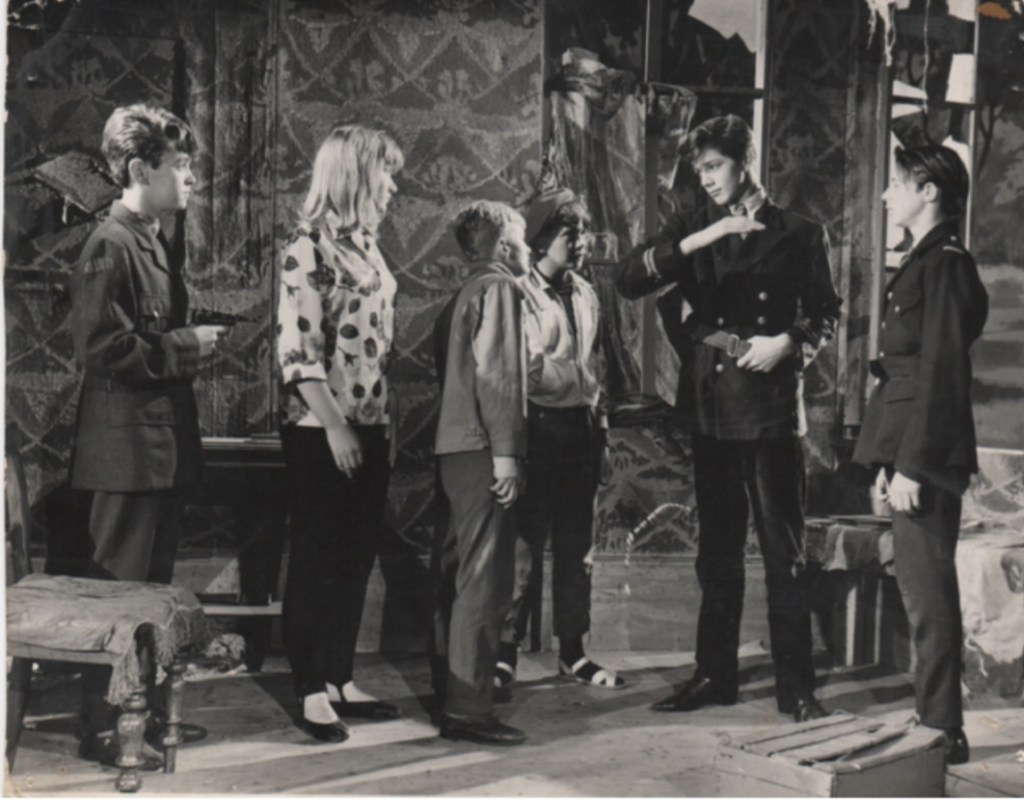
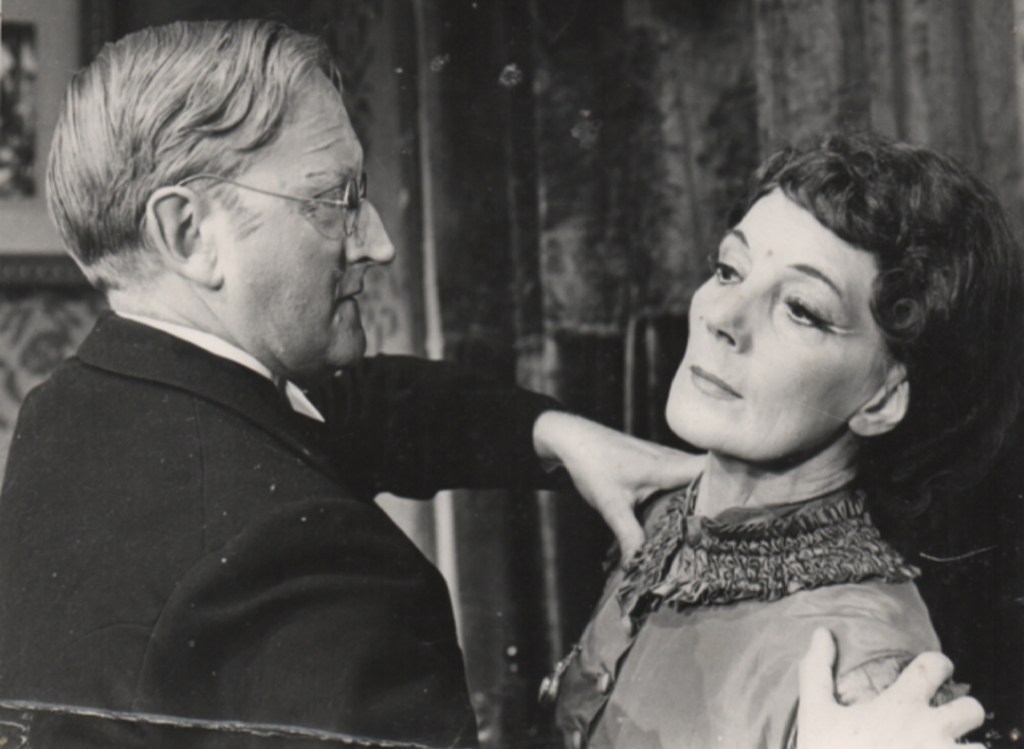
Tony was reminding me of people we knew but slightly jumped the gun with RLT as this was due to surface in a day or two. So just for Tony here’s a taster of what is to come.

Anyone you recognise? More news later this week.

PS: Tony, I did not forget Paul Brown another of our generation who died too soon.

Never forget his face when he swigged the “wine” in The Deserted House.

See you all tomorrow.

PPS: if anything jogs a memory please feel free to comment.