I know the colour rose, and it is lovely, but not when it ripens in a tumour; and healing greens, leaves and grass, so springlike, in limbs that fester are not springlike.
I have seen red-blue tinged with hirsute mauve in the plum-skin face of a suicide. I have seen white, china white almost, stare from behaind the smashed windscreen of a car.
And the criminal, multi-coloured flash of an H-bomb is no more beautiful than an autopsy when the belly’s opened – to show cathedral windows never opened.
So in the simple blessing of a rainbow, in the bevelled edge of a sunlit mirror, I have seen, visible, Death’s artifact like a soldier’s ribbon on a tunic tacked.
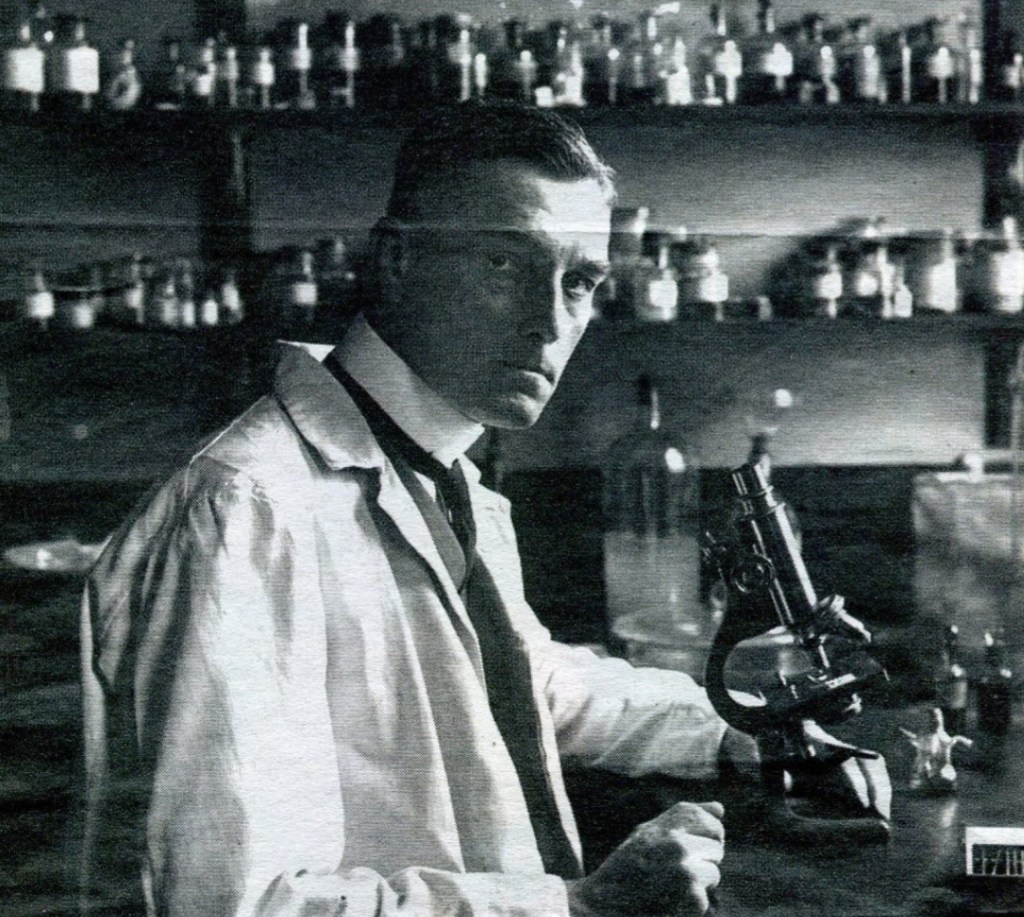
Sir Bernard Spilsbury, the pathologist who became known as the father forensics.
Over the last four or five decades forensic science has become a major factor in TV series.
If the main character was not a pathologist then he/she was sure to be one of the stars.
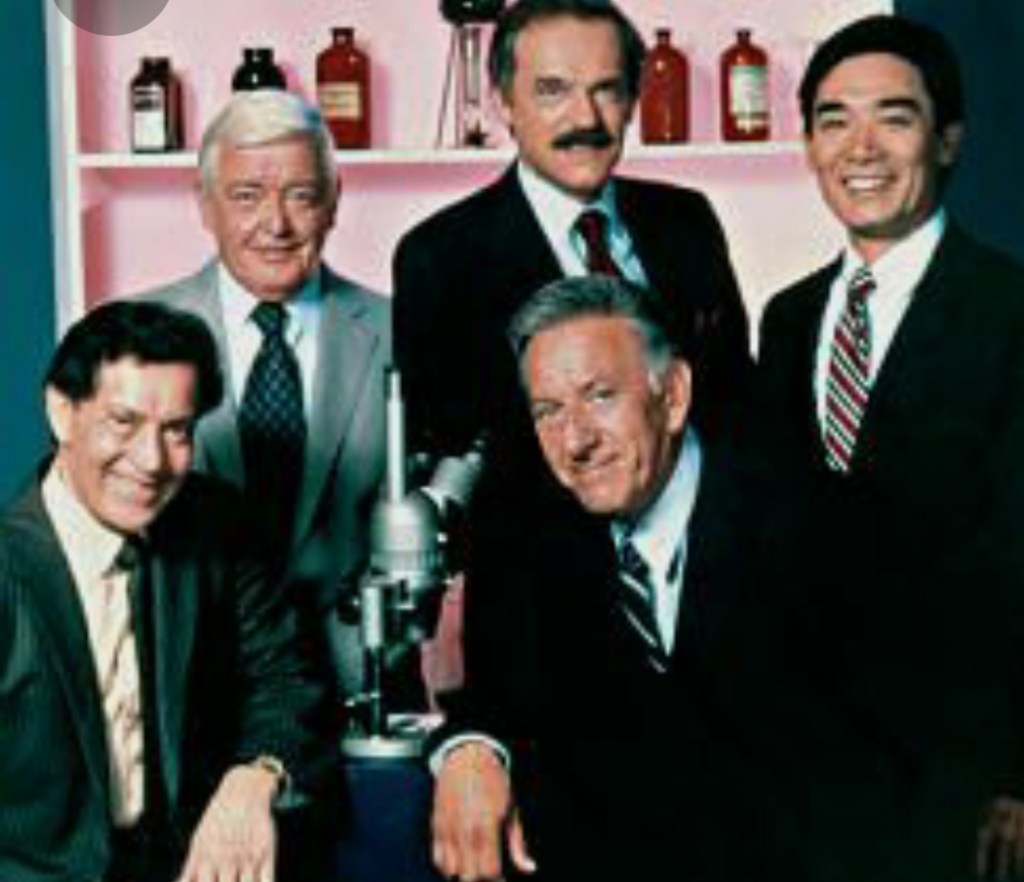
The first major tv show starring a pathologist was Quincy ME, starring the lugubrious Jack Klugman as Professor Quincy, a medical examiner (an American version of our pathologist), which began in the late 1960s.
Jack Klugman, seated right, with other major stars in the American TV series Quincy ME
My own interest in forensic pathology began long before that. Just a few months after starting at Rhyl Grammar School in September 1961 I had decided on my future career. I was going to be a pathologist and my benchmark for success would be the great British pathologist Sir Bernard Spilsbury.
Over the next few years I became an “expert” on crime and the importance of science in solving murders in the first half of the 20th century.
I was already a fan of Conan Doyle’s ceation Sherlock Holmes and it was clear the author had imbued his offbeat hero with many of the elements of the forensic scientist.
By the time I was in my second year I was getting my books from the adult library and was reading the trials of some of the most notorious murderers of the first half of the 20th century. It was in reading one of the trial reports that I came across Spilsbury.
He was involved in a case which is still frequently referred to these days – that of Dr Hawley Harvey Crippen accused of murdering his wife Cora and entombing her in the cellar before eventually fleeing to Canada on the SS Montrose with his young lover Ethel Neave.
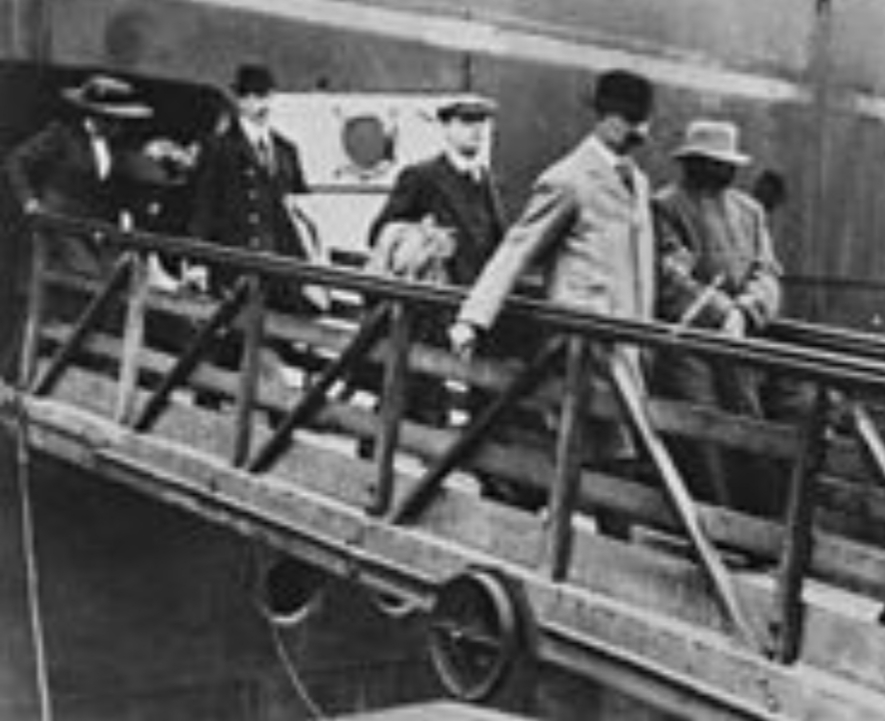
A Morse code message to the ship ensured Crippen was held and a detective sailed on a faster ship and was in Quebec when Crippen’s ship docked.
A Scotland Yard detective escorts the arrested Dr Crippen off the SS Montrose in Quebec.
Spilsbury was also central to the brides in the bath murder case (George Joseph Smith) which I saw referenced in a recent UK crime series.
These and many others gave him a reputation which lived on for years after Spilsbury’s death.
It saddened me years later to find that this “great man” had feet of clay and in many of his cases later examinations revealed errors in his methods.
In fact there is now a belief that the body in the cellar might not even be that of Cora Crippen and might have been buried before Crippen lived in the house.
In the 60s, however, all that lay ahead and I applied myself to chemistry and biology lessons and also to physics as I would need all three if I wanted to get to university.
The problem came in my fourth year. The physics teacher and I did not get along (a situation I was to face many times with people I did not see eye to eye with) and this meant I did not always pull my weight.
Not that this bothered me as what I fell down on during term time I tended to make up just before the exams.
In the summer term of 1964 the exams would determine which subjects we would be allowed to choose for the following year and which we could drop.
My intention was to stick with the sciences and I was quite prepared to drop geography for a start.
Unfortunately the physics teacher, Bill Fizz, had different ideas. He wanted me to drop physics and said that no matter how well I did in the subject if I did better in geography then that was what I had to do.
As I say, I wasn’t worried. Diligent revision would get me what I wanted, except it didn’t.
Just as my belief in Spilsbury was to be destroyed so was my belief in my own abilities.
My chemistry and biology marks were adequate but for the first time my physics mark was below 50% and my geography mark, usually faltering around the 50% mark, was over 60.
Bill Fizz got his way but that was not all.
The headmaster called me to his study and gave me a lecture on how failure at school would lead to failure in life. He had, therefore, decided that the best thing for me was to stay down a year and go through fourth form all over again.
Now I was well aware that I had done badly in my exams and it certainly looked as though my brilliant medical career, slicing up dead bodies, was about to crumble around me.
I was always a contrary little son-of-a-gun but this time something inside me went into overdrive and I told the headmaster I had no intention of staying down and would quit school rather than do so.
I don’t think this had ever happened before and he appeared dumbstruck until he managed to say: “It will not be your choice boy. I will be speaking to your parents.”
With that I was dismissed and as it was the end of the school day I headed straight home to get the first word in with my parents.
Let me die a youngman’s death not a clean & inbetween the sheets holywater death not a famous-last-words peaceful out of breath death
When I’m 73 & and in constant good tumour may I be mown down at dawn by a bright red sports car on my way home from an allnight party
Or when I’m 91 with silver hair & sitting in a barber’s chair may rival gangsters with hamfisted tommyguns burst in & give me a short back & insides
Or when I’m 104 and banned from the Cavern may my mistress catching me in bed with her daughter & fearing her son cut me up into little pieces & throw away every piece but one
Let me die a youngman’s death not a free from sin tiptoe in candle wax & waning death not a curtains drawn by angels borne ‘what a nice way to go’ death
Just for a change I thought you’d like a poem.
This is from The Mersey Sound, number 10 in the Penguin series of Modern Poets. I bought it when it first came out in 1967 and it remains in my Top Ten books of poetry.
The three poets who made up the Mersey Sound were AdrianHenri (Birkenhead-born but raised in Rhyl), RogerMcGough and BrianPatten. I saw them perform live once in Basildon and once in Great Yarmuth.
Three poets sitting on a stage reading their own poetry – it was brilliant both times.
I miss Rhyl but is it the Rhyl I remember that I miss or is it the place itself?
The closest I can manage at present is to let Google do the walking but even then when did Google create the images?
I took you through the Rhyl I remember now let’s see the Rhyl of more modern times.
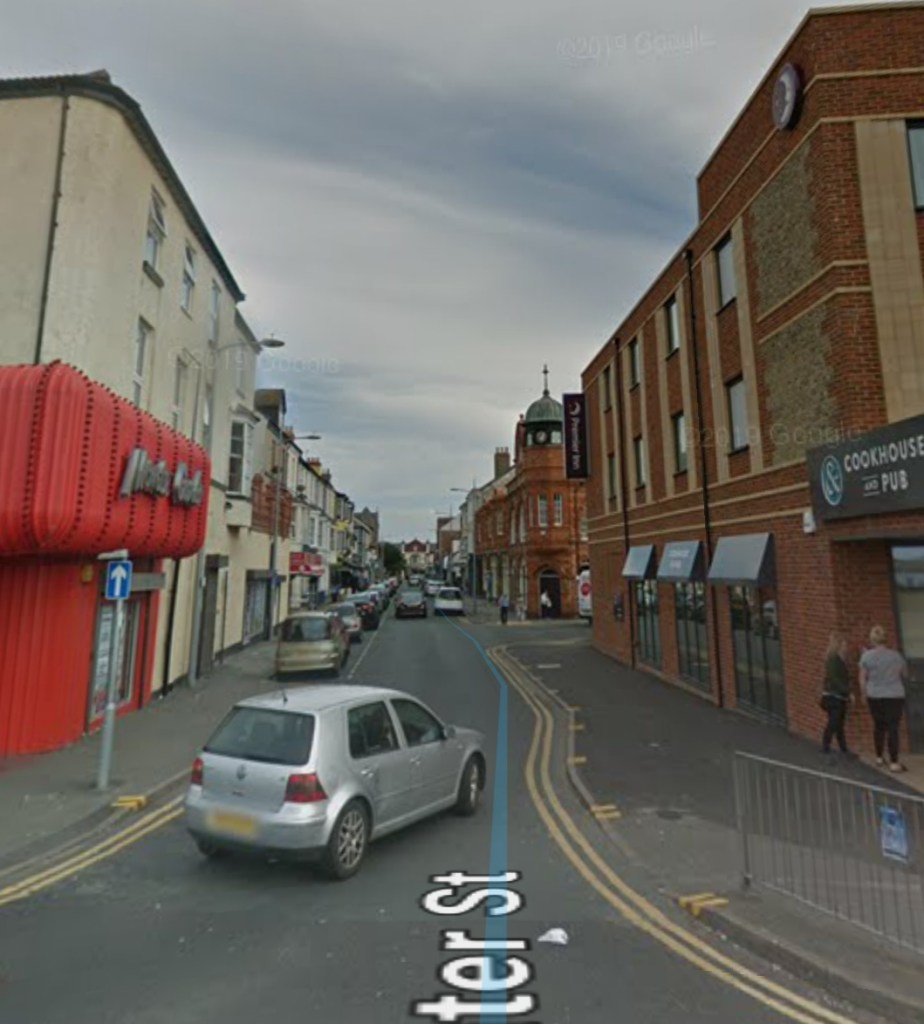
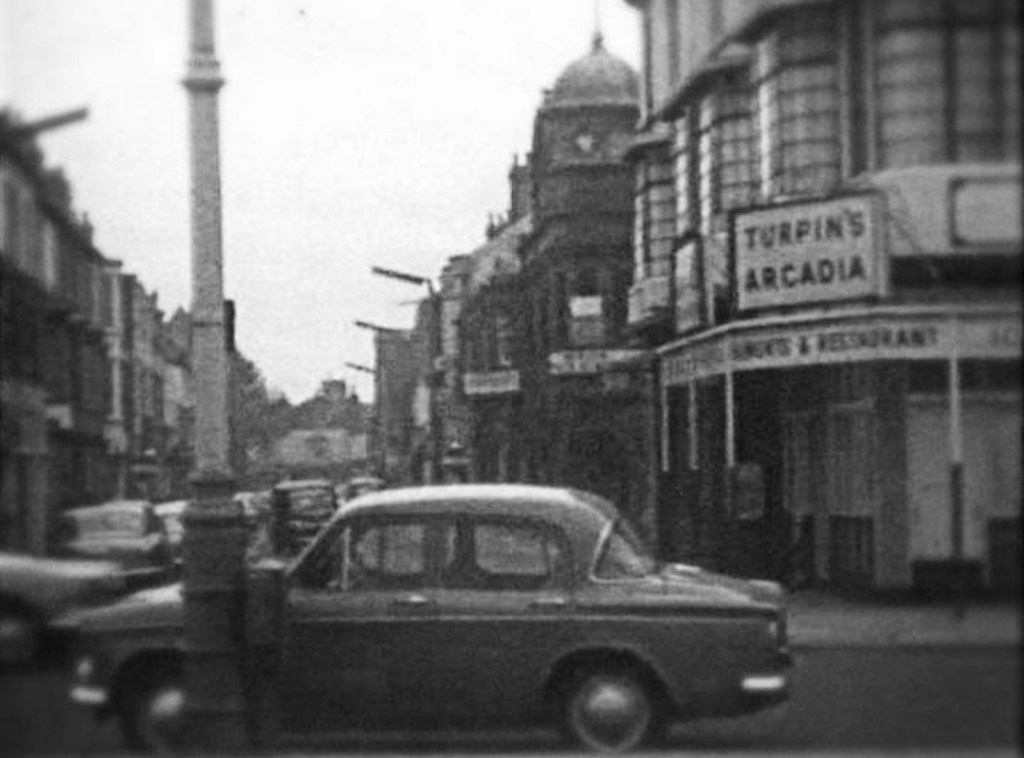
The view from West Parade up Water Street. Turpin’s arcade has gone from the right to be replaced by a Beefeater Hotel. Good for attracting holidaymakers but a little bit of old Rhyl that’s gone.
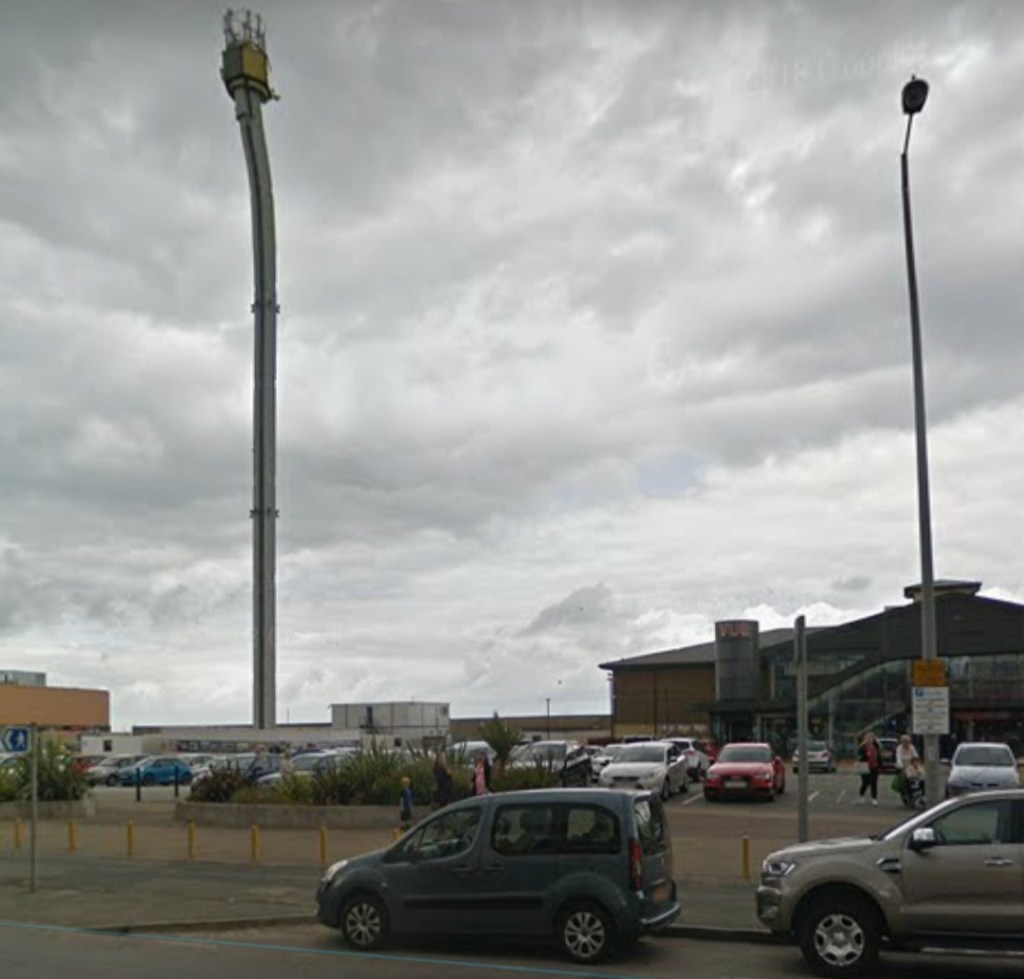
Turn around and where the beautiful domed Pavilion once stood I now get to see:
A Sky Tower? I don’t even know when it replaced the Pavilion and whether it is still there.
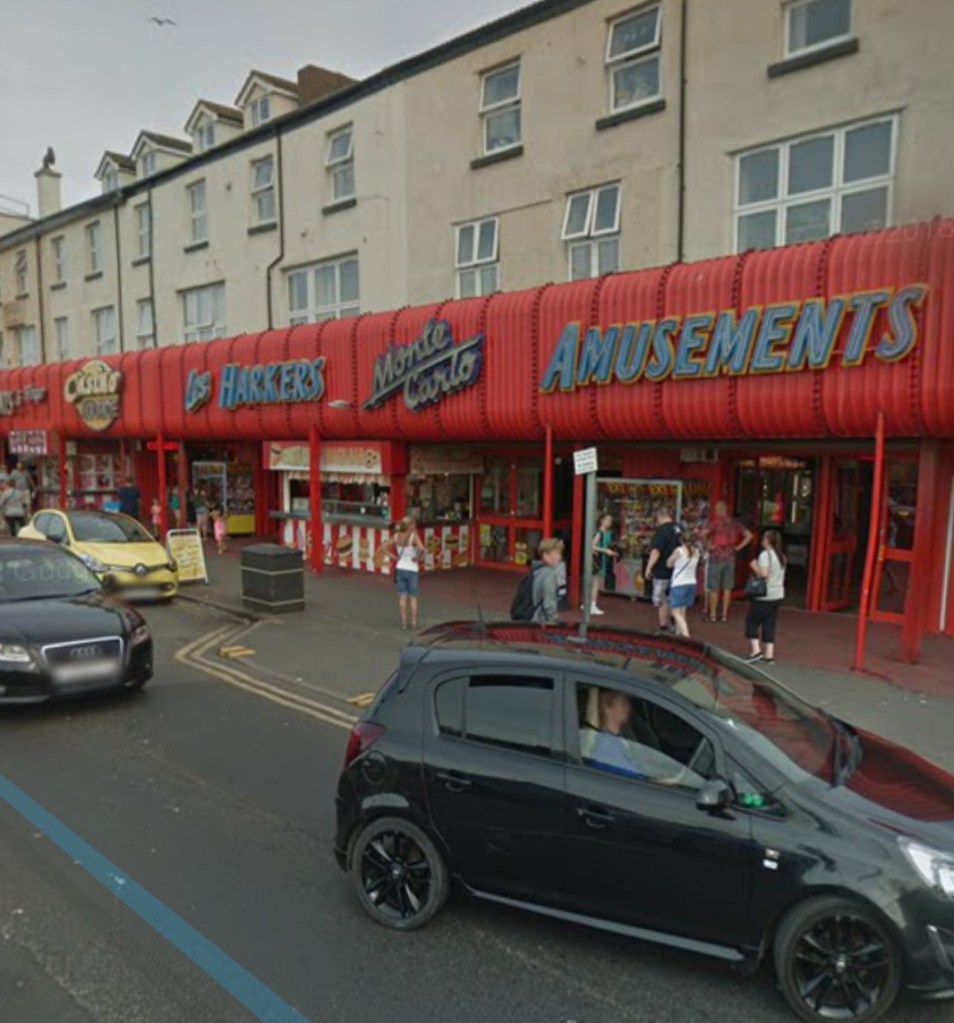
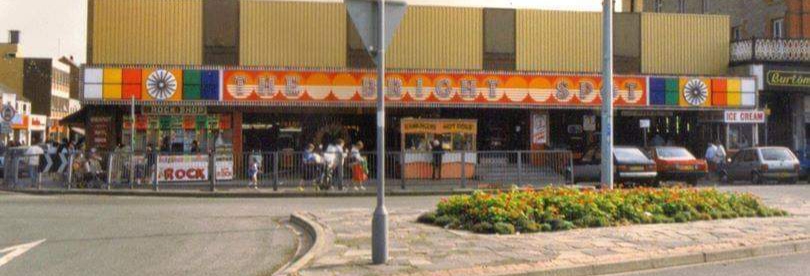
Look to the other side of the Water Street opening, however, and there is a slightly flashier version of the arcades I knew and loved.
The only thing from my days in Rhyl is the name Harker on the arcade frontage, Les Harker.
I know that in the years I have been away there have been many changes in what was my home town for 17 years. They do say you should never go back because it will destroy your memories.
The last time I physically returned to Rhyl was two years ago following the funeral of my good friend Roger Steele. We said farewell at the Colwyn Bay Crematorium then travelled to Rhyl to raise a glass or two and spin yarns about him at one of the pubs where we once drank many years ago.
The Rhyl I really remember is from over 40 years ago now. Even starting outside my father’s old shop is different. The premises and those next door became part of a housing association company and even the front door to the house has changed.
Once a chemist shop but now changed completely. The window area was once a plate glass window curved at the right end where there was a porch with the shop door set back. The arch to the left once led to a covered porch with steps up to our front door, a magnificent Victorian porch. The bay window above was my bedroom in the late 60s.
I can imagine standing there then walking towards the prom before turning left on to Crescent Road to walk past our old back gates and the yard.
Now the yard is bigger because the Victorian mews at the back, which once would have housed a carriage but later housed our boats out of season when they were stripped and repainted or varnished, has gone and the dividing wall between our yard and the bakery is no more.
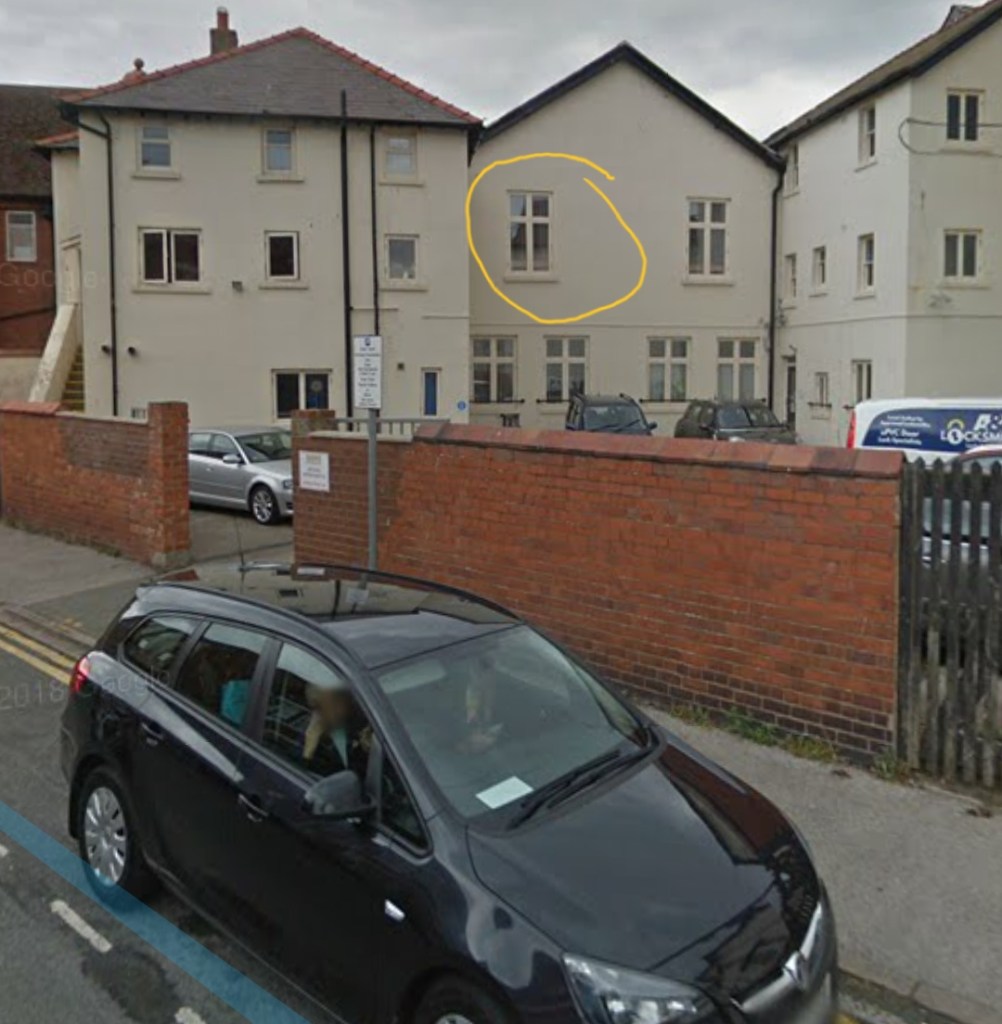
The back end of our house and business as it is now when seen from Crescent Road. To the left the stairs leading up to flat that Mr Massey once rented from us. The marked window, right, was my bedroom for a few years, shared with my brother, before we moved to a room at the front. The setback section of this property once had a wall coming out from between the two lower sets of windows.
As I continued down Crescent Road I could see the former bus and coach station, where I briefly ran my casing business, is now a car park for the Beefeater and where Marshall’s warehouse once stood is now a brand new house.
The biggest change was at the five-way junction. Where once had stood my Victorian red brick primary school there was now a featureless red brick, rectangular monstrosity.
At least the old tuck shop on the facing corner was still there. Gone are the Sherbert Dabs and Black Jacks and Spangles because it’s a hairdresser now.
Instead of going forward I turned to the left and took Bedford Street which would return me to Water Street. As it happens at the far end the barber’s shop which I first was taken to when I was five years old still offers the same service. Facing it, what was once the jeweller’s shop run by Vin Thomas, has been taken back as a home.
The barber’s shop where the five-year-old me used to sit on a board across the chair is now turned unisex.
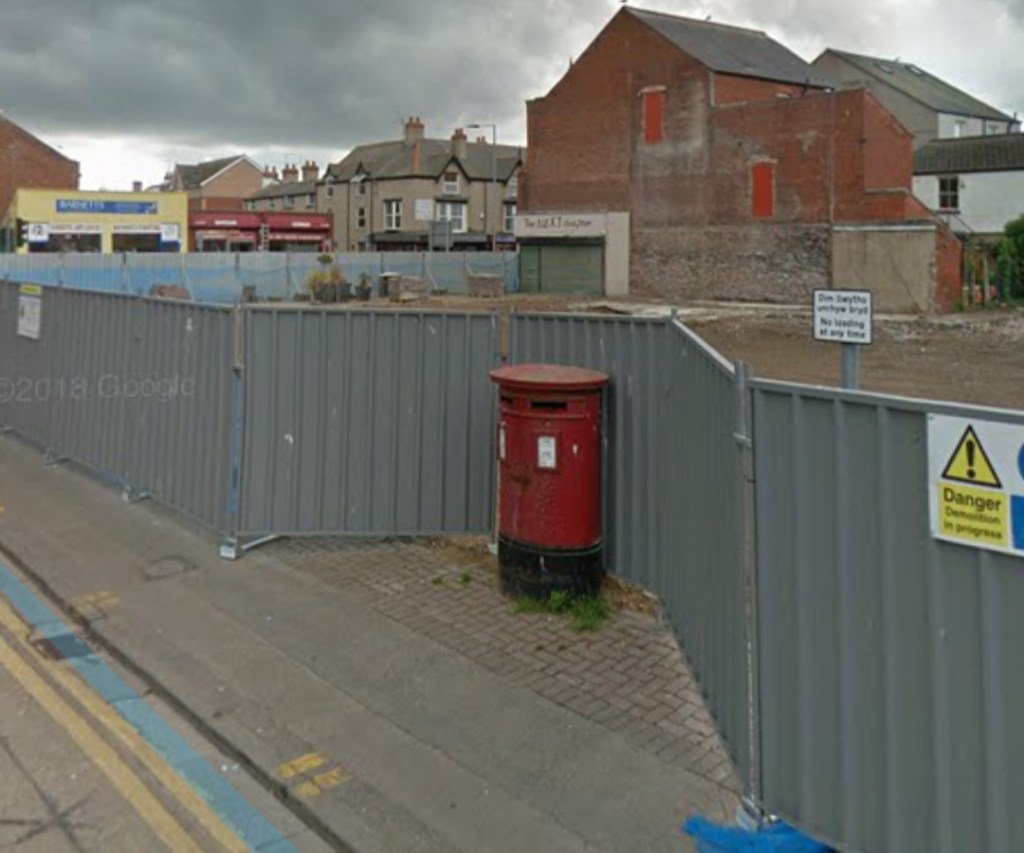
The final part of the journey took me right out of Bedford Street on to Water Street. At the top where once stood the new Post Office when I was a child this is what remains:
At least you could still post a letter.
I did follow the Google maps to neighbouring streets but when I reached Queen Street I could not take any more. Too much of it had become a buiding site.
Many of the changes in Rhyl are probably vast improvements on the way it had become during its downturn period. They may have made it look tidy but they have taken its heart and soul.
I went for a walk yesterday. Something I have not done since the lockdown began.
In fact I went for two walks.
In both I walked the streets of Rhyl. The difference being that one walk was in the Rhyl locked away in my mind to be taken out and revisited whenever I wanted.
The other was a virtual tour of the Rhyl that is or was as others see it on Google maps where you can see the streets frozen in time with people and animals who are strangers..
Today I want to take you with me on a walk in the Rhyl I loved from 1955 to 1972. A brash, saucy seaside resort which never tried to attract the clientele that strolled the streets of Llandudno, just down the coast.
In the summertime Rhyl displayed her wares for all to see, especially visitors from the North West.
I walk out of my father’s shop and turn left, crossing the mouth of Crescent Road and up to the West Parade.
That was where I could see one of my strongest memories – the great dome of the Pavilion Theatre, surrounded by its four mini-me domes.
A wonderworld of fun and excitement, whether it was Prince Cox’s Circus on its annual visit, or a concert with the variety stars of the day.
Even in daytime the Pavilion drew your eye no matter where you stood, from Splashpoint to the Foryd harbour.
Turpin’s Arcade at the promenade end of Water Street. The clock tower building beyond is at the corner of Crescent Road and Water Street.
The promenade entrance to Water Street was flanked by amusement arcades, ice-cream vendors, seaside rock stalls and doughnut stands.
If I went left I could get a strawberry and vanilla ice cream cone, drawn from a machine with a nozzle like that on an icing bag. Stick a flake in it and you had your 99.
If I turned right I was outside an arcade with a hot dog vendor and a fancy goods stall where you could buy saucy postcards, a stick of rock, a Kiss Me Quick hat or some other memento of your day out.
Slot machines could win you sweets as well as pennies.
Behind the stall, and virtually all the way from there to the High Street were the arcades with their penny slot machines, pinball tables, a glass cube full of exciting prizes if you could only manipulate the jaws of the crane to get one out, and the bingo sessions with holidaymakers seated, eyes down and ears ready to catch the showman’s calls:
“Two fat ladies- no I don’t mean you and your mum luv – 22.”
“Kelly’s eye.”
“Never been kissed – sweet 16. But she’d better watch herself under the pier tonight.”
Eah caller had their own references for the numbers but the players got to know them all and could give a snappy response before the caller had finished.
If I had turned into Crescent Road when I left the shop I would have passed our back gate and the big wooden gates which offered vehicular access to our yard, past the dingy blue wood and glass doors which led through to the baker’s yard and ovens, and past the boarding houses down that side of the street.
Then there was Marshall’s fancy goods warehouse, an Aladdin’s Cave full of rubber beach shoes; plastic goggles, “scuba” tubes and flippers; cheap plastic sunglasses and tacky toys for the children to take back to remember their holiday.
The warehouse supplied many of the shops in town including ours.
We might have made our bread and butter out of cough medicines, little liver pills and rosehip syrup, but the jam came from the holiday trade – those plastic sunglasses, beach shoes, and, of course, suntan cream.
On the way back from the beach they would call in for calamine lotion to soothe the sunburn because they hadn’t realised that going for a dip washed the suntan cream off.
Halfway along Crescent Road was the junction of five roads with my primary school, Christ Church CP, dominating in its red brick glory.
Christ Church School.
Opposite at the corner of Abbey Street and Crescent Road, was what we called the tuck shop with its four-a-penny chews, sherbert in a conical bag and Spangles.
I carried on down Crescent Road and past the infants section of the school. Tis was as far as I would normally have gone on my own but on this walk I could age from five to 12 and carry on to cross Wellington Road and head past the Catholic Chrch down Ffynnongroew Road.
Oddly, by ths stage I had acquired a bike and was soon pedalling up one side of the H bridge, turning across the bridge itself and freewheeling down the other side to join Marsh Road where in the distance was the municipal rubbish tip.
Fortunately before I reached that smell zone I turned into Frederick Street and part way down on the left was the home of my schoolfriend and later lifelong chum Roger Steele.
My journey came to an end at that point and I found myself back in 2020 in Hampshire.
For 70 years my life has played out to a background of music and now just a few bars of a song or an instrumental can bring memories flooding back.
Today’s unfortunate news does mean that for a while certain songs will not have the same happy memories that others do.
Of course I’m talking about the death of Little Richard. You may not approve of his morals but at the end of the day you have to admit he could shake the house when he rattled the ivories.
RIP Little Richard.
Back on track the musical link came to mind recently when I watched a BBC recording from Glyndebourne of Mozart’s Magic Flute.
My mother was a fan of classical music and I had been raised on Mozart, Saint-Saens, Debussy, Bach and more. Those were not the memories evoked by this production, however.
Instead I was taken back to a performance of the opera at Rhyl Grammar School in the 1960s and the entrance of Papageno, the bird-catcher, as played by my friend Louis Parker.
Nathan Gunn as Papageno in a Met Opera production if Wolfgang Mozart’s The Magic Flute.
The part suited Louis down to the ground, for Papageno was a wily, merry soul whose spirit longed to be as free as the birds – even though he took that freedom from them.
Louis was also a free spirit who was unfortunately taken too soon.
Most of the music in my early days at home consisted of classical music on 78s along with the occasional big band sounds of the 30s and 40s played on our radiogram, a large piece of furniture which housed the radio and a gramophone and had been part of the household since before I was born.
The day came, however, when my parents decided to embrace the new form of music in vinyl instead of shellac.
Out went the radiogram, with its special smell of hot valves, and in came the Dansette. A portable record player which could play 45s and LPs.
The first record mum bought to go with it was the Beatles Love Me Do and every time I hear it I am whisked back to the living room in in our Water Street home – dancing to the Liverpool Sound with my mum.
Of course it wasn’t long before my brother and sister also started buying records which meant my repertoire of music took in The Walker Brothers courtesy of Nigel and The Animals courtesy of Jacqueline.
Maybe it was the variety of music I was subjected to made my own taste eclectic.
I can just as happily listen to Buddy Holly and Elvis as I can to Benny Goodman or Bix Beiderbecke.
The first record I bought, however, was Wild Thing by the Troggs and they have always held a special place in my pantheon of music.
From that time on I bought every record of this Andover band and although some of the albums were lost on our travels I still have those singles.
The Troggs who formulated their sound in a garage in Andover in the 60s – an early exponent of what is now called garage music or even garage punk.
A completely different experience comes to my mind when I hear the Swans theme from Tchaikovsky’s Swan Lake. The difference here is that it transports me not to one place but two – both in Russia.
Almost 20 years ago I accompanied my daughter Jacqueline to Russia. A place I had long wanted to visit. At the time I really just wanted to stand in Red Square and see Lenin in his tomb.
As it happens my two favourite places are now The Bolshoi Theatre in Moscow and the Mariinsky Theatre in St Petersburg.
We had the thrill of watching the two most famous ballet companies in the world in two different interpretations of the tale of Odette and Odille the white swan and the black.
The music had always been of interest but that trip gave me my enduring love of the ballet. Since then Jacqueline and I have seen other performances by some of the UK’s finest companies. Including Ballet Cymru.
Another piece of music can whisk me to a completely different theatrical experience.
“Sleigh bells ring, are you listening? In the lane, snow is glistening A beautiful sight We’re happy tonight Walking in a winter wonderland
Yes, it’s pantomime time again because that will always bring up a vision of the Rhyl Little Theatre stage as the lights go up for the transformation scene from a dark wood or a desert island to a fairyland winter grotto.
This is where the principal boy and girl are no longer the stars as the chorus and principal dancers whisk us off to a wonderland of snowball fights, Santa Claus and good fairies.
Then there is the song that no matter where I have been in the world will take me back to my favourite place.
The song is Myfanwy.
The place is Wales.
Next time: During the lockdown my mind is skipping around all over the place so we could find ourselves on Rhyl promenade or on top of Snowdon.
Growing up in Rhyl in the 50s and 60s was a mixed blessing, but at the end of the day I was sorry to leave.
During the summer it was a bustling, noisy place with crowds on the promenade and the cries of bingo callers from all the arcades along the front.
Our house was minutes away from this maelstrom of fun and laughter.
From about the age of 8 I used to stroll past the arcades and the candy floss and rock stalls. The sweet smell of doughnuts mingling with that of hot dogs and fish and chips.
By the end of the day, when the holidaymakers had gone back to their B&Bs and the arcade lights had been turned off and the shutters rolled down, the promenade and streets running off it, were littered with fish and chip wrappings (newspaper); discarded ice-lolly wrappers and sticks; cigarette packets and stubs casually discarded; and all the other detritus they had left behind them.
Yet by the time a new day dawned and the shutters came down again all that was gone and the crowds were out again enjoying their seaside holiday.
I was often drawn to the revolving racks of seaside postcards and would look at every one within my range.
Many were just pretty pictures of Rhyl, the Pavilion, the Floral Hall, the clock tower and even the Punch and Judy booth.
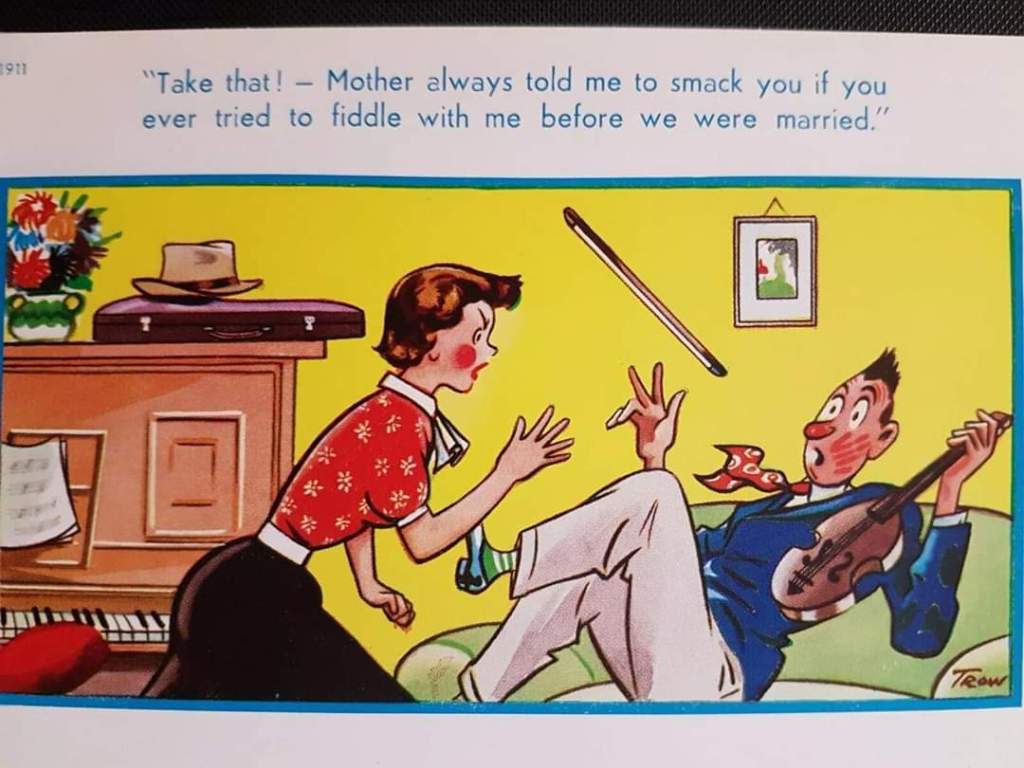
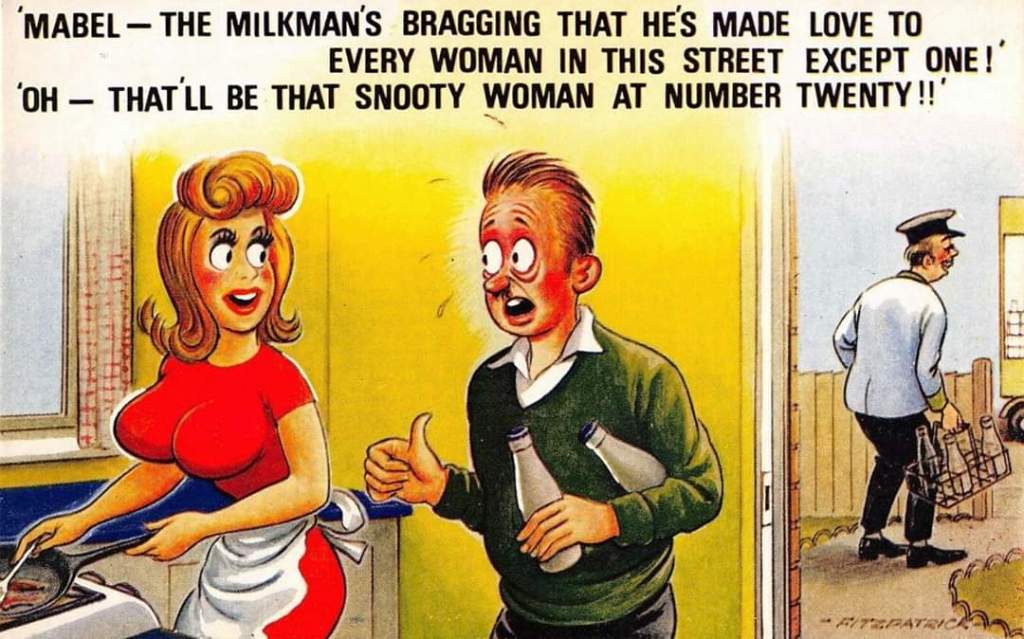
The ones I enjoyed, however, were the saucy cartoons. I found them funny without even knowing why.
Some like the one above were a play on words and even as a child I loved words. As my grandfather played the violin I knew what “fiddle” meant. I also knew that you were not supposed to “fiddle around” with things and the joke made sense on an innocent level.
Years later I still enjoyed the postcard jokes but began to understand them on a new level.
Jokes like the milkman ones raised many a snigger. I just wonder how many milkmen got dirty looks from the man of the house.
The point is these postcards were mainly harmless fun and part of the “Kiss Me Qick” atmosphere of a holiday resort when British humour was saucy but not obscene.
Boobs were about as naughty as it got and the postcards worked well with the wider British humour of Benny Hill chasing, but rarely catching, nubile young women in the park and around the trees and similar “innocent” fun.
Even the cinemas were in on it with the smutty but enjoyable “Carry On” films which often included the saucy and even bawdy jokes we had got used to on postcard racks.
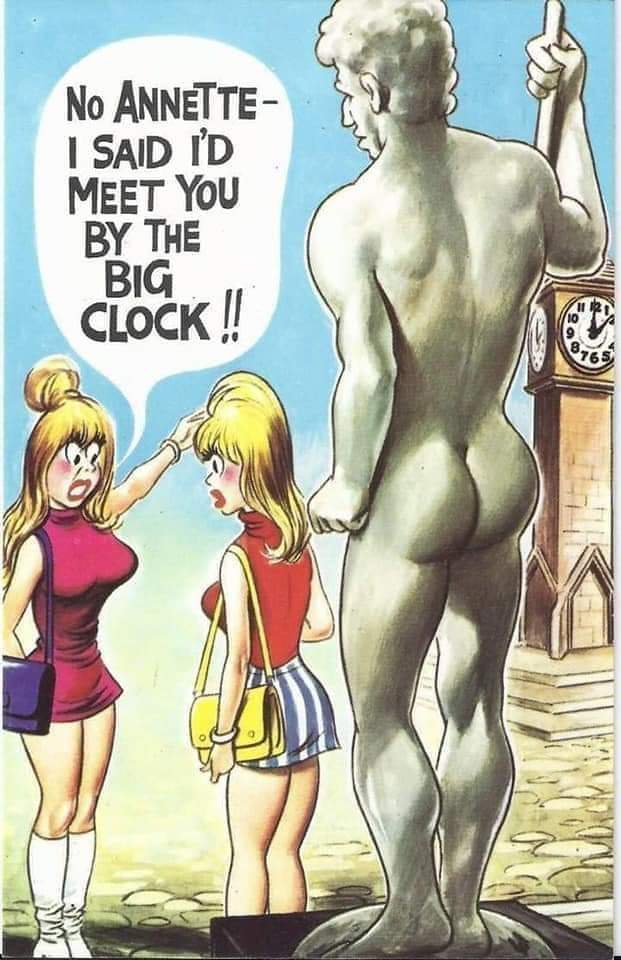
The innocence of postcard jokes like the one above began to move more blatantly to the bawdier style below:
By the 1970s more and more postcards were getting nearer and nearer to the knuckle. At the same time the Carry On films were doing the same and by the time Carry On England arrived the knuckle was in the dim and distant past.
Donald McGill, some of whose postcard cartoons had been banned in many allegedly upmarket resorts, would appear as pure as the driven snow compared to modern ones.
I still check out postcard racks but nowadays it is in the vague hope of seeing saucy postcards back there.
The men who ran the arcades (and at that time it WAS mostly men) were characters in their own right. Les Harkness, Solly Parker and Billy Williams spring to mind. Many of them, along with their employees, would stop off at my father’s shop for one reason or another. Although my father might chat to “Solly”, or “Les” to me it was “Mr Parker” or “Mr Williams” and even “Mr Turpin” whose first name I never did get to know.
The last provided me with a very special memory.
Mr Turpin owned one of the arcades at the top of our street and he administered his businesses from an office above the arcade.
When I was about 8 I had a child’s watch, not the most expensive in the world, but one day at the beach I lost it and was devastated.
The day after this incident my father told me to go and see Mr Turpin. I had often taken prescription items to him before so did not find it extraordinary.
In his office I saw the great man sitting behind his desk and proffered him the items from the shop.
Normally that would have been it but this time Mr Turpin told me to wait and then said: “Robin, your Daddy tells me you were very upset yesterday because you lost your watch.”
“Yes sir.”
“Well I have something for you to cheer you up.”
I just thought he was going to give me one of the plastic toys he often had in his office, they were prizes in things like the “Control a crane” game in his arcade.
Instead he presented me with a brand new watch, with a posh imitation leather strap and a coloured dial.
I was amazed. This was one of the major prizes that nobody seemed to ever win when controlling the crane’s claws.
To him it was not much. He probably bought them by the gross. To me it was one of the kindest acts I had known from someone outside my family.
Shakespeare knew that nature hides many secrets and that *man* (or in Antony and Cleopatra the Soothsayer) would be forever trying to seek them out.
*man* please forgive this sexist reference but at the time science was, wrongly, seen as a male preserve.
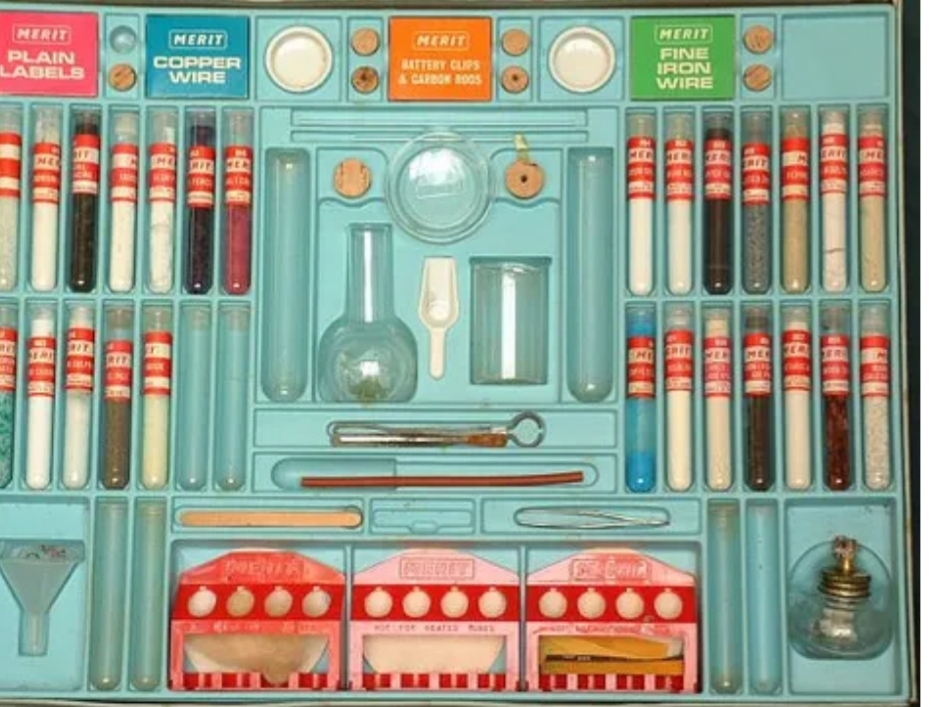
By the 1950s young boys were being persuaded to show an interest in chemistry:
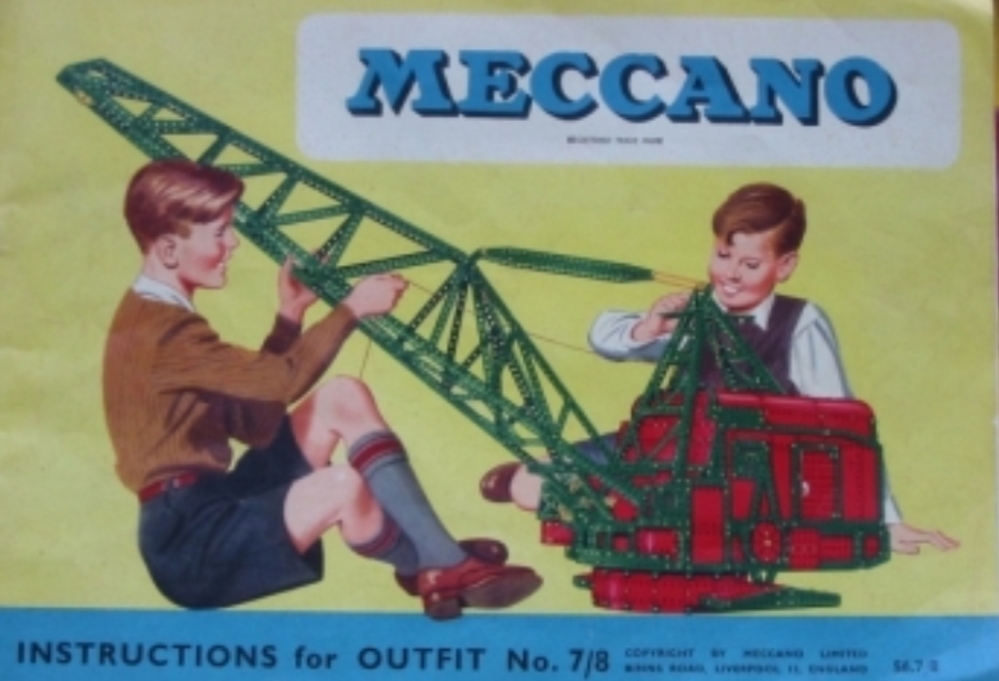
or mechanics (physics):
or biology:
Birthdays or Christmas could bring one of these science kits to your home and you could learn things that were not taught in primary schools.
The chemistry set was filled with phials of chemicals; tweezers; test tubes; and suggestions for experiments which today would have the health and safety people in absolute fits.
Even worse if it had a bunsen burner as well which would allow you to heat iron filings in a test tube or make oxygen from potassium permanganate crystals, heat sulphur and plunge it into the oxygen to see the reaction.
Surely a microscope kit could not be as dangerous?
Of course not, unless you worry about your child having a scalpel to cut up specimens or a piece of dowel with a long sharp needle in it.
At least the Meccano was relatively safe and not only taught mechanical construction but also some basic physics principles especially if your kit had pulleys and levers.
This whetted the appetite for scientific discovery and when our age group made it into grammar school a lot of little boys (and I am sure girls) found all their birthdays and Christmases had come at once with science kits blown up to the size of large rooms.
Even in the first year the initial experiments were interesting but by the second year some of us wanted more exciting things to do.
Which is why a small group of us, Louis and Jimmy Parker, Tony Custy, Peter Horton, Roger Steele and myself, formed our own little out-of-school club.
The Parkers provided a room over one of the unused stables at their home and we all chipped in funds to buy chemicals by mail order (no internet then).
We used to meet up once or twice a week after school and for a couple of hours would try out various experiments which Harry Davies the chemistry teacher (and deputy head) would never have condoned in a million years.
Our little club was provided with some of the lab equipment courtesy of the school. After all there seemed to be more test tubes, beakers and pipettes than they could ever use even if all the pupils took lessons at the same time.
We always intended to return them before we left school.
Most of our experiments were moderately harmless and produced interesting coloured smoke or bright flashes. It would have been very handy if we had decided to form a magical act.
There were no real problems with our youthful experiments, except one time when a combination of various chemicals (to this day I still can’t remember all of them but a couple of acids were involved) made a bigger flash bang wallop than a Victorian photographer with one of those magnesium powder flashes that took half an hour to clear.
We all got out of the room coughing and spluttering but managed to get back in to open the windows and by wafting the door back and forth we eventually made things breathable.
We decided after that to disband the club and stick to what we could learn from Harry Davies.
It was many years later I checked out some of the chemicals we did have, and others easily obtainable from the school lab, and realised we had everything we needed to nitrate toluene.
This would have given us mononitrotoluene from which we could have continued to dinitrotoluene.
The third stage would have been . . .
Well figure it out for yourself. Now that would have been a real flash BANG wallop.
I did retain my interest in scientific experiment out of hours but it tended to move more to the biological side rather than the chemical side. I still have the junior microscope I was given at that time.
I actually ended up with my own dissection table in the warehouse in our backyard but the only clients on it were a rabbit (which ran out in front of my bike early one day as I was doing my paper round and dropped dead); and a pig’s head which we had used for the banquet scene when we performed Macbeth.
I discovered the rabbit was riddled with shot and must have kept running, not realising it had been shot, until it broke cover and died at my feet.
The pig’s head ended up in the bin on rubbish collection day because it raised too much of a stink.
Despite this it still left me with my ambition to become a forensic pathologist. I had read up on all the Sir Bernard Spilsbury cases that were published before I was 13.
Just to show I am aware my female classmates were also interested in science I unearthed this school laboratory picture:
*** *** *** ***
PS: yesterday’s yarn had a slightly spooky outcome.
I had been talking about the people in the Humpty Dumpty pantomime and Gwyneth Dillon (nee Roberts) told me that just before she read it she found an old newspaper cutting. It was the local newspaper review of the last week of that very pantomime.













 Robin's Nest