Eighty years ago today my father was celebrating his 25th birthday – somewhere in France. It was a week before the mass evacuation of the British Expeditionary Force from the French port of Dunkirk.
Unfortunately Sgt. David Pierce, RAMC, did not get to Dunkirk with his ambulance convoy.
My father was studying at the Liverpool College of Pharmacy when war was declared on 3 September 1939. He immediately went and volunteered for the Royal Army Medical Corps.
The second thing he did was to visit his fiancee, Ivy Lloyd, who he had met in Rhyl two years earlier when she was on holiday with her family.
He told her what he had done and asked her to have their wedding earlier than planned – in fact in just six weeks’ time.
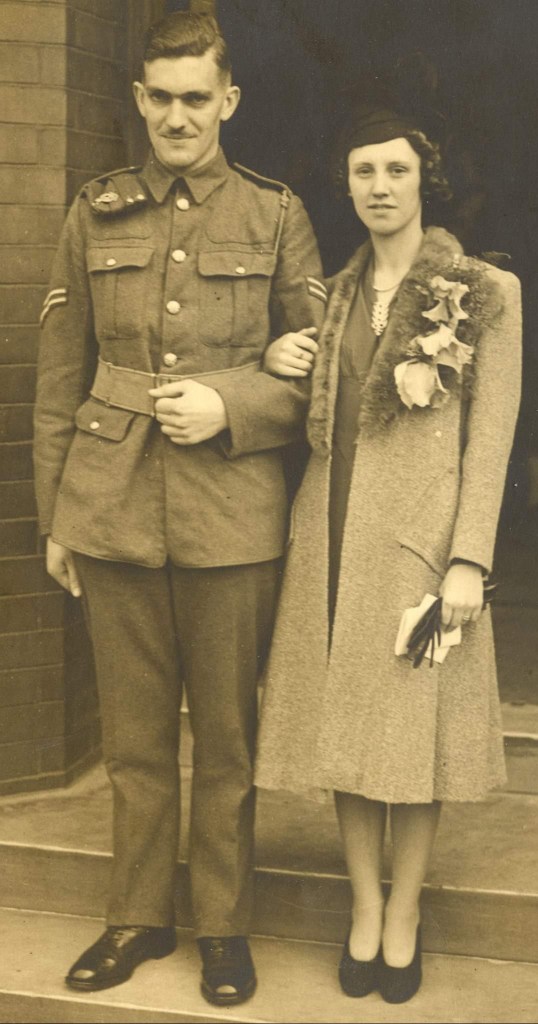
He spent those six weeks at an army training centre in the south and returned to Liverpool on Sunday, 15th October, having gained the rank of corporal.
They got married on Monday, 16th October and had a two-day honeymoon in London. Then she returned to Liverpool and he joined the troops heading for Belgium.
Seven months later she did not know if her new husband was dead or a prisoner of the Germans. She did know that he was not one of those evacuated from Dunkirk on the “armada of little ships”.
In fact his ambulance convoy was eventually evacuated from a port on the West coast of France (Brittany).
Following a recently-released film most people are aware the Dunkirk evacuation was called Operation Dynamo.
The last ships left Dunkirk on 4th June and then they had to organise Operation Aerial which took two weeks to get the rest out. Unfortunately the families of those who did not get out at Dunkirk were not informed there was a second chance.
Dad could have reached Dunkirk if he had been willing to leave the ambulances of wounded men to be captured by the Germans. Every single medic and driver refused to leave their charges and struck out for the West.
They managed to stay roughly 24 hours ahead of the German army. Unfortunately the Luftwaffe constantly pursued them and time after time they had to seek cover as the Germans didn’t seem to notice the red crosses when they strafed the road.
Dad made light of this when he told us of his wartime adventures but to this day we knew we were lucky to be here because he was lucky to get home.
It was mid-June before he finally got back to Britain. He was given a short leave and was then posted to the Middle East and my mother didn’t see him again for five years.
Do not go gentle into that good night, Old age should burn and rave at close of day; Rage, rage against the dying of the light.
Though wise men at their end know dark is right, Because their words had forked no lightning they Do not go gentle into that good night.
Good men, the last wave by, crying how bright Their frail deeds might have danced in a green bay, Rage, rage against the dying of the light.
Wild men who caught and sang the sun in flight, And learn, too late, they grieved it on its way, Do not go gentle into that good night.
Grave men, near death, who see with blinding sight Blind eyes could blaze like meteors and be gay, Rage, rage against the dying of the light.
And you, my father, there on that sad height, Curse, bless, me now with your fierce tears, I pray. Do not go gentle into that good night. Rage, rage against the dying of the light.
Home schooling is not easy, as many parents are discovering during this crisis. That does not mean it can not be done and done well.
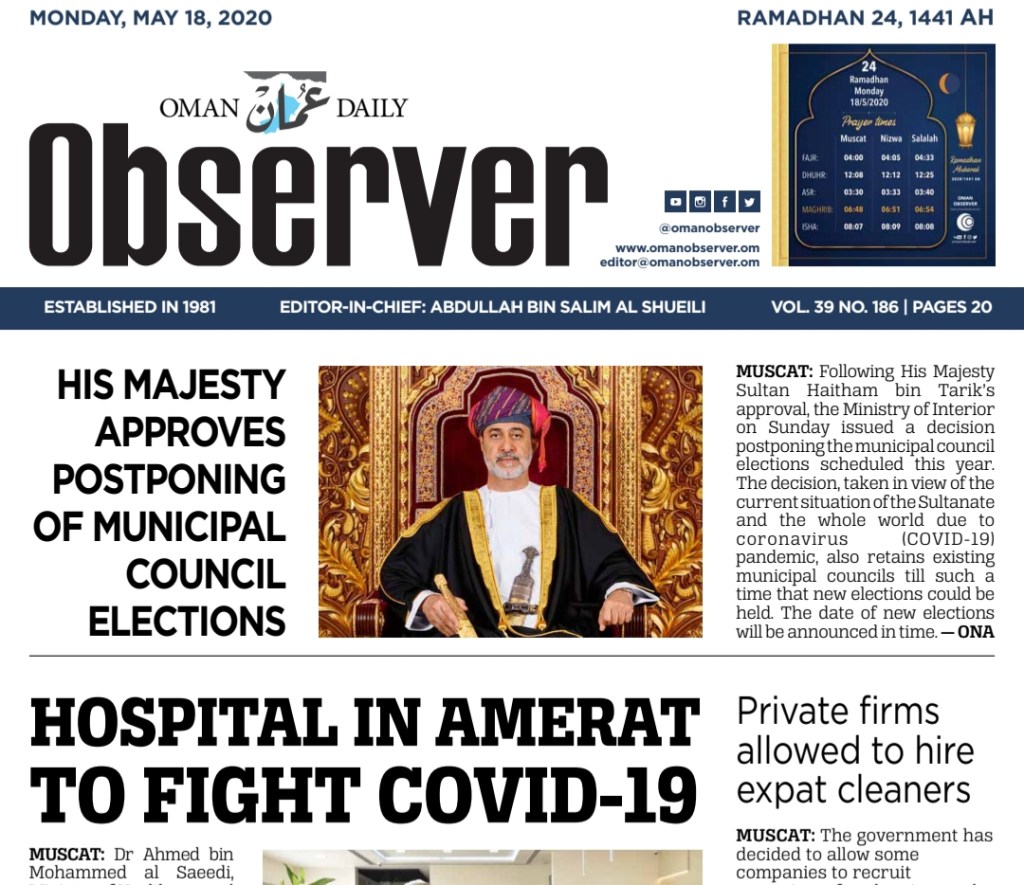
In the 80s I spent two years working in Oman as night editor of the state-owned daily newspaper.
Th Oman Obsrver as it looks today. When I did the layouts over 30 years ago we did not use all caps headings
After a few months my wife and children joined me but it was not long before we realised it was not the best place for a 13-year-old and an 11-year-old girl to be.
My daughters went back to Prestatyn to stay with my brother and his family and attend the local secondary while my son, aged seven, stayed with us in Oman and began home schooling.
Simple maths problems were easy to supply and for English a teacher back home had given us material to get us through a couple of years.
That left geography and history. The latter wasn’t too hard as Marion and I had a good working knowledge of both and for the former we started with a large scale world map pinned up on the apartment wall.
It began with giving him a place to find on the map. After two weeks he was finding towns or countries within 60 seconds.
By the time we returned to North Wales he was ahead of his peers in almost every subject. I was not that hot with Welsh but his maths and command of the English language was great.
My own home schooling was not quite so free and easy.
In September 1965 my first major problem surfaced. I missed my friends.
I know Roger and I, along with a couple of others, Dennis Randall and Peter Horton, had knocked about together all summer.
The difference on the first day of the autumn term was that I was sitting down at home with a stack of books and lesson booklets and they were together in a classroom.
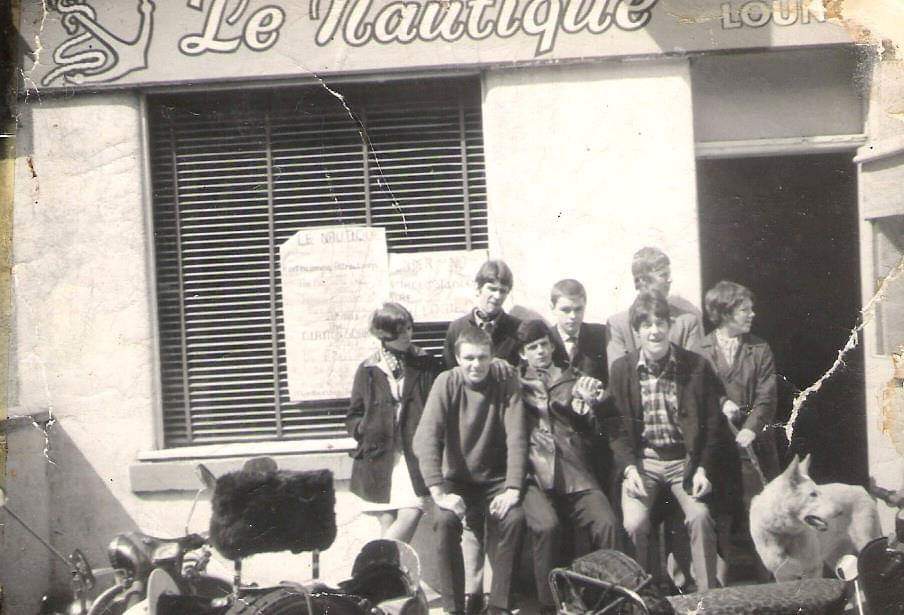
Ater a while I began to take a break and meet Roger and others after school at a local coffee bar in town Le Nautique.
Le Nautique – a great place to meet for a coffee and to play favourite hits on the juke box and even catch a live gig.
The difference to learning in school as to learning at home was that without the school discipline I had to discipline myself.
Later in life I found that this was a bonus especially as a journalist when setting a deadline and sticking to it was vital. If deadlines weren’t met and presses didn’t roll on time the story didn’t get to the people.
A few years later when I was on a journalism block release course a lecturer (teacher not journalist) said: “Robin needs deadlines and if they are not set then he sets his own, which is not always a good thing.”
She was right and she was wrong.
At work my personal deadlines meant I always completed my work to fit in with the overall deadline.
In life itself I often set unnecessary deadlines as to when to set off to get somewhere, allowing for problems en route. This has meant that at times I arrived for appointments half an hour beforehand. At least I wasn’t late.
Back to home school.
My first delivery of schooling material arrived about a fortnight before the September start which meant I did have time to go through it and work out my own timetable.
For history and geography it was fairly easy to plan because pieces of work had to be returned at set dates and, especially with history, there was a chronological order of study.
Englsh was a different matter. Did I read Lord of the Flies in one straight run and then refer back to it as necessary or should I read it alongside the course insructions?
That was easy – I read it on the day I got it, for pleasure, then read it twice more before home school began. Once because I enjoyed it and the second time just to make sure I hadn’t missed anything.
Occasionally I slipped and instead of working I would let my mind wander.
In school this would have meant a sharp reprimand or even a well-flung piece of chalk.
In my lounge/classroom I had to snap out of it and get back on track because I wanted to, not because someone was making me do it.
It soon dawned on me that my problem was grammar school rigid authority. The school’s problem was that the more they clamped down on me the more I rebelled.
It doesn’t make either setup right or wrong but it was a lesson that helped me over the next 55 years and continues to help me to this day.
That’s the school bell ending the lesson. Or is it just the old black telephone ringing away?
Hope you liked the Larkin this morning. Taking time out today to have a virtual chat with the family. Back tomorrow morning in poetical mood and then the neverending story goes on.
That Whitsun, I was late getting away: Not till about One-twenty on the sunlit Saturday Did my three-quarters-empty train pull out, All windows down, all cushions hot, all sense Of being in a hurry gone. We ran Behind the backs of houses, crossed a street Of blinding windscreens, smelt the fish-dock; thence The river’s level drifting breadth began, Where sky and Lincolnshire and water meet.
All afternoon, through the tall heat that slept For miles inland, A slow and stopping curve southwards we kept. Wide farms went by, short-shadowed cattle, and Canals with floatings of industrial froth; A hothouse flashed uniquely: hedges dipped And rose: and now and then a smell of grass Displaced the reek of buttoned carriage-cloth Until the next town, new and nondescript, Approached with acres of dismantled cars.
At first, I didn’t notice what a noise The weddings made Each station that we stopped at: sun destroys The interest of what’s happening in the shade, And down the long cool platforms whoops and skirls I took for porters larking with the mails, And went on reading. Once we started, though, We passed them, grinning and pomaded, girls In parodies of fashion, heels and veils, All posed irresolutely, watching us go,
As if out on the end of an event Waving goodbye To something that survived it. Struck, I leant More promptly out next time, more curiously, And saw it all again in different terms: The fathers with broad belts under their suits And seamy foreheads; mothers loud and fat; An uncle shouting smut; and then the perms, The nylon gloves and jewellery-substitutes, The lemons, mauves, and olive-ochres that
Marked off the girls unreally from the rest. Yes, from cafés And banquet-halls up yards, and bunting-dressed Coach-party annexes, the wedding-days Were coming to an end. All down the line Fresh couples climbed aboard: the rest stood round; The last confetti and advice were thrown, And, as we moved, each face seemed to define Just what it saw departing: children frowned At something dull; fathers had never known
Success so huge and wholly farcical; The women shared The secret like a happy funeral; While girls, gripping their handbags tighter, stared At a religious wounding. Free at last, And loaded with the sum of all they saw, We hurried towards London, shuffling gouts of steam. Now fields were building-plots, and poplars cast Long shadows over major roads, and for Some fifty minutes, that in time would seem
Just long enough to settle hats and say I nearly died, A dozen marriages got under way. They watched the landscape, sitting side by side —An Odeon went past, a cooling tower, And someone running up to bowl—and none Thought of the others they would never meet Or how their lives would all contain this hour. I thought of London spread out in the sun, Its postal districts packed like squares of wheat:
There we were aimed. And as we raced across Bright knots of rail Past standing Pullmans, walls of blackened moss Came close, and it was nearly done, this frail Travelling coincidence; and what it held Stood ready to be loosed with all the power That being changed can give. We slowed again, And as the tightened brakes took hold, there swelled A sense of falling, like an arrow-shower Sent out of sight, somewhere becoming rain.
In 1965 in the UK Harold Wilson was Prime Minister; wartime PM Winston Churchill was given a state funeral; Liverpool won the FA Cup for the first time; Ian Smith was preparing to declare UDI in Rhodesia; the Beatles first film ‘Help” was released; capital punishment was ended; Kenneth Tynan was the first person to use the “f” word on British television.
Meanwhile in Rhyl my friends and I were making the most of a mediocre summer.
I truly intended to make the most of what might be my last summer of freedom. After all if you don’t go to school you don’t get school holidays.
The amusement arcades and the theatre were not my only source of enjoyment.
In later years, when we had our own motorised transport, we could travel far afield but that summer we relied on our bikes or just walked.
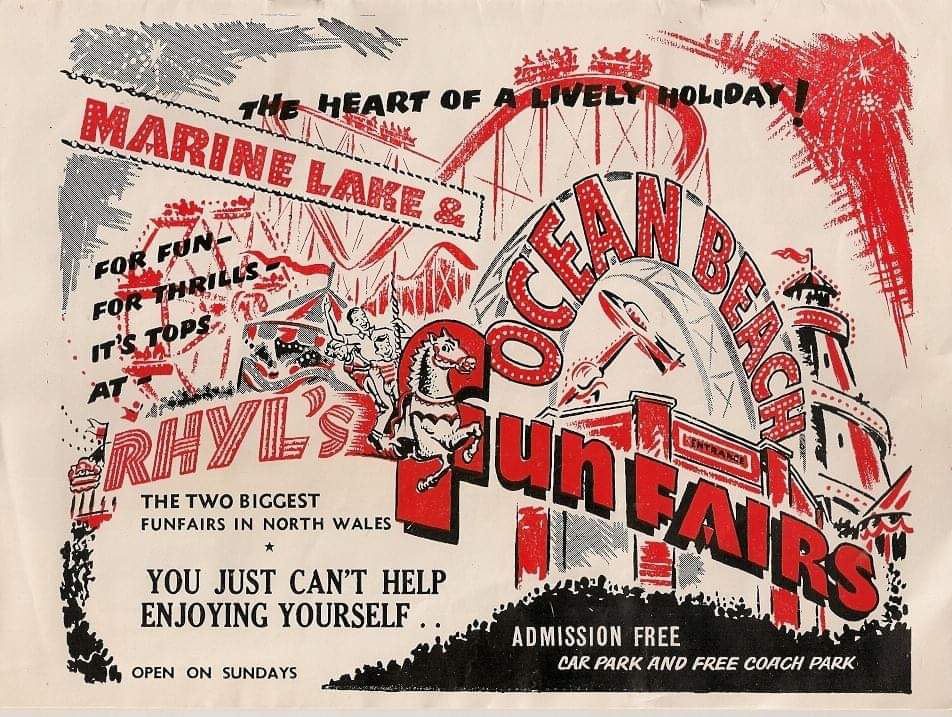
It wasn’t far from the town centre to the harbour or the Marine Lake and at that end of town Rhyl had not one but two funfairs.
Although they were technically two separate fairs the Marine Lake Fun Fair and the Ocean Beach were one great homogenous, flashy, brightly-lit and loud source of fun.
Sometimes we would go down in the daytime but the real fun was to be had at night when all the stalls and rides were garishly lit with multi-coloured bulbs; the stallholders and barkers shouted out the delights of their offerings; and holidaymakers screamed and shouted on rides such as the Caterpillar, or the Mad Mouse rollercoaster; or the carousel.
The Big Wheel, from the top of which you got a view of the Clwydian Range in one direction or out to sea the other, and the Mad Mouse, a rollercoaster ride which left your stomach behind as it dropped from the heights, or had you scared it would come off the tracks on corners.
At ground level the fair seemed to go on and on with hoop-la stalls, coconut shies, roll-a-penny pitches, even a rifle range with real rifles, Winchesters, and real bullets, just as the cowboys used at the Saturday morning pictures.
At 15 (going on 16) we were aware of the opposite sex. Not that sex was really on the cards with local girls where you were more likely to get a slap wthout even the slightest tickle.
Holidaymakers were a different matter.
Don’t get me wrong. I am not suggesting that these girls were ‘easy’. Far from it. Yet wandering hands might get a bit further when the girl knew she was unlikely to see you ever again once the holiday was over.
When the cover went over the carriages on the Caterpillar the shrieks weren’t all from girls scared of the dark.
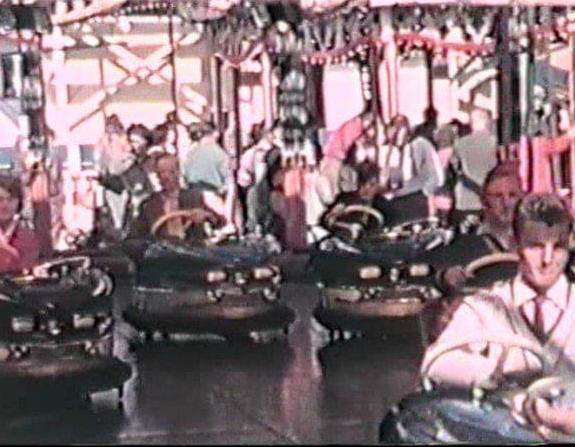
Not that local boys had the pick of the girls at the fair. That ‘honour’ was more likely to benefit the lads on the dodgem cars who would jump from car to car as they collected the money.
Dodgem cars at Rhyl were holidaymakers were an easy target for the lads who collected the fares.
If you did find a girl at the fair you were best advised to take her round some of the sideshows first to win her a cuddly toy by hitting the Ace of Spades with three darts; or flicking a wooden ring over a post with a prize on top. Trying to impress her with the ‘Test Your Strength’ machine was not a good idea.
A couple of prizes, a candy floss or hot dog followed by a ride on the carousel was the perfect prelude to a trip on the Ghost Train where you had a good chance of your partner clinging to you in fright at the luminous skeletons and giant spiders.
An offer to walk her back to her digs was a further chance of intimacy as you slipped an arm around her waist and, if you were really lucky, you might get a five-minute midnight smooch on the doorstep.
There are probably numerous boys who went back to school after that summer and told their pals of the fun they had under the pier with a different girl every night.
In reality the closest they would have got to the birds and the bees was in a biology lesson.
Philip Larkin claimed in his poem Annus Mirabilis that sex was invented in 1963 – he may have been right but it didn’t reach North Wales for quite a few years after that.
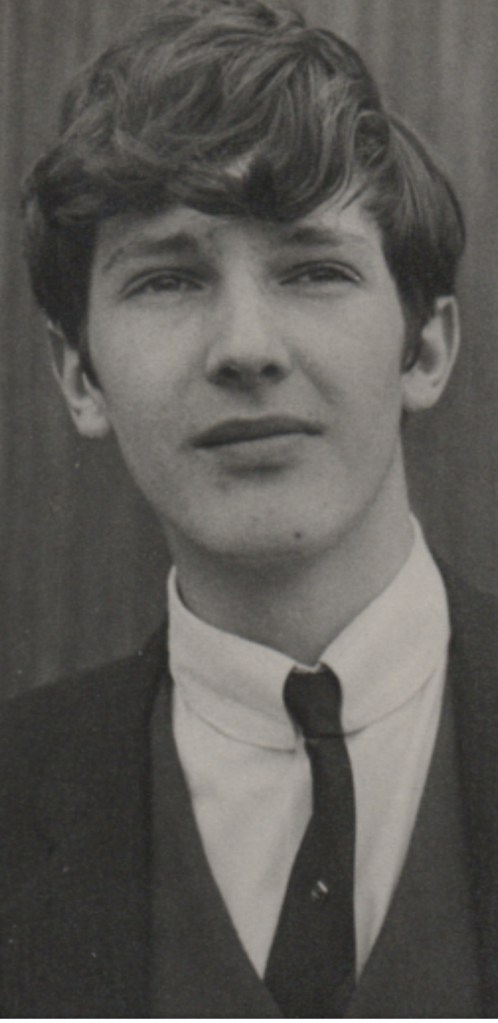
School’s out so the dull school uniform was a thing of the past as was the old school tie. Me at 15.
I have to admit 1965 turned out to be quite a year. Leaving grammar school at 15 was not a usual occurrence in the 60s. The point is I didn’t fit in.
If a lesson interested me then I gave it my full attention. The problem was that other than English the major part of most lessons was boring.
Even the science subjects, which for four years were the foundation of my dreams for a future in forensic science, could not hold my attention for more than half a lesson period – and we sometimes had double periods.
Put me in an English class, especially literature, and I was all eyes and ears. Dale Jones had opened a new world for me.
For now, however, I had an early summer holiday and the actual summer holidays ahead of me as my correspondence courses did not start until September.
An extra bonus was that I could give more time to my major interest – the theatre. Not theatre in general but specifically the Rhyl Little Theatre.
Since my debut as a fish I had participated in a number of productions including my first Shakespearean role.
That’s me on the right with horned helmet (indicated), posh red cloak with a yellow lining and a sword
Unfortunately when I won a part I used to throw myself into it heart and soul and with a week of evening performances this can be quite draining to a 14-year-old boy. By the third night I had developed a temperature and felt constantly cold – not that I admitted that to anyone.
When I was offstage I would go to the dressing room and wrap myself up in my cloak and do everything possible to stay awake.
I kept going for the week, Monday to Saturday 7.30pm to 10.30pm. When I woke on Sunday morning I felt drained, but by then I could afford to feel that way as the play was over.
My parents kept me in bed all that day and the following day they called the doctor. He could not identify the actual sickness but he knew the best cure. I spent that week in bed not school.
I have had similar bouts since but have normally recognised it in time and just spent 24 hours in bed gettng shot of it.
I think it was 1965 that I appeared as Dennis in the Group 200 production of Loot by Joe Orton. It was a risque play for any theatre company let alone an amateur drama group in a Welsh seaside town.
I suggest you look up the plot. Suffice it to say that at 15 I was playing a bisexual undertaker’s assistant turned bank robber. My fellow criminal was Mike (Williams) Carpenter who had appeared with me in The Deserted House. He also played the eponymous hero in The Adventures of Tom Sawyer when I played his pal Joe Harper.
I said 1965 was an important year in the sense of my growing up. I mean at 15 I had certainly recognised the delights of some of my female companions at the theatre.
I did go out on some rather juvenile dates, generally to the pictures, but things certainly never went as far as others claim was their experience in that “summer of love”.
Maybe that is why so many “girl friends” remained girl friends.
That was not the major part of my growing up that year, however. That came with a Sunday magazine supplement and an article about a young revolutionary who within two years would become an international icon of youth.
At that time he was still a niche character, subsidiary to the Cuban president Fidel Castro who had expelled the corrupt dictator Fulgencio Batista in January 1959.
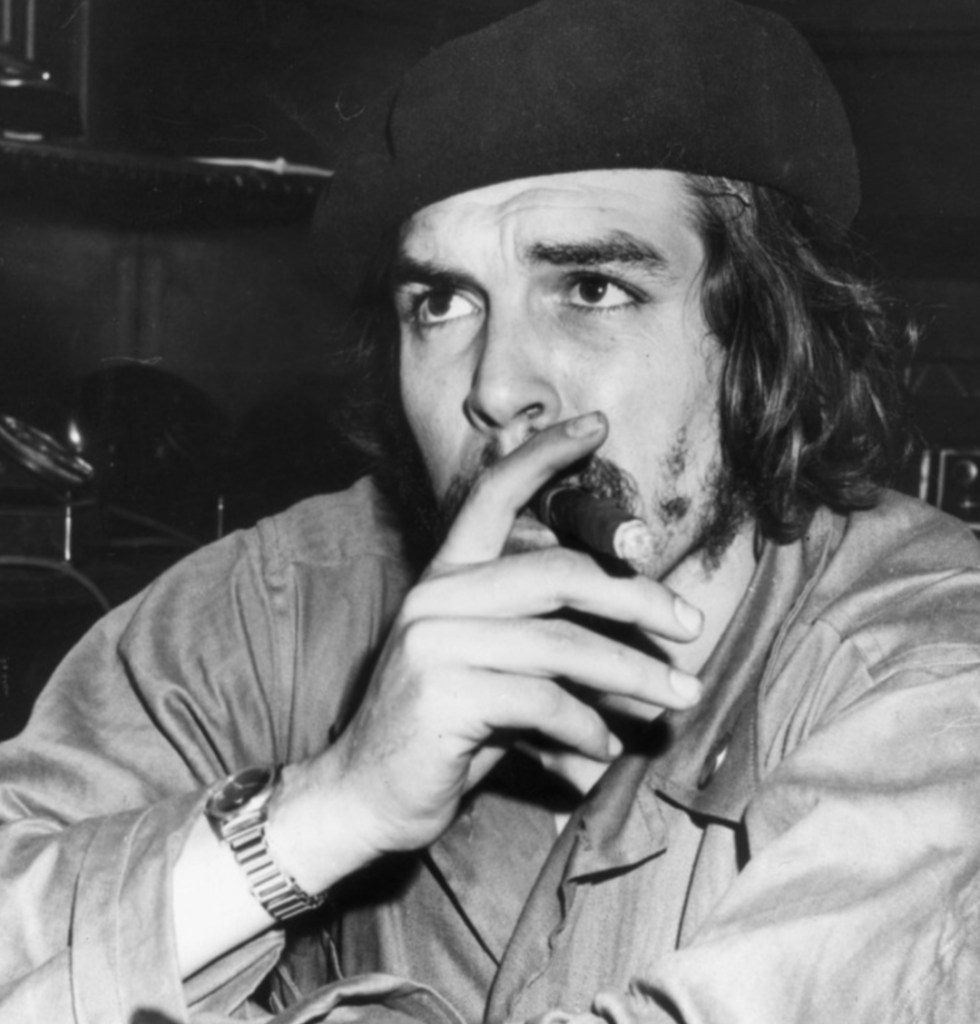
The newspaper article was about a young Argentinian who accompanied Castro in 1959 but was now resigning from the government to take the revolutionary message further afield.
Ernesto ‘Che’ Guevara
Not that I jumped straight in to revolutionary politics, although that was when my earliest socialist views kicked in. Probably the radical background of Nonconformist ancestors including Welsh weavers and shoemakers.
My first affiliation to any political party was, as many people will be surprised to hear, Plaid Cymru led at that time by Gwynfor Evans.
Plaid Cymru’s attraction to me might not have been totally political. I was in a relationship with a very attractive red head at that time and she might have had an influence on me.
It did not last long as both the girl and Plaid Cymru were put behind me later that year and I looked towards a political ideology that was not quite so nationalistic – possibly more internationalist.
That, as they say, is another story. For now we will leave it there in the glorious summer of 65 when my life began to branch out.




 Robin's Nest