Tiny Warrior

by Sharmagne Leland St. John

Nikolai 1982-1983
You never saw the spring my love
Or the red-tailed hawk circling high above
On feathered wings my love
You only knew the snow
You never saw the prairie grasses bend and blow
And undulate like the shimmering indigo sea
You never saw me
Your eyes were closed so tight
They say you put up quite a fight
Somehow your life was over before it had begun and
Gently did I touch and kiss your tiny-fingered hand
Born too soon
You never saw the silver moon
Or the light of a summer's day
Last night I dreamt a gathering of eagles
Had come
To spirit you away
Born too soon
Your tender heart
Could not beat
To the pulsing rhythm
Of life's taut drum

Fox-Hunting

by Rudyard Kipling

The Fox Meditates
When Samson set my brush afire,
To spoil the Timnites barley,
I made my point for Leicestershire
And left Philistia early.
Through Gath and Rankesborough Gorse I fled,
And took the Copslow Road, sir!
And was a Gentleman in Red
When all the Quorn wore woad, sir!

When Rome lay massed on Hadrian's wall,
And nothing much was doing,
Her bored Centurions heard my call
O' nights when I went wooing.
They raised a pack - they ran it well
(For I was there to run 'em)
From Aesica to Carter Fell,
And down North Tyne to Hunnum.

When William landed, hot for blood,
And Harold's hosts were smitten,
I lay at earth in Battle Wood
While Domesday Book was written.
Whatever harm he did to man,
I owe him pure affection;
For in his righteous reign began
The first of Game Protection.

When Charles, my namesake, lost his mask,
And Oliver dropped his'n,
I found those Northern Squires a task,
To keep 'em out of prison.
In boots as big as milking-pails,
With holsters on the pommel,
They chevied me across the Dales
Instead of fighting Cromwell.

When thrifty Walpole took the helm,
And hedging came in fashion,
The March of Progress gave my realm
Enclosure and Plantation.
'Twas then, to soothe their discontent,
I showed each pounded Master,
However fast the Commons went,
I went a little faster!

When Pigg and Jorrocks held the stage,
And Steam had linked the Shires,
I broke the staid Victorian age
To post, and rails, and wires.
Then fifty mile was none too far
To go by train to cover,
Till some dam' sutler pupped a car,
And decent sport was over.

When men grew shy of hunting stag,
For fear the Law might try 'em,
The Car put up an average 
Of twenty dead per diem.
Then every road was made a rink
For Coroners to sit on;
And so began, in skid and stink,
The real blood-sport of Britain!

Lucifer and his little devils take a load off the editor’s shoulders

In the beginning was the Word.

And the Word was spelt E-D-I-T-O-R.

Since the news sheets of the 17th century metamorphosed into the newspapers of the 19th and 20th centuries the editor, who might once have been reporter, typesetter and even printer all in one, grew to become the final arbiter regarding what appeared in the newspaper.

Throughout the 19th century the editor’s job was not exactly mind-stretching. Reports came in from far-of places, or just around a specific locality, and were typeset in 7pt (that is very small type) then run into the newspaper columns until the story ran out or the space ran out.

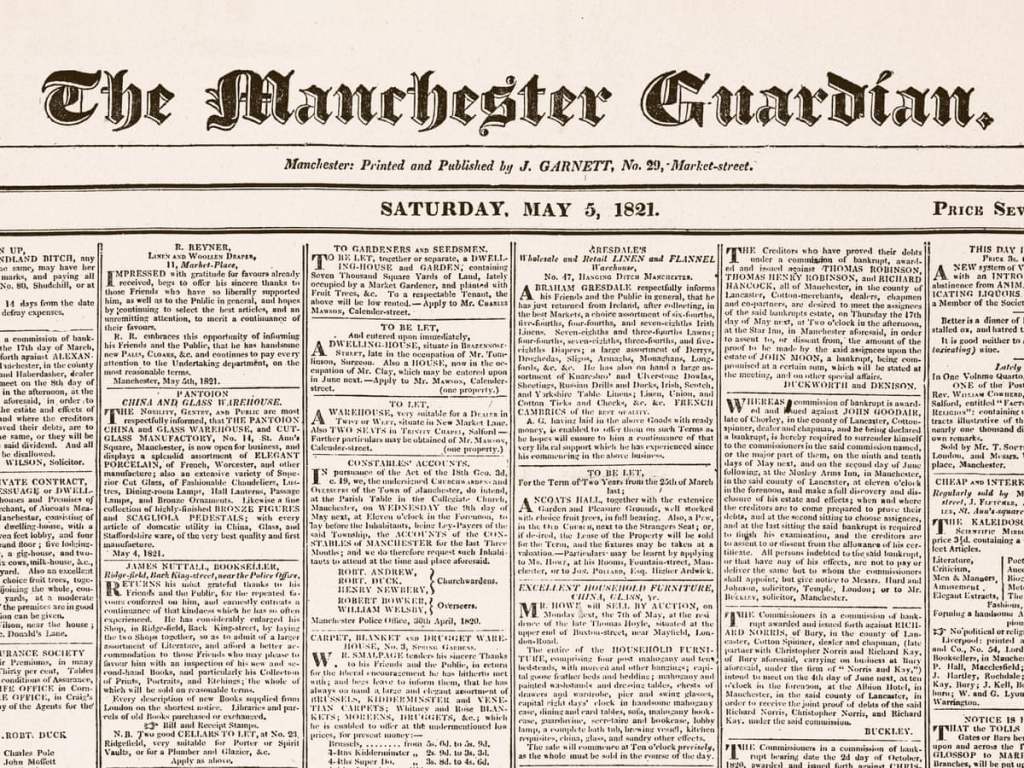
All this often appeared within the pages as the front page was given over to small advertisements: these would cover auctions; properties to let; public notices; share prices; even market prices for vegetables.

The first edition of the Manchester Guardian front page in 1821

Things changed in the 20th century when newspaper editors, and owners, realised that, rather than lengthy slabs of foreign news, or council reports, or other lengthy articles, the readers wanted more news items and stories and better direction to the content they wanted to read.

The editors could not handle alone the vast quantity of material that thus came in from reporters: the news reports; the crime reports; the foreign reports; the political reports.

This is why, in the early 20th century, a new role was created – a barrier between the reporters and the editor – if the editor was God then this new creation (the sub-editor) was Lucifer, or at least it seemed that way to the reporters.

Now, instead of copy going to the editor, it was the sub-editor (or on bigger newspapers the chief sub and his crew of devils) who decided which copy was fit to go through, which could be allowed through after some tidying up and which got spiked.

In fact the sub-editor was brought in to take a load off the editor’s shoulders and allowing him (not many women in the role at this point) to concentrate on the overall design of the newspaper and the most important stories.

The devilish reputation of the sub-editor came about when reporters felt their stories had been cut back too much; had been spiked; or had been rewritten to the extent that the reporter did not recognise the story as his or her own. Not that they dared speak out because after the EDITOR the sub’s word was law.

In fact rewriting a story was the last thing most subs wanted to do as it took greater time to do that than to just tidy up and check facts and grammar. If a sub rewrote a story then it was either the only way to save it (sign of a good sub) or the sub felt he or she could write a better version (not the sign of a good sub).

I was initiated into the dark arts of subbing in that glorious summer of 1973 when Tony Blandford, the editor, set me to work initially with the paper’s single sub one day a week to learn the ropes (although we had studied subbing on the NCTJ courses) and then gave me a general round-up page People in Close-up on a Wednesday, rather than the whole day I was allowed the afternoon for that, having to have cleared any stories on my notebook from the morning.

As most of my time was spent reporting at this stage I did not consider myself even a part-time sub at this stage. My love of editing and design was to come later, much later.

TO COME: what differentiates the sub from the reporter when it comes to words.

To An Absent Lover

by Helen Hunt Jackson

That so much change should come when thou dost go,
Is mystery that I cannot ravel quite.
The very house seems dark as when the light
Of lamps goes out. Each wonted thing doth grow
So altered, that I wander to and fro
Bewildered by the most familiar sight,
And feel like one who rouses in the night
From dream of ecstasy, and cannot know
At first if he be sleeping or awake.
My foolish heart so foolish for thy sake,
Hath grown, dear one!
Teach me to be more wise.
I blush for all my foolishness doth lack;
I fear to seem a coward in thine eyes.
Teach me, dear one, - but first thou must come back!
 

The Miner

by Henrik Ibsen

translated by Fydell Edmund Garrett
Beetling rock, with roar and smoke
Break before my hammer-stroke!
Deeper I must thrust and lower
Till I hear the ring of ore.

From the mountain's unplumbed night,
Deep amid the gold-veins bright,
Diamonds lure me, rubies beckon,
Treasure-hoard that none may reckon.

There is peace within the deep -
Peace and immemorial sleep;
Heavy hammer, burst as bidden,
To the heart-nook of the hidden!

Once I, too, as a careless lad,
Under starry heavens was glad,
Trod the primrose paths of summer,
Child-like knew not care nor cummer.

But I lost the sense of light
In the poring womb of night;
Woodland songs when earth rejoiced her,
Breathed not down my hollow cloister.

Fondly did I cry, when first
Into the dark place I burst:
"Answer spirits of the middle
Earth, my life's unending riddle!--"

Still the spirits of the deep
Unrevealed their answers keep;
Still no beam from out the gloomy
Cavern rises to illume me.

Have I erred? Does this way lead
Not to clarity indeed?
If above I seek to find it,
By the glare my eyes are blinded.

Downward, then, the depths are best;
There is immemorial rest.
Heavy hammer burst as bidden
To the heart-nook of the hidden!--

Hammer-blow on hammer-blow
Till the lamp of life is low,
Not a ray of hope's forewarning;
Not a glimmer of the morning.

Twice Shy

by Seamus Heaney

Her scarf a la Bardot,
In suede flats for the walk,
She came with me one evening
For air and friendly talk.
We crossed the quiet river,
Took the embankment walk.

Traffic holding its breath,
Sky a tense diaphragm:
Dusk hung like a backcloth
That shook where a swan swam,
Tremulous as a hawk
Hanging deadly, calm.

A vacuum of need
Collapsed each hunting heart
But tremulously we held
As hawk and prey apart,
Preserved classic decorum,
Deployed our talk with art.

Our Juvenilia
Had taught us both to wait,
Not to publish feeling
And regret it all too late -
Mushroom loves already,
Had puffed and burst in hate.

So, chary and excited,
As a thrush linked on a hawk,
We thrilled to the March twilight
With nervous childish talk:
Still waters running deep
Along the embankment walk.

Take your pick on our origins but it all leads back to socialism

In the beginning . . .

What?

Was there nothing and did some supernatural being create all we have now?

OR;

Was there nothing except a tiny condensed spot of everything which then started to expand, like a magician’s box out of which you can pull everything you need, from tiny grains of sand to mighty oceans.

You pays your money and you takes your choice.

If you fancy the Creation route or the Big Bang route it would be hard to argue against it all being created with a background of socialism.

After all the Bible tells us that God gave man dominion over all:

“And God said , Let us make man in our image, after our likeness: and let them have dominion over the fish of sea, and mover the fowl of the air, and over the cattle, and over all of the earth, and over every creeping thing that creepeth upon the earth.”

Genesis 1:26 KJV

Now there are those that says this refers to man not woman but Genesis also says that God made woman of man which means they are flesh and blood. There is no mention of Adam or his children, or his children’s children, or his children’s . . . . well you get the idea, having to work for someone else and then buy back what he has produced.

On the other hand if you follow the evolutionary route then you accept the first blob split itself into two, and kept on doing so until they amassed as an entity which slowly but surely (and by slowly I mean over billions of years) evolved into the creatures we call man, or mankind, or homo sapiens.

Even as Charles Darwin was working on his theory of evolution Friedrich Engels and Karl Marx were highlighting their version of why all men are equal despite the many changes over the millenia.

In 1844 Marx wrote in his Economic and Philosophical Manuscripts: “Man lives from nature, i.e., nature is his body, and he must maintain a continuing dialogue with it if he is not to die. To say that man’s physical and mental life is linked to nature simply means that nature is linked to itself, for man is a part of nature.”

This was 15 years before Darwin’s Origin of the Species but the theories were being bandied around before that. Darwin did, of course, have a great influence on Engels and his The Part Played by Labour in the Transition From Ape to Man, essays written in 1876.

Now that evolution was being taken fairly seriously Engels was highlighting that the earliest changes from ape to man were based on labour. His basic argument is that some early hominids had abandoned the trees and started to walk – bipedalism – instead of putting some of their weight on their forearms by resting their knuckles on the ground.

The benefits of this first change were many and various according to the scientists – including the fact that they offered less of their body mass to direct sunlight at a time when they were still living on the savanna.

Engels believed a major benefit was that it freed up the hand for other purposes allowing them to become more dexterous and capable of crafting rudimentary implements. He points out that this signifies that: “hand is not only the organ of labour, it is also the product of labour.”

As we know change does not happen in an instant and homo erectus did not become homo sapiens overnight.

The change in the hand led to changes in the brain as well and our early man recognised that more and more could be done with the hand and as such the hand developed further and the implements they manufactured could be used for specific purposes, such as developing flint to cut while lashing weighty stones on to fashioned shafts to make an instrument for hitting rather than cutting.

With these tools (some of which could be weapons) early man moved beyond basic foraging. This early stage, still the way many animals exist, meant consuming everything in an area, leaving little for replenishment, before moving to a new area, which would also be denuded.

Having developed the ability to create as well as consume these hominids recognising a need for mutual support sought methods of collabaration which meant they needed a method of commuinication.

“In short,” wrote Engels, “men in the making arrived at a point where they had something to say to each other. . . . The undeveloped larynx of the ape was slowly but surely transformed . . . and the organs of the mouth gradually learned to produce one articulate sound after another.”

The adaptation continued and encompassed a change in their diets, allowing them to inhabit new environments. With the consumption of meat, and later the discovery of fire, they had found a rich source of protein that nourished their bodies and their physical brains. Each now used individual abilities to work for the good of all: some would fish, some hunt and others craft tools enabling the hunters and fishermen to carry out their works more efficiently.

Engels suggests that following on from the development of the meat diet and control of fire our forebears began the domestication of animals. Then, finally, agriculture was added to hunting and cattle raising; then came spinning, weaving, metalworking, pottery, and navigation. Along with trade and industry, art and science finally appeared.

He goes on to point out that humans became distinguished from animals by their ability to manipulate nature in varying ways rather than just fitting into a singular niche.

Thus we find that whether Creation or Evolution there was no differentiation between individuals by means of class, servitude or mastery.

From each according to ability and to each according to need.

The Waradgery tribe

Dame Mary Gilmore

Australian socialist and poet
Harried we were, and spent,
broken and falling,
ere as the cranes we went,
crying and calling.

Summer shall see the bird
backward returning;
never shall there be heard
those who went yearning.

Emptied of us the land;
ghostly our going;
fallen like spears the hand
dropped in the throwing.

We are the lost who went,
like the crane, crying;
hunted, lonely and spent
broken and dying.

Springtime carries you forward – and promises a glorious summer

The Spring of 1973 was a glorious time.

As far as I was concerned the sun shone every day; I was raking in the stories for the Standard Recorder; my circle of socialist-minded friends was widening; my social circle was a round of fun, parties and theatre; and I was getting to spend more and more time with my Muse.

On the work front I was not just covering courts and the emergency services, I was also forging strong links with members of the Basildon Town Council, both sides of the political divide, and with the right people working for the corporation.

On top of this Tony Blandford, the editor, had given me a fairly free rein to find off-diary features as well as letting me have experience of sub-editing.

This last was to set me on the path which would take me to the top of the game in provincial journalism, not just in the UK but in Australia and the Middle East as well.

My early subbing was for a page called People in close-up and would have four or five different stories which had some form of common theme. One week, for instance, it was Armed Forces. Two local RAF lads who had been given their commissions, both as pilot officer but one was now an actual pilot while the other was a plotter.

A gunner with the Royal Artillery, stationed in Singapore, had just been on a training exercise in the Malaysian jungle where the Brits and Aussies had faced their Kiwi “foes”; a driver in the Royal Corps of Transport had just spent two weeks on exercise in the Rockies in Canada, which included driving a two and a half ton Army truck on a narrow twisty mountain trail at 7,000 feet; and a leading seaman on a frigate had just rejoined the Fleet after the frigate he was on had been refitted at Chatham and then had sea trials off Portland.

Although I had not allied myself to any political party I had befriended local councillors, most of whom were Labour members. After council meetings there was often an adjournment to the nearby Arts Centre bar where “any other business” was conducted over a pint or so.

There were also NUK chapel and branch meetings where talk was building up about the annual pay talks the union would be holding with Newspaper Society bosses later in the year.

There was also a mix of work and social with press tickets to see Joe Brown and his new band Home Brew, as well as Kenny Ball and his Jazzmen offering some foot-stomping trad jazz.

The core of that time for me, however, was The Thalians.

Rehearsals were going well for the Wilde which meant at least one evening a week in the company of my Muse; at least once month, sometimes more, there would be a party at someone’s house or flat. We even had a group trip out to Epping Forest for an open air production of Brecht’s Caucasian Chalk Circle which, as there was limited parking, the 10 of us travelled in just two cars. Hubby did not join the trip (he really wasn’t theatre-minded) and there and back I sat in the back of a car between my Muse and one of the other women from the group.

To be so close and yet not being close enough.

Other than that there were Friday or Saturday mornings meeting at the bookstall in the market, choosing our treasures of the week and then going for a coffee in a nearby cafe to discuss our choices.

In the last few weeks of June, as spring prepared to give way to summer, I noticed a change in my Muse. I was aware, as we all were, that hubby was working away a lot but there seemed to be more than that, not just at rehearsals but also when we met for coffee.

As the month drew to a close, and my feelings grew stronger and stronger, we met as usual one Saturday morning and while browsing the books she said she was looking for historical novels with a Scottish base but there was nothing to be had.

That was when I remembered a couple of books I had picked up while still in North Wales, They were part of a series by Dorothy Dunnett called The Lymond Chronicles and fitted the bill perfectly.

I mentioned them and suggested we could go back to the flat for coffee (I had no ulterior motive as I didn’t intend ruining it all with a rash action) and she could see the books and if interested borrow them.

It was not long before noon and when we got up toi the flat I made the coffee first and then, while it was cooling, we went into the hall and knelt down by the bookcase, just three shelves but a lot of books.

I found the first of the Lymond books, Game of Kings, and handed it to her. As she opened it and bent her head to study the information on the back cover her hair fell forward, curtaining her face, and I could not resist saying: “I love you.”

She looked up in surprise and I leaned forward and kissed her.

Rather than pull back she seemed to lean into the kiss.

When she did pull away it was to say: “At last. I love you too.”

We kissed again, still kneeling, and then – the doorbell rang.

We both pulled back and she shot into the lounge before I had even had the time to open the door.

It was the postman.

Then again I can’t think why I should have expected anyone else.

He handed me a thick package which wouldn’t have gone through the letterbox, along with a couple of letters, one of which was possibly a bill.

Before he left my beloved’s voice came from behind me, saying: “I should be leaving now, thank you for the book> I look forward to reading it.”

With that she was gone, following the postman down the corridor to the lift, and I was left wondering if it had all been just a dream.

I couldn’t risk going to her house, it was a Saturday and hubby might be home. The same applied to Sunday and on Monday, Tuesday and Wednesday I had courts and councils with only evenings free and |I did not dare call at that time without a solid excuse in case anyone was there.

By Thursday I was cursing her lack of a telephone.

We were busy all morning tying up the final pieces for that week’s edition. The afternoon would be quieter, unless a major story cropped up, but it was 2pm before I could get away.

I could see from the end of the road that hubby’s distinctive old Humber was not parked in its usual place so, provided she was at home the only other person there would be her mother or a neighbour and I could always fudge up a good reason to be there, possibly to do with play.

I parked a few doors down and then walked to her front door and knocked.

She opened the door, saw me there and immediately reached out, grabbed my hand and pulled me inside, quickly shutting the door.

She still held my hand as we went into the living room and only let it go as she turned to face me, flung her arms around my neck and sent an electric pulse through my body as she kissed me.

My arms went around her, pulling her close, and we kissed again and again and . . . .

I got back to the office at 4pm.

The Dream Called Life

by Edward Fitzgerald

From the Spanish of Pedro Calvadon de la Barca
A dream it was in which I found myself.
And you that hail me now, then hailed me king,
In a brave palace that was all my own,
Within, and all without it, mine, until,
Drunk with excess of majesty and pride,
Methought I towered so big and swelled so wide
That of myself I burst the glittering bubble
Which my ambition had about me blown,
And all again was darkness. Such a dream
As this, in which I may be walking now,
Dispensing solemn justice to you shadows,
Who make believe to listen; but anon
Kings, princes, captains, warriors, plume and steel,
Aye, even with all your airy theatre,
May fit into the air you seem to rend
With acclamations, leaving me to wake
In the dark tower; or dreaming that I wake
From this that waking is, or this and that,
Both waking and both dreaming such a doubt
Confounds and clouds our moral life about.
But whether wake or dreaming this I know,
How dreamwise human glories come and go;
Whose momentary tenure not to break,
Walking as one who knows he soon may wake,
So fairly carry the full cup, so well
Disordered insolence and passion quell,
That there be nothing after to upbraid
Dreamer or doer in the part he played;
Whether tomorrow's dawn shall break the spell,
Or the last trumpet of the Eternal Day,
When dreaming, with the night, shall pass away.