We all know Shakespeare described the world as a stage which makes us all actors whether or not we have learned the lines.
How many of us see ourselves in that way and if we do are we a spear bearer, the star or Dandini to someone else’s Prince Charming?
If we merely stick to the Bard’s script will we go through the seven ages from “mewling, puking infant” to the second childhood and oblivion “sans teeth, sans eyes, sans taste, sans everything.”
Professional actors seek to win the starring role and some will even become directors as well as actors to ensure that they choose the path their fellow actors must take.
That does not mean you need to be a professional actor to choose your roles and direct your path through life.
Every town has its amateur dramatic group or amateur operatic society but that does not mean they know how to act or direct.
Those of us who were or are members of the Rhyl Children’s Theatre Club were taught far more about the ways of theatre and how to adapt many of those skills to help them find their way in life.
Joe Holroyd and Angela Day – an inspirational pair.
For me it took many years to realise that the decade I spent learning from Joe Holroyd and Angela Day, which saw me play many parts from a fish to a psychotic killer (not that the actual roles were lessons in life).
The greater lessons were those which taught us when to make an entrance; how to project ourselves to ensure the back row heard us without deafening those in the front seats; how not to upstage your fellow thespians but still prevent others upstaging you.
These were the onstage skills but we learned far more as Joe and Angela demonstrated the offstage workings which were as important as appearing before the audience.
Stage lighting is as nuch an art as acting. A bare stage sans scenery, sans tabs, sans backcloth can be transformed by a skilled lighting expert (John Gilbert was an artist in that field).
There are often more people offstage as on, ensuring everything runs smoothly ranging from director to stage manager; props controller to wardrobe mistress (or just as likely master); box office ticket sellers to ushers and ice-cream sales attendants.
I know that what I learned there was a major help in my life.
The art of projection can be used in real life when you need people to pay attention. This proved invaluable in my future roles in my union and later when addressing political meetings.
At the same time it helped me through two father-of-the-bride speeches when I had to draw attention to myself yet also ensure the bride and groom remained the stars of the show.
It taught me how to control my emotions and make my point without shouting.
That decade taught me that in life, as in a theatrical company, everyone has a role to play and we must consider the value of the walk-on role without a line as highly as we appreciate the star.
I may have gone a little bit off-piste today but there are times when something inside of you must be brought to the surface.
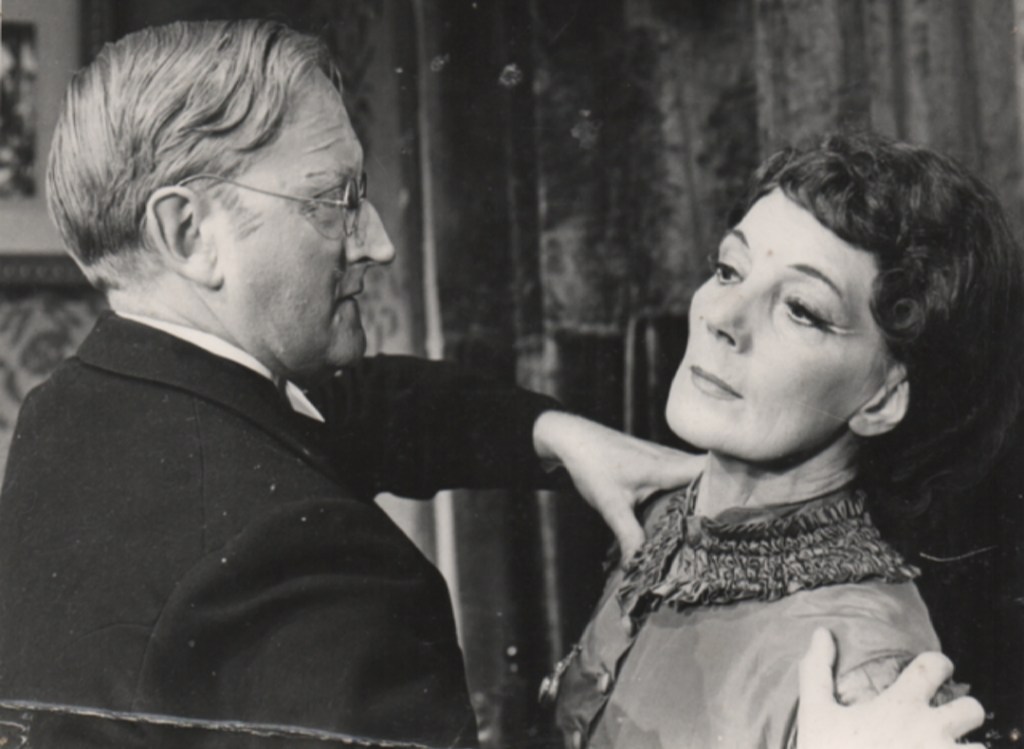
The author as psychotic killer Danny in Emlyn Williams’ Night Must Fall. You will have to imagine the fish.
As the old year ended and the New Year of 1966 began I made the most of the last week or so of my holidays before getting my head down for studies in my home classroom.
Naturally I was enjoying the English studies, especially the literature. I have read, seen or appeared in a number of Shakespeare’s masterpieces and no longer have a clear memory of which one I studied that year.
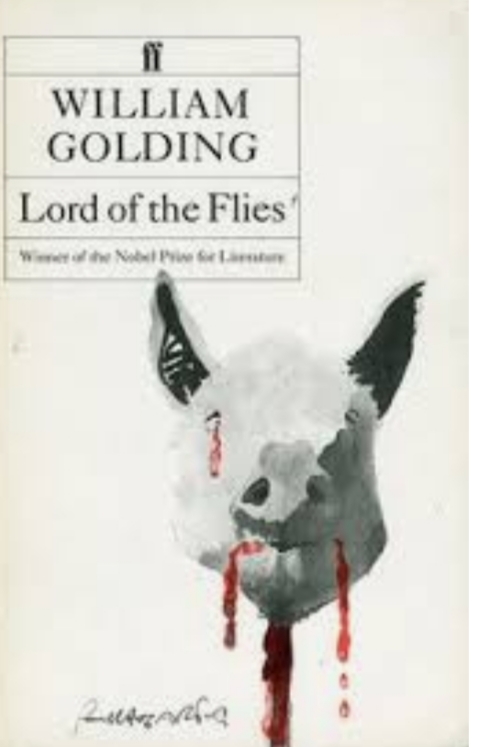
I do remember the major work of fiction I studied, however. It was William Golding’s brilliant vision of how the thin veneer of civilisation that coats us all can be so easily stripped away: Lord of the Flies.
The iconic image of the pig’s head from Lord of the Flies
Young people who grew up in the 60s are sure to remember this book and the film released in 1964 which brought to life the schoolboys stranded on a Pacific island with no adults to guide them.
It was a well-made film but the book was far better because more was left to the reader’s imagination. After all it was the imagination of those boys that created real monsters from their own minds.
I was used to creating my own visions from the books I had read. Those of my childhood had been left behind and for almost five years I had been browsing my parents’ bookcases as well as the packed shelves of the municipal library.
At home I could choose from classics such as Alexander Dumas or the more recent tales of Maigret by Simenon, or fall in between with Conan Doyle’s Baker Street detective or Bronte’s Jane Eyre.
Now I had a new author to discover. If an author wrote more than one book then it was down to me to see if all the books were the same story or whether they varied.
There appeared to be one theme running through Golding’s first three books – survival; but the means of survival or lack thereof, were treated in differing ways.
If a book is written in isolation then it can only be read that way; but if there is more than one (and I don’t mean a series) then they all need to be considered when making a judgment on any.
It sounds like some form of philosophical meandering but at the time it was an early entry into literary review.
Of the three books I still think the first was the best but maybe that is because it was a plot that I was closest to in that I was a boy and could imagine what boys might do on a deserted island with no adult supervision.
I could not yet turn my imagination to existence in prehistoric terms, even when that is the direction the boys had been heading.
Harder still was to see myself as Pincher Martin, surviving alone on an island when he had already died before being washed up on the island’s shore.
Many years later I read all three again and now found myself feeling a greater affinity with Lok than with Ralph and Jack but still failing to find that empathy with Pincher Martin.
We all take something from every book we read and it helps us to grow. Not necessarily physical growth but certainly a growth in understanding.
Tomorrow: the exams loom and another decision on my future must be taken.
Clownlike, happiest on your hands, Feet to the stars, and moon-skulled, Gilled like a fish. A common-sense Thumbs-down on the dodo’s mode. Wrapped up in yourself like a spool, Trawling your dark as owls do. Mute as a turnip from the Fourth Of July to All Fools’ Day, O high-riser, my little loaf.
Vague as fog and looked for like mail. Farther off than Australia. Bent-backed Atlas, our traveled prawn. Snug as a bud and at home Like a sprat in a pickle jug. A creel of eels, all ripples. Jumpy as a Mexican bean. Right, like a well-done sum. A clean slate, with your own face on.
Studying at home while getting work experience with a recently-launched local newspaper was working well in the run-up to Christmas 1965.
Naturally I took a break from studying over what would have been a school holiday and spent a little bit longer at the Gazette offices while also having time to spend at the Little Theatre as panto time approached.
This led to me getting my first ever byline in a real newspaper while helping to publicise the theatre group which meant so much to me.
The editor asked me to write a feature about the pantomime, Mother Goose, which I turned into a potted history of panto and the Little Theatre.
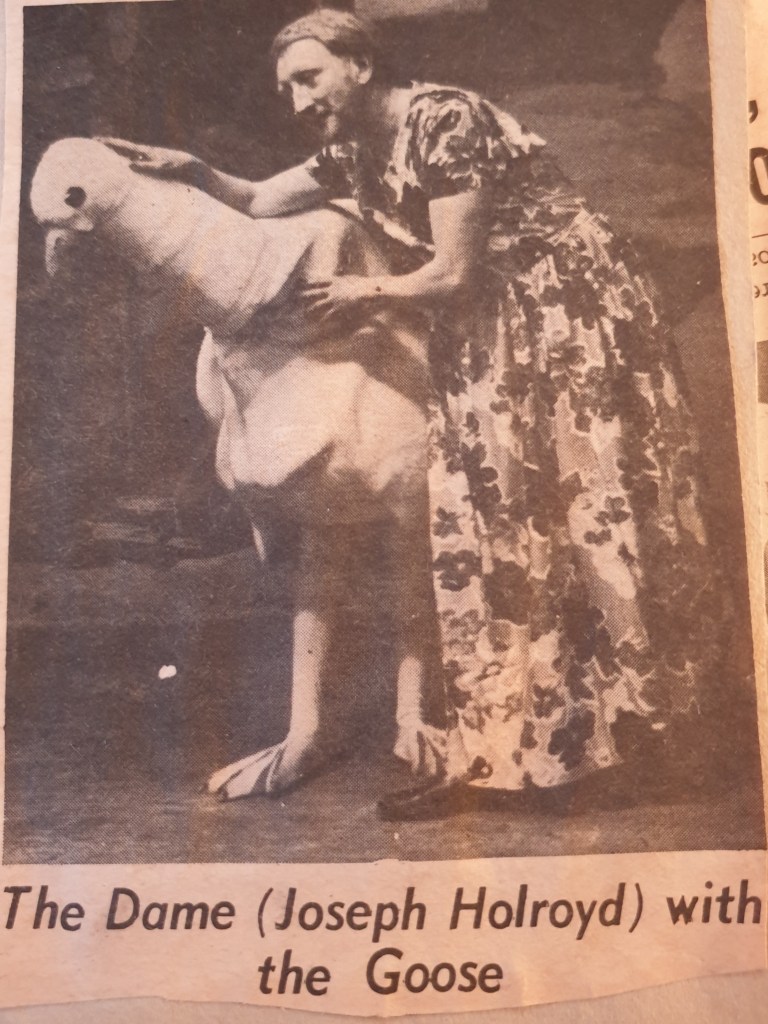
Naturally a main picture for the spread had to include theatre director Joe Holroyd as the Dame
The feature included a number of pictures of main characters and the chorus but it also showed the start of my feature-writing style which set a standard for me for decades to come.
The pictures illustrating this piece are somewhat discoloured as they are almost 55 years old and were brought into the daylight when I found the scrap book they were in up in the loft.
Whether written about a drama group, or a school group ski-ing in Austria I would ensure there was some background, even historical at times.
In this case I brought in the history of pantomime, the history of the Little Theatre and even a reference to the local Conservative MP Nigel Birch in six paragraphs.
The rest of the article was mainly details of the main players and of the chorus members, local names for local people in a local paper.
For this I was granted my first ever byline at the age of 15. In the 60s and 70s bylines were rare occurences and not dished out like lollipops to well-behaved children at a party as they seem to be nowadays.
For a new newspaper the feature was worthwhile because it was the first time such a piece had appeared in the Gazette. For a long-running newspaper it would just have been dragging out the same old story as the previous year.
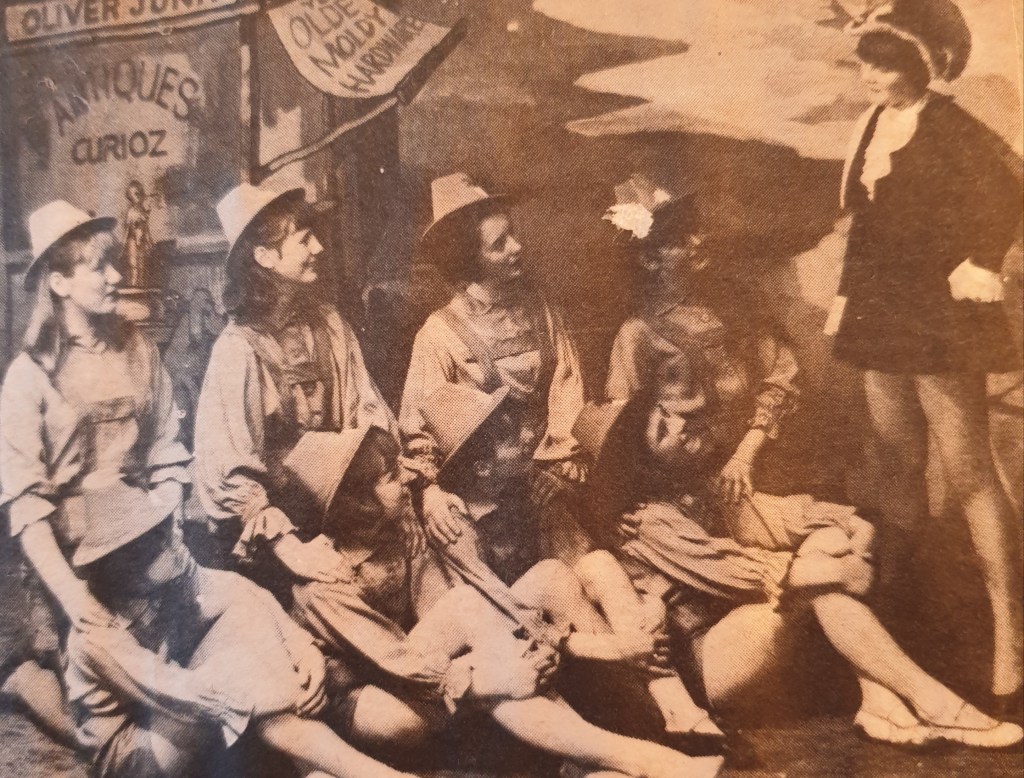
The Foresters who would also have been villagers and the fairyland chorus, Karen Lees, Freda Turner, Pamela Jeffries, Elaine Davies, Kay Parry, Valerie Owen, Linda Hughes and Lilian Diparno.
That first byline was very important to me. I achieved many more before I moved from reporting to production – and even a couple afterwards, but that’s another story.
I actually helped out backstage at the panto as well, but on the night the pages were being made up for an overnight print run I was allowed to stay on and lend a hand.
Luckily I wasn’t in the union at that time, not being a “proper reporter” or even old enough to join the NUJ (National Union of Journalists) because things I did to help out that night would have brought the unions out at most newspaper offices.
All that was still to come.
I was just happy to get a byline.
PS: Memories can be rusty especially when harking back over 50 years.
In the same scrapbook I found the picture of Monica Rose on the elephant. That was when I discovered we did not use the picture with Hughie Green. Hannibal the baby elephant was well-behaved without his touch.
If I had been born a few years later I would not have had the option to leave the regimented education system of the grammar school behind me.
As it was in 1965 the age was still set at 15 even though attempts had begun a year earlier to raise it to 16. Luckily for me the efforts were stalled and the change did not go through until 1972.
Leaving at 15 did me no harm. Thanks to Harold Wilson I did actually go on to tertiary education in the 1990s with the Open University and have the right to put BA (Open) after my name.
I’m getting ahead of myself, however, as in September 1965 I had officially left school and was studying for my GCEs at home.
Without the rigid structure of the grammar school I could study each subject at the time that felt right for me.
It was that joyous moment between school and work when I could start at 8am if I had woken bright and early or 10 if it had not been a good night.
I was still getting up at the same time as when I went to school, after all the household routine didn’t revolve around me. My sister still had to get off to school and Dad had to open the shop.
The living room became my classroom and the big table was my desk – with plenty of room to spread books and papers.
If I wanted more information I only had to go to the library. At school this would have required a note of permission from a teacher and a walk to the old buildings.
Now I could go to the library whenever I felt like it as it was just a walk to the end of our street. The only danger was that I would be distracted by the books that surrounded me.
By the end of September I was well ahead in all the subjects I was studying. That was the moment my big break came out of the blue.
The local newspaper when I was growing up was the Rhyl Journal, which had been around since the 1800s and had incorporated at least one other paper during that time.
In April that year a new weekly newspaper was launched called the Rhyl and Prestatyn Gazette, run by a journalist and an advertising executive.
The journalist was clearly the editor (and editorial director) and his partner was advertising director. The editor was in our shop one day chatting with my father who just happened to mention I wanted to be a journalist. When he heard this he asked my father if I would like a bit of work experience (I’m not sure that was even a concept at that time) – a few hours a week.
The deal was struck and I joined the team the following week. Initially it was a couple of hours on a Monday morning and the same on a Thursday afternoon, the day the paper went to the printers.
The offices were a lock-up shop set over three floors in the building which housed the Odeon Cinema. The Rhyl and Prestatyn Gazette had the middle shop in the row.
The shops in the Odeon building in Rhyl where the Rhyl and Prestatyn Gazette was born in 1965.
Downstairs there was a receptionist and a small room to one side whch housed the filing cabinets for pictures and other editorial cuttings and material as well as a desk. The next floor was the advertising department with a team of reps on phones drumming up business.
The top floor was the page setting and makeup department as well as the editor’s office and a desk for a reporter.
The editorial and ads were set on a system using punched tape to produce typeset material which was cut and pasted on to page layouts.
Nowadays it is all done by computers (which is pretty well what a lot of journalists are these days) but even this form of typesetting was a move on from the hot metal setting used on most newspapers at that time.
My role, for four or five hours a week, mainly consisted of sitting in the downstairs office typing up lists of mourners and floral tributes for funeral reports; taking down sports reports over the telephone; filing the previous weeks’ photographs; and, joy of joys, occasionally going out with a real reporter on a story.
My biggest scoop was getting quotes from Hughie Greene (Double Your Money) and his miniscule assistant Monica Rose to go with a picture of Monica on the back of a baby elephant with Hughie patting its trunk.
Not the biggest scoop in the world but it made me feel good.
I also wrote a serial story for the Gazette Childrens Club and set puzzles for the youngsters under the guise of Uncle Bill.
This continued through to the summer of 1966 and was my first real taste of the world of newspapers.




 Robin's Nest