Timely lesson about trust

My mix of shadowing David Nicholas and spending time under my own command at the Holywell office certainly strengthened my nature when it came to coping for myself in later years.

David taught me what to watch for when out and about as a good story could come from the smallest reference.

He said you had to talk when necessary but, far more, you had to listen. Not just listen to the speaker at a meeting but also what others might say within earshot.

At a crowded meeting, council or any other large group, asides muttered during a speech can give clues to dissent or harmony.

This is where I believe the Liverpool heritage my mother gave to me proved useful.

She always seemed to know everything that was going on, even if she had appeared busy with something else.

I remember one of my aunts telling me: “Your mother can be watching television while reading a book, knitting, taking part in a conversation, listening to another and butting in on a third.”

I did wonder if my mentor had become disillusioned during his years as a reporter. He certainly had little trust in any politician, whatever the persuasion, and at times even distrusted the word of fellow journalists.

His attitude towards ordinary people, however, was very different. He felt thay had to be handled gently. A politician could be verbally bullied at times because they need us as much as we need them.

The general public were very different. They liked to see their names in the paper but at the same time they will turn away from you if you misinterpret them.

“You must remember, Robin, when you talk to these people they have to trust you. Local reporters are just that, local. If you write something about them that isn’t true you are still around at the end of the week and they will let you know their feelings. You have to earn their trust”

“It is not worth antagonising your readers for the sake of one good story.

“It’s different for the national mob. By the time the paper comes out they will be far away and don’t have to worry about what hits the fan.”

It was a lesson I learned well and it proved invaluable a few years later when putting it into practice gave me a scoop worthy of a front page byline.

That is in the future, however.

In the here and now, or the now that was then, I was picking up a few off-diary stories worth at least a top of the page slot and occasionally even a byline.

There was one story, the exact content of which I don’t remember half a century later, certainly attracted Peter’s attention because the day it had gone with the early morning copy he rang me at the office.

He wanted to double-check the facts to be sure it was as good as it appeared. I checked my notes and confirmed it was good.

On the day our paper came out, with my story an above-the-fold page one slot, Peter rang me again. Only this time he wasn’t in such a good mood and told me I was to drive over to the Mold office, immediately.

When I got there he called me straight into his office and shut the door.

On his desk was our paper and a copy of a regional daily paper. Ours was displayed with the front page showing my story. The regional daily was opened to an inside right-hand page with a prominently displayed top of the page story with a two-deck head very similar to ours.

“How did they get this story? It is almost word for word the same and you said you were positive nobody else had it.

“Did you sell it on?”

I was taken aback, especially as I had no idea what he meant.

“I’m sorry Peter. I have no idea how they got hold of it. I am positive nobody else got this story. I typed it up the same day and left it with all my other copy to be picked up first thing and taken to Mold office.

“I didn’t tell anyone else about it and I certainly did not ‘sell it on’. I work for you and I don’t even know how to ‘sell it on’.”

He must have believed me because his tone changed.

“OK. I had to make sure. There is an office lineage pool which stories can be put into and at the end of the week they can be “sold” to other publications. People get a share of the pool based on how much they put in.

“You obviously haven’t been told about this.

“One thing I have always been clear on is that certain stories will remain exclusive to us. This one fits that spec.

“I’m sorry to have doubted you but I really didn’t expect to see this anywhere else.”

He said we should leave it there and he would deal with any trouble it caused.

That was it except that the following Wednesday David told me about the office pool and asked if I wanted to be a part of it.

At the next share-out from the pool I discovered I had been credited with the problem story.

The extra bit of cash each month wasn’t going to make me a millionaire but it provided some cash in my pocket for nights out.

The incident taught me two lessons:

Most things have a price.

Be careful who you trust.

The Tyger

by William Blake

Tyger! Tyger! burning bright,

In the forests of the night,

What immortal hand or eye

Could frame thy fearful symmetry?

In what distant deeps or skies

Burnt the fire of thine eyes?

On what wings dare he aspire?

What the hand dare sieze the fire?

And what shoulder, and what art,

Could twist the sinews of thy heart?

And when thy heart began to beat,

What dread hand? and what dread feet?

What the hammer? what the chain?

In what furnace was thy brain?

What the anvil? what dread grasp?

Dare its deadly terrors clasp?

When the stars threw down their spears,

And water’d heaven with their tears,

Did he smile his work to see?

Did he who made the Lamb make thee?

Tyger! Tyger! burning bright

In the forests of the night,

What immortal hand or eye

Dare frame thy fearful symmetry?

Touch of deja vu as memories meld

Have you ever found yourself watching an old film on the television and thinking: “I’ve seen this before but I don’t know when.”

Or: “I am sure this film is taken from a book but I don’t remember reading it.”

Over the past 20 years more and more films have been resurrected to fill space on channels desperate to attract new viewers.

At one time you read a book or you watched a film or you watched a tv series of a book you might have once read.

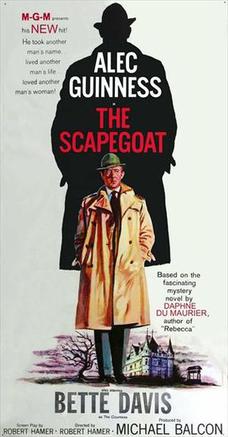
I am a great fan of Alec Guinness and a few years ago I spotted an old 1950s film he starred in with Bette Davis called The Scapegoat.

It hadn’t been on for long when I got that feeling of familiarity.

The film was made in 1959 and, although my father used to take us to the pictures on a Friday night, it was not the sort of film that would have appealed at the time.

Once a film had done the cinematic rounds in those days it would be many years before it might end up on tv.

The basic premise of the story is that Guinness’s English character meets his French double while on holiday .

They spend the night drinking and telling stories of their lives. The following morning the Englishman finds himself alone in a hotel room with just the clothes and belongings of his French double.

You can probably guess where the story is leading. The point is I knew the characters and what they would do. I even knew there would be a scene with him walking across broken glass in the factory of his doppelganger.

It was quite a time before I realised when and where I had come across the story before.

In a book belonging to my parents.

The book was a Reader’s Digest Condensed Novel. RD used to publish four or five books in a single volume initially released four times a year but eventually every two months.

We must have had 20 or 30 of the books and I used to read them right through even the ones that were really terrible.

This was one I had read when I was about 10 or 11 and was written by Daphne du Maurier.

I thought back to those books and remember the array in the bookcase.

With four or five condensed books in each volume there must have been well over 100 stories and at some point I read them all.

There were many well-known writers there and probably many more who may not have written again after this single tale.

Another I remember was a strange one called “This is Goggle” with a sub title about educating father or something similar.

It was the tale of an American boy who was five when his father went to war in the 40s and 10 when he returned.

During those years the boy, Goggle, had come to see himself as the man of the house and when his father returned they both had to adjust in a postwar world.

Not the most brilliant book I have read but the message it held was very deep.

I don’t know what happened to those books. They did not become part of my “library” and probably ended up at a charity shop.

I hope others got to enjoy them.

Ode on Solitude

by Alexander Pope

Happy the man whose wish and care

A few paternal acres bound,

Content to breathe his native air,

In his own ground.

Whose heards of milk, whose fields of bread,

Whose flocks supply him with attire,

Whose trees in summer yield him shade,

In winter fire.

Blest! who can unconcern’dly find

Hours, days, and years slide soft away

In health of body, peace of mind,

Quiet by day,

Sound sleep by night; study and ease

Together mix’d; sweet recreation,

And innocence, which most does please,

With meditation.

Thus let me live, unseen, unknown;

Thus unlamented, let me die;

Steal from the world, and not a stone

Tell where I lye.

Castaways a century apart

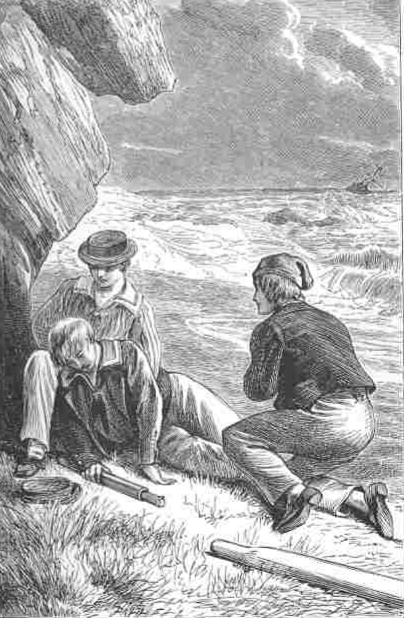
Boys shipwrecked on a deserted island in the 19th century
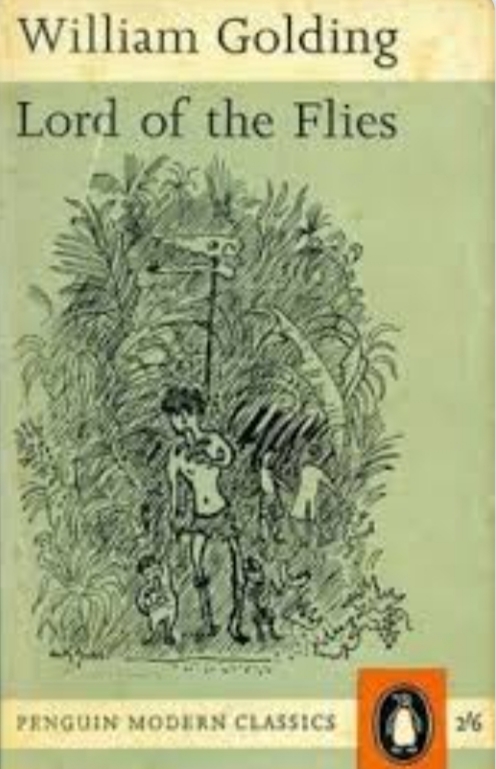
Boys cast away on a deserted island in the 20th century

The subjects of two tales of boys surviving on a desert island are almost 100 years apart.

One tells the story of three boys shipwrecked and cast up on a desert island in the Victorian era. This was written in 1857 by a Scottish author, RM Ballantyne, who wrote almost 100 adventure stories for boys.

The other, written in 1954, is the story of a larger group of schoolboys who survive a plane crash and are washed up on a desert island in the new Elizabethan age. This was written by William Golding, who acknowledges the influence Ballantyne had on him.

But what else links them?

Well, both books were written when a queen sat on the British throne.

Both were written by men.

Also both ended up in my library. I say library but I actually mean a collection of books I have accumulated over the decades. Some end up on shelves, some end up in boxes. Then some change places.

What is more important is that one I eventually inherited from my father, the other I bought because I needed to study it.

Growing up in the 50s and 60s books were always a part of my life. I don’t remember when I first became aware of them or even when I first read a book.

It seems they have been there all of my life. All 70 years.

I do know that when we moved to Rhyl in the mid-50s we had a three-shelved oak bookcase in the hall. It was in between the front door and the door which led into Dad’s shop.

Next to it was a hall chair with a tall back which widened from its leathern-inset seat to the top, which would have been up to the shoulders of a seated man.

Opposite was an old oak sideboard with three drawers above three cupboards. On the top was a three branch candelabra, which I always believed was silver, and a wooden bowl with a foot which had a silver rim and held wooden-handled salad servers.

Next to the sideboard, between it and the front door, was another slender shaped chair but this one had a chintz-covered seat and slender arms.

The chairs were there for people who came to get urgent prescriptions made up after the shop had closed – I think I have told you all before that Dad was a dispensing chemist.

For now, however, it is the bookcase that counted.

On top of it stood a pewter tray with a pewter teapot, milk jug and sugar bowl on it. When I learned to read I read the inscription on the teapot.

It was a gift from my mother’s work colleagues when she got married in 1939.

All three of the shelves were filled with books. Books of every size and binding you could imagine.

Some of them were obviously very, very old and had leather bindings with gilded titling.

Others were large and hard-backed but not of the type that would have had dust covers.

Then again there were a number of books the size of a modern paperback only with hard covers again.

I remember one of these had the title “Coral Island” by RM Ballantyne and I remember being about eight when I took it off the shelf to read.

The rule on books in our house appeared to be that if you could reach it off the shelf without standing on anything then you could take it to read.

The only other unwritten rule was: Treat it with Respect.

I know there was a label stuck on the inside first blank page but I didn’t bother reading it. I was more interested in the story and the illustrations.

I became immersed in it and had to be told not to bring it to the table when we had our dinner.

I became a fast eater.

The protagonists were three boys, all in their teens, the oldest being 18. The ship they sailed on was wrecked in the South Seas and they were the only survivors, washed ashore on a deserted island.

The early parts of the book were about how they survived and managed to build a shelter, find food and, with the use of a few tools found in a box which was washed ashore, even build a small boat to go fishing a bit further offshore than they could wade or swim.

The really exciting part was when a group of “natives” came ashore and they had to hide.

To a young boy the events that then occurred seemed quite normal because at the time we were taught to believe that this was how the world was in the 19th century.

One group of natives had captured another, including women and children, and on the first night the boys watched them kill, cook and eat one of the captives.

The boys being brave and English hatched a plan to rescue the captives. The “cannibals” left and their prisoners were free and their own tribe sent a boat to collect them.

Their next adventure came when the island was invaded by pirates. One of the boys was captured and taken to their ship.

Being brave and English he escaped with a pirate who had repented. The pirate ship was attacked by the “friendly” natives and the pirates were all killed. The repentant pirate died and the “brave” boy managed to get back to his friends and they all escaped to a trading village where there were missionaries.

The boys told their story and were praised for fighting evil and being “truly British”.

Years later I read Lord of the Flies. The similarities were few and the differences many but it all came down to Victorian values compared to 20th century lack of values.

Ballantyne’s boys fought evil.

Golding boys found evil within.

On the same shelf as Coral Island I found another book by a Scottish author which fell in between the Ballantyne and the Golding.

It was Robert Louis Stevenson’s Treasure Island, of course.

Written between the times of the other two books but set well before either.

That bookcase held many more treasures and held more family information than I realised at that time.

The Race Industry

by Benjamin Zephaniah

The coconuts have got the jobs.

The race industry is a growth industry.

We despairing, they careering.

We want more peace they want more police.

The Uncle Toms are getting paid.

The race industry is a growth industry.

We say sisters and brothers don’t fear.

They will do anything for the Mayor.

The coconuts have got the jobs.

The race industry is a growth industry.

They’re looking for victims and poets to rent.

They represent me without my consent.

The Uncle Toms are getting paid.

The race industry is a growth industry.

In suits they dither in fear of anarchy.

They take our sufferings and earn a salary.

Steal our souls and make their documentaries.

Inform daily on our community.

Without Black suffering they’d have no jobs.

Without our dead they’d have no office.

Without our tears they’d have no drink.

If they’d stop sucking we could get justice.

The coconuts are getting paid.

Men, women and Brixton are being betrayed.

To His Mistress Going To Bed

by John Donne

Come, Madam, come, all rest my powers defy,

Until in labour, I in labour lie.

The foe oft-times having the foe in sight

Is tir’d with standing though he never fight.

Off with that girdle, like heaven’s Zone glistering,

But a far fairer world encompassing.

Unpin that spangled breastplate which you wear,

That th’eyes of busy fools may be stopped there.

Unlace yourself, for that harmonious charm,

Tells me from you, that now it is bed time.

Off with that happy busk, which I envy,

That still can be, and still can stand so nigh.

Your gown going off, such beauteous state reveals,

As when from flowery meads th’hill’s shadow steals.

Off with that wiry Coronet and shew

The hairy diadem which on you grow;

Now off with those shoes, and then safely tread

In this love’s hallow’d temple, this soft bed.

In such white robes, heav’ns Angels used to be

Received by men; Thou Angel bringst with thee

A heaven like Mahomet’s paradise; and though

Ill spirits walk in white, we easily know,

By this these Angels from an evil sprite,

Those set our hairs, but these our flesh upright.

Licence my roving hands, and let them go,

Before, behind, between, above, below,

O my America! my new-found-land,

My kingdom, safeliest when with one man mann’d,

My Mine of precious stones, my Empirie,

How blest am I in this discovering thee!

To enter in these bonds, is to be free;

Then where my hand is set my seal shall be.

Full nakedness! All joys are due to thee.

As souls unbodied, bodies uncloth’d must be,

To taste whole joys. Gems which you women use

Are like Atlanta’s balls, cast in men’s views

That when a fool’s eye lighteth on a Gem,

His earthly soul may covet theirs, not them,

Like pictures, or like books’ gay coverings made

For lay-men, are all women thus array’d;

Themselves are mystic books, which only we

(Whom their imputed grace will dignify)

Must see reveal’d. Then since then that I may know;

As liberally, as to a Midwife, shew

Thyself: cast all, yea this white linen hence,

There is no penance due to innocence.

To teach thee, I am naked first; why then

What needst thou have more covering than a man.

Getting to grips with politicians

The weeks continued with the one-day training at Mold and the rest on my own at the Holywell office.

It appeared David Nicholas had become my mentor. On the second Wednesday I shadowed him as he did regular diary jobs and worked on off-diary stories.

The following week he took me to a meeting of the Flintshire County Council; later he came over to Holywell to keep an eye on me when I attended my first meetings of the Holywell Urban and Rural District Councils. One of these was an evening meeting and my first experience of getting expenses for working at night and banking up a half-day off in lieu.

Welsh politics was quite complex at the time and Holywell itself was even more of a mixture.

As a Parliamentary area Holywell was covered by two different constituencies.

The urban district was in the Flintshire East constituency which was held by Labour, the MP was Eirene White who had held the seat since it was created in 1950.

West Flintshire constituency, which included the Holywell Rural District Council, was also created in 1950 and had been held since then by Nigel Birch, a Conservative.

I attended a dinner with Nigel Birch which gave me a story I dined off for many years (more on that in the future).

The Labour MP barely made any impression on me at all. In fact I only got her name right because I Googled it.

I don’t remember the political makeup of the local councils at that time as local politics did not always reflect national politics.

The three main parties, Labour, Conservative and Liberal, were represented on the county, urban and rural councils. It did not mean, however, that one of those parties actually controlled a council.

As well as the Big Three there were always candidates for Plaid Cymru at the national and local levels and the local councils also attracted Independent and Ratepayers Association candidates.

Reporters needed to know all the councillors, their allegiances and where, at times, their priorities lay. Often the Independents were local business people.

It also meant that at times no party would have overall control of the council.

Sometimes Labour might need to persuade the Liberals or Plaid, even both, to work with them. Independents, at that time, had their own reasons for being on the council, often business reasons, and this could well mean them allying themselves with the Conservatives.

As I have said, at the time I was still formulating my own political views but was definitely leaning towards the left.

I knew even then that reporting had to be even-handed. It was my duty to gather the facts and report them. I couldn’t leave something out, or twist a quote to favour one side.

In later years my ability to separate my working life and interests and my personal life and interests was sometimes queried by colleagues or superiors.

All I could say was that I could separate the issues, even when the actions of some politicians made me seethe, I never allowed either life affect the other.

I did get the chance over the years to meet politicians of all persuasions. This began at this time, and certainly when dealing with councillors and MPs in my patch, I did not reveal my own leanings.

My interest in politics had to be dealt with in the way I sought knowledge of any other subject at that time – through books.

Bearing in mind that the government at this time was Labour, Harold Wilson was the Prime Minister, I started to look into the background of that party and how it worked in with my general ideals of socialism.

As it happened the postwar Labour Prime Minister, Clem Attlee, died at about this time, only a couple of years after the man he defeated – Winston Churchill. Soon afterwards I was browsing the shelves of a secondhand bookshop when I found an original copy of The Labour Party in Perspective by Clem Attlee, published in 1937. It remains a part of my political library which I have built up over the decades.

All this work did not play havoc with my social life. An occasional evening job midweek did not matter much as during the week I tended to stay home and saved my weekends for socialising.

It was also at this time I discovered the benefits working life could have on my social life.

Most towns in the area had cinemas, some of which were independents or small local chains.

One of the major cinema chains was, of course, the Odeon Cinema group which included one at Rhyl.

This would often screen major films before their release to smaller chains.

The Odeon Cinema manager in Rhyl (I have a strong feeling his surname was Kelly) used to have midnight press screenings and if an invite landed on Peter’s desk he often asked me if I would like to go as I lived in Rhyl.

There are girls who are quite impressed at an invitation to a screening for a major new release, especially a late night press reception with drinks and nibbles laid on.

Often gave me a good start to the weekend.