My Spectre around me night and day
Like a wild beast guards my way;
My Emanation far within
Weeps incessantly for my sin.
'A fathomless and boundless deep,
There we wander, there we weep;
On the hungry craving wind
My Spectre follows thee behind.
'He scents thy footsteps in the snow
Wheresoever thou dost go,
Thro' the wintry hail and rain.
When wilt thou return again?
'Dost thou not in pride and scorn
Fill with tempest all my morn,
And with jealousies and fears
Fill my pleasant nights with tears?
'Seven of my sweet loves thy knife
Has bereavèd of their life.
Their marble tombs I built with tears,
And with cold and shuddering fears.
'Seven more loves weep night and day
Round the tombs where my loves lay,
And seven more loves attend each night
Around my couch with torches bright.
'And seven more loves in my bed
Crown with wine my mournful head,
Pitying and forgiving all
Thy transgressions great and small.
'When wilt thou return and view
My loves, and them to life renew?
When wilt thou return and live?
When wilt thou pity as I forgive?'
'O'er my sins thou sit and moan:
Hast thou no sins of thy own?
O'er my sins thou sit and weep,
And lull thy own sins fast asleep.
'What transgressions I commit
Are for thy transgressions fit.
They thy harlots, thou their slave;
And my bed becomes their grave.
'Never, never, I return:
Still for victory I burn.
Living, thee alone I'll have;
And when dead I'll be thy grave.
'Thro' the Heaven and Earth and Hell
Thou shalt never, quell:
I will fly and thou pursue:
Night and morn the flight renew.'
'Poor, pale, pitiable form
That I follow in a storm;
Iron tears and groans of lead
Bind around my aching head.
'Till I turn from Female love
And root up the Infernal Grove,
I shall never worthy be
To step into Eternity.
'And, to end thy cruel mocks,
Annihilate thee on the rocks,
And another form create
To be subservient to my fate.
'Let us agree to give up love,
And root up the Infernal Grove;
Then shall we return and see
The worlds of happy Eternity.
'And throughout all Eternity
I forgive you, you forgive me.
As our dear Redeemer said:
"This the Wine, and this the Bread."'
Being a journalist does not always mean being constantly on the lookout for hard news stories (although the best reporters have a subconscious awareness for news even when they’re not looking for it).
There are times when you can relax, such as an evening at the theatre.
There are also annual events, and for weekly newspaper reporters one of the best is an agricultural show.
I was reminded today, by my former mentor and colleague Elwyn Edwards, of the annual Flint and Denbigh show held just outside Rhyl at Cwybr Farm.
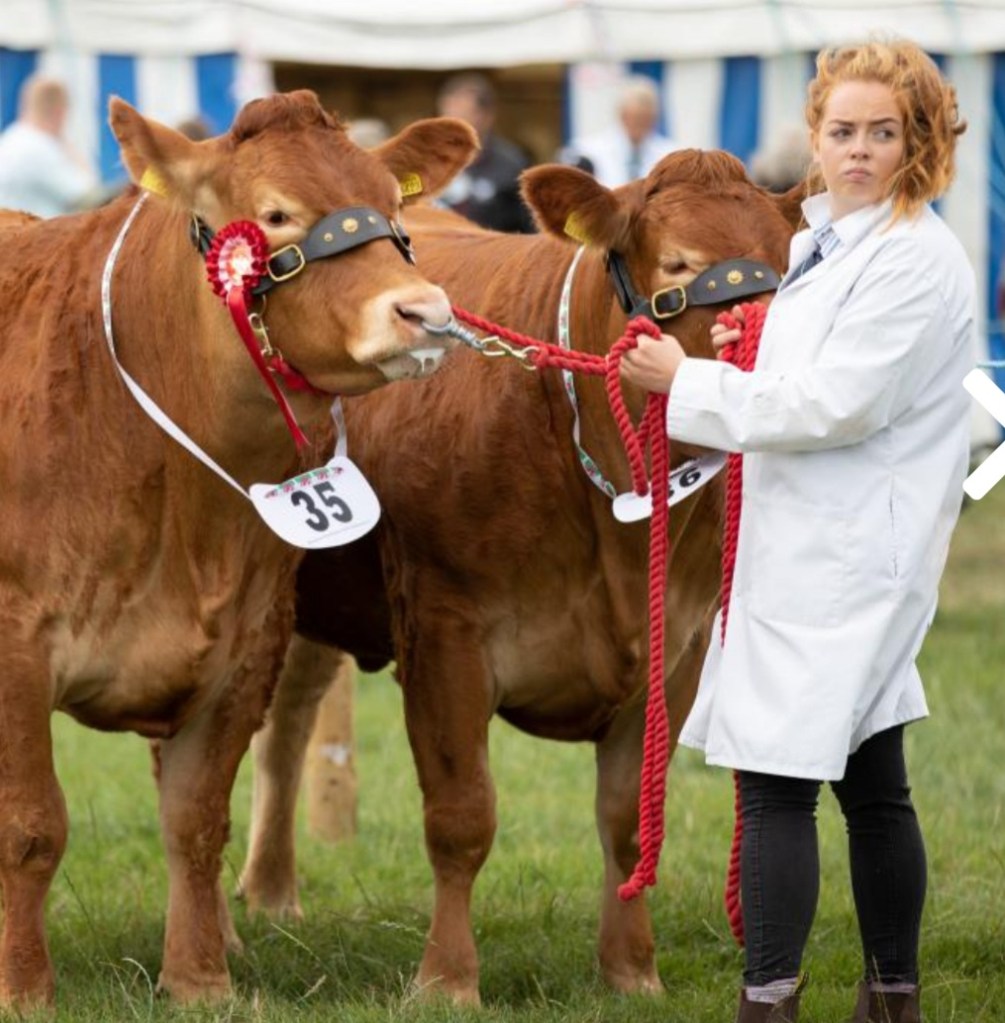
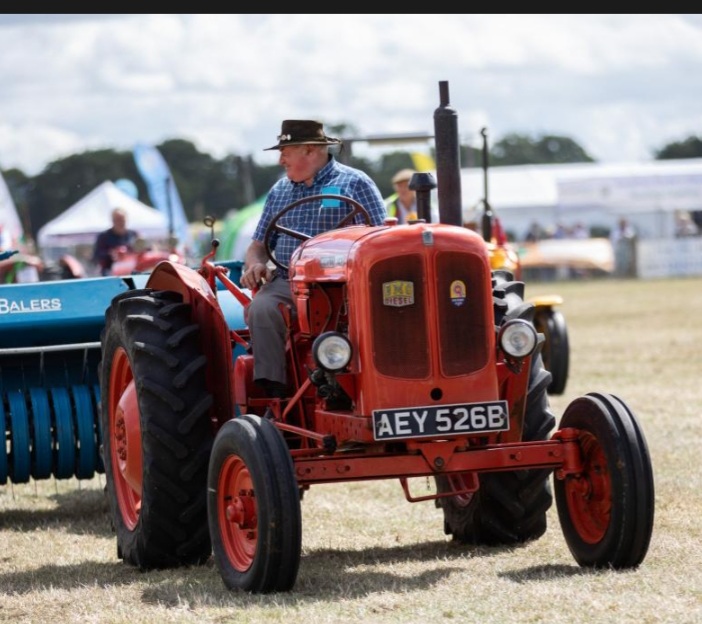
This one day event, usually held in August, had everything from displays of farming equipment, including tractors, hay balers etc., to livestock ranging from rabbits to mighty shire horses.
For the journos, however, the focal point for the day was not, as some might think, the beer tent but instead the press tent.
That is not to say that the press tent was devoid of alcohol – the odd firkin and a few crates of beer were generally tucked under the trestle tables where the portable typewriters were ready from early morning to late afternoon ready for the reporters to bash out their copy all day long.
The junior in the team often had to go and collect results from the competitions: best bull; fluffiest bunny; prize porkers; biggest marrow; tastiest sponge cake; and lambs frolicking in their pens.
The seniors would take an occasional stroll to garner any major stories, and to visit some of the corporate displays where they were often treated to a dram of whiskey or a gin sling.
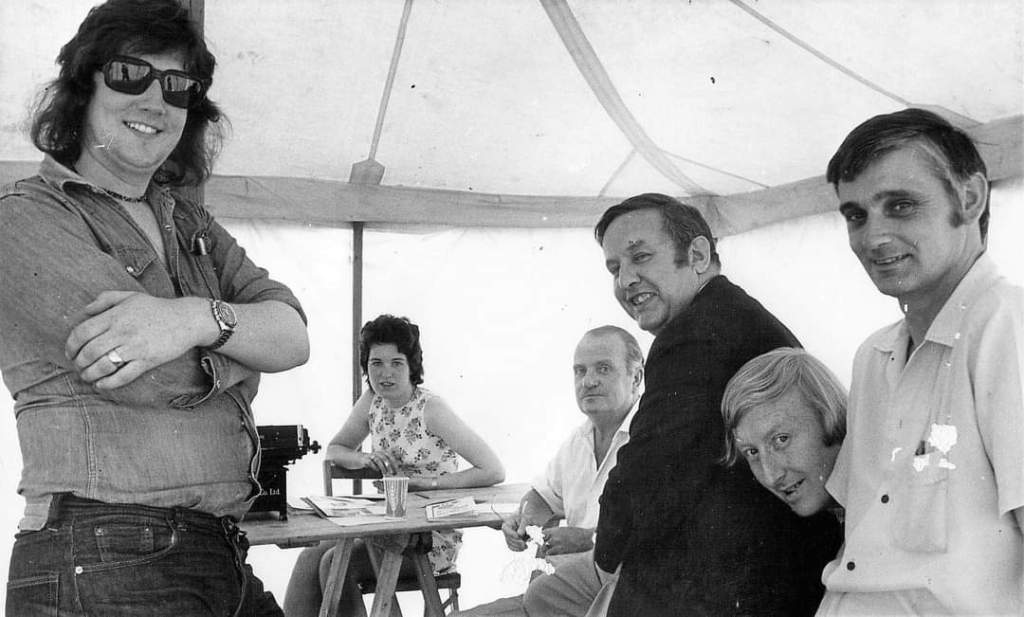
Press tent at the Flint and Denbigh (possibly 60s). From the left: Bob Hewitt, photographer; Pat Durkin(?) reporter; Bill Prandle, sports editor; Brian Barratt, editor Rhyl Journal; extreme right Glyn Robert, one of the best press photographers I have known; and, finally, Elwyn Edwards, probably one of the earliest photo bombers, here doing an impression of a disembodied head, a great chief reporter.
By mid-afternoon the journalists’ copy often needed double-, even triple-checking as the alcoholic haze spread through the press tent.
At the end of the day the farmers and show organisers were delighted with the newspaper reports of the shows, the competions and the pages of prize winners with photos as well as stories.
Agricultural shows were a grand day out and a good way to fill the pages for our group’s papers which spread across North Wales.
Here's the rule for what to do
If ever your teacher has the flu
Or for some other reason takes to her bed
And a different teacher comes instead
When the visiting teacher hangs up her hat
Writes the date on the board, does this or that
Always remember, you have to say this,
OUR teacher never does that, Miss!
When you want to change places or wander about
Or feel like getting the guinea pig out
Never forget, the message is this,
OUR teacher always let's us, Miss!
Then, when your teacher returns next day
And complains about the paint or clay
Remember these words, you just say this:
That OTHER teacher told us to, Miss!
My tears are like the quiet drift
Of petals from some magic rose;
And all my grief flows from the rift
Of unremembered skies and snows.
I think, that if I touched the earth,
It would crumble;
It is so sad and beautiful,
So tremulously like a dream.
Looking back over the last 50 years I see 1971 as a turning point in my life.
Not just because I celebrated my 21st birthday (although by now 21 was no longer a magic number as in 1970 we were granted the right to vote at 18) or that I had ended my indentures and having passed my NCTJ exams was now a fully accredited senior reporter.
This was the year I stopped seeing Rhyl as the place where I would spend the rest of my life, marry, settle down and maybe, eventually, become editor of MY newspaper.
I was not so arrogant as to believe that overnight I had become a fully-fledged ace reporter just because I had passed an exam and completed a set number of years working for one company.
I still had a lot to learn and was glad that I had worked with so many excellent journalists over the previous six years.
The trouble is I wanted more.
Ever since journalism became a “respectable” career (it has now turned full circle and journalists have once more become pariahs) the main ambition of any journalist was seen to be reaching “Fleet Street”.
In my youth this was a physical place where national newspapers had their main offices and sent their reporters out to far flung corners of the country or the world to gather the news.
Reporters would become specialists: political reporters; crime reporters; royal reporters; fashion reporters etc. etc.
That was not my ambition.
I wanted to be a good, all round reporter and then work my way up to become a good sub and then a good editor.
For this I needed experience of a wider field than I would find in Rhyl.
I was covering more important stories now I had graduated but I missed the opportunity to watch the process once I had handed my copy in and it went off to the head office in Oswestry.
Looking back, and over 50 years some memories do become fuzzy, I began to feel that my stories should have become tighter but newspapers were still changing from being “papers of record” to being papers that offered an insight into every aspect of life.
Like many young reporters testing their mettle I did feel that my copy did not always get treated in the way it deserved.
There were times when I felt my copy was being hacked to fill a space and others when I felt that it had been allowed to run when I should have kept it tighter myself.
I needed to get out in the world and find new experiences and learn from new “teachers”.
My feet were getting itchy.
I just didn’t realise how far those restless feet would take me.
I am sure we all have a view whether it is based on science, or religion or just your own bloody-mindedness.
Personally I couldn’t care less.
What is more important is which of these came first for you?
The book?
or
the film?
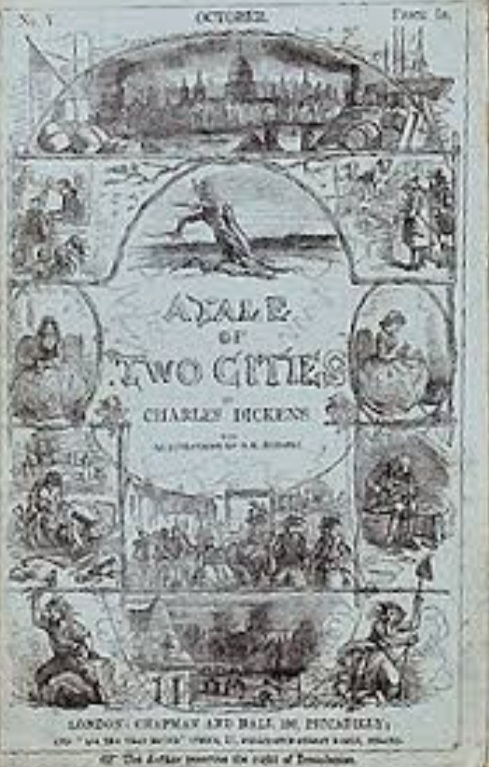
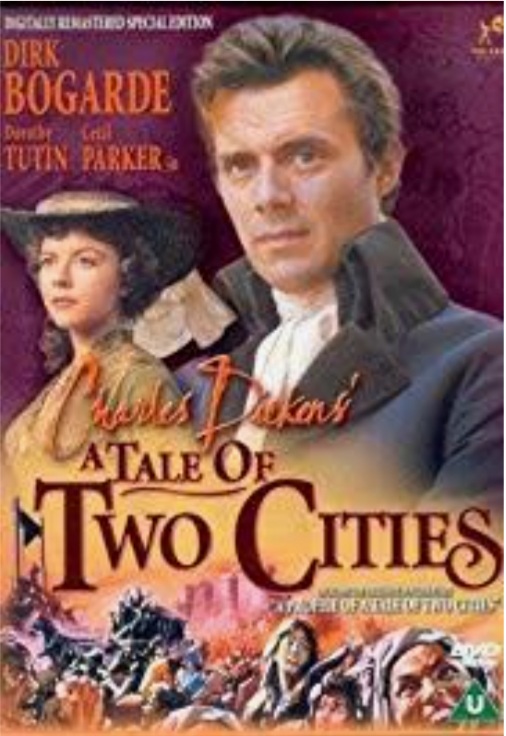
I know that in this case the book obviously came first and Charles Dickens did not get the inspiration for The Tale of Two Cities from the film starring Dirk Bogarde, released in 1958. At least not unless he was a time traveller, and we all know that was Wells not Dickens.
What I am talking about is the order of your introduction to various pieces of literature. Did you read the book first or did you see the film/TV series and then decide to read the book.
When I was younger I often read a book and then later decided to go and see a film version. At the same time it was possible to see a TV series and then to read the book it was based on as well as others by that author.
Sometimes I have read a book and decided it was so good that any film about it would be just as delightful – only to be really disappointed.
Then again I have seen a film or TV series only to find the book.it was based on was so banal that the screen version had really just taken the title and the names of the main characters.
As a child I devoured books and also loved to watch drama series on TV based on books. Sunday afternoon, teatime at our house coincided with the children’s drama series, often Dickens but also from books by people I had never heard of.
I can certainly recall David Copperfield, Children of the New Forest (with Warren Mitchell as Oliver Cromwell), The Count of Monte Cristo and many more.
After Dumas’ Monte Cristo was aired I found another of his books on the bookshelf in the hall – The Three Musketeers, and this was followed by its neighbour Twenty Years After.
Over the years I discovered other books from TV or film and films or TV series I have watched and then read the books.
In the main there will be differences (for better or worse) but not often does one equal the other.
That is until we began to watch the wonderful Italian TV series (subtitled) Inspector Montalbano based on the books by Andrea Camilleri.
Luca Zingaretti as Salvatore Montalbano
This was originally broadcast on BBC Four and we used to find odd episodes being shown again.
Its quirky nature saw the hero, based in a Sicilian coastal town, was not just a detective procedural programme, it also dealt with his longterm and long distance partnership with Livia, who lives somewhere halfway up mainland Italy.
The characters are well-crafted (including a comic policeman who mangles the Italian language) and their personal lives are also portrayed.
We found it so good that we tracked down all episodes on BBC iplayer and watched them in order.
The one thing that niggled, although it wasn’t serious enough to detract greatly from our enjoyment, was the way the narrative sometimes jumped leaving inexplicable gaps.
I decided I enjoyed it so much that I would have a look at the first book in the series.
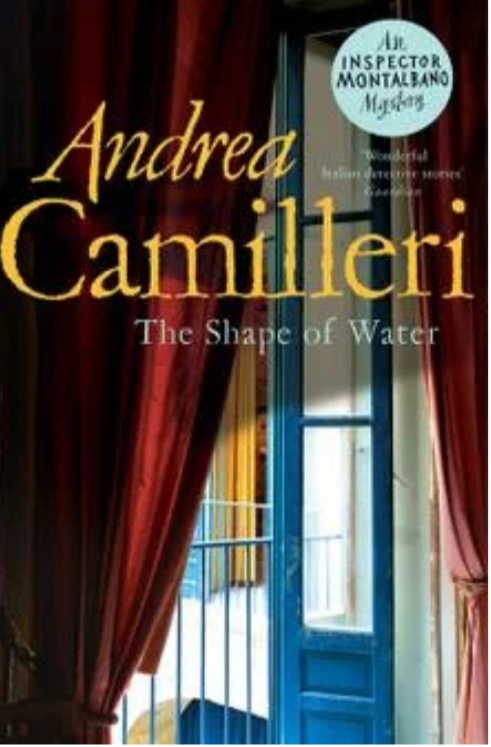
As it happened the first book was not the same as the first episode. The TV team had started at the third book, The Snack Thief, and later went back to the first book, The Shape of Water.
The first in the Montalbano series
When I started that book I was immediately drawn in to the little world of Salvatore Montalbano.
I soon realised why there appeared to be gaps in the narrative.
Andrea Camilleri is a talented writer and fortunately the translator has presented an English version which does credit.
The missing sections in the TV series were filled in by Camilleri’s narrative in which he presents Montalbano’s thoughts.
What is clear is that, in the main, the TV series does present the writing of Montalbano’s creator in the way in which it was intended.
It certainly conveys the great pleasure the inspector takes in his food, especially sea food and rich desserts.
I finished that first book within 24 hours of its arrival and have since read The Terracotta Dog (second in the book series but fourth on the tv) and am now reading The Snack Thief.
Surprisingly I can immerse myself in the books and enjoy the case without thinking ahead to what I have seen.
We may have finished the TV series but there is a spinoff of six episodes about Young Montalbano which we have started watching and more than 20 books to go.
Have you read a book and then seen a film or TV series or watched a film or TV series and then read the book?
Without doing anything a lion is a lion:
but hapless man must brave death
to have the honor of being compared
with that animal, strong, without limit.
Nourished by the soaring thoughts of an
afflicted soul, if one reaches an apex.
A grand prize awaits. Then it is said
you truly fly like an eagle.
Write a sublime poem,
that sinks in silken rhyme
of your innermost intense feelings
and they say you'll sing like a nightingale.
What must a man do to not be likened to
an animal? can he simply do nothing?
without feeling anxious or troubled?
People would then take him for a jackass.
Today was a very good day to be Welsh. The chariots headed to Cardiff and were destroyed by the dragons.
A Triple Crown already won and a Grand Slam on the horizon.
It takes me back to those glorious days in the 60s and 70s when if we couldn’t make it to Cardiff a group of us would gather at one of the houses and watch it on TV.
Plenty of beers and lagers to hand and the cheers reverberated down the street when those heroes – from all walks of life but brought together by their red jerseys – crossed the opposition line for yet another try.
I gave up playing when I left school but I have never lost my passion for the game.
The joy of seeing those great players, Barry John, Gareth Edward’s, JPR Williams, JJ Williams, Gerald Davies, Mervyn (Merve the Swerve) Davies, Delme Thomas and so many more, remain etched in my memory.
My greatest joy, however, remains my meeting with the player who has always sat on the rugby throne of Wales as far as I am concerned.
I went to report on the opening of a new rugby clubhouse in Rhyl in 1971 – the man who opened it was none other than Barry John.
I had met a few famous people before then and over the next 40 years I met many more but this is the meeting that stands out, even more than getting a hug from Harry Secombe in Australia.
There was a time you could hold the Daily Mirror up to the world and see real life reflected in it.
Hold it up now and all you will see is the fantasy life of plastic people who, we are told, are celebrities.
To my mind a celebrity is an outstanding person in their field of expertise. Richard Burton is a celebrity (unfortunately a dead one now) and rightly deserves the label.
The parish clerk who took over a council meeting and barred the officers from taking part (yes I do know her name but I refuse to add to the love/hate surrounding her by mentioning it) is NOT in the celebrity category.
Nowadays the Mirror strives to give everyone their 15 minutes of fame (well more like 15 seconds) whether they deserve it or not.
I grew up with the Mirror, it is one of two newspapers we had delivered when I was a child.
Initially I enjoyed it for the cartoon strips – Andy Capp and The Perishers – but later went on to read the news stories and by the time I was at grammar school I was following columnists such as Cassandra and Keith Waterhouse.
It might have been the BBC that broke into its schedule on Friday 22 November, 1963, at about 7.30pm to tell the UK that President Jack Kennedy had been shot, but it was the Mirror that really gave the true horror of the story on Saturday morning:
Less than five years later, in 1968, it was the Mirror again that gave us the news of another Kennedy death when Bobby was shot.
It was punchy pages like this that made the Mirror stand out over the years and although I read other newspapers my regular was always this proper socialist presenter of news.
What has happened to it now?
Over the last 15 years I have watched, in sorrow, as I saw it sink lower and lower into the gutter and feared the day it would be indistinguishable from Murdoch’s Scum.
Today I think it has come close to hitting rock bottom.
As I did my daily trawl of the online news I found that the Mirror was headlining three “news” stories.
It began with a screamer about the Queen “slamming” anti-vaxxers. It toned it down a bit by the time it reached the next layer of headlines when it claimed Her Maj had “hit out” at those unwilling to have the vaccine.
When it finally reached the story we discovered HM had merely urged those unwilling to be vaccinated to go ahead for their own sake as well as for others.
I did in fact hear the interview in question and Maj had spoken in a warm, kindly manner showing concern for those fearing the effects of the vaccine rather than “slamming” or “hitting out” or even “urging”.
This anti-climax of a story was followed by a tale of a “terrible, friendship-breaking row” between two actresses who had known each other since childhood and even played sisters in a long-running TV series.
The couple in question were Pauline Quirke and Linda Robson probably best known from Birds of a Feather, a story of two sisters living together when their Essex “gangster” hubbies are sent down for a long stretch.
I say best known but Pauline Quirke has actually done more work on her own and my feeling is that Robson tagged along on her coat tails.
To get back to the non-story, however, and we discover that they had been involved in the friendship-busting row as Quirke was “left out” of a couple of special editions of BOAF.
Throughout the tale there was no quote to support the “row” claim, from Quirke, Robson or their co-star Lesley Joseph (said to be at the centre of the row).
The only suggestion that attempts had been made to get any quote from the participants was a final paragraph to say Quirke’s agent had not been available to comment.
If I had submitted that story it would have been spiked and I would have been carpeted by the editor.
Finally we came to the ultimate in non-stories.
Apparently Emma Watson (yes the one who played the schoolgirl witch in the Potter saga) is to retire from the silver screen aged just 30.
A poet is born
A poet dies
And all that lies between is us
and the world
And the world lies about it
making as if it had got his message
even though it is poetry
but most of the world wishing
it could just forget about him
and his awful strange prophecies
Along with all the other strange things
he said about the world
which were all too true
and which made them fear him
more than they loved him
though he spoke much of love
Along with all the alarms he sounded
which turned out to be false
if only for the moment
all of which made them fear his tongue
more than they loved him
Though he spoke much of love
and never lived by 'silence exile & cunning
and was a loud conscientious objector to
the deaths we daily give each other
though we speak much of love
And when such a one dies
even the agents of Death should take note
and shake the shit from their wings
in Air Force One
But they do not
And the shit still flies
And the poet now is disconnected
and won't call back
though he spoke much of love
And still we hear him say
'Do I not deal with angels
when her lips I touch'
And still we hear him say
'O my darling troubles heaven
with her loveliness'
And still we hear him say
'As we are so wonderfully done with each other
we can walk into our separate sleep
On floors of music where the milk white cloak
of childhood lies'
And still we hear him saying
'Therefore the constant powers do lessen
Nor is the property of the spirit scattered
on the cold hills of these events'
And still we hear him asking
'Do the dead know what time it is?'
He is gone under
He is scattered
undersea
and knows what time
but won't be back to tell it
He would be too proud to call back anyway
And too full of strange laughter
to speak to us anymore anyway
And the weight of human experience
lies upon the world
like the chains of the sea
in which he sings
And he swings in the tides of the sea
And his ashes are washed
in the ides of the sea
And 'an astonished eye looks out of the air'
to see the poet swinging there
And dusk falls down a coast somewhere
where a white horse without a rider
turns its head
to the sea
RIP - Lawrence Ferlinghetti