The lamps now glitter down the street;
Faintly sound the falling feet;
And the blue even slowly falls
About the garden trees and walls.

Now in the falling of the gloom
The red fire paints the empty room:
And warmly on the roof it looks,
And flickers on the back of books.

Armies march by tower and spire
Of cities blazing, in the fire; --
Till as I gaze with staring eyes,
The armies fall, the lustre dies.

Then once again the glow returns,
Again the phantom city burns;
And down the red-hot valley, lo!
The phantom armies marching go!

Blinking embers, tell me true
Where are these armies marching to,
And what the burning city is
That crumbles in your furnaces!
As long as there have been stories there have been storytellers. Even if the story is just about hunting a bear.
Back in prehistory somebody had to tell the tribe about the bravery of the hunters who faced the fury of a giant animal who could rip you open with a slash of its claws.
I mean to say if the tribe didn’t know how brave the hunter was they probably would have little respect.
Often it wasn’t the hunter who told the story – a bit like blowing your own trumpet – and instead someone who could weave magic with words would present the story in the best light possible.
Basically the same as modern journalists.
The storyteller earns reflected glory depending on how he or she depicts the hunt – which is sometimes told as if the storyteller was there.
Basically the same as modern journalists.
For all we know the same stories are repeated today but with embellishments to suit the age in which they are told.
This is how we get our folk tales; or our fairy stories; or our myths and legends.
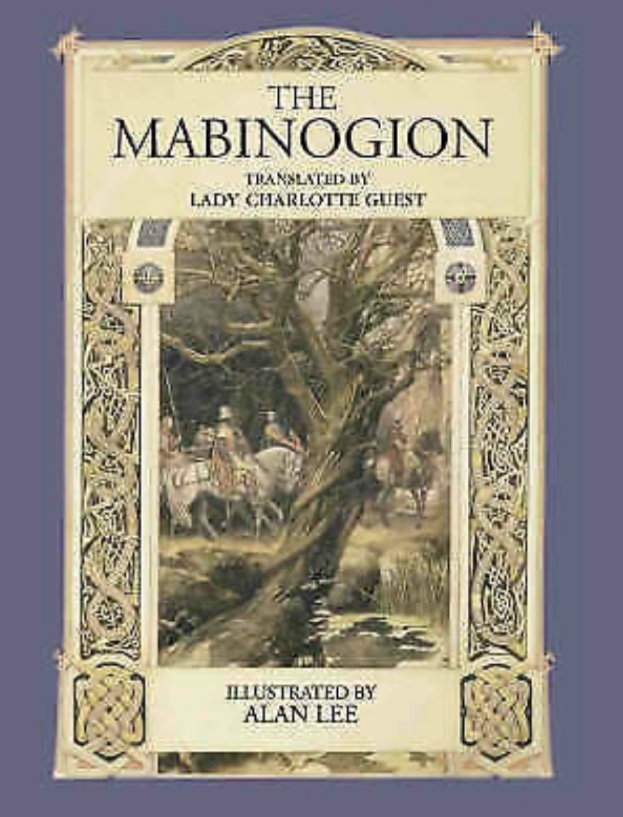
Ancient Welsh tales written down in the 12th or 13th century but going back centuries more in oral tradition
Did little people used to live underground? Were they driven away by giants who crossed the sea on foot with the water barely reaching their knees?
Or did a smaller race, more adapted to tougher climes, dig into the ground to make warmer, safer homes with only a roof above ground?
Did a taller group cross the old land bridge from Europe and establish themselves as the new inhabitants.
Or are the two integrated?
That’s the way these stories work, handed down from parent to child and sometimes getting bits added on.
My father had three family stories which he says he was told by his father who was told by his father who got it from his father and . . . . you can imagine.
In fact one story only begins with his father, my grandfather the Rev. Edward Vyrnwy-Pierce.
We were told that Edward was almost born on the banks of the River Vyrnwy (as it was then).
His mother, Margaret, lived at the nearby manse at Meifod SO, with her husband, Rev. David Pierce, a Welsh Presbyterian minister and their large family.
My great grandparents, David and Margaret Pierce, pictured in the late 1850s before David was ordained as a Welsh Presbyterian minister. At this time he was a schoolmaster in Wolverhampton.
She was down by the river – getting some water or washing clothes depending on my father’s memory on the day – when she went into labour and only just managed to get back to the manse before Edward was born.
They named him Edward Vyrnwy Pierce.
Another of my father’s stories was “the murder at the crossroads”.
An ancestor was going home one night and was set upon and killed. Who the ancestor was, or whether he was the killer not the victim, or even if it happened at all I do not know.
The story that really stuck in my memory was the tale of the soldier’s farewell to his mother.
According to the story, told to my father by his father (and he by his father), begins with the family, Elias Pierce (my great great grandfather), his wife, brother and children were seated by the kitchen fire in the family cottage in Machynlleth.
Upstairs the family matriarch lay dying. In her final days she had been pining for her son William, Elias’s older bother, who had always been her favourite. He had joined the army in the early 1800s and fought in France and then went to India.
As the family sat there in the firelight they heard the sound of boots on the cobblestones coming towards their cottage.
Then the sound stopped right outside their door.
They waited with bated breath expecting a knock.
Instead they heard the sound of the boots on the flagstoned floor of the kitchen, passing by them all seated by the fire, then on the stairs and into the bedroom where the old mother lay dying.
Then there was silence.
After a while they heard the old woman cry out and then all was silent.
Elias, his brother and my great grandfather David rushed up the stairs and found the old woman, dead, but she had a smile on her face.
They had heard nothing from William since he left for India but they were sure he had come back to say goodbye to his mother.
My father told this story many times and it rarely changed – except that sometimes the footsteps stopped at the door and sometimes they were said to have kept going without missing a step.
My father knew little of his grandfather’s history, the old man died in 1913 two years before Dad, who was named for him, was born.
He had some old notebooks (all in Welsh and believed to be Rev David Pierce’s notes for sermons and various pieces of poetry he had written) plus some certificates as well as a piece of paper with odds and ends of notes on it.
This included some names and dates; a reference to “Elias Pierce shoemaker”, and a child’s writing (very neat) saying “David, his hand”.
It was much later I took an interest in family history. Dad had loaned the Welsh notebooks to a professor at Bangor University, but he recovered them and gave them to me.
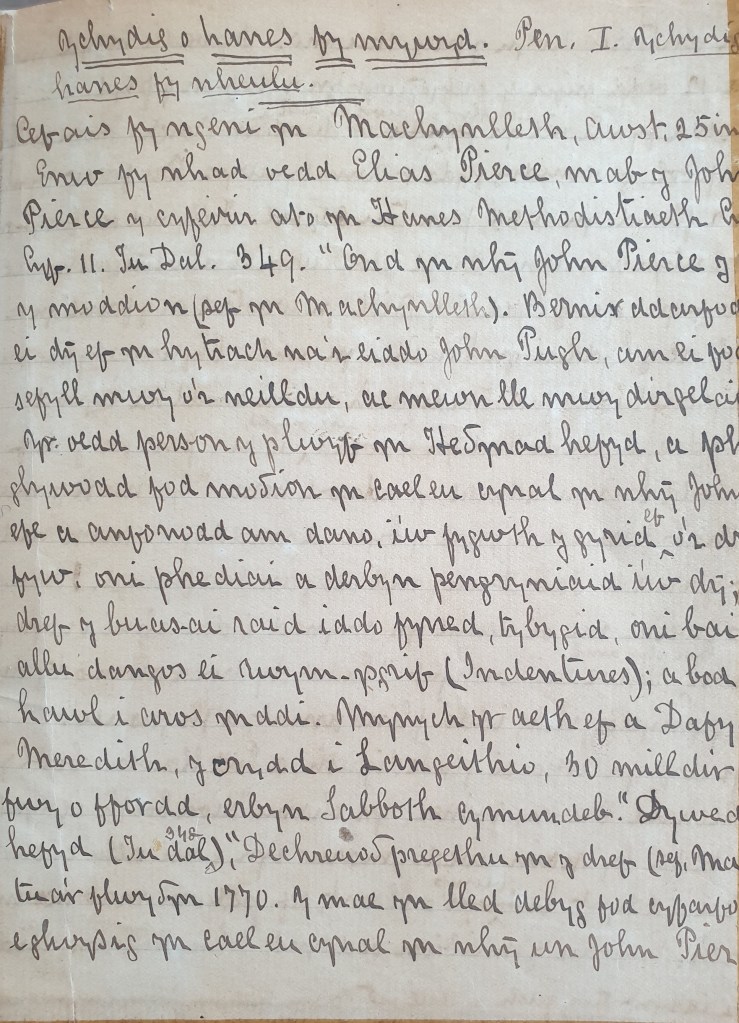
My Welsh was very basic but in going through them I realised one had Rev. David Pierce’s family notes giving his date of birth and his parentage back to a John Pierce who was born in 1727.
The first page of the Rev. David Pierce’s notebook starting with his own birth and basic family details.
On the third page I saw the name “William” with a reference to “filwr” (soldier) and “Ffrainc”(France). There was also a reference to “Madras, India”.
The third page of the notebook referring to “William yn filwr” and “Ffrainc” along with a reference to Madras, India.
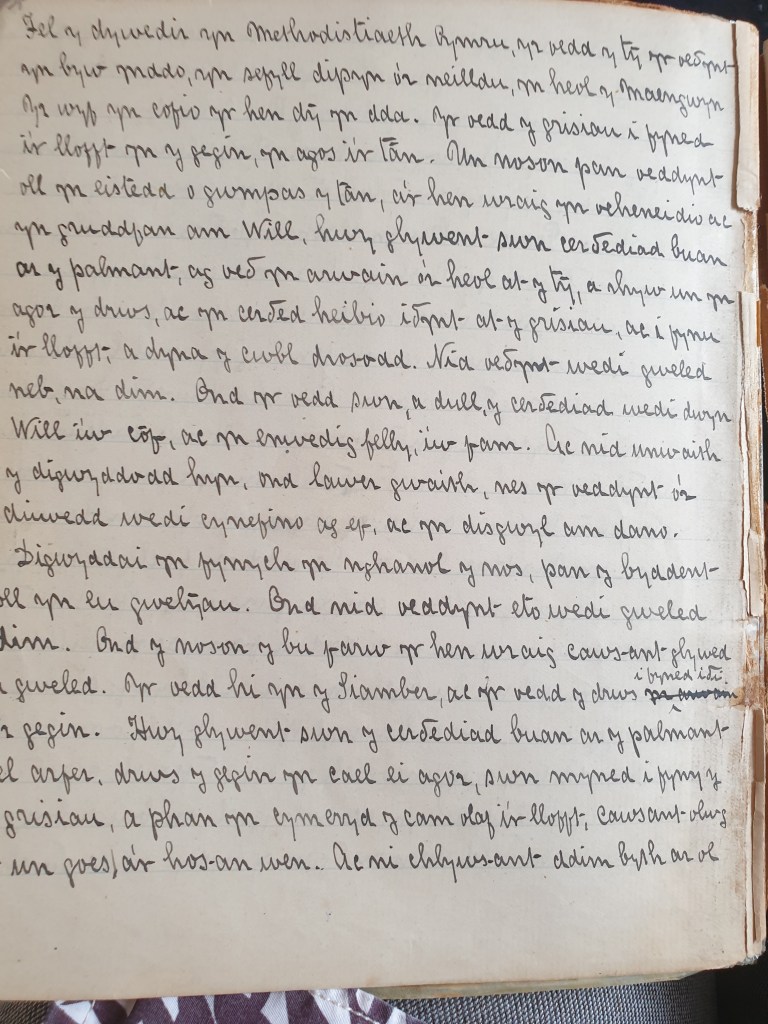
Over the page I managed to roughly translate a reference to them all sitting around the kitchen fire when they heard footsteps on the pavement which came into the kitchen and went up the stairs to the loft.
The fourth page of the notebook describing the family sitting by the kitchen fire and hearing footsteps coming down the road to their house.
There it was in David’s own handwriting – the story David had told his son Edward who passed it to his son David who passed it to me.
When your grandparents, or your great aunts or uncles, tell you tales of their childhood and that of their own grandparents don’t dismiss them.
They may have been embellished over the generations but there is often some truth in there.
I have always meant to get the notebook properly translated but we moved around so much I never got around to it.
When one day missing you becomes unbearable
I will seek you out from deep within the ocean of my memories
Walk on the sands of time till it leads me to your sun-kissed shores
Where our journey ended and love will once again be reborn
Here I will await your loving heart

I will gaze out across the ocean
Breathe in the winds of hope
Close my eyes and cast the nets of faith once more
Reel in the vision of bygone times

In one precious moment
I shall surrender my soul, my heart, my being
To the remembrance of the fragrance of your body
Rediscovering its secrets
I shall recall the waves to the shore and bathe blissfully in the ocean of your memories

We shall become one
Dance to the rhythm of our heartbeats
Watch a million butterflies taking flight
Shimmering bubbles floating above us
Watch the sun as it rises and sets in eyes yours and mine

Embrace and behold the beauty of loves tidal wave
Ride the waves of ecstacy
Reaching a crescendo
As each wave of passion hits the shore and we evanesce into sprays of pearls and water
Ultimately
Just another drop in the ocean of memories
Strawberries that in gardens grow
Are plump and juicy fine,
But sweeter far as wise men know
Spring from the woodland vine.

No need for bowl or silver spoon,
Sugar or spice or cream,
Has the wild berry plucked in June
Beside the trickling stream.

One such to melt at the tongue's root,
Confounding taste with scent,
Beats a full peck of garden fruit:
Which points my argument.

May sudden justice overtake
And snap the froward pen,
That old and palsied poets shake
Against the minds of men.

Blasphemous trusting to hold caught
In far-flung webs of ink
The utmost ends of human thought,
Till nothing's left to sink.

But may the gift of heavenly peace
And glory for all time
Keep the boy Tom who tending geese
First made the nursery rhyme.

By the brookside one August day,
Using the sun for clock,
Tom whiled the languid hours away
Beside his scattering flock.

Carving with a sharp pointed stone
On a broad slab of slate
The famous lives of Jumping Joan,
Dan Fox and Greedy Kate;

Rhyming of wolves and bears and birds,
Spain, Scotland, Babylon,
That sister Kate might learn the words
To tell to Toddling John.

But Kate, who could not stay content
To learn her lesson pat,
New beauty to the rough lines lent
By changing this or that;

And she herself set fresh things down
In corners of her slate,
Of lambs and lanes and London Town.
God's blessing fall on Kate!

The baby loved the simple sound,
With jolly glee he shook,
And soon the lines grew smooth and round
Like pebbles in Tom's brook.

From mouth to mouth told and retold
By children sprawled at ease
Before the fire in winter's cold,
In June beneath tall trees;

Till though long lost are tool and slate,
Though the brook no more runs,
And dead long time are Tom, John, Kate,
Their sons and their sons' sons.

Yet, as when Time with stealthy tread
Lays the rich garden waste,
The woodland berry ripe and red
Fails not in scent or taste,

So these same rhymes shall still be told
To children yet unborn,
While false philosophy growing old
Fades and is killed by scorn.
My one failing as I prepared to become a journalist was getting to grips with Pitman’s shorthand.
Out of our class of less than 20 on my Kelsterton College course myself and four of the girls could not grasp the Pitman system.
I don’t know if it was a means of letting us down lightly but the shorthand tutor said that mastering Pitman’s was not a means of measuring intelligence. Some of the cleverest people around could not grasp it.
Personally I did not care if people doubted my intelligence based on a writing system which appeared to bear no relation to written English.
I would have said that all my fellow students at Kelsterton had a decent degree of intelligence and I wouldn’t have been able to differentiate between Pitman successes and Pitman failures.
My lack of shorthand did not prove a major problem as I started work.
Note-taking is important, especially in council and court reporting. Nowadays “journalists” tend to use recording devices (mobile phones in the 21st century) but this does take a long time to run back and forth.
I started to make my own version of shorthand – not much use if anyone else wanted to read my notes but then again my handwriting was nothing to shout about – beginning with dropping vowels and using accepted abbreviations such as “tt” for “that” and an ampersand (&) or a plus sign (+) for “and”.
This worked well and once I started to cut the letters down to simple strokes I found I could produce an acceptable and readable set of notes.
I knew shorthand was an important part of the NCTJ Proficiency Test but I thought I would cross that bridge when I came to it.
As it happened the NCTJ had just that year ditched Pitman’s (invented by Isaac Pitman in the 1850s) and were trying out a new system invented the previous year (1968) by James Hill – this was Teeline.
As soon as I received my first Teeline textbook I felt immediately at home.
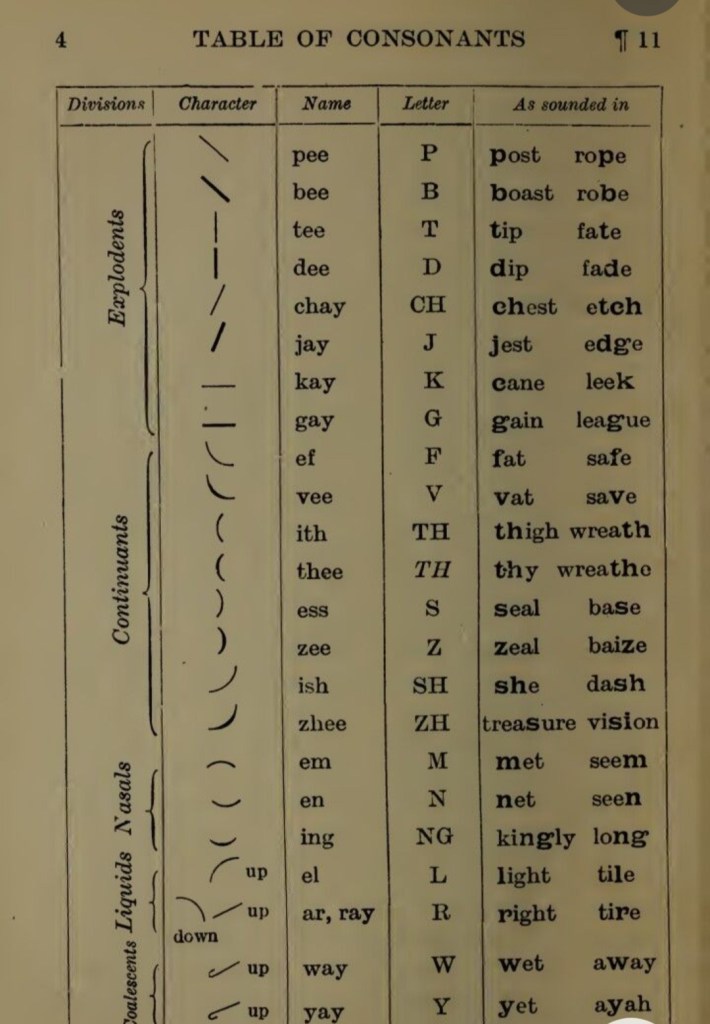
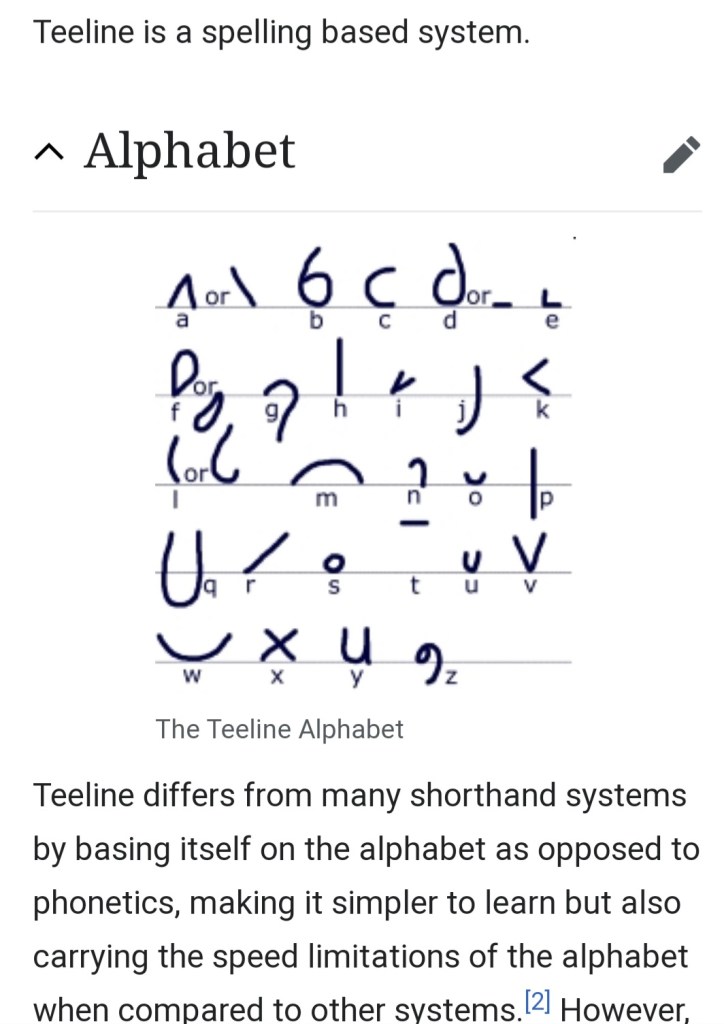
Instead of this:
Pitman’s
We had this:
Teeline
Basically Mr Hill had codified the method I was using. Simplified letters with unnecessary vowels and consonants removed.
It normally takes a year to learn Pitman’s (Hill was a Pitman’s teacher who was almost 60 when he came up with Teeline) – after the eight-week first course I was at a perfect 90wpm and 95% on 100wpm over a five-minute dictated speech.
Like a duck to water.
Others also picked up quite speedily and we even contributed suggestions re certain letter combinations which were passed on to Mr Hill.
(I believe James Hill died a couple of years after our course but his work was continued by IC Hill who might have been his wife, sister or daughter – Ivy Constance Hill)
A couple of people on the course did struggle at first with Teeline and I later found out they had both of them studied and mastered Pitman’s.
For the rest of us we had no previous method clogging our minds (I had put my failed Pitman’s attempt completely out of my attic of memories).
It was not all work and no play during our time in Cardiff. We weren’t fantastically rich (what junior reporter ever is?) but we did get expenses for travel and meals and most journalists know expenses rarely leave you at a loss and generally at a profit.
We had nights out at the theatre and cinema and a small group of us even blagged our way in to the local casino which had a cabaret theatre above it.
I had a fiver in my pocket when we went in and that was a lot of money at that time.
When we left I had £25 ‐ a fortune.
The only gambling I had ever done was on slot machines in the Rhyl amusement arcades. Other than that I used to play cribbage with my grandfather for matches and Newmarket with Grandad and my elderly aunts when they came to visit.
That night I made two bets on the roulette table – first was just on red which doubled my pound stake and then I put two pounds on odds (still only risking my original pound stake).
Two safe bets and I was already up £3.
I shifted to the blackjack table and, never having been in a casino before, watched a few hands.
It looked like pontoon to me and that was something I had played with my Grandad and great aunts since I was knee high to a grasshopper.
Half an hour later my original fiver had four mates and I called it quits.
Before leaving we thought we might as well take in the midnight cabaret show upstairs.
It was a small auditorium, probably no bigger than the Little Theatre in Rhyl, and we were a couple of rows from the front.
It started off with a magician who was reasonable followed by a juggler who had his hands full with balls, clubs, knives and flaming torches – I kept my eye on the exit in case he missed one of the torches.
Then came the stars of show – a well-known TV double act quite high in the ratings at that time.
I was pretty certain I knew what the routine would be. This was an act often seen on family variety shows.
I obviously had not learned my lesson from Ken Dodd at Billy Williams’ Downtown Club.
I’m no prude but I was shrinking in to my seat after five minutes. I can’t think of one joke they told that night that I could possibly repeat.
I have never been able to watch that particular double act ever since – I still didn’t watch either of them when they split and did solo acts.
They’re both dead now.
I had a far better time when I met Morecambe and Wise a few years later and I was saddened when first Eric and then Ernie died.
Over the western sea, hither from Niphon come,
Courteous, the swart-cheek'd two-sworded envoys,
Leaning back in their open barouches, bare-headed, impassive,
Ride to-day through Manhattan.

Libertad! I do not know whether others behold what I behold,
In the procession, along with the nobles of Asia, the errand-bearers,
Bringing up the rear, hovering above, around, or in the ranks marching;
But I will sing you a song of what I behold, Libertad.

When million-footed Manhattan unpent descends to her pavements,
When the thunder-cracking guns arouse me with the proud roar I love,
When the round-mouth'd guns out of the smoke and smell I love spit their salutes,
When the fire-flashing guns have fully alerted me, and heaven-clouds canopy my city with a delicate thin haze,
When gorgeous the countless straight stems, the forests at the wharves thicken with colors,
When every ship richly drest carries her flag at the peak,
When pennants trail and street-festoons hang from the windows.

When Broadway is entirely given up to foot-passengers and foot-standers, when the mass is densest,
When the façades of the houses are alive with people, when eyes gaze riveted tens of thousands at a time,
When the guests from the islands advance, when the pageant moves forward visible,
When the summons is made, when the answer that waited thousands of years answers,
I too arising, answering, descend to the pavements, merge with the crowd, and gaze with them.


Superb-faced Manhattan!
Comrade Americanos! to us, then at last the Orient comes.

To us, my city,
Where our tall-topt marble and iron beauties rage on opposite sides, to walk in the space between,
To-day our Antipodes comes.

The Originatress comes,
The nest of languages, the bequeathed of poems, the race of eld,
Florid with blood, pensive, rapt with musings, hot with passion,
Sultry with perfume, with ample and flowing garments,
With sunburnt image, with intense soul and glittering eyes,
The race of Brahma comes.

See my cantabile! these and more are flashing to us from the procession,
As it moves changing, a kaleidoscope divine it moves changing before us.

For not the envoys or the tanned Japanee from his island only,
Lithe and silent the Hindoo appears, the Asiatic continent itself appears, the past, the dead,
The murky night-morning of wonder and fable inscrutable,
The envelop'd mysteries, the old and unknown hive-bees,
The north, the sweltering south, Eastern Assyria, the Hebrews, the ancient of ancients,
Vast desolate cities, the gliding present, all if these and more are in the pageant-procession.

Geography, the world, is in it,
The Great Sea, the brood of islands, Polynesia, the coast beyond,
The coast you henceforth are facing -- you Libertad! from  Western golden shores,
The countries there with their populations, the millions en-masse are curiously here,
The swarming market-places, the temples with idols ranged along the sides or at the end bronze, brahmin, and llama,
Mandarin, farmer, merchant, mechanic, and fisherman,
The singing girl and the dancing girls, the ecstatic persons, the secluded emperors,
Confucius himself, the great poets and heroes, the warriors, the castes, all,
Trooping up, crowding from all directions, from the Altay mountains,
From Thibet, from the four winding, and far-flowing rivers of China,
From the southern peninsulas and the demi-continental, from Malaysia,
These and whatever belongs to them palpable, show forth to me, and are seiz'd by me,
And I am seiz'd by them, and friendily held by them,
Till as  hear them all I chant, Libertad! for themselves for you.

For I too raising my voice join the ranks of this pageant,
I am the chanter, I chant over the pageant,
I chant the world on my Western sea,
I chant copious the islands beyond, thick as the stars in the sky,
I chant the new empire grander than any before, as in a vision it comes to me,
I chant America the mistress, I chant a greater supremacy,
I chant projected a thousand blooming cities yet in time on those groups of sea-islands,
My sail-ships and steam-ships threading the archipelagoes,
My stars and stripes fluttering in the wind,
Commerce opening, the sleep of ages having done its work, races reborn, refreshed,
Lives, works resumed -- the object I know not -- but the old, the Asiatic renew'd as it must be,
Commencing from this day surrounded by the world.

And you Libertad of the world!
You shall sit in the middle well-pois'd thousands and thousands of years,
As to-day from one side the nobles of Asia come to uou,
As tomorrow from the other side the Queen of England sends her eldest son to you.
The sign is reversing, the orb is enclosed,
The ring is circled, the journey is done,
The box lid is but perceptibly open'd, nevertheless the perfume pours copiously out of the whole box.

Young Libertad! with the venerable Asia, the all-mother,
Be considerate with her now, and ever hot Libertad, for you are all,
Bend your proud neck to the long-off mother now sending messages over the archipelagoes to you,
Bend your proud neck low for once, young Libertad.

Were the children straying westward so long? so wide the tramping?
Were the precedent dim ages debouching westward from Paradise so long?
Were the centuries steadily footing  it that way, all the while unknown, for you, for reasons?

They are justified, they are accomplish'd, they shall now be turned the other way also, to travel toward you thence,
They shall now also march obediently eastward for your sake Libertad.
By the time I had been a journalist for almost three years I was sent back to the classroom — at least it was at a college and not going back to school.
The National Council for the Training of Journalists (it does what it says on the tin) had initially decreed trainee journalists should spend one day a week at college studying the basics of journalism.
This was changed by 1969 and it was decided an eight-week block release course, followed by a year back at the office and then a second eight-week course, was the better way to go.
To my mind they were right.
I would probably have gone on the first block release earlier if it had not been for the changeover in the newspaper I worked for.
Didn’t make that much difference because although I was not the oldest on that first autumn course at the Cardiff College of Food Technology and Commerce (that’s right journalism was lumped in with trainee chefs and office workers) I was one of the most experienced.
There were about 20 of us on the course, more male than female (but not by much) and ages ranged from 17 to 21/22.
On that first morning we had a “getting to know you” session with the course tutor.
It started with saying where we were from – most of the students were from Wales with a few from border counties.
Then she went into the routine of finding out how experienced we were.
“Those who have done parish rounds?”
All hands up.
“Emergency service calls?”
All hands up.
“Council meetings?”
Not quite so many.
“Court?”
Even less.
This continued until she had run the gamut of inquests; major emergency stories; behind the scenes features; etc. etc.
By this time the only hands up were mine and one of the older trainee reporters (who, it turned out later, was the son of two journalists and grandson of an old-time editor/proprietor).
When we had a chat after the first tutorial we discovered we had both had experiences the other had not but this was mainly based on the differences between an urban newspaper and a rural/seaside newspaper (the two I had worked on).
The remainder of the day was mainly based on meeting other tutors covering the range of subjects we would study:
Newspaper practice;
Newspaper law;
Local government;
Shorthand;
English.
I think that covers it all but some of the subjects may have overlapped.
As I said, the group was a mixed bag both in age and experience. A couple of them had no more than six months probationary period and even the older ones had gone through sixth form and one was ex-university.
At the end of the first day some of us did what so many journalists did at that period – we repaired to a nearby pub.
Some of the younger ones declined the invite and said they wanted to study the assigned books and prepare for the next day.
As I had been put in a B&B for the duration I ordered a pub meal as did some of the others.
The drinks got us all chatting and before long it was as though we had known each other for years and it was getting on for 10pm before we went our separate ways.
The following day the work began – but beforehand there was an amusing incident as we all arrived just before 9am to enter our classroom.
We had noticed other young students around on their way to cookery classes or typing but in the corridor outside our room we passed a group of youngsters who stopped chattering as we passed and just stared at us in either amazement or admiration.
Once we were all in and the door closed one of our number asked our course tutor who the youngsters were.
It turned out they were the first members of a pre-entry journalism course and apparently had been looking forward to seeing “real journalists”.
It certainly amused us and someone asked if they had expected us to be wearing raincoats and trilbies with PRESS cards in our hatbands.
The pre-entry group were in a room on the same corridor and various groups of them were outside our room when we arrived or left for the first two weeks.
The idea of being put on a pedestal appealed to some of our group. Naturally I was unaffected — honest.
After that first day of settling in we got stuck in to some hard work.
The next eight weeks were hectic but good fun at the same time.
Next time: Learning a new “language” and a night at the casino.
To Mercy, Pity, Peace and Love,
All play in their distress,
And to these virtues of delight
Return their thankfulness.

For Mercy, Pity, Peace and Love,
Is God our Father dear,
And Mercy, Pity, Peace and Love,
Is man his child and care.

For Mercy has a human heart
Pity, a human face;
And Love, the human form divine;
And Peace, the human dress.

Then every man, of every clime,
That prays in his distress,
Prays to the human form divine:
Love, Mercy, Pity, Peace.

And all must love the human form,
In heathen, Turk or Jew.
Where Mercy, Love, and pity dwell,
There God is dwelling too.
They put a leather belt around her
13 feet of tape and bound her
Handcuffs to secure her
And only God knows what else,
She's illegal, so deport her
Said the Empire that brought her
She died, nobody killed her
And she never killed herself.
It is our job to make her
Return to Jamaica
Said the Alien Deporters
Who deports people like me,
It was said she had a warning
That the officers were calling
On that deadly July morning
As her young son watched TV.

An officer unplugged the phone
Mother and child were now alone
When all they wanted was a home
A child watch Mummy die
No matter what the law may say
A mother should not die this way
Let human rights come into play
And to everyone apply.
I know not of a perfect race
I know not of a perfect place
I know this is not a simple case
Of Yardies on the move,
We must talk some Race Relations
With the folk from immigration
About this kind of deportation
If things are to improve.

Let it go down in history
The word that is officially
She died democratically
In 13 feet of tape,
That Christian was over here
Because pirates were over there
The Bible sent us everywhere
To make Great Britain great.
Here lies the extradition squad
And we should now all pray to God
That as they go about their job
They make not one mistake,
For I fear as I walk the streets
That I may just one day meet
Officials who may tie my feet
And how I would escape.

I see my people demonstrating
And educated folks debating
The way they're separating
The elder from the youth,
When all they are demanding
Is a little overstanding
They too have family planning
Now their children want the truth.
As I move around I am eyeing
So many poets crying
And so many poets trying
To articulate the grief,
I cannot help but wonder
How the alien deporters
(As they said to press reporters)
Can feel absolute relief.
O thou bright jewel in my aim I strive
To comprehend thee. Thine own words declare
Wisdom is higher than a fool can reach.
I cease to wonder, and no more attempt
Thine heights t'explore, or fathom thy profound.
But, O my soul, sink not in despair,
Virtue is near thee, and with gentle hand
Would now embrace thee, hovers o'er thine head.
Fain would the heav'n born soul with her converse,
Then seek, then court her for her promis'd bliss.
Auspicious Queen, thine heav'nly pinions spread,
And lead celestial Chastity along;
Lo! Now her sacred retinue descends,
Array'd in glory from the orbs above.
Attend me, Virtue, thro' my youthful years,
O leave me not to the false joys of time!
But guide my steps to endless life and bliss.
Greatness, or Goodness, say what I shall call thee,
To give me an higher appellation still,
Teach me a better strain, a nobler lay,
O thou,  enthrone'd with Cherubs in the realm of day.


 Robin's Nest