Kissing frogs is a job for a princess

A princess who wants to find her prince will have to kiss a lot of frogs during the search.

A young reporter seeking a page one byline will have to type up a lot of funeral and wedding reports on the way.

The late 60s was still a time when weekly newspapers were considered a “paper of record”. That meant publishing things like marriages and funerals with as much detail as possible.

By the time I worked on the Flintshire Leader, and then the Rhyl Journal, wedding photos and reports could build up and often not get into the newspaper until long after the honeymoon was over.

Newspapers provided forms for the happy couple to fill in the details including their names; parents’ names; addresses; names of bridesmaids, best man and ushers; description of the bride’s dress, and those of the bridesmaids; and even extra space if they wanted to add on other information: jobs or shared hobbies such as am dram.

Some poor junior reporter (in those days me) would have to type this into a readable format.

There was worse to tackle, however, the dreaded funeral reports.

The funeral report forms were left with funeral directors and after the basic details (name, age, address, occupation and date and place of death and burial) they would include the full list of mourners and the names of the people who gave floral tributes.

On an important funeral there could be 100 mourners and well over 100 floral tributes. Each and every one would have to be listed.

I was told by an older reporter that in his young days he had to go to the church where a funeral was held and note down the names on the cards for floral tributes and even have to copy down the names from cards the mourners had filled in and left in the pews.

At least those days are long gone.

I referred to newspapers being “papers of report” and this did not lend itself to striking page layouts or gripping storylines.

In fact it was not long before the Rhyl Journal was taken over by NWN that they stopped putting only advertisements on the front page.

In many local newspapers in the 1950s, even well into the 60s, a report from a monthly council meeting might fill the whole of an inside broadsheet page. There would be sub heads (really crossheads) to break up the slabs of type but a lot of it was verbatim.

Gradually this style of recording rather than reporting was replaced by genuine journalism. This meant the reporter would pick out the best stories from a meeting and use the relevant points of interest rather than using everything that was said.

A strong story from a council could make an inside page lead or even a front page piece. In fact, if there was contention at the meeting it could even make a splash.

If I went to a meeting with a senior reporter I would often be assigned some of the lesser stories which might make inside anchors (bottom of the page) or even hampers (top of the page above the page lead.

In that year in between my Cardiff courses I did not have much in the way of exciting stories to put in my scrapbook but I was certainly prolific with the sort of stories that made up the bulk of a newspaper.

A story about a shop selling seashells made a good feature with a picture but it was really bordering on an advertising puff piece. The only news angle was that it was the first time someone had started selling foreign seashells at a seaside town.

Other than that there were lots of minor court cases; WI reports; stories about Scout troops or Girl Guides going off to camp.

In a way it came as a relief to head off to Cardiff again in autumn 1970 for the second part of my block release course.

At least there I wasn’t still on the bottom rung of the ladder.

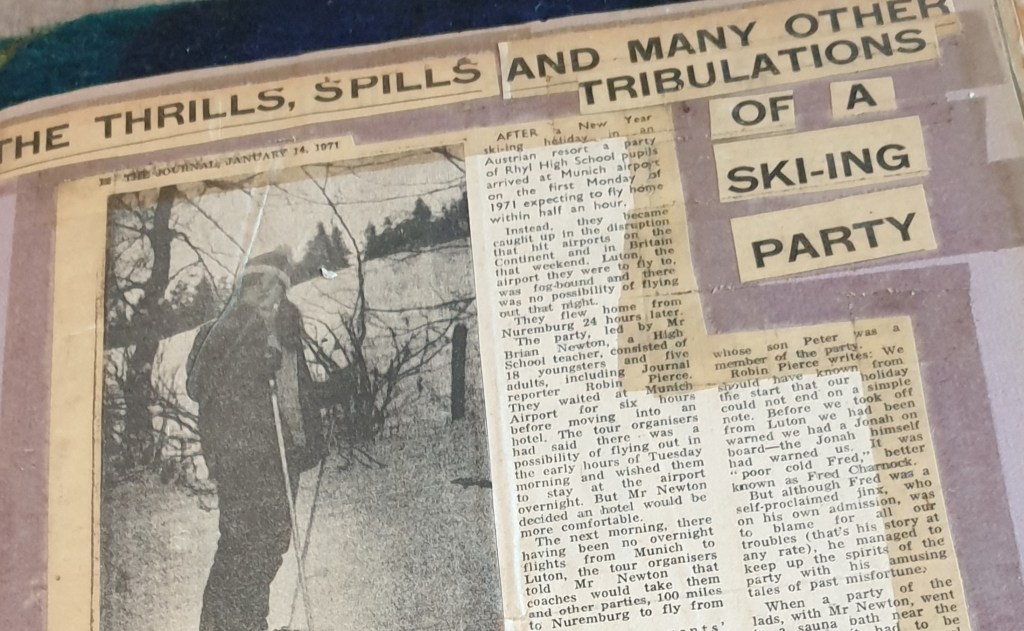
Next time: how I became a badminton fan and learned how to ski.

Caught having a crafty fag behind the bike sheds

Time to take another trip back in time and find out how young Robin Ace Reporter coped as the 60s came to an end.

The first of my block release training courses in Cardiff came to an end and it was time to head home, not just for the weekend but for the next 10 months.

It was good to be back at work and not to feel like a schoolboy any more. Mind you we had been given “homework”.

Our English teacher had set us the task of researching and writing a feature piece on any subject we fancied.

Themed work like this reminded me of a punishment I was given at school after being caught smoking on school premises.

I was actually caught out by the biology teacher who, instead of marching me off to the headmaster’s office, decided I should benefit from my misdemeanor and told me to write a 1,000 word piece on the links between smoking and lung cancer.

In a way he did me a favour in that he had set me the task of researching what in my journalistic future would be considered a form of investigative reporting.

At the time, however, I was still a contrary, bloody-minded teenager and I scoured the school library and the town library for everything that disproved any connection between the two.

Nowadays it is easy to find the information you need online. It is also easy to find the information that suits your agenda online.

It was not so easy in the 60s when your best friend was a card file index and you had to hope you would find what you wanted.

Nowadays there is so much information that you drown in the stuff.

The pros and cons of smoking were still in their early stages at this time and the teacher in question did allow me access to papers he had collected when they were published.

I can’t remember the full details of that school essay but basically I centred it on research that had looked at cases of lung cancer in industrial or heavily urbanised areas as opposed to rural areas.

In part this research indicated that it was possible for a non-smoker to live for 50 years in an industrial or urbanised area and die of lung cancer.

It also indicated that a smoker could live for 80 years in a rural area and not show any signs of lung cancer.

It satisfied me at the time to present my findings, which went against what the teacher had hoped for, and highlight that this came from his own research papers.

The point is that I could just as easily have done a Boris Johnson and written an essay putting the totally opposite viewpoint.

Getting back to my journalistic “homework” – I chose to do a feature on the rise of the Hells Angels and their effect on motorbike groups in Britain in the 1960s.

At the time, late 1969 into 1970, the Hells Angels were known about but had not yet made the break into Europe although many British motorcycle gangs were beginning to adopt a pseudo Angels’ look.

Research material on the Angels was readily obtainable as they had been operating for over 20 years by then (the Hells Angels Motorcycle Club was formed after the Second World War, initially by bikers who had served in USAAF fighter squadrons, and traditionally St Patrick’s Day 1948 is considered the founding date).

I was more interested in finding out whether the Angels had an influence on the British bikers and in this I was in a perfect position in Rhyl during the summer of 1970.

The seaside town had more resident motorbike riders than fashion-conscious scooter fans (known in the 60s as Mods).

These young bikers were often the siblings of the 1950s Teddy Boys and were heavily into rock ‘n’ roll and the cowboy music of “outlaws” such as Johnny Cash and Willie Nelson.

On evenings and at weekends my old mate Roger Steele and I would go down to some of the favoured haunts of these guys and over a few drinks it was easy to turn the conversation to the bike fraternity; the seaside battles between Mods and Rockers earlier in the 60s; and the rise of Hells Angels in America and their influence on British biker gangs.

By the end of that first summer of the 70s I probably had enough research to fill a book.

That’s when I had to start the real work of condensing it into a feature length piece.

After all the work I put into it the reaction from the English teacher was very satisfying.

“Robin has produced a racy yet readable article on a subject which encapsulates the 60s for many people.”

It certainly gave me a grounding for some of the feature work I did later in the 70s when I moved down south. In another way it was useful on advertising features and others on the Rhyl Journal.

Old TV drama recalls the passions of youth

Regarding my regrets – I did not have a sudden realisation that I regretted not learning Welsh. I was not even hit by a revelation that I am proud to be Welsh.

Similar to many of my compatriots who are far from home (I have, of course been much farther than Hampshire) I am surrounded by objects which remind me of my heritage – they range from a full-size Red Dragon flag down to a “Cymru” sheep fridge magnet.

What brought it back home was a sense of utter boredom in the choice of TV during lockdown.

I mean to say, you can only read so many books, or listen to so much music, or radio programmes.

Recently, however, my wife and I discovered all the 1970s’ drama series uploaded to YouTube and it was among these (well hidden) we found a six-episode gem from 1975 based on one of my favourite books How Green Was My Valley, by Richard Llewellyn.

I remember getting it from the library when I was about 14 and certainly understood about the passion, sorrow, joy, musical pleasure and relationships embodied in this tale of the Morgan family living in a South Wales mining village in the latter part of the 19th century.

I remember in particular feeling an affinity with the socialist brother and his trade union work even though at this time I was still working on my political beliefs.

More especially I was struck by the matriarchal power combined with care of Beth Morgan, the mother, and more so the character of Bronwen, Huw’s sister-in-law and object of his juvenile infatuation.

The TV series is not a scene for scene reproduction of the book. Although the blurb for the TV series refers to Huw’s brothers we only see and hear of three. Ifor, Ianto and Owen are obviously major characters on TV but in the book many of the incidents attributed to them were actually the realm of Gwilym or Davey.

Again the book offers two more members of the Morgan family, Huw and the boys have three sisters, not just Angharad.

This does not lessen the impact of the TV programme. After all it is easy enough to write 100 characters into a novel but not as easy to pay 100 actors to appear in a TV drama.

What the TV series did was to take the heart and soul of the story from the book and bring it to life on the screen.

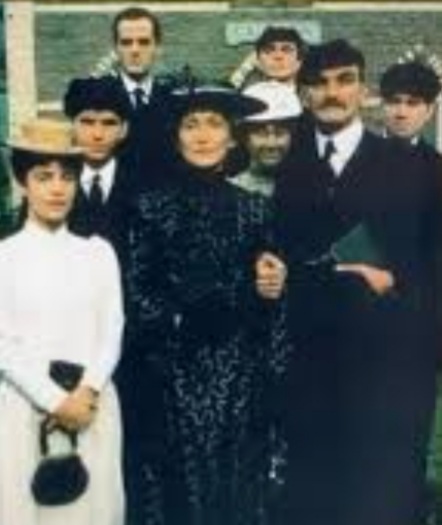
The Morgan family ready for chapel

With Siân Phillips as Beth and Nerys Hughes as Bronwen the two best characters in the book were well portrayed.

More than this, however, the series reminded me of the sense I got from reading the book of the fire and passion that lies within the Welsh people.

The fire and passion that makes them stand up to those who try to “keep them in their place”.

The fire and passion that makes them pour out their souls in song.

The fire and passion that makes them pour out their hearts in love.

Now I have to go through my books to find my old copy of How Green Was My Valley and read it again.

Well you didn’t think I only read it once after borrowing it from the library did you?

Gwalia Deserta XV

The poem on which the folk song The Bells of Rhymney was based

by Idris Davies (1905-1953)
O what can you give me?
Say the sad bells of Rhymney.

Is there hope for the future?
Cry the brown bells of Merthyr.

Who made the mineowner?
Say the black bells of Rhondda.

And who robbed the miner?
Cry the grim bells of Blaina.

They will plunder willy-nilly,
Say the bells of Caerphilly.

They have fangs, they have teeth
Shout the loud bells of Neath.

To the south, things are sullen,
Say the pink bells of Brecon.

Even God is uneasy,
Say the moist bells of Swansea.

Put the vandals in court,
Cry the bells of Newport.

All would be well if - if - if -
Say the green bells of Cardiff.

Why so worried, sisters, why
Sing the silver bells of Wye.

Idris Davies, who had been a miner at Mardy Colliery, Rhymney, South Wales, from the age of 14, wrote this during a four-year period on the dole in his early 20s.

He was encouraged by Dylan Thomas and T S Eliot and in 1938 Eliot published a collection of Davies’ work, in a collection titled Gwalia Deserta (Wasteland if Wales).

My real regret – I don’t speak Welsh

I have one great regret in life (having lived for nearly 71 years) – I did not concentrate on learning Welsh 60 years ago.

Personally I blame my teacher at Rhyl Grammar School. She was too pretty. I blame my Latin teacher for my failure to master Latin for the same reason.

Beauty in the eye of the beholder also explains my failure in French – ah what a beauty that French teacher was.

When you gaze on beauty you are oblivious to other joys.

As it happens I have never needed to be fluent in French. I have never been to France and am never likely to go.

Latin is not a problem but for different reasons. On gaining an interest in genealogy I discovered many records written in Latin. I managed to get hold of a Latin dictionary and have muddled my way through ever since.

Welsh is different.

Even at 11 I should have known I would regret not applying myself to the Welsh language.

There are many reasons:

♡ it would have been useful in my teens for chatting up some of those beautiful young ladies from Ysgol Glan Clwyd;

♡ it would have been useful for insulting non-Welsh speakers without them knowing they were being insulted;

♡ it would definitely have been useful for reading my great grandfather’s notes on his family history and his stories of family life in mid-Wales in the first part of the 19th century.

The real reason I regret not applying myself to the language of the land of my fathers is that it is a language of song, a language of love and a language of great antiquity.

I have tried to compensate for my lack of foresight over the decades by making efforts to learn Welsh.

At least now I can say odd useful phrases in Welsh. Such as wishing my darling wife goodnight in the language of my ancestors and greeting her in the morning.

I can also manage, with a Welsh dictionary and grammar book, to stumble through my great grandfather’s notebooks and one day I hope to read his penillion pieces, his sermons and other writings.

What it does show is how easy it is to lose a language.

My great grandfather, the Rev David Pierce, was born in Machynlleth the son of a shoemaker and began work as a weaver yet later he was listed in the census as a pauper.

He came back from poverty, went to college and became a schoolteacher and then a minister in the Welsh Calvinistic Methodist Church.

His was a Welsh-speaking household but he had learned to speak English (for a time he was a teacher in Wolverhampton) and his son, my grandfather was bilingual.

Maybe it was because my grandmother was English and Welsh was not the usual language at home that my father only had a smattering of Welsh.

My mother, maiden name Lloyd, was part of a Liverpool Welsh family but it was her great grandfather, I think, who moved from Bagillt to Liverpool.

Although my father and I “lost” the language it did not mean we did not love the language – especially in song.

I have a large collection of Welsh choir music, including some recordings of a 1000 Welsh male voice choir from the Royal Albert Hall.

Most of them belonged to my father and some I had bought as presents for him.

To hear a Welsh male voice choir sing Myfanwy will still bring tears to my eyes.

What brought all this to my mind? The story of the Morgan family.

I’ll explain that next time.

Ave Maria Plena Gratia

by Oscar Wilde (1854-1900)
Was this His coming! I had hoped to see
A scene of wondrous glory, as was told
Of some great God who in a rain of gold
Broke open bars and fell on Danae:
Or a dread vision as when Semele
Sickening for love and unappeased desire
Prayed to see God's clear body, and the fire
Caught her white limbs and slew her utterly:
With such glad dreams I sought this holy place,
And now with wondering eyes and heart I stand
Before this supreme mystery of Love:
A kneeling girl with passionless pale face,
An angel with a lily in his hand,
And over both with outstretched wings the Dove.

My mate the Marmite Man

Is this the face of the most-hated man in Britain?

There are people (including politicians) who are loved by some and hated by others. Yet the majority don’t care one way or the other.

Jeremy Corbyn, as we know full well from the media hype, is not one of these.

He is like Marmite – you love him or you hate him.

Love is maybe not the right word but it comes closest in suggesting admiration, respect, belief or a hundred other terms.

Hate certainly seems to be the right word for the attitude of so many who shudder and cross themselves at the mention of his name or if his face appears on the television screen or the front page of a newspaper.

Why do people fear him? Especially as the vast majority have never even seen him in the flesh, at Glastonbury, or one of the many rallies he addressed while campaigning for the leadership (two years’ running) or when he campaigned against Brexit.

I first met him at a much smaller rally over 20 years ago – the Burston Strike School Rally in Norfolk.

I already knew about him and the work he was doing – especially regarding his actvities opposing racism in general and apartheid in partiular.

He was this feisty, casually-dressed (some would say scruffy) man who looked nothing like the popular image of an MP. After all in the 70s MPs didn’t take their jackets off in public, let alone remove their ties and roll up their sleeves.

Jeremy Corbyn arrested in the 1970s at a rally protesting about apartheid in South Africa

At the Burston rally as many people as possible joined the Candlestick Walk, which goes around Burston and its environs to visit sites important to the Strike School story.

As a steward I was in the vanguard of people with Jeremy and on that 45 minute walk we (about half a dozen people including Jeremy) chatted but it wasn’t all about politics.

As we all appear to know these days, Jeremy is a keen cyclist.

That Sunday morning he had risen early and cycled from his home in Islington to Liverpool Street Station (about three miles or 15 minutes by bike); travelled to Diss; cycled out to Burston (about five miles); mingled with the crowds at the rally; joined the Candlestick Walk (about two or three miles) and at about 4pm he set off by bike to Diss station (another five miles) and when he got to London cycled another three miles home.

Not bad for a man over 50 who cycled 16 miles and walked another three as well as standing for most of the day addressing the crowd as well as walking around the green visiting socialist stalls and just chatting to people.

I was already an admirer of the man. After all here was a believer in socialism who would not betray his beliefs just to gain power.

This first meeting with him strengthened my admiration of the man.

I kept an eye on his activities from then on and met him a few more times at conference or similar socialist gatherings.

It made my day in 2015 when I heard he was putting himself forward for the leadership of the Labour Party.

By this time I had retired from journalism and had moved to Hampshire, but when I heard Jeremy Corbyn was to attend that year’s Burston Rally I determined to drive the 150 miles to the Norfolk village on the Sunday of the rally. My son accompanied me.

The rally has always attracted hundreds of socialists to the small village but on that day there were thousands. It was estimated in local newspaper reports that there were at least 3,000 people present that day.

Leadership candidate Jeremy Corbyn speaking to 3,000 socialists in the tiny Norfolk village of Burston on 6 Sepember 2016

Over the past few years one of the names given to Jeremy Corbyn has been Magic Grandpa – not in a kind way but as an insult in suggesting that is all he is, a doddering grandpa not a real politician.

Well on that day in 2015 Jeremy Corbyn was a real politician AND a Magic Grandpa.

As he addressed those thousands of socialists they listened with rapt attention to a man who was offering a brighter and better future for the whole country.

At the end of an enthralling speech, as thousands applauded this great socialist, a little boy appeared at the side of the stage.

We know Jeremy Corbyn is good with children and at that moment we discovered why.

He turned and saw the little boy, probably a child or grandchild of one of the organisers, and gestured him forward. The little boy trotted over and held the great man’s hand in the most natural way.

That little boy recognised a man who cared. At that moment he WAS Magic Grandpa.

He was also the best chance the Labour Party had to recover from three disastrous leaders.

He proved his capabilities in the surprise election of 2017 – less than two years after becoming leader.

No wonder they got scared and ratcheted up the campaign against him.

Not all lessons can be taught in a classroom

Now what was I saying when I so rudely interrupted my tales of a hardworking hack?

I remember now, myself and my fellow journalism students were trying to cope with the trauma of a class “day out” to a psychiatric hospital – or mental asylum as it was called at the time.

I know that nowadays people will be horrified at the reference to mental asylum but this was at a time when that term was mild. More people would have called it the “lunatic asylum”, “looney bin” or even “nut house”.

I was 19 when we visited that place and it has stuck with me for more than 50 years. There were some in our group aged just 16 or 17 and I still wonder if they have that trip etched into their minds.

In fact there were a number of things involved with that course which in hindsight (and possibly even at the time) I believe were a waste of time.

Not the whole course – but cetainly sections of it.

I definitely found benefit in the shorthand classes as I still use elements of TeeLine today. By the end of the first eight-week course I had reached 100 wpm with 100% accuracy and managed 110 wpm at 95%.

Naturally the section on Newspaper Law was also important.

Newspaper Practice was more of a mixed bag. It certainly included a multitude of sins.

Learning how to handle a running story, for instance, was invaluable.

It involved having to write a basic report on a major accident for the next edition of an evening newspaper; updating it for the second edition as more reports came in; and providing a completely updated report for the final edition.

The beginning comes via a fax report from a local “stringer”, someone who picks up bits of news and passes them on to a newspaper for their own reporters to follow through.

Initially the reporter will get direct local comment from police and other emergency workers on site.

Eventually the reporter will be receiving reports from police, fire and hospital sources along with interviews with witnesses and survivors.

It all has to be sifted for information and filed to update the story before each appropriate deadline.

Some reporters may never find themselves facing such a situation. Some may only face it once. Some may face it on a regular basis. Whatever the situation, having worked on a running story under controlled conditions may prove a godsend one day.

On the other hand having English lessons as though you were back in school seems a pointless exercise.

Being given lessons in the use of verbs and adjectives; or the ideal length of a sentence and the appropriate number of sentences to a paragraph as applicable to a novel, is not really helpful when writing a report on a court case or condensing a three-hour council meeting into a 15 paragraphs.

You would learn far more by reading Harold Evans’ excellent book Newsman’s English.

At the end of the day lecturers can teach you shorthand; they can teach you matters of law affecting newspapers; they can even teach you the correct ways of referring to government ministers; prelates; members of the royal family; even the differences between religious denominations.

The can’t teach you how to interview the young, grieving mother and widow of the man she thought she would live with forever.

They can’t teach you to judge whether a politician is telling truth or lies.

They can’t teach you to spot the special story hidden in a mundane report.

You learn all these by experience; by working with colleagues who have already dealt with these situations; by studying stories in your paper and others.

In all honesty they could probably put all the worthwhile material into one eight-week session rather than two with a 10-month break in between.

The funniest thing about the NCTJ course was that they even gave us “homework” at the end of the first year.

More about that next time.

It’s the little things in life that make you smile

There are times when you can feel down; or feel sorry for yourself; or just feel angry about something you can do nothing about.

I’ve been through all three today and it took the smallest of incidents to cheer me up.

It was the delivery of . . .

Well let’s just wait a moment and consider why my day was going so badly.

I woke with a gut ache (no, not a stomach ache because it was lower down, in the area most people think of as the stomach).

It was not a raging, sharp pain – more of a dull ache.

The wday wasn’t going to let me off that lightly: I also had a pain across my lower back, it was almost as though I was wrapped in a girdle of pain.

Dull, aching, persistent pain.

Add in the tiredness of erratic, spasmodic sleep and it’s enough to bring anyone down and make them feel sorry for themselves.

It was not wind making me ache as there was no sign of movement up or down.

Even an hour or so sleep on the sofa didn’t help.

Meanwhile every bit of news I saw or heard was just making me more and more angry.

I can understand the lockdown – we went into the first one a week ahead of the Cabinet of Clowns ordering it. We actually started on my birthday, 16 March, 2020, when I hit 70.

Since then the way it has all been handled has often annoyed me. Not angered me – annoyed me.

When you are annoyed you can remain calm and consider what should be done.

I am not a health expert, then neither is Johnson or any of the C of C, but I do understand that if you are facing a pandemic of a virus which can kill almost as many as the Black Death or the Spanish ‘flu then you lock down everything as tight as you can.

You don’t just rely on a face mask, a six-foot gap, and regular washing of hands.

Boris Johnson seems to think that if he throws money to his pals, ignores the advice of health experts, and relies on a man who flouts every rule in the Covid19 handbook, then everything will be OK.

Despite this, and despite Starmer giving Johnson’s C of C an easy time, I still remained annoyed not angry.

Then, knowing two companies had created a vaccine and we might be on the last lap of a deadly race, I accepted that Christmas was not going to be a family affair.

Johnson needs to be loved, however, and decided, against the odds and against the health advice, that we should all have a day off for Christmas.

I am sure you know, as I do, that viruses don’t know about Christmas and Covid19 was certainly not going to take a day off for Christmas, New Year or any other holiday.

Even then I was only annoyed at Johnson and all the other idiots.

I did get really annoyed when Johnson’s decision to give us all of Christmas Day off resulted in a massive spike in the pandemic and an upsurge in Covid19 cases and deaths.

Following which he rushed into a new major lockdown – too little, too late – and I got angry.

By 7pm I was angry about something I could do nothing about; I was feeling very sorry for myself; and I was feeling down because of the pain (easing somewhat after the judicious use of a hot water bottle).

That was when the doorbell rang.

My son opened the door to see a delivery man standing by the gate and a package on the doorstep.

It was something I had ordered just after Christmas and for some unfathomable reason it really cheered me up.

Tomorrow I will probably still have a gut ache and a back ache; I will probably be less than my usually cheery self; and I will almost certainly be annoyed at least about the feckless behaviour of Johnson and his clowns.

I will have warm feet though.

London 1802

William Wordsworth (1770-1850)
Milton! thou shouldst be living at this hour;
England hath need of thee: she is a fen
Of stagnant waters: altar, sword, and pen,
Fireside, the heroic wealth of hall and bower,
Have forfeited their ancient English dower
Of inward happiness. We are selfish men;
Oh! raise us up, return to us again;
And give us manners, virtue, freedom, power,
Thy Soul was like a Star, and dwelt apart;
Thou hadst a voice whose sound was like the sea:
Pure as the naked heavens, majestic, free,
So didst thou travel on life's common way,
In cheerful godliness; and yet thy heart
The lowliest duties on herself did lay.