Even the man on a Clapham omnibus could understand these basic instructions

You never know what you’ll find on an instruction sheet when you buy a gadget.

Once upon a time it would identify the component parts and explain what each part did.

If it was made in the UK it would have assembly instructions (if it needed assembling) and operating instructions. These would be written in English and possibly in French, German and Spanish.

When we joined the EU the information required grew and the number of languages had to cover every single one.

From the days when a small slip of paper was enough as an information leaflet a lot of items we buy these days have what amounts to a slim paperback.

My son works for a company which has to ensure the information in these tomes is accurate. A lot of this work is now done online.

He started off in this line working as what amounted to a quality controller and also involved quality testing an item to make sure it is safe.

Nowadays he concentrates on ensuring all the information needed (including warnings on whether or not it is suitable for different age ranges) is provided.

Over the years he has explained to me the necessity for certain things provided in these leaflets.

It is not down to bureaucracy, much of it is to ensure the safety of the purchaser and any user of the item.

As a journalist I was always told that a news story had to be understood by an average reader, known in the early 20th century as “the man on a Clapham ombibus”.

Although the term is archaic it is still a good guide these days and applies to any purveyor of information.

Mind you this tenet now looks as though instructions are being brought to an extremely basic statement.

I have just bought a kitchen gadget for which information instructions have come down to the most basic I have ever seen.

HOW TO USE:

Press button: machine works.

Release button: machine stops working.

I think even Donald Trump could understand that.
From home phones to mystery emails – grifters keep trying

Why do scam artists (actually that’s an insult to real artists, sorry Vincent, Renè, Michelangelo, Pablo, Salvador et al) think that anyone over 70 is as dumb as Trump, and you’d need to get close to the bottom of the IQ ladder before you’d find a candidate, and an easy mark for a grifter.

Five years ago it was mainly our landlines that had the trolls jiggling in excitement when they called on behalf of: “your bank”; “your computer security company”; “your Sky account”; or whatever company they claimed to be.

My initial reaction was to accuse them of lying and put the phone down.

The trouble is that did not deter them. They continued to use a range of different numbers in the hope that I would not notice the same person was calling from so many accounts.

I did go to the well-tried move of engaging them in conversation:

“Ah yes, didn’t you call yesterday? Good to hear from you again. Sorry I cut the call short but I was concerned about my mother who is 92 and bedridden. How is your mother by the way?”

This would put some of them off, but there were the persistent ones who would change tack and start telling you that with an elderly person in the house you needed to ensure your cyber safety, as if you were scammed you might end up unable to provide care for them.

Anyone who tries that just gets cut off.

The problem is that some of the scammers just can’t stop. This used to put me on the “shaming” tack.

“Does your mother know what you do for a living? Does she know that you try and con elderly people to pay over all their savings just so that you can live the high life?”

Surprisingly this does turn some of them away. I have had an occasional one even say sorry but most of them get narked and tell me to do things to myself that I have not been able to do in 20 years before cutting the call.

Eventually they appeared to have realised they were not going to con me out of my hard-earned savings and the phone calls slowed to a trickle and then just stopped.

Then they tried a new tack. An email, which was allegedly from my Internet provider; or my bank; or my McAfee security.

Over the past couple of years these emails have increased from one every now again to two or three a week; then to every day; and now three or four a day.

The thing is all you have to do is to put your marker on the word details and will reveal who sent the email. Normally it will have a name and what is also a company name.

These are not necessarily cyber thieves, they just want you to open the email which takes you to their email site and gives them a click on their site.

It might make it difficult for you to leave the site unless you shut down completely.

The scammer only succeeds if the recipient opens the email.

Do not open the email.

Blame those responsible not the NHS front line workers

We all know the National Health Service is under tremendous strain.

Staff shortages; not enough time for GPs to spend with patients; hospitals having to leave new patients on trollies because there are not enough beds on the wards.

Who is to blame for all this?

In fact that should be who is responsible for the current state of affairs because we know the blame gets laid on the shoulders of those in the front line.

The GP receptionists take the brunt when they have to tell patients there are no face-to-face appointments with a doctor within two weeks.

The doctors themselves are accused of not giving enough time to their patients, or do not pay enough attention to those they do see.

Higher up the chain doctors or consultants are accused of spending too much time dealing with private patients.

What we must remember is that the receptionist can only offer appointments when they are available; GPs have to allot a specific period of time to an appointment, if they go over even a minute it builds up to six minutes in an hour and over a day could take up an hour which means six patients lose out.

Although I do not condone private practice if hospital doctors and consultants are not allowed time out for such moneymaking activities then they are more likely to drop NHS work and go completely private.

The real problem lies with the politicians, politicians of all colours, who believe that by gradually putting more and more effort into slicing off sections of the NHS and giving them to the private sector.

Of course the politicians are not the only ones to blame. There is a large chunk of pencil pushers at the heart of NHS management.

Forms must be filled in and then need to go to another department to be verified, after which they get passed to another division for a signature and finally to the department which files the forms.

Details of appointments also take a circuitous route. From being written (when a date goes on it) a letter might not even go out for delivery for a few days.

How else could a letter dated 6 January only get delivered on 11 January?

Yet this is a problem which crops up time after time after time.

Why not email the appointments on the day they are made? Or send them by telephonic messaging services?

It doesn’t take a genius to cut the waste.

Pick a puzzle to keep a sound mind in a not-so-sound body

There’s nothing like a good puzzle to keep your mind active – over the years I’ve tried them all: crosswords; wordsearch; Sudoko; even a GCHQ quiz book and that modern phenomenon Wordle.

The best of them all, however, is the puzzle to end all puzzles – the jigsaw.

I remember as a little child having one of those wooden jigsaws (24 pieces) with a picture of ducklings, or piglets or something just as cute.

When I became a man I put away childish things, well not really but you get the idea.

I made a return to them when I was out in Australia. Working on a daily paper meant leisure time during the day. With the children at school and Marion at work I started doing jigsaw puzzles again.

The point is in Oz I couldn’t find many “normal” puzzles: country cottages; steam trains; harbour views etc.

What I did find were puzzles based on: a multitude of gaily-coloured parrots; a wide variety of different types of bread; pantry shelves stacked with cans of food.

I think you get the idea.

They went to the local charity shop in Townsville when we decided to return to Britain.

Over the next few years the jigsaw puzzles went on the back burner until my brother happened to visit a London art gallery and sent me a postcard-sized puzzle of The Last Supper.

After that I received an occasional birthday/Father’s Day/Christmas Day present of a jigsaw puzzle not all of which I got around to doing, especially in 2024 which seems to have been a generally barren year when it comes to hobbies and pursuits.

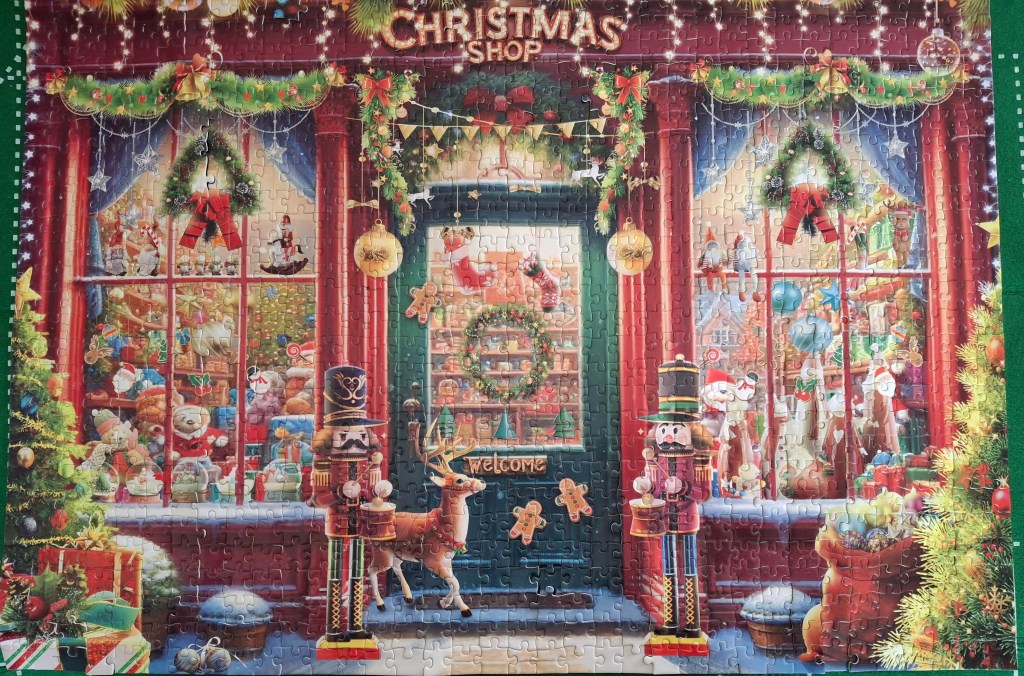
What did happen, however, is that my daughter Sarah bought me an “Advent Calendar” puzzle.

This was a normal jigsaw puzzle box inside which were 24 numbered boxes, one for each of the 24 days of Advent.

The idea was to do one day at a time leading to the completion of the puzzle on Christmas Eve.

This was the first time I had come across a jigsaw puzzle which had pieces identified by numbers on the back. Not each single piece, of course, but all of the first box would be 1 and the second 2 and so on.

It did make it simpler as you were literally doing 24 42-piece jigsaws.

I actually ended up doing two, three or four in a day.

Although I have a couple of jigsaws I had not got round to doing I did put puzzles on my Christmas list but rather than having random ones I suggested well known paintings by artists as Van Gogh, Michelangelo, Matisse, Botticelli etc. and no more than 2000 pieces.

I thought initially a 1000 piece or even 1500 piece jigsaw might turn up.

As it happened my daughter bought me a 2000 piece puzzle of Botticelli’s Venus.

Now I have to decide whether to: do a 1000 piece puzzle of the Sgt Pepper album cover; go straight on to the Venus; or work the two together.

Whatever I decide to do it should certainly keep my mind active.

Don’t judge a book by its cover, or a TV show by a snippet

Once upon a time the only real way to discover when new programmes were being broadcast was either by buying the weekly Radio Times (which included BBC TV programmes as well as ITV programmes); or buy a daily newspaper which had all TV listings.

If a new programme was being introduced you had to rely on the information printed in the newspaper or the somewhat more detailed TV magazine.

You had to decide whether to watch the new programme or an old favourite on the other channel.

Nowadays you can get all the information you need and if the new programme appears interesting you can record it to watch later.

The point is how do you decide whether or not to watch a new programme?

At one time we would check the subject matter and the cast and make a decision based on that.

Months later you hear of a second series which everyone is raving about and you think: “I didn’t see the first series so I won’t know what’s going on.”

With modern technology you can look up the original series and watch it before watching the new series.

Of course, after watching a couple of episodes, you might consider it is not your cup of tea at all.

Nowadays we always watch a couple of episodes before deciding whether or not to continue.

This is because a new programme might take a couple of episodes to really get going.

Here is where the fact that we can call up programmes from years previously proves to be a boon.

This year a lot of people watched the Gavin and Stacey Finale and wondered why they had not bothered to watch the original series.

It is this series that first made us decide to give series at least two episodes before making up our minds as to whether or not to watch it all.

As it happens having seen The Finale we thought we would watch the series from the beginning.

We are now on series 2 and are finding it is as hilarious as it was the first time round.

It is amazing how many things you miss when you first watch a programme and don’t even catch some of them only after watching an episode three or four times.

One thing that puzzled me about the Gavin and Stacey Finale was the reaction some people had about.

Many comments have been made about the programme and most of them were favourable.

Some people reckoned The Finale was not as good as the previous programmes.

The ones that puzzled me, however, were those who attacked the whole show and taking pride in saying: “I have never watched a single episode because it’s rubbish.”

How do they know if they have never watched it.

Turn on your tv and switch off your mind as you binge watch

It is amazing how much our attitude to watching TV has changed over the past half a century.

Then again think of the way entertainment changed between 1875 and 1925.

By 1875 Music Hall was the big thing. The working classes flocked to see and hear variety acts ranging from Little Tich to Marie Lloyd.

At the same time the middle classes could rent boxes to get a good view of the entertainment and see the workers making the most of the few leisure hours they had.

Music Hall continued to grow to the end of the century and from the Victorian era into the Edwardian era.

Then came the First World War and a great chunk of the audience were shipped to Europe to fight and die in the “war to end all wars”.

By the time the war ended and the boys came home Music Hall was already waning and in the next few years entertainment had changed.

By 1920 Marconi was making informal broadcasts from Chelmsford and the British Broadcasting Company was in full swing by the early 1920s.

At the same time there was a new form of entertainment with the rise of jazz and the introduction of big bands and the arrival of swing and instead of flocking to the music halls the populace were heading to the music halls.

In 1975 we had just three television channels in the UK: BBC1, BBC2 and ITV.

In most homes you had to watch the TV programme when it was broadcast. Video tape recorders were available but price wise they were way out of range of most television viewers.

If you started watching a TV drama serial then you were committing yourself to being at home at a set time every week for anything from six weeks up to three months.

You could not record it and it would not normally be repeated.

If you started another series you were committing yourself to be at home another evening per week.

Over the three channels you could commit yourself to being home at least five days a week or more.

Surprisingly people could keep track of the plots of four, five or even six TV programmes every week.

Nowadays we can record any programme we want and watch it whenever we want.

You don’t even need to record them.

Nowadays you can go to BBCiplayer, ITVX or any of the other channels and watch programmes shown weeks, months or even years earlier.

Some series are available in full on these channels as soon as the first one has been broadcast.

This means you could watch a short series over two nights, even in a single night if you wanted to.

This means you don’t have to remember a plot for six weeks or more and nowadays people sometimes fail to keep up with a plot when the series was not available to binge watch until the series broadcast had finished.

At least when the music halls gave way to dance halls people were still going out to be entertained.

Beginning a brand-new adventure still going strong half a century later

We all have those times when we make a decision and then suddenly realise we have made a commitment which requires a great number of actions in a very limited time.

The first time Marion and I faced such a situation was in the first half of 1977.

I had been offered a reporter’s job with my old company, North Wales Newspapers, based on Anglesey.

We had to find a place to live, almost certainly a rental, in North Wales; Marion had to put the Basildon house on the market; furniture would need to be stored; we would have to decide what we needed with us and what could be stored with the furniture.

All this as well as working out my notice with Rank; doing all the things we had to do in the normal world.

It was Spring but we didn’t know how long it would be before we would find our own place and have all our things with us: all of the girls’ toys and clothes; dining table and chairs; three-piece suite; my records; and on and on and on . . .

Then, suddenly, it happened. We looked back at the house in The Upway, said goodbye, then we were facing a bungalow in Valley and behind us was the narrow strip of water separating Anglesey from Holy Island . . . separating Valley, with its RAF base, from Holyhead, with its ferry terminal linking North Wales with Ireland.

For me it was starting on a new venture; for Marion it was far greater.

She had moved to Basildon with her family in the mid-50s, about the same time we moved to Rhyl; she had moved with her parents just once, but only a few streets away; then one final move to The Upway until that day when I took her from her Essex and whisked her and the girls off to a different country, with a different language and different customs.

There we started a brand new adventure almost 50 years ago, and we are still enjoying it.

Friendship’s Mystery, To My Dearest Lucasia

by Katherine Phillips

Come, my Lucasia, since we see
That Miracles Men's Faith do move,
By wonder and by prodigy
To the dull angry world let's prove
There's a Religion in our Love.

For though we were design'd t'agree,
That Fate no liberty destroyes,
But our Election is as free
As Angels, who with greedy choice
Are yet determined to their jokes.

Our hearts are doubled by the loss,
Here Mixture is Addition grown;
We both diffuse, and both ingross:
And we whose minds are so much one,
Never, yet ever are alone.

We court our own Captivity
Than Thrones more great and innocent
'twere banishment to be set free,
Since we wear fetters whose intent
Not Bondage is, but Ornament.

Divided joyes are tedious found,
And griefs united easier grow:
We are our selves but by rebound,
And all our Titles shuffled so,
Both Princes, and both Subjects too.

Our Hearts are mutual Victims laid,
While they (such power in Friendship lies)
Are Altars, Priests and Off'rings laid:
And each Heart, which thus kindly dies,
Grows deathless by the Sacrifice.


Time to stop passing the buck as the NHS slowly sinks

There is a lot of talk these days about pharmacies (what most people call the chemist shop) being more involved in the overall aspect of health, including giving advice and even becoming a first step when you feel unwell.

This doesn’t mean the local chemist can give you a full medical examination and then prescribe the best drugs for what bothers you.

We all know the National Health Service, created following the Second World War by Labour Secretary for Health Nye Bevan, as part of the post-war government of Labour Prime Minister Clement Attlee, has been facing problems for the past 30 or 40 years.

Yet the solution recent governments have come up with is to basically go back to the days of mid 20th century pharmacists.

My father was a pharmacist and served with the RAMC during the Second World War. He signed up in September 1939, breaking into his studies at the Liverpool College of Pharmacy, and when he was demobbed in 1945 he was a sergeant pharmacist.

He returned to his studies and was very soon a qualified pharmacist.

Initially he began working life as a manager in Liverpool, Much Wenlock and then Chesham but he wanted to be his own man.

In the mid 50s a business became available in Rhyl, in North Wales and with a bit of help from my mother’s aunt, Florence affectionately known as Auntie Flo, and her husband, my grandfather’s cousin and brother-in-law and fellow soldier in the Liverpool Pals in WW1, my father became D G Pierce, MPS, at 14 Water Street, Rhyl, in North Wales.

The business and property had come up for sale after the death of the former pharmacist and owner Mr C Dixon.

It had clearly been a good business and Mr Dixon had been a much-loved member of the community. Locals soon became aware that my father was just as hard-working and helpful as his predecessor.

The property included our living quarters accessed from a large porch to the left of the shop.

The shop was open during normal trading hours but even after 6pm customers knew that they could ring the doorbell and have urgent prescriptions made up on the spot.

This was in the days when doctors made home visits even at night.

If a doctor gave a home patient a prescription and marked it “urgent” they would often be directed to Dad’s premises to have the script made up.

The point is he would also give advice if someone came in with minor complaints and would make up a mixture we all called Dad’s Jollop which helped with many things from heartburn to an upset stomach.

In all cases, however, his final advice was always: “See your doctor as soon as you can.”

This is how things were in the mid-50s, yet now politicians are looking at the situation in a broken NHS and the answer, apparently, is to get pharmacists to take on work normally done by doctors.

The point is I believe most pharmacists can take on a number of these tasks which would help GP practices freeing doctors up to do other work.

The problem is most of these pharmacists are already stretched to the limit supervising the making up of prescriptions and the general supervision of a busy pharmacy.

It is time the government put more money into the National Health Service to improve the efficency.

A year of delight at home again in my beloved country

I left you all dangling in the first half of last year after I quit the glamorous (on the surface) life of a London cinema manager and moved our little family from the South East of England to the North West of Wales.

I was back not only in Wales but in the job I was born for – a journalist.

Just a brief summary of what preceded this change.

A mere four weeks before I had been in my office at the Odeon, Camden Town.

Two days beforehand I had been assaulted in the foyer of the cinema I managed.

That weekend Marion and I had a long talk and the following Monday I had called one of the directors of North Wales Newspapers and within 24 hours he had come back to me with the offer of a job as a district reporter for the North Wales Chronicle in Holyhead, which is on the island that marks the “nose” of Anglesey.

Basically I was about to start work on an island which was off another island off the coast of God’s own country.

During our tenure in Holyhead I experienced three major events which marked the beginning of my return to the job I was born to.

One was the fact that for the first time Marion and I bought our first house together.

Two was my first ever meeting with a major international film star.

Three, my darling Marion and I got married.

Queen Elizabeth’s Silver Jubilee proved to be quite a momentous year for us.

To be continued.