Hence Cupid! with your cheating toys,
Your real griefs, and painted joys,
Your pleasure which itself destroys.
Lovers like men in fevers burn and rave,
And only what will injure them do crave.
Men's weakness makes love so severe,
They give him power by their fear,
And make the shackles which they wear.
Who to another does his heart submit,
Makes his own idol, and then worships it.
Him whose heart is all his own,
Peace and liberty does crown,
He apprehends no killing frown.
He feels no raptures which are joys diseased,
And is not much transported, but still pleased.
Still let my tyrants know, I am not doom'd to wear
Year after year in gloom and desolate despair;
A messenger of Hope comes every night to me,
And offers for short life, eternal liberty.

He comes with Western winds, with evening's wandering airs,
With that clear dusk of heaven that brings the thickest stars,
Winds take a pensive tone, and stars a tender fire,
And visions rise and change, that kill me with desire.

Desire for nothing known in my maturer years,
When Joy grew mad with awe, at counting future tears:
When, if my spirit's sky  was full of flashes warm,
I knew not whence they came, from sun or thunder-storm.

But first a hush of peace - a soundless calm descends;
The struggle of distress and fierce impatience ends.
Mute music soothes my breast - unutter'd harmony
That I could never dream, till Earth was lost to me.

Then dawns the Invisible; the Unseen its truth reveals;
My outward sense is gone, my inward essence feels;
Its wings are almost free - its home, its harbour found,
Measuring the gulf it stoops, and dares the final bound.

O dreadful is the check - intense the agony -
When the ear begins to hear, and the eye begins to see;
When the pulse begins to throb - the brain to think again -
The soul to feel the flesh, and the flesh to feel the chain.

Yet I would feel no sting, would wish no torture less;
The more that anguish racks, the earlier it will bless;
And fired in robes of hell, or bright with heavenly shine,
If but herald Death, the vision is divine.
We have had kings and queens in England (Britain, UK or whatever you want to call it) for almost 2,000 years and during that time they have been raised up from nothing; brought down even lower; died peacefully in their beds; died less peacefully on battlefields or in castle dungeons; and even had their heads chopped off.
Strangely many people in this country still believe Britain (which some believe is the same as England, or the United Kingdom) was discovered by the Romans, invaded, colonised and then disappeared from human ken for a few hundred years when the Romans went off to try and save the rest of their empire.
From the time we (reluctantly some say) said goodbye to the Romans Britain fell into the Dark Ages to appear a few hundred years later as an Anglo Saxon kingdom before it was invaded again, this time by Normans.
This confused bit of history came about because there were periods which, until more modern times, appeared to have left very little mark on anywhere outside this island nation (or group of nations).
Strangely, although England (and then later with the addition of Wales, Ireland and Scotland) was really forged by Norman monarchs, after William (affectionately known as the Conqueror) barged in, many English consider themselves Anglo Saxons rather than Normans (or, heaven preserve us, French) and believe those hardy Saxon serfs proved to be a thorn in the side of their conquerors for the next couple of centuries.
In fact the thorn in the side of King William and his royal descendants was not Saxon peasants but those who fell in between peasants and the royal family – the barons and other noble knights who today would equate to our middle class.
Over the centuries this has remained the same as even that middle class split into further groups.
The peasants did not revolt, it was their bosses, the landowners, the minor aristocracy and their ilk, who turned on their royal masters as they wanted more power for themselves.
A POTTED HISTORY OF BRITAIN (55 BC to 1066 AD)
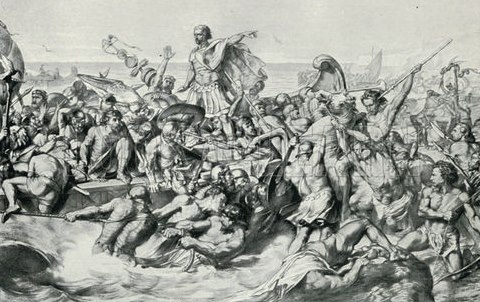
Julius Caesar is met by the loc7als when he popped over to Britain.+
There is a story that Britain was “discovered” by the Romans in the time of Julius Caesar, who first invaded in 55BC. In fact he came ashore, fought a couple of battles against the indigenous people, called it a victory and then popped back to the “real world”.
He did have a second trip to Britain but didn’t get far inland before he felt the need to head back to Rome where he had plans for the Ides of March.
Over the next 100 years a couple more cursory invasions of Britain followed before in 43 AD Emperor Claudius (think of Derek Jacobi as the stuttering and reluctant Caesar of that name) sent four legions to conquer Britain.
They did get further than JC and over the next couple of decades seemed to be getting on well with the locals, tribes of Celts who had settled there a few hundred years beforehand.
They did make one big mistake in that when one local king died, instead of making his wife a client ruler the governor seized his land and property on behalf of Rome. As if that wasn’t bad enough they flogged his wife and raped her daughters.
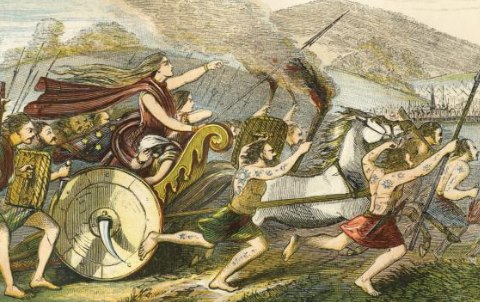
This got Boudicca somewhat annoyed and in 60 AD she started a revolt.
Boudicca, Queen of the Iceni (modern-day Norfolk, was really the first of the native Britons to revolt.
Boudicca, Queen of the Iceni , who lived in what is now East Anglia, took advantage of the fact that Rome’s top military man in Britain had headed up to North Wales with most of the troops to sort out the Druids in Anglesey.
She drew tens of thousands of Britons to her banner and rampaged through the South East killing Roman settlers and pro-Roman Britons alike.
Unfortunately for her the general and his troops hotfooted it back South and, although outnumbered, drew her forces into a trap and slaughtered them. Boudicca fled and was never seen again.
Thus ended the first rebellion in Britain. A rebellion led by a member of a royal family and not by the workers.
For the next 400 years there was an uneasy truce between the Britons and the Romans and many Britons became Romanised. Also many soldiers who had completed their service time and been paid off decided to stay.
By the 5th century the Roman Empire was falling apart. Eventually the troops were pulled back and Britain was left to fend for itself.
The next 500 years or so were cloaked in darkness and it is only from the late 19th century and into the 20th century that historians uncovered the archaeological clues, and written ones as well, which shows there was far more going on during those centuries than anyone had realised.
NEXT TIME: drawing back the veil to throw some light on the Dark Ages.
They took their stand where the appointed judges
Had cast their lots and ranged the rival cars.
Rang out the brazen trump!
Away they bound,
Cheer the hot steeds and shake the slackened reins;
As with a body the large space is filled
With the huge clangor of the rattling cars.
High whirl aloft the dust-clouds; blent together,
Each presses each and the lash rings; and loud
Snort the wild steeds, and from their fiery breath,
Along their manes and down the circling wheels
Scatter the flaking foam, Orestes still -
Ays, as he swept around  the perilous pillar
Last in the course, wheeled in the rushing axle;
The left rein curbed, that on the dexter hand
Flew loose.- So on erect the chariots rolled!
Suddenly the Ænian's fierce and headlong steeds
Broke from the bit - and, as the seventh time now
The course was circled, on the Libyan car
Dashed their wild fronts: then order changed to ruin:
Car crashed on car; the wide Crissæan plain
Was sea-like strewed with wrecks; the Athenian saw,
Slackened his speed, and wheeling round the marge,
Unscathed and skillfull, in the midmostspace,
Left the wild tumult of that tossing storm.
Behind, Orestes, hitherto the last,
Had yet kept back his coursers for the close;
Now one sole rival left - on, on he flew,
And the sharp sound of the compelling scourge
Rang in the keen ears of the flying steeds.
He nears, he reaches - they are side by side -
Now one - the other - by a length the victor.
The courses all are past - the wheels erect -
All safe - when, as the hurrying courses round
The fatal pillar dashed, the wretched boy
Slackened the left rein: on the column's edge
Crashed the frail axle: headlong from the car
Caught and all meshed within the reins, he fell;
And masterless the mad steeds raged along!
Loud from that mighty multitude arose
A shriek - a shout! But yesterday such deeds,
To-day such doom! Now whirled upon the earth,
Now his limbs dashed aloft, they dragged him - those
Wild horses - till all gory from the wheels
Released; - and no man, not his nearest friends,
Could in that mangled corpse have traced Orestes.
They laid the body on the funeral-pyre;
And while we speak, the Phocian strangers bear,
In a small, brazen, melancholy urn,
That handful of cold ashes to which all
The grandeur of the Beautiful hath shrunk.
In the desert,
Turn towards emptiness,
Fleeing the self.
Stand alone,
Ask no-one's help,
And your being will quiet
Free from the bondage of things.

Those who cling to the world,
Endeavour to free them;
Those who are free, praise.
Care for the sick,
But live alone,
Happy to drink from the waters of sorrow,
To kindle Love's fire
With the twigs of a simple life.
The trees along this city street,
Save for the traffic and the trains,
Would make a sound as thin and sweet
As trees in country lanes.

And people standing in their shade
Out of a shower, undoubtedly
Would hear such music as is made
Upon a country tree.

Oh, little leaves that are so dumb
Against the shrieking city air,
I watch you when the wind has come,-
I know what sound is there.
Revolution: a forcible overthrow of a government or social order in favour of a new system.
Rebellion: an act of armed resistance to an established government or leader.
How is it that despite the demise of various ruling monarchs; peasants’ revolts; rebellion by bastard royalty; and a few civil wars here and there Britain is still a monarchy (not absolute of course, just constitutional).
France had a revolution which took them from absolute monarchy to semi-anarchy, to a republic. They even chopped the heads off their king and queen (although we had beaten them to that by executing a king).
The original revolution came via a population which was still living in what we would call serfdom and had ended in England centuries before. It then came under the power of the bourgeosie , a middle class that we now call capitalists, and political arguments and the Terror, until 1799 when Napoleon Bonaparte, who had raised himself high in the ranks of the revolutionary army, returned from military campaigns in Syria and Egypt, and led a coup d’etat which eventually saw him declared Emperor in 1804.
Napoleon went from revolutionary to emperor but France returned to a monarchy in 1814 after he was defeated (he did come back for 100 days as emperor) and the monarchy was fully restored (though not as absolute monarchy) in 1815. For the next few decades France became an absolute monarchy; a very limited constitutional monarchy; a republic in which a nephew of Napoleon Bonaparte (also called Napoleon) became president for four years; then an “empire” once more when the president decided he liked to rule for as long as he liked and styled himself Emperor Napoleon III.
The changes in control had also been called revolutions although they tended to be more rebellions and a coup d’etat than a revolution similar to the 18th century movement.
Although the empire lasted for almost 20 years Napoleon III was deposed in 1870 and France became a republic once more, and remains so.
Russia also had a a number of rebellions and revolutions against the Tsars but the autocratic rule of the Romanovs did not end until the full revolutions of 1916/17 when Tsar Nicholas abdicated.
After a a political wrangle between Bolsheviks and Mensheviks the Bolsheviks eventually gained control and later had the whole Romanov family executed. This forceful and complete ending of a dynasty was more effective than the to and fro in France which lasted for the best part of a century.
Then we come to Britain, or the United Kingdom, or just England as it was for many centuries.
Here we kid ourselves that the monarchy goes back to Alfred the Great although it was his grandson Athelstan who was the first king of ALL England. Yet our Elizabeth is not a direct descendant as Athelstan was her 30X great-uncle.
Many British people also claim that absolute monarchy was ended here because we executed a king before the French or the Russians got around to it. Yet our interregnum lasted only 11 years before we begged Charles II to come back and be king.
A lot of time is given to the daring (or audacity) of the people rising up and throwing off the shackles of “serfdom” and getting rid of the monarchy by executing the king.
Except that it was not the people who rose against the king – it was the ruling class, just as it was the ruling class who rebelled against King John and forced him to sign the Magna Carta.
In 1215 and in 1649 the people had nothing to do with the way way in which they were ruled. After all it wasn’t long before King John was up to his old tricks, and mainly getting away with them, and 11 years after Charles lost his head (literally lost it as opposed to other kings who just lost their minds) this country begged Charles II to come back and everything continued just as before.
The people themselves have never had a real revolution and this might account for why, despite an allegedly democratic system of government, we have never really had a socialist government in a country where all people are supposed to be equal.
NEXT TIME: It’s not the peasants who are revolting, it’s the middle classes.
Up and lead the dance of Fate!
Lift the song that mortals hate!
Tell what rights are ours on earth,
Over all of human birth.
Swift of foot to avenge are we!
He whose hands are clean and pure,
Naught our wrath to dread hath he;
Calm his cloudless days endure.
But the man that seeks to hide
Like him, his gore-bedewèd hands,
Witnesses to them that died,
The blood avengers at his side,
The Furies' troop forever stands.

O'er our victim come begin!
Come, the incantation sing,
Frantic all and maddening,
To the heart a brand of fire,
The Furies' hymn,
That which claims the senses dim,
Tuneless to the gentle lyre,
Withering the soul within.

The pride of all of human birth,
All glorious in the eye of day,
Dishonored slowly melts away,
Trod down and trampled to the earth,
Whene'er our dark-stoled troop advances,
Whene'er our feet lead on the dismal dances.

For light our footsteps are,
And perfect is our might,
Awful remembrances of guilt and crime,
Implacable to mortal prayer,
Far from the gods, unhonored, and heaven's light,
We hold our voiceless dwellings dread,
All unapproached by living or by dead.

What mortal feels not awe,
Nor trembles at our name,
Hearing our fate-appointed power sublime,
Fixed by the eternal law.
For old our office, an our fame,
Might never yet of its due honours fail,
Though 'neath the earth our realm unsunned regions pale.
Love and the gentle heart are one thing,
just as the poet says in his verse,
each and the other one as well divorced
as reason from the mind's reasoning.

Nature creates love, and then creates love king,
and makes the heart a palace where he'll stay,
perhaps a shorter or a longer day,
breathing quietly, gently slumbering.

Then beauty in a virtuous woman's face
makes the eyes yearn, and strikes the heart,
so that the eyes' desire's reborn again,
and often, rooting there with longing stays,

Til love, at last, out of its dreaming starts.
I don't give a monkey-nut for their prissy talk.
Sunday - forgive me Lord - is an amiable time
to chase the chaste. After church of course.
But no unburdened smile or sweet kiss ever
from one starched lady of Llanbadarn
And me, so randy, I can hardly walk.

Give them boils, Lord, for none my needs assuage
- not even she whose nose seems like a chair
for spectacles! I ache. If only one, in luck,
roused me in the heather then Garwy himself
would stagger back envious and awestruck.
Lesbians, they must be. Give them pox, Lord, and age.

When parasolled, they left the church slow-paced
along the gravel pathway, past the grand
shadow of the yew, I winked, I whispered.
Nun-faced they frowned their strait-laced Never!
So I, as true a stud as Garwy stand
near graves, full of sperm. Oh what a waste!
 Robin's Nest