You take the high road or the low road – I’m heading down the middle

Please note: If you are a fan of Vladimir Putin or Volodymyr Zelenskyy you might not be keen on what I have to say in this article.

The war (or military operation or invasion – take your pick) in Ukraine has very clearly polarised opinion in this country.

We all know and love or loathe Vladimir Vladimirovich Putin. Born in 1952 he joined the KGB in 1975 and had a brilliant career as far as we know even though KGB members did not really publicise their careers.

In 1991, as the USSR was disintegrating after General Secretary, later President, Mikhail Gorbachev had attempted to bring it up to date and join the world beyond its borders, Putin quit his work with the KGB (better to get out before the whole edifice comes tumbling down) and decided to become a politician in St Petersburg.

Five years later he moved to Moscow and hitched his star to the bandwagon of the President of the new Russia, Boris Yeltsin. Initially he was in charge of security (not much difference to his KGB days) but in 1999 he was appointed as Prime Minister (yes, not elected but appointed).

Bearing in mind that one of Boris Yeltsin’s priorities was to keep the Russian vodka industry alive and kicking, if for no other reason than to make sure his personal supply never dried up, it is not surprising that a few months later he stood down as president (probably for health reasons) and Putin was appointed acting president and soon afterwards was named as President of United Russia.

We know how it went from there: two terms as president, and then a term as prime minister (no president was allowed more than two consecutive terms) while his pal, the former prime minister Dmitri Medvedev, became president. The four years later he was “elected” president again with his pal back in the role of PM.

It also appears that from this point he has become president for life (wasn’t that how Julius Caesar upset his fellow senators which led to his sudden death on the senate floor).

Now let’s turn to his opponent, the President of Ukraine Volodymyr Oleksandrovych Zelenskyy, elected as the country’s sixth President in May 2019.

He’s quite a bit younger than his adversary Putin, having been born in the former Soviet Socialist Republic of Ukraine in 1978, and before turning to comedy gained a law degree at the University of Kiev (Kyiv). There are equivalents in the UK: both John Cleese and Susan Calman hold law degrees. Neither of them have become PM of the UK, however, although that might have been better than what we have been lumbered with.

One of Zelenskyy’s most famous roles was in Servant of the People in which an ordinary man became President of Ukraine. Basically it portrayed a comedian acting the part of a teacher who came from nowhere to the presidency.

The series lasted four years, 2015 to 2019, and obviously gave the star a taste of being top dog in the Ukraine, so in 2019 Zelesnkyy stood for the presidency and, to everybody’s surprise won. Nobody was surprised when Putin became President of Russia.

So there we have the background. It is a journalist’s job to look for the background in any story, especially a story as serious this.

Last year Putin started building up his forces on the borders with Ukraine as part of a “military training exercise” and then in February he announced a “tactical operation” which involved crossing the border and then, rather than just concentrating on the Donbas region (a bone of contention between Russia and the Ukraine) his troops aimed into that region but also struck at other major cities and headed for the capital Kyiv.

The Ukrainians, in the main, were not happy about this intrusion and many have since fled to safety to the West with the men, even untrained civilians, staying put, joining the army or preparing to defend their homes, their villages, their towns.

As I have said many times before, as a journalist I look for facts and do not judge a situation on what I see at first glance.

It’s a bit like a policeman at the site of a crash.

The car might be in a ditch, the driver slumped dead across the wheel, and a strong smell of whiskey as though the driver had been saturated in it.

At first glance, it could be supposed the driver had been drinking, possibly even while driving, had lost control of the vehicle, banged his head on the wheel or dashboard and died where he was.

A second glance might reveal the smell of drink was because a gift-wrapped package of unopened whiskey bottles had been thrown off the parcel shelf, between the front seats, shattering on the dashboard and soaking the front of the car and the driver in drink.

At third glance it could be seen that the driver went off the road with no sign of braking and fourth glance – or rather following a forensic examination by the pathologist – the man had died of a heartache and had no alcohol in his blood.

Thus: heart attack; car continues but goes into ditch; gift package of whiskey shatters and drenches driver. No blame, just a terrible accident.

I am not going into all the ins and outs of the current situation in the Ukraine. Stories of atrocities have been levelled from both sides and I do not have the evidence to judge for myself.

What I am going to do is to take a Twitter comment I made the other day to demonstrate how hard it is to take the middle ground.

The wording is exactly as I posted it:

A picture shows some dead civilians in Bucha had packs of military rations.

A. did they steal them and get shot by Russians?

B. did the Russians give them the packs and then shoot them?

C. did Ukrainians shoot them as collaborators paid in ration packs?

Shades of grey.

One of the first replies came from an anonymous poster who considered themself to be worldly wise:

You think shooting a person who may or may not have taken a mouldy ration pack is justified?! What is wrong with you?!

Now I must admit this kneejerk reaction annoyed me and my response might show through:

Typical. If you bothered to read that properly you will discover I asked three questions. I have not justified any potential actions or answers. What is wrong with you?

My worldlywise attacker came back with:

The fact that you posed such a question says everything!

To which question I responded:

Why?

Here endeth THAT conversation.

The next response came from another source, identified but also bearing an odd Twitter handle and using the blue and yellow colours of Ukraine as an avatar:

E. Can you **** off?

My response*:

Standard response from someone who accepts everything they are told as the absolute truth. I posed three questions to which I do not know the answers. As a journalist I look at a situation and ask questions. I expect the people who provide answers to prove those answers.

PS: what happened to E?

PPS: I meant what happened to D?

To which the person replied:

You’re posing the question “are there mitigations for Russian atrocities in Ukraine?” the answer is “no”. Hope that helps.

My response:

I would not consider anything could possible (sic) mitigate any atrocities. All I seek is evidence to go with any answers. Any decent reporter would want to see that evidence. PS: I think Vladimir Putin is a despicable man who puts Russia to shame.

Response:

In that case “Shades of grey” is an unfortunate choice of phrase.

Me:

Why? My comment just means nothing is black and white.

Response (although there may have come a point where posts crossed):

The reason your seemingly reasonable questions are offensive is the notion that lofty objectivity is always justified. It is obviously true that whatever the exact circumstances of their deaths these corpses are a result of Putin’s aggression. In “no” sense did they deserve it.

Me:

At no point have I suggested anyone “deserves” anything that is happening in Ukraine. Nobody deserves to have their home invaded whether it is invaded by a thief or an army. Nobody deserves to die. Please do not put words into my mouth or think you can read my mind.

The final reply:

I’m sure you’re one of the good guys. No offence intended. X

This is an example of how Twitter conversations often go. No matter how carefully you word a comment in the main others do not read everything everything before leaping to the keyboard and condemning everything you have said.

I would like to hear from anyone who feels they have a comment make. All I ask is that you read it first and then check that your answer actually applies to the article.

Please be polite as I don’t think free speech is a defence for obscenities.
Yon Wild Mossy Mountain

by Robert Burns

1759-1796
Yon wild mossy mountains sae lofty and wide,
That nurse in their bosom the youth o' the Clyde,
Where the grouse lead their coveys thro' the heather to feed,
And the shepherd tends his flock as he pipes on his reed.

Not Gowrie's rich valley, nor Forth's sunny shores,
To me hae  the charms o'yon wild, mossy moors;
For there, by a lanely, sequestered stream,
Besides a sweet lassie, my thought and my dream.

Among thae wild mountains shall still be my path,
Ilk stream foaming down its ain green, narrow straith;
For there, wi' my lassie, day long I rove,
While o'er us unheeded flie the swift hours o'love.

She is not the fairest, altho' she is fair;
O' nice education but sma' is her share;
Her parentage humble as humble can be;
But I lo'e the dear lassie because she lo'es me.

To Beauty what man but maun yield him a prize,
In her armour of glances, and blushes, and sighs?
And when wit and refinement hae polish'd her darts,
They dazzle our een, as they flie to our hearts.

But kindness, sweet kindness, in the fond-sparkling e'e,
Has lustre outshining the diamond to me;
And the heart beating love as I'm clasped in her arms,
O, these are my lassie's all-conquering charms!

Harold and his Saxons see off the Norsemen at major battle

Following the death of Edward the Confessor in 1066 the English crown was claimed by the dead king’s right-hand man, who had charge of the royal bodyguard. His claim that Edward named him as successor was approved by the Witan (a sort of Privy Council as it was called in latter days) who unanimously voted to give Harold the crown.

Not that he was the only claimant, as we well know.

First there was Duke William of Normandy, just across the channel, the descendant of Rollo, a Viking or Norseman granted land by the French king. The Duke was also known as William the Bastard as his mother was not married to his father.

He had a double claim. First he claimed Edward had named him his successor when the king was in exile in Normandy. His second claim was based on Harold having sworn an oath, having been shipwrecked and rescued by William, to support William’s claim.

William raised an invasion fleet but could not set sail because the wind was in the wrong quarter and remained so for months.

Meanwhile Harold kept his army on standby ready to repel any invaders.

The wait lasted through the summer at which time the fyrd {the major part of the army called on when necessary as the rest of the time they had land to be farmed and raise crops to feed the country) was eventually disbanded to go back to their land.

This was when the third claimant to the throne, the King of Norway, Harald Hardrada, stuck a spanner in the works when he led an invasion fleet of 300 ships to attack in the North of England. His claim was based on his descent from King Cnut, a Dane who ruled England peacefully for many years.

He was supported by Harold Godwinson’s younger brother Tostig who brought mercenary troops from Flanders and joined Harald’s invasion force at Stamford Bridge, near York, in September 1066.

When King Harold received the news that Harald’s invasion was boosted by his own brother Tostig he set off with the core of his army to face the usurper, picking up members of the fyrd as they headed North.

Meanwhile Hardrada’s force had attacked York having defeated the Earl of Mercia’s army. They then retired to Stamford Bridge having ordered the defeated earl to send more hostages and supplies to their camp.

What he didn’t know was that King Harold had made a forced march north with his expanding army and went round the city of York to take on the Norwegians at Stamford Bridge.

Having taken only four days to get there they caught the invaders by surprise on 25 September, 1066, and after a long and bloody battle, most of the blood being Norwegian, Harold won the battle and the remnants of the enemy sailed away in just 30 ships – there weren’t enough men left out of the approximately 8,000 force to man any more ships.

The invasion had been launched because the wind that kept Duke William bottled up in Normandy had favoured the Norwegians.

Then the wind changed, speeding the defeated Norwegians back to their homeland but now blowing favourably for the Norman invaders.

Harold and his men rested up following their forced march and the bloody battle, but just a few days after the battle riders came from the South and met Harold as he was heading home to tell him that him that William and his Normans had landed at Pevensey, East Sussex, on 28 September and appeared to be making camp there while they unloaded the men, horses and equipment.

Harold knew his men were worn out from battle and he took them to London were they stayed for at least a week, gathering strength and replacing supplies.

Surprisingly the Normans remained in their camp all this time.

On 13 October Harold took his army of 8 to 10,000 men to Caldbeck Hill above a valley which lay on the road to Hastings. They took their positions that night on a hilltop ridge about 800 yards wide and with sharp inclines on either side.

Guards were placed and the men took what rest they could, but ready at a moment’s notice to defend their king and country.

COMING SOON: Harold prepares to send the Normans packing.

Amidst the Noisy Ball . . .

by Aleksander Pushkin

1799-1837
Amidst the noisy ball, in Hell
Of everyday distress,
I've seen you, but the secret's veil
Was covering your face.

Your fair eyes were sad and bright,
And voice was so sweet,
As sound of a pipe apart
Or murmur of the sea.

I've liked your fine and slender waist,
And thoughtful image, whole,
And sound of your voice - it nests
Forever in my soul...

When tired, in my lone nights,
I lie down to pause -
And see your beautiful, sad eyes,
And hear your merry voice.

And sad, I fall asleep to see
My dreams that run above...
I'm sure not whether I love thee -
But, maybe, I'm in love.

Frantic fortnight as we get ready to take Sooty, Sweep and Soo on tour

After the first week at Harry’s place, a very busy time all round, it was time to make the master show tape with all the sounds and music for the show.

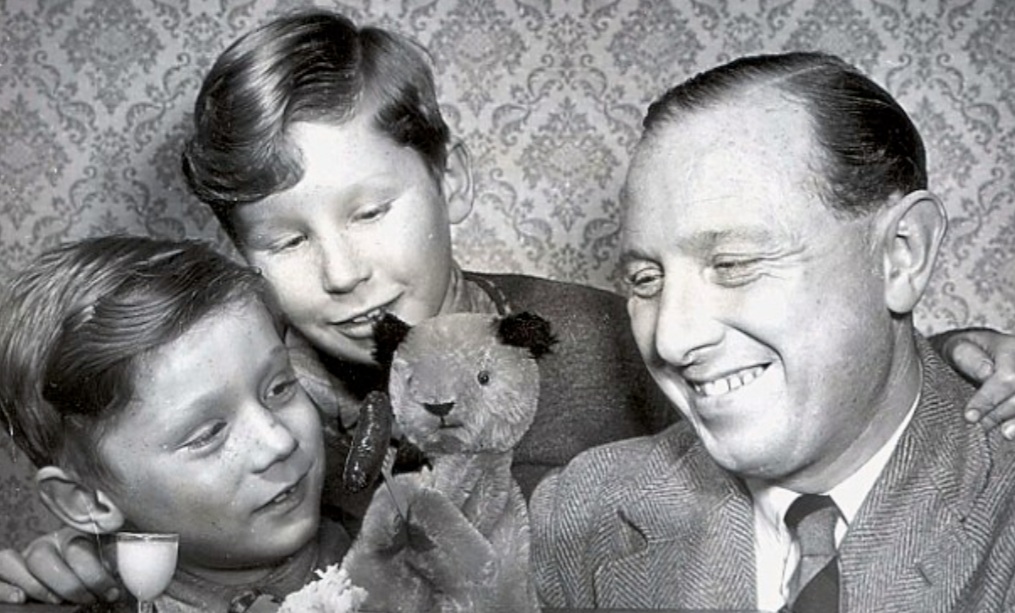
The recording studio was the Corbetts’ living room and the musicians were the Corbett sons, David and Peter (the latter known professionally as Matthew as there was already an actor called Peter Corbett), as well as two or three others whose names I can no longer remember.

The show tape was initially recorded on a Revox reel to reel tape deck, there was a second as backup because Harry was a belt and braces man.

It was a fun Sunday when we did the recording as the Corbetts, parents and sons, knew the other musicians, I think they might have been friends of Matthew (I use his stage name as that is how everybody knows him). Toabs made sure there were refreshments to keep us all going.

Harry Corbett and Sooty with Harry’s sons, David (left) and Matthew (Peter) in the 1950s

The reason we needed a show tape was because I could not be by the sound system at all times during the show to operate any musical interludes or sound effects.

The UV sequence, for instance, had everyone on stage. Harry had Sooty of course and was dressed as normal, but the rest of us, Lawrence, myself, Toabs and Howard were all dressed head to toe in black so that we disappeared against the black drapes.

Lawrence and myself were operating giant butterflies which showed up with the UV light. We had one in each hand on canes with attachments to allow us to make the wings beat up and down.

During all this there was music, for the butterfly dance, and sound effects for the appearance of the genie (Howard) and I couldn’t very well nip offstage to turn them on and off and there were no computers in those days to program the show.

As I have said before Harry was a perfectionist and there were a number of takes on the music for the spooky Haunted Castle, the Magic Lamp UV sequence and the Water Gardens when Sooty did his magic to make the water fountain appear from various points. before Harry was satisfied.

By evening everything was recorded to the boss’s approval and Lawrence and I went down to the pub and had a couple of beers to relax.

The following morning, after breakfast, I settled down with my Revox tape decks and a timed and annotated script for the show.

I then had to cut and splice the tapes to match the script.

In my youth I had played around with editing reel to reel tapes and also 8mm home movies. In my teens a group of us had got together to make a wacky film with the sort of gags we would see later in programmes like Monty Python or the 6. I’m sure I have got it tucked away with some other old 8mm home movies.

The editing was not the end of the matter.

I had a spliced tape which was exact to the second. From this I had to make a master tape, with no splices and then a back-up master as well.

The original spliced tape was put in a strong container and sealed as it was the absolute emergency fallback. Of the two others one would travel with Harry and Toabs and one with us in the Sooty van.

During the tour I had to make numerous fresh master tapes using the backup unused tape. This is because constant use gradually stretched the tape putting timings out.

Harry had started life as an engineer had always paid attention to the slightest detail. Even when we made up the frontispiece for the UV sequence he insisted on us making proper joints on the support pieces holding up the facade. As he pointed out, taking time at the start would be certain to save time later in the tour.

That two weeks before we set out on tour was the busiest in my life so far. It certainly took my mind off other matters.

On the final Saturday we loaded the van in the exact order we had practiced.

Some of the theatres might have been expecting a puppet show on the lines of a Punch and Judy booth, but our sets would take up half the width of most stages and we had set dressings and drapes and lighting rigs which the theatres might have had but, as I said, Harry didn’t take chances and we could have dressed a bare stage.

Once we had loaded Lawrence and I went for a final pint at our local, ready to get on the road on Sunday.

Normal service will be resumed as soon as possible

My apologies for the lack of regular content, other than poetry, which has, itself, been lacking in regularity of late.

For various reasons I have found myself too busy to provide the regular input which readers so rightly deserve. Or is it that I am too tired at times, not as up to the mark as I should be?

It is remiss of me to treat readers in such a way and I will, therefore, ensure that in future I will write more frequently about my life, and journalism, episodes of British history which I find interesting (or even just amusing), or just things that I find interesting or amusing – even politics which is always good for a laugh.36666666666

Normal service will be resumed this week.

Honest.

Cross my heart.

Farewell

Ann Brontë

1820-1849
Farewell to thee! but not farewell
To all my fondest thoughts of thee:
Within my heart they shall still dwell;
And they shall cheer and comfort me.
O, beautiful, and full of grace!
If thou hadst never met mine eye,
I had not dreamed a living face
Could fancied charms so far outvie.

If I may ne'er behold again
That form and face so dear to me,
Nor hear thy voice, still would I fain
Preserve, for aye, their memory.

That voice, the magic of whose tone
Can wake an echo in my breast,
Cresting feelings that, alone,
Can make my tranced spirit blest.

That laughing eye, whose sunny beam
My memory would not cherish less;-
And oh, that smile! Whose joyous gleam
Nor mortal language can express.

Adieu, but let me cherish, still,
The hope with which I cannot part.
Contempt may wound, and coldness chill,
But still it lingers in my heart.

And who can tell but Heaven, at last,
May answer all my thousand prayers,
And bid the future pay the past
With joy for anguish, smiles for tears? 

The Pied Piper of Hamelin

Robert Browning

1812-1889
Hamelin town's in Brunswick,
By famous Hanover city;
The river Weser, deep and wide,
Washes its wall on the southern side;
A pleasanter spot you never spied;
But, when begins my ditty,
Almost five hundred years ago,
To see the townsfolk suffer so
From vermin, was a pity.

Rats!
They fought the dogs, and killed the cats,
And bit the babies in the cradles,
And eat the cheeses out of the vats,
And licked the soup from the cooks' own ladles,
Split open the kegs of salted sprats,
Made nests inside men's Sunday hats,
And even spoiled the womens' chats
By drowning their speaking
With shrieking and squeaking
In fifty different sharps and flats.

At last the people in a body
To the Town Hall came flocking:
'Tis clear, cried they, our Mayor's a noddy;
And as for our Corporation - shocking
To think we buy gowns lined in ermine
For dolts that can't or won't determine
What's like to rid us of our vermin!
Rouse up, Sirs! Give your brains a racking
To find the remedy we're lacking,
Or sure as fate we'll send you packing!
At this the Mayor and Corporation
Quaked with a mighty consternation.

An hour they sate in council,
At length the Mayor broke silence:
For a guilder I'd mine ermine gown sell;
I wish I were a mile hence!
It's easy to bid one rack one's brain -
I'm sure my poor head aches again
I've scratched it so, and all in vain.
Oh for a trap, a trap, a trap!
Just as he said this what should hap
At the chamber door but a gentle tap?
Bless us, cried the Mayor, what's that?
(With the Corporation as he sate,
Looking little though wondrous fat);
Only a scraping of shoes on the mat?
Anything like the sound of a rat
Makes my heart go pit-a-pat!

Come in! - the Mayor cried, looking bigger;
And in did come the strangest figure!
His queer long coat from heel to head
Was half of yellow and half of red;
And he himself was tall and thin,
With sharp blue eyes, each like a pin,
And light loose hair, yet swarthy skin,
No tuft on cheek or beard on chin,
But lips where smiles went out and in -
There was no guessing his kith and kin!
And nobody could enough admire
The tall man and his quaint attire:
Quoth one: It's as my great-grandsire,
Starting up at the Trump of Doom's tone,
Had walked this way from his painted tombstone!

He advanced to the council-table:
And, Please your honours, said he, I'm able,
By means of a secret charm, to draw
All creatures living beneath the sun,
That creep, or fly, or swim, or run,
After me so as you never saw!
And I chiefly use my charm
On creatures that do people harm,
The mole, and toad, and newt, and viper;
And people call me the Pied Piper.
9And here they noticed round his neck
A scarf of red and yellow stripe,
To match with his coat of the self-same cheque;
And at the scarf's end hung a pipe;
And his fingers, they noticed, were ever straying
As if impatient to be playing
Upon this pipe, as low it dangled
Over his vesture so old-fangled.)
Yet, said he, poor piper as I am,
In Tartary I freed the Cham,
Last June, from his huge swarm of gnats;
I eased in Asia the Nazam
Of a monstrous brood of vampyre-bats;
And, as for what your brain bewilders,
If I can rid your town of rats
Will you give me a thousand guilders?
One? fifty thousand! - was the exclamation
Of the astonished Mayor and Corporation.

Into the street the Piper stept,
Smiling first a little smile,
As if he knew what magic slept
In his quiet pipe the while;
Then, like a musical adept,
To blow his pipe his lips he wrinkled,
And green and blue his sharp eyes twinkled,
Like a candle-flame where salt is sprinkled;
And ere three notes the pipe uttered,
You heard as if an army muttered;
And the muttering grew to a grumbling;
And the grumbling grew to a mighty rumbling;
And out of the houses the rats came tumbling.
Great rats, small rats, lean rats, brawny rats,
Brown rats, black rats, grey rats, tawny rats,
Grave old plodders, gay young friskers,
Fathers, mothers, uncles, cousins,
Cocking tails and pricking whiskers,
Families by tens and dozens,
Brothers, sisters, husbands, wives, -
Followed the Piper for their lives.
From street to street he piped advancing,
And step by step they followed dancing,
Until they came to the River Weser
Wherein all plunged and perished
- Save one who, stout as Julius Caesar, 
Swam across and lived to carry
(As he the manuscript he cherished)
To Rat-land home his commentary,
Which was, At the first shrill notes of the pipe,
I heard a sound of scraping tripe,
And putting apples, wondrous ripe,
Into a cider-press's gripe:
And a moving away of pickle-tub boards,
And a leaving ajar of conserve-cupboards,
And a drawing the corks of train-oil-flasks,
And a breaking the hoops  of butter-casks;
And it seemed as if a voice
(Sweeter than by harp or psaltery
Is breathed) called out, Oh rats, rejoice! 
The world is grown to one vast drysaltery!
'So munch on, crunch on, take your nuncheon,
'Breakfast, supper, dinner, luncheon!
And just as one bulky, sugar-puncheon,
Ready staved, like a great sun shone
Glorious scarce an inch before me,
Just as methought it said, Come bore me!
- I found the Weser rolling o'er me.

You should have heard the Hamelin people
Ringing the bells till they rocked the steeple;
Go, cried the Mayor, and get long poles!
Poke out the nest and block up the holes;
Consult with carpenters and builders,
And leave in our own town not even a trace
Of the rats! - when suddenly up the face
Of the Piper perked in the market-place,
With a, First, if you please, my thousand guilders!

A thousand guilders! The Mayor looked blue;
So did the Corporation too.
For council dinners made rare havock
With Claret, Moselle, Vin-de-Grave, Hock;
And half the money would replenish
Their cellar's biggest butt with Rhenish.
To pay this sum to a wandering fellow
With a gipsy coat of red and yellow!
Beside, quoth the Mayor with a knowing wink,
Our business was done at the river's brink;
We saw with our eyes the vermin sink,
And what's dead can't come to life, I think.
So, friend, we're not the folks to shrink
From giving you something for a drink,
And a matter of money to put in your poke;
But, as for the guilders, what we spoke
Of them was, as you very well know, was in joke.
Beside, our losses have made us thrifty;
A thousand guilders? Come, take fifty!

The Piper's face fell, and he cried,
No trifling, I can't wait, beside!
I've promised to visit by dinner time
Bagdat and accept the prime
Of the Head Cook's pottage, all he's rich in,
For having left, in the Caliph's kitchen,
Of a nest of scorpions no survivor -
With him I proved no bargain-driver,
With you, don't think I'll bate a stiver!
And folks who put me in a passion
May find me pipe after another fashion.

How, cried the Mayor, d'ye think think I'll brook
Being worse treated than a Cook?
Insulted by a lazy ribald
With idle pipe and vesture piebald?
You threaten us, fellow? Do your worst,
Blow your pipe there till you burst!

Once more he stept into the street;
And to his lips again
Laid his long pipe of smooth straight cane;
And ere he blew three notes (such sweet
Soft notes as yet musician's cunning
Never gave th'enraptured air)
There was a rustling, that seem'd like a bustling
Of merry crowds, justling at pitching and hustling,
Small feet were pattering, wooden shoes clattering,
Little hands clapping, and little tongues chattering,
And like fowls in a farm-yard when barley is scattering,
Out came the children running.
All the little boys and girls,
With rosy cheeks and flaxen curls,
And sparkling eyes and teeth like pearls,
Tripping and skipping, ran merrily after
The wonderful music with shouting and laughter.

The Mayor was dumb, and the council stood
As if they were changed to blocks of wood,
Unable to move a step, or cry
To the children merrily skipping by -
Could only follow with the eye
That joyous crowd at the Piper's back.
But how the Mayor was on the rack,
And the wretched Council's bosoms beat,
As the Piper turned from the High Street
To where the Weser rolled its waters
Right in the way of their sons and daughters!
However he turned from South to West,
And to Coppelburg Hill his steps addressed,
And after him the children pressed;
Great was the joy in every breast.
He never can cross that mighty top!
He's forced to let the piping drop,
And we shall see our children stop!
When lo, as they reached the mountain's side,
A wondrous portal opened wide,
As if a cavern was suddenly hollowed;
And the Piper advanced and the children follow'd,
And when all were in to the very last,
The door in the mountain side shut fast.
Did I say, all? No! One was lame,
And could not dance the whole of the way;
And in after years, if you would blame
His sadness, he was used to say, -
It's dull in our town since my playmates left!
I can't forget that I'm bereft
Of all the sights they see,
Which the Piper also promised me;
For he led us, he said, to a joyous land,
Joining the town and just at hand,
Where waters gushed and fruit-trees grew,
And flowers put forth a fairer hue,
And every thing was strange and new;
The sparrows were brighter than peacocks here,
And their dogs outran our fallow deer,
And honey bees had lost their stings,
And horses were born with eagles' wings:
And just as I felt assured
My lame foot would be speedily cured,
The music stopped and I stood still,
And found myself outside the Hill,
Left alone against my will,
To go now limping as before,
And never hear of that country more!

Alas, alas for Hamelin!
There came into many a burgher's pate
A text which says, that Heaven's Gate
Opes to the Rich at as easy a rate
As the needle's eye takes a camel in!
The Mayor sent East, West, North, and South,
To offer the Piper, by word of mouth,
Wherever it was men's lot to find him,
Silver and gold to his heart's content,
If he'd only return the way he went,
And bring the children behind him.
But when they saw 'twas a lost endeavour,
And piper and dancers were gone for ever,
They made a decree that lawyers never
Should think their records dated duly
If, after the day of the month and year,
These words did not as well appear
"And so long after what happened here
"On the twenty-second of July,
"Thirteen hundred and Seventy-six;"
And the better in memory to fix
The place of the Children's last retreat,
They called it, The Pied Piper's Street -
Where anyone playing on pipe or tabor
Was sure for the future to lose his labour.
Nor suffered they Hostelry or Tavern
To shock with mirth a street so solemn;
But opposite the place of the cavern
They wrote the story on a column,
And on the Great Church Window painted
The same, to make the world acquainted
How their children were stolen away;
And  there it stands to this very day.
And I must not omit to say
That in Transylvania there's a tribe
Of alien people who ascribe
The outlandish ways and dress
On which their neighbours lay such stress
To their fathers and mothers having risen
Out of some subterranean prison
Into which they were trepanned
Long time ago in a mighty band
Out of Hamelin town in Brunswick land,
But how or why, they don't understand.

So, Willy,  let you and me be wipers
Of scores out with all men - especially pipers:
And whether they pipe us from rats or from mice,
If we've promised them aught, let us keep our promise.

Sacred relics and broken oaths with three claimants to English throne

It took 600 years to really establish the Saxons as lords and masters of the land now called England. They had driven the original inhabitants into the West and then pushed back the various Nordic invaders into small enclaves.

Edward the Confessor had ruled for a good time but in 1066 he popped his clogs and, as he had no children, died without an heir.

In latter years he had relied heavily on Harold Godwinson, son of the Earl of Wessex, Godwin, and brother to Edward’s wife, Edith.

It was no surprise then that when Edward gasped his last Harold Godwinson claimed Edward had named him his successor before he died. That was enough for the Witan, a group of elders who ruled as to the right of any claimant to the crown, to name him successor to the old man.

Thus on 6 January 1066 Harold became king in what was to be a very busy year for him, and a very short reign (I don’t think you can really call that a spoiler).

He could have expected a fairly peaceful reign, after all Edward had ruled in peace for many years.

Instead he was wary of a challenge from across the channel which divided England from France. Not that France had been any sort of problem to England in the past.

The problem lay with a a land inhabited by descendants of the Vikings who used to harass England before Alfred had succeeded in confining to a small area of England.

Early in the 10th century a band of these Vikings, or Norsemen as they were sometimes called, had settled in the lower valley of the Seine and under the leadership of a Viking called Rollo had taken to brigandry (highway robbery).

The French king at the time employed them initially as mercenaries and later granted Rollo and his men an area of land and Rollo himself was made a duke owing allegiance to the French king.

The Vikings gradually began to be referred to as Normans rather than Norsemen and the duchy became known as Normandy.

Roll on a few generations and Rollo’s descendant Duke Robert was ruling Normandy. He never married but did have a mistress who bore him his one and only son, William, also referred to as William the Bastard.

When little William grew up he claimed to be Edward the Confessor’s rightful successor as Edward had promised him this when the English king was in exile in Normandy.

Now Harold had been elected by the Witan, even if he hadn’t been named Edward’s successor by the Confessor himself.

The problem lay in the fact that Harold Godwinson had once been shipwrecked on the French coast and eventually became a hostage of William and actually fought by his side in certain local skirmishes.

William claimed that at this time, two or three years before Edward the Confessor died, Harold had made an oath that he would support William’s claim to the throne when Edward died. Well, when you’re a hostage you’ll say anything won’t you?

When Edward died Harold reckoned that the Witan’s decision and vote topped any oath he might have given “under duress” so he went ahead and had himself crowned.

William saw it in a completely different way. Oaths in those days were sworn over sacred relics and the Church, nowadays based in Rome, took them very seriously. Under these circumstances William said Harold had broken his oath by having himself crowned instead of supporting the Norman’s claim.

It wasn’t long before Harold heard the news that William was gathering an invasion fleet ready to come to England and take the throne. On top of this William had the support of the Pope.

After barely a month as top dog King Harold had to face the fact that he was not going to have an easy introduction to the role of ruler. He had to gather his own army ready to drive William back across the channel to Rouen.

At that time England did not have a standing army. The king had a personal bodyguard, his housecarls, often quite a large force who were trained fighters equipped with the best arms by the king.

This was fine if dealing with small groups of attackers but if it came to major battles then the all men of fighting age were called up to serve the king. Once the battle or battles ended these men would go back to their lands and get on with their farming.

By February 1066 Harold knew that William was preparing his invasion force and he sent out messengers to call all men to arms and he had a large army ready to face William.

The trouble was William didn’t come.

Sailing ships in those days required a following wind as the sails were basically big squares which gathered the wind coming from behind and any deviation in the wind direction would have taken them too far East or too far West to make landfall at a suitable spot.

Thus William sat on one side of the channel, with all his ships, his men and his horses ready to set forth as soon as the wind changed.

Meanwhile Harold sat on the English side of the channel with his army ready to repel the invaders.

Both forces waited, and waited, and waited . . . . . . . .

Now William’s force consisted of Norman knights and infantry along with mercenaries. It might have cost him a lot to keep the mercenaries paid while waiting but he did not have to worry about the rest of the country not being worked as the peasants were not involved with the invasion force.

The trouble is that Harold’s army mainly consisted of men who should have been working the fields as spring and then summer arrived.

In the end as summer came to an end and there was no sign of the invasion fleet setting out, let alone landing. That was when Harold disbanded the army and sent them back to work the fields.

Having waited for seven months with no action what were the odds that as soon as he sent his army away he would suddenly find himself in need of them.

That is exactly what happened and in September 1066 a claimant to the English throne landed with an army of experienced fighters.

The problem was that this was not William landing on the South coast but Harald Hardrada King of Norway who reckoned he had a claim to the English throne. Urging him on was Harold Godwinson’s brother, Tostig, who had been exiled by Harold earlier that year.

This Viking army had landed up North at Stamford Bridge in Yorkshire.

Harold put the William problem on the back burner and set off North with his housecarls, picking up the peasant soldiers on the way.

NEXT TIME: Anglo Saxons 1 Vikings 0 – then back South for the big fixture

The French Revolution

by Washington Allston

1779-1843
Earth has had her visitation.
Like to this
She hath not known, save when the mounting waters
Made of her orb one universal ocean.
For now the Tree that grew in Paradise,
The deadly Tree that first gave Evil motion,
And sent its poison through
Earth's sons and daughters,
Had struck again its root in every land;
And now its fruit is ripe,- about to fall,-
And now a mighty Kingdom raised the hand,
To pluck and eat. Then from his throne stepped forth
The King of Hell, and stood upon the Earth:
But not, as once, upon the Earth to crawl,
A Nation's congregated form he took,
Till, drunk with sin and blood,
Earth to her centre struck.