Night time raiders who treat our garden with complete disdain

/

One of our friendly hedgehogs bumbling around in the dark

You, my readers, have probably realised by now that I enjoy nature and love our garden (mainly created by my dear Marion) as well as all the visitors – well, maybe not all, in fact definitely not all.

We have always welcomed birds to our garden, providing safe feeders for them as well as water for them to drink and bathe in.

There have been some surprising visitors over the years, including a pheasant in the front garden, a heron (not actually in the garden but it perched on the roof opposite), and the occasional sparrow hawk.

Yes, I do consider the sparrow hawk a welcome visitor, it is part of nature’s broad spectrum and, like others, has to survive. I would prefer it not to kill birds in our garden but if it happens, it happens.

When you think about it sparrow hawks may kill sparrows, and other small birds, but those birds also feed on insects and worms, both of which can benefit the garden. If I don’t try to stop the little birds eating worms why should I deny the raptor’s right to its prey?

We also do all we can with planting to attract insects to the garden, this includes wilding some areas as well as planting more normal garden plants – flowers, shrubs and trees.

I don’t forget our nocturnal visitors eithers.

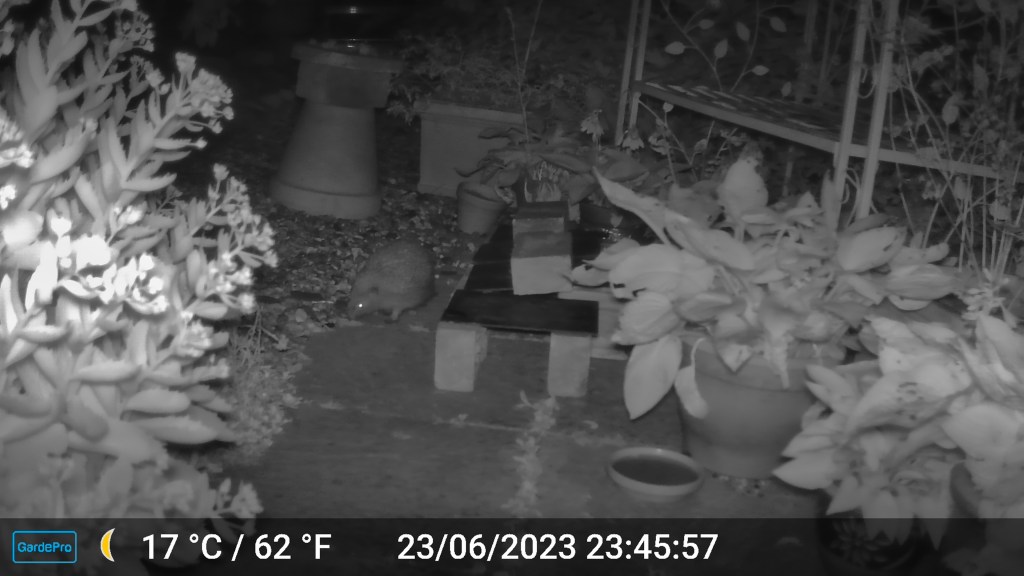
The hedgehogs are a joy to see on the videos from our garden trail camera. They bumble around at night, looking for insects and enjoying a snack at our garden café, or a quick drink, before getting on their way again.

The foxes are also a delight and at times I get glimpses of them from the conservatory, if I keep still and quiet, with the light off.

There are two kinds of visitor I do NOT welcome, however.

The first of these is the rat and I have made my views on these very plain and I think that after three casualties they have got the message and now keep as far away as possible from our garden.

The second is CATS.
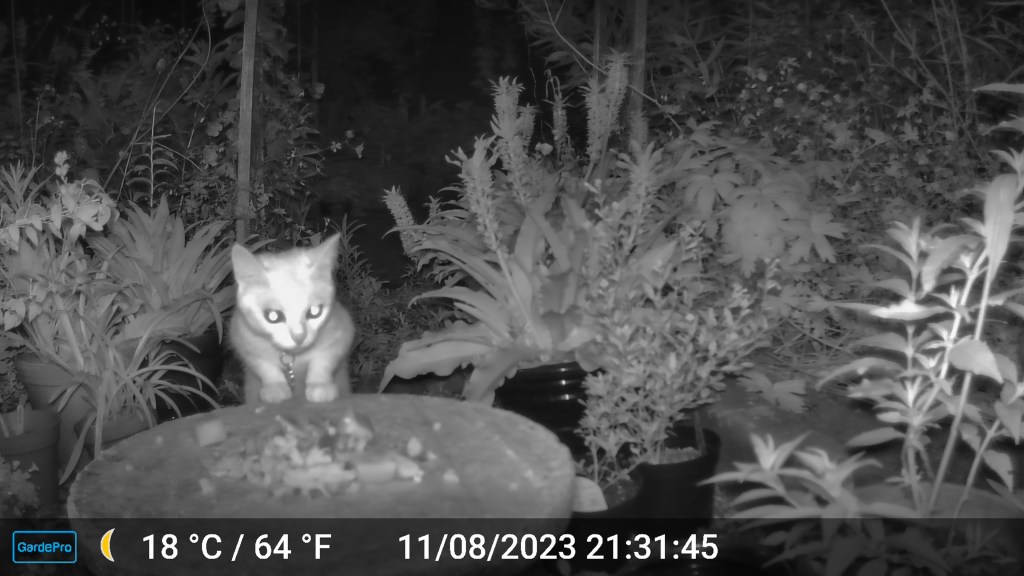
The evil leader of the nighttime feline raiders – evil incarnate

I am not opposed to cats per se. We had one when I was young, along with our dog – Scrap. It never bothered me, it spent most of the day sleeping.

In the 70s we actually had three kittens which we called Tom, Dick and Harriet, and late on we had another called Missy and she was a right little missy at that, forever yowling outside the window letting all the tom cats in the area know she was ready and willing.

No, cats in their place are not a problem,

That place is NOT in our garden, eating food we put out for wild animals.

None of the cats using our garden as a feeding place, a toilet and a super highway to allow them access to other gardens to shit in, is a stray. They are clearly well fed, above and beyond what they steal from our wild animals, and most of them have collars.

It would be like people with a good job, a home and all the trimmings went out at night and barged to the head of the queue of homeless people lininbg up to get their one decent hot meal of the day.

No, as far as I am concerned these animals are the spawn of the devil and deserve a soaking from a water gun. They are lucky I am opposed to the use of real guns and to killing in general (rats don’t count)

The thought fox

by Ted Hughes

I imagine this midnight moment's forest:
Something else is alive
Beside the clock's loneliness
And this blank page where my fingers move.

Through the window I see no star:
Something more near
Though deeper within darkness
Is entering the loneliness:

Cold, delicately as the dark snow,
A fox's nose touches twig, leaf;
Two eyes serve a movement, that now
And again now, and now, and now

Sets neat prints into the snow
Between trees, and warily a lame
Shadow lags by stump and in hollow
Of a body that is bold to come

Across clearings, an eye,
A widening deepening greenness,
Brilliantly, concentratedly,
Coming about its own business
Till, with a sudden sharp hot stink of fox
It enters the dark hole of the head.
The window is starless still; the clock ticks.
The page is printed.

Triple trouble or a family affair

When I first started filming the wildlife in our garden at night it seemed fairly straightforward.

We had at least two hedgehogs because at they both turned up at the same time one night. In fact the one we named Horace appeared to be bullying the smaller hedgehog.

We also knew we had two foxes, one of which we called Ferdinand and the other Francesca. It was easy to tell them apart as Ferdinand had half the hair on his tail missing.

At the same time Francesca appeared to be smaller and easily spooked. She would take a single piece of the food and run off, returning a couple of minutes later to snatch another

Ferdinand, on the other hand was cock of the walk and would even stand on his back legs with his front paws on the stone table as he chomped away at the night’s delightful offerings.

Although we never saw them together we began to believe they might be a couple. Ferdinand would clearly mark the area around the table and the bowl of water – basically by urinating on the area, including in the water bowl.

Although he left these olfactory signs Francesca would still turn up and have a feed – and a drink of water.

This would appear to indicate that Francesca was his mate and so not scared off by the scent markings.

Then one night recently we saw a new, younger fox, arrive with one of our adult foxes, The youngster stayed slightly back from the adult, who we believe was Francesca.

After this we once again only saw one fox at a time and it began to be difficult to differentiate as Ferdinand’s tail appeared to be bushing out.

At one time I began to believe that it was only one fox until Saturday night when we saw two foxes on the video at the same time with one of them top one said and slightly behind its companion.

I am now going to have to go through previous recordings to try and find identifying marks on each of the foxes.

I believe that it is a family of three, Ferdinand and Francesca and their remaining offspring Freddy or Freda.

I’ll let you know how I get on.

Emotions to the fore as I say my last farewells to a trusted companion

It has always been my belief that Cymro (that is our name for ourselves as opposed to Welsh, which is what the Saes call us) are passionate and not afraid to show their emotions, whether it be joy or sorrow or even anger.

I can be passionate about much in life but mainly about people, music, food and especially my love for my darling Marion.

I do not believe that I get emotional or passionate about “things”. By that I mean objects that we use almost every day whether it be a simple glass to drink water from or the plate from which I eat my food.

I have “liked” various things in my life and this includes many of the cars I have owned, or used as part of my job, or even just test-driven and written about in whatever paper I was working on at the time.

Some cars have been more than “like”, such as my first ever car, a British Racing Green Morris Minor, and my second, a black Austin Cambridge A55.

Even those, however, were still just objects, possessions, whatever you want to call them, which provided me with the means to get from A to B at the time I want to travel, rather than relying on trains or buses, or even other people prepared to drive me from A to B.

This is why I surprised myself this week with my reaction to the demise of my current vehicle – a black Chevrolet Lacetti, VA07 HYB.

This car, which has served me faithfully, well fairly faithfully as it has needed quite a lot of work on it in recent years, for almost 13 years, has finally given up the ghost. It is a dead Chevy; it has deceased; it is not resting it is dead; it is demised.

When it overheated on a drive back from town and had to be restarted four times on a 100 yard stretch of road near home I was lucky to have a guardian angel turn up, actually a guy in a hi vis jacket and a hard hat, who pushed it around the corner off the main road while I steered.

As he started pushing he was joined by his mate, also hi vis jacketed and hard hatted, and we got it far enough from the junction to be safely parked.

When I tried to offer them a tenner each as a sign of gratitude they refused

The smoke or steam, I know not which, from the engine compartment started to ease and once I was sure it was safe I locked it and left it, intending to come back later, put in some oil (the oil lamp had kept flickering) and probably water before driving it the few hundred yards back home.

This I did the following morning and although it was not willing to start (starting had never been a problem in the past except for the time the battery completely died on me) it eventually limped home.

I sent a message to Martin, the mechanic who has kept me on the road for the past eight years, outlining the problem and he said he would call round the following morning.

Even then I think I knew it was curtains for the Chevy.

Why did it make me feel sad. After all it was just a car.

I had bought it 13 years ago when the car itself was just three years old.

It was the closest I have ever come to buying a new car.

My first two were 1955 models I bought the Morris in 1967 when it was 12 years old, and the Austin the following year when it was 13 years old.

The only time I have ever driven a new car was when I did a test drive or when the appropriate company provided me with a vehicle for my personal use as well as for work.

The 13 years ownership of the Chevy was the longest period I have ever owned a car, the previous longest was about five years.

If I thought really hard about it I could probably identify most of the cars I have owned or driven but it would not be as easy as naming my top ten books or my favourite writers, or my best-loved poets.

Why then did this one hurt so much?

Martin came round the following morning, lifted the bonnet, and as soon as he took out the oil dipstick I knew by the look on his face that this was terminal. He said he could smell it, by “it” I think he meant the cylinder head gasket, it was that or something similar and the cost would be far more than the car was worth.

It was only later that I realised why this car was so special.

I bought it in 2010 from a dealer in Redditch.

It was the year my mother died and was reunited with my father.

She had left an estate which, once bequests to each of the grandchildren had been made, was to be divided between my brother, my sister and myself.

While the ins and outs of probate and sale of her property went through we each received an initial amount from bank accounts and similar savings and Marion and I decided to put that to good use and buy a car which, although not brand new, would last for a considerable time.

I am not saying that the car kept my memory of my mother alive. That, and that of my father, would never die until I do. What I am saying is that the purchase of the car is something that she would have approved. Something that would last for many, many years.

My mother was a very practical person.

The car did last for many years and has repaid me over that time.

Now we have to decide whether or not we will replace it.

You’ve got to have style if you’re one of the London (Odeon) boys

The day I took over as manager of the Odeon in Camden, an inner city suburb of London, was a big step as I would be in charge of a cinema, responsible for the presentation, screenings, staff and all that goes into entertaining the public.

The place had begun life in the 1920s as the Gaumont Palace, a luxury theatre with full stage facilities as well as the cinema screen. In the stalls and the circle there was seating for over 2,700 patrons.

In 1961, in line with the growing trend for popular entertainment, the Gaumont (as it was now called) hosted a bingo session on Sunday afternoons, run by Top Rank Bingo.

Just three years later the Rank Organisation took over the Gaumont and turned the stalls into a fulltime bingo club, with a separate entrance, and the circle was turned into a single screen cinema with almost 1,200 seats.

The foyer still maintained the ticket office and confectionery counter, as well as a stockroom, and the grand staircase led up to where the magic happened.

It was still a large complex upstairs, as well as the main office, with its own manager’s office taking up one section, plus a staffroom, the projection room and a manager’s flat which had been occupied for some years by the local assistant manager.

There was also a large area which had housed a projectionist training centre, with a fully operational projection room, during the 1960s.

In fact the place was big enough to ensure I kept a trim figure, thanks to all the walking I had to do, including going up and down the stairs at least five times a day.

Within my first week I attended the district manager’s regular meeting with managers and soon found out the difference between a London Odeon manager, even if it was in the suburbs, and managers in the rest of the country – we London managers had style.

This was mainly based on the dress code.

As I have said before managers, and assistants, wore a smart lounge suit with a plain shirt, a tie and appropriate shoes, up until 6pm.

At that time the manager would change into evening dress, with shirt and bow tie.

London managers would have the lounge suit, but often with a pastel shirt, rather than white, and tended to wear a silk tie (I’ve had a passion for silk ties ever since and probably have about 40 to 50 these days).

Evening wear was also black but in London we tended to have silk lapels and once again often pastel shirts with a ruffle down the front covering the buttons, and a butterfly style velvet bow tie.

I had shirts in white, light blue, and a pale brown, with a light blue ruffle, edged in black, and embroidered strip down the centre, a white ruffle with black edging, a pale brown ruffle with a dark coffee coloured edge and pale brown centre, and, finally, one similar to the brown only with burgundy edging. My bow ties came in black, navy, chocolate brown, and deep burgundy. I’ve still got them.

Looking back on those days it was really quite an affectation but we were mostly in our late 20s or early 30s and at the time London was still considered the style capital of the world and we felt we had to do our bit.

Mind you I have always been a snappy dresser when it comes to the workplace, normally wearing a suit (sometimes three-piece) with a smart shirt, with cuff links not buttons, and well-polished shoes.

Compare that at the time to the weekend me, in jeans and a roll neck sweater along with a pair of comfortable slip-on shoes, or, in the hot summer of 1976, just a cut-off pair of old faded jeans when I played in the garden with our two girls, or when Marion and I stretched out on sun loungers watching the girls have fun.

This current theatrical style life was a far cry from the Sooty Show.

Creating a construction to baffle even the most cunning of cats

When we first realised hedgehogs used our garden as part of their highway, and decided to put out food and water for them, the weather was still unpredictable.

It didn’t matter about their water, rain would only fill up the bowl. The food, on the other hand, needed to be kept dry as the dry pellets used for hedgehog food would go mushy and even the wet hedgehog food would end up inedible if it got too wet.

The first version was a large terracotta flower pot with a chunk missing on one side. The idea was that a hedgehog could get in easily but a cat might be wary about getting caught on the jagged piece.

The hedgehog feeding station can be seen at the bottom of the picture in the centre. Unfortunately the cats managed to get at the food by hooking out the dish with their paws.

This led to MkII with a rectangular terracotta planter with a broken side covering the food dish and a roof ridge tile which would allow a hedgehog to walk in but would be too low for a cat.

Unfortunately, as can be seen below, the cats could still manoeuvre the dish with their paws. Clearly something more was needed.

What was needed was something long and low which would allow something short and low (like a hedgehog) to enter and access the dining area to one side, but would not admit a wider, longer animal (such as a cat) to get far enough in and turn to get to the food.

This led us to MkIII with a brick tunnel, roofed in slate, with the dining area offset at the centre.

When Horace arrived early in the morning he mad a thorough inspection of the new construction and soon found his way in to the food.

.

The real test, of course, would be to see how a cat coped with the situation. Would it get in for some fine dining or would it have to crawl away, frustrated and hungry?

The cat that turned up was not the most cunning of its kind. In fact, when it comes down to it this cat is more on the stupid side.

Yes, it got its0 head in; yes, it even flattened itself down to get its shoulders in. Unfortunately for our dumb chum it could not get in far enough to reach the food and eventually gave up.

If it had only had the sense to realise that if it raised its head the tile would have been knocked off and the others would have followed suit.

This time it only needed some minor alterations and MkIV was catproof.

This version was left in place for a week or more with night time video surveillance and during that time not one of the four or five foolish felines who consider our garden to be a super highway managed to get at the food.

Eventually I created a grander version of the hedgehog feeding station in the area under an ornamental cherry tree by the compost bin and water butt.

This was built in the form of a house with two wings. Both entrance sections were high enough for a hedgehog and in each case there was a sharp right angle turning at the end leading into a slightly higher dining area with food and water under the upturned terracotta planter. All the areas had slate tiles with bricks to weigh them down.

Our little coterie of hedgehogs seem perfectly happy with MkV.

Thanks for all the information – now it’s time for me to say goodbye

By the time Christmas 1975 came round I began to think it was time to put in for a manager’s role at one the Rank Organisation’s Odeon cinemas.

I believed Tony, my manager at Romford, had taught me all he could teach me. This included matters one did not automatically connect with cinemas, such as publicity in the local newspaper.

At first you might think cinemas rivalled newspapers in the matter of local advertising. I am sure you all remember the locally made advertising films which were shown before the film started and, in those days, when adverts appeared in the interval as well.

The point is cinemas also needed to advertise what films they were showing and the times of the showings. There was another way of advertising and that was by running a competition in the local newspaper.

These would be linked to the main film on show in any one week and could consist of a picture for children to colour in; or a spot the difference competition using an image from the film.

The prize on offer might be a pair of tickets to see that week’s film. At other times Rank might have done a deal with a manufacturer and offer prizes of their products.

Bassets offered advertising products based on Jelly Babies – there was a Bassets barrel bag, or Jelly Baby jelly moulds, or similar products.

Sometimes the manufacturer would send enough of the product to make 20 prizes or more, and there were times when the competition would only attract 10-15 entrants.

I’m not sure what Tony did in this situation, apart from the fact that myself and Sheila might receive one of the prizes each, but when I was running my own cinema I would let the contact at the newspaper have a couple of the excess *prizes, give members of the staff some and, depending on the prize itself, I might take a couple home.

In fact almost 50 years later I still have one of the barrel bags, along with a PG Tips tin tea caddy and chef’s apron (in fact we only got rid of the PG Tips tea cosy earlier this year).

As I sad at the beginning I felt it time to get my own cinema and initially I looked at ones up North, especially those that offered a manager’s flat as well. One of these was at Southport, where we had done the Sooty Show, but unfortunately I just missed out on that one.

Early in 1976, however, my application for one of the London cinemas, Camden Town Odeon, was successful which meant I could still travel from Basildon because although there was a flat connected to the theatre, this had been offered to the local assistant manager in the early 60s.

Just a year after leaving Sooty I was getting ready for a new challenge as manager of a London cinema, not a West End one but still London where they had a different breed of managers – with a touch of class.

I’ll tell you all about that next time.

Happy workers are good workers, as long as you’re not a soft touch

I was much happier when my induction course in Birmingham was ended and I could get back to proper work at the three-screen Odeon cinema in Romford, where I had recently become an assistant career manager.

It is not that I have anything against Birmingham. In fact when we lived in Redditch we went to the city a few times, including a trip to a museum. It is just out of the three major cities in that area I prefer Liverpool over Birmingham and Manchester. In fact Liverpool is my favourite city in the world, after all I was born there as was my mother.

No, I just preferred a working environment over what was basically a glorified classroom. Also it meant that I was back with my little family every day, or nigh, depending on my shifts.

With a management team of three, Tony, the boss; Sheila, the local assistant manager; and myself as career assistant manager, two of us would always be rostered on every day (except if someone was on holiday when an assistant from another cinema nearby would do a couple of shifts), and shifts would overlap so that at times all three of us were present.

I actually preferred it when Sheila and I were rostered on together because, although I liked him, I didn’t always agree with the way Tony dealt with some situations.

A prime example was the way he dealt with the cleaning staff.

The cleaners came in every morning, yes, every morning including Saturday and Sunday because cinema audiences to not make less of a mess at weekends, in fact a Saturday night audience could often make more of a mess than the rest of the week put together.

Their shift would start at about 7am and would be almost finished by the time I came in for an early managerial shift at about 10am.

When Tony did his first inspection tour of the day, one of us would always be visible to staff during opening hours, he would note everything that was wrong, or not up to his standards, and if he was not satisfied he would make his displeasure abundantly clear to the cleaners.

I, on the other hand, would keep an eye out for anything that had been done really well so that if I had to point out a flaw I could balance it with a compliment, even if it was only pointing out how clean the ashtrays were, or an extra shiny hand rail.

I generally found, on my observation tour, that conditions were above average as the staff had made an extra effort. It is something that I have kept in mind and utilised ever since.

After all, it is easy to tell a reporter their copy needs a complete rewrite and leave it at that. On the other hand telling the : “There’s a good story in there, with all the facts, but it is not clear enough for readers to understand them.”

Of course a cinema staff has more than managers and cleaners, but the same principle applies to dealing with the ushers and usherettes (yes I know it sounds sexist but that is how they were listed on staff rosters and wages ledgers at that time), the ticket kiosk and confectionery sales staff, and, last but by no means least, the projectionists.

The most important lesson for any would-be manager to keep in mind is that a happy staff makes for a well-run cinema. Just don’t let them see you as a soft touch.

I did learn quite a lot from Tony, sometimes not by what he told me, or the way he did things, but often by doing it by the book (or my interpretation of the book), or the way I felt was best.

Before the year was out I was already applying for managerial vacancies throughout the country.

It didn’t take me too long but that’s a story for another time.

Quick as a flash – in fact it takes a lot longer to do simple tasks nowadays

Strange thing about people, they think they will go on forever, doing the things they do and still doing the things they did when they were younger.

When I was younger I could drink till morning at an all night party; I could get behind the wheel of any car from a 1955 Moggie Minor to a Lamborghini (that’s a tale from the Middle East, I’ll tell you about it later) and drive it straight away; even, in my teens, date three girls at the same time and none of them knew about the others.

Of course once I met the love of my life I forgot about fast cars and loose women, well the women at least, I still like fast cars I just can’t hit the same speeds any more.

In my 40s I slowed down a bit, but just to make the time to enjoy life.

Occasionally I would find it took me a littlie bit longer than usual to finish a crossword or complete a book; nor could I stay awake to watch the dawn.

But it was the rats that really brought it home to me that at 73 I could not do what I did at 23, or 33, or even 53.

Disposing of the vermin who had gnawed through cable coverings in my garage workshop, risking a shortcut and an electrical fire, was the least part of the whole rigmarole which left me realising I can definitely not do things as easily I used to.

The repair job consisted of removing a section of cable on the freezer lead and replacing the plug before removing a similarly gnawed piece of cable on the extension lead and replacing the socket.

That should have taken me about five minutes, 10 at a push.

It took me the best part of an hour.

Stripping the insulation back to bare the actual copper wire in the cable ended up with not stripping it far enough or actually cutting off half the wire strands with the insulation.

Then I had to put each wire to its right socket inside the plug and screw it in before reattaching the plug cover and then going through it all again for the extension cord.

Fifty minutes, 50 minutes for a five-minute task.

Over the years I have rewired three houses, two over here and one in Australia. That, of course, was when you were allowed to carry out this task for yourself. Nowadays you need a certificated electrician to change a fuse. Maybe that is taking it a little bit to the extreme but beyond changing a fuse or changing a light bulb you are definitely restricted to DIY at home.

All that rewiring and never a spot of trouble and now it takes me almost an hour to carry out the simplest of tasks.

Ah well, I suppose I’ll just have to take a little bit longer putting up that new fence, after all it has taken about three months so far so I suppose it’ll be Christmas before I get it finished.

A child’s imagination is a wonderful gift, never take it away from them

Our daughter brought our grandchildren over to see us today, they’re here for a few weeks from the UAE and this week they will be visiting friends but from the weekend will be staying near us so we can spend time together.

My granddaughter, Harriet, wanted to have a look around the garden so I sat on the bench while she wandered through the undergrowth (well not really, it’s well cultivated and there are gravel paths but it’s fun to add in the atmosphere).

Every now and then she would come over to show me a stone, or a shell (all sorts go in to make up the gravel paths) and we would talk about where it might have come from.

There were pebbles split in two showing a reddish centre in its grey shell; or a piece of slate showing the layers of compressed mud that would have created it over the millennia.

She listened intently as I told her how slate mined out of mountains in North Wales had been shipped all over the world as roof tiles used to keep people dry from Patagonia to Perth. from Canada to the Caribbean.

There were even pieces of flint and I explained to her how thousands and thousands of years ago people had used these stones in the same way as we now use knives, axes and anything else which needed a sharp edge.

It is wonderful how the young mind can take in such information and store it for when they might need it.

Soon afterwards she was telling me about fairies and elves – don’t try telling a child that fairies and elves are impossible, after all the Queen told Alice that she could believe six impossible things before breakfast.

This is why children are so wonderful. They have imagination.

The problem is we take that away from them as they get older.

I am happy for my granddaughter to believe in fairies and elves. In fact I added to her imagination by telling her about leprechauns.

Later she asked me if leprechauns were real and I told her: “They are as real as fairies and elves, as real as dragons and unicorns.”

I did not tell her a lie, you shouldn’t lie to children.

When she gets older and possibly no longer believes in fairies and elves she will remember that I did not lie to her about leprechauns, dragons and unicorns.