All the World’s a Stage

by William Shakespeare

All the world's a stage,
And all the men and women merely players;
They have their exits and their entrances,
And one man in his life plays many parts,
His acts being seven stages. At first, the infant,
Mewling and puking in the nurse's arms.
Then the whining schoolboy, with his satchel
And shining morning face, creeping like a snail
Unwillingly to school. And then the lover
Sighing like a furnace, with a woeful ballad
Made to his mistress' eyebrow. Then a soldier,
Full of strange oaths and bearded like the pard,
Jealous in honor,sudden and quick in quarrel,
Seeking the bubble reputation
Even in the cannon's mouth. And then the justice,
In fair round belly, with good capon lined.
With eye severe and beard of formal cut,
Full of wise saws and modern instances;
And so he plays his part. The sixth age shifts
Into the lean and slippered pantaloon,
With spectacles on nose and pouch on side;
His youthful hose, well saved, a world too wide
For his shrunk shank, and his big manly voice,
Turning again to youthful treble, pipes
And whistles in his sound. Last scene of all,
That ends this strange eventful history,
Is second childishness and mere oblivion,
Sans teeth, sans eyes, sans taste, sans everything.

A Birthday

by Christina Rossetti

My heart is like a singing bird
Whose nest is in a water'd shoot;
My heart is like an apple-tree
Whose boughs are bent with thick-set fruit;
My heart is like a rainbow shell
That paddles in a halcyon sea;
My heart is gladder than all these
Because my love has come to me.

Raise me a dais of silk and down;
Hang it with vair and purple dyes;
Carve it in doves and pomegranates,
And peacocks with a hundred eyes;
Work it in gold and silver grapes,
In leaves and fleur-de-lys;
Because the birthday of my life
Is come, my love is come to me.

What a carry on as I start having second thoughts on my new career

It’s been a while since I recounted any of the chronological episodes of my life and I left you fairly early in my new role as manager of an Odeon cinema in London – Camden Town to be precise.

It’s strange the period from me going to work for Harry Corbett and my move into cinema management with the Rank Organisation was not a long period compared to my 50 years as a journalist and the period since then in retirement, in fact my teenage years were almost three times as long.

Yet I seem to have spent a lot of time on a miniscule part of my life.

I spent the best part of a year at Camden Town and in all honesty I enjoyed it most of the time. My customers ranged from nine to ninety and in the main they behaved themselves. Some of the Saturday morning crowd could be a bit rowdy (in fact it is one such that eventually led to my next career move, but more of that later) but you tend to make an allowance for youngsters, most of the time.

I have previously described the busy life of an Odeon manager but it did tend to have its lighter moments (and darker ones).

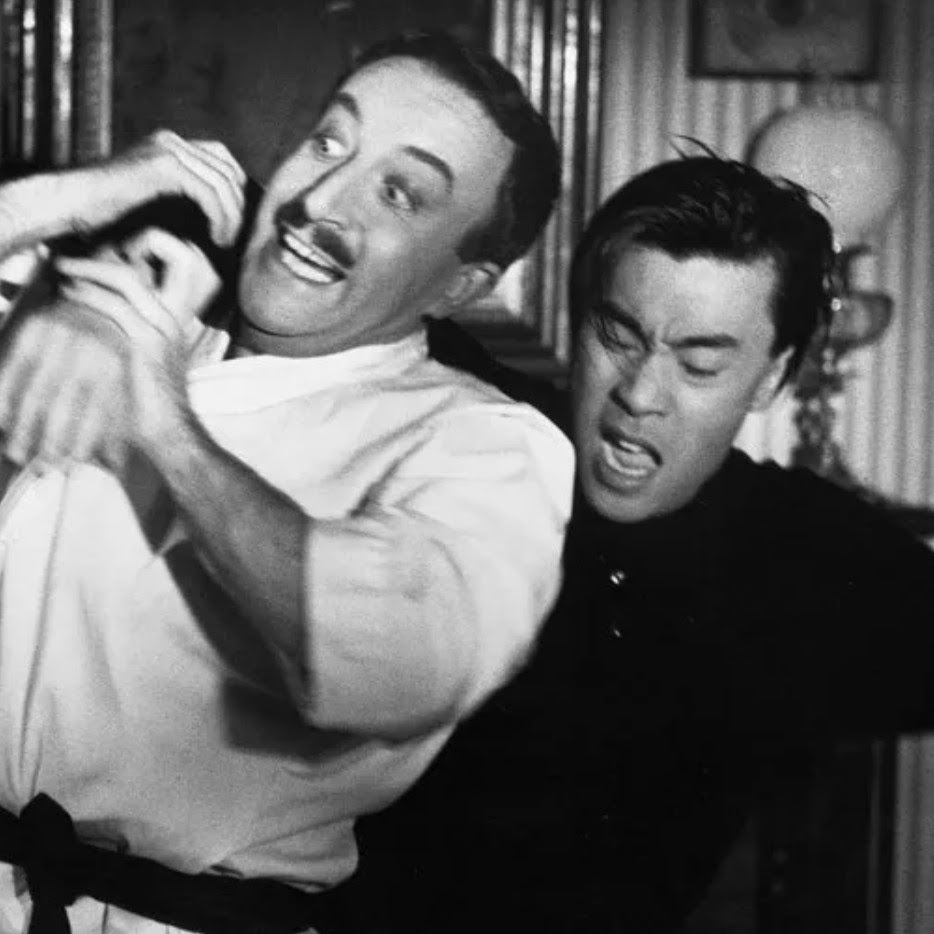
Occasionally we would welcome a guest star to the first showing of a new film and I remember the launch of “The Pink Panther Strikes Again” starring Peter Sellers as Inspector Clouseau and Burt Kwouk as his man servant Cato.

The foyer was decorated with posters and cut-outs of the Pink Panther and we also had someone dressed as the Pink Panther prowling the foyer and the auditorium.

The best part, however, was that we had Burt Kwouk making a guest appearance, which, of course, gave me a chance to ham it up in the limelight.

Instead of just standing in front of the screen and introducing the celebrity guest I first welcomed the audience and then explained that we had intended to have one of the stars of the film at the launch but he hadn’t arrived yet. Which is why I then pulled the old panto trick of asking them to tell me if they saw him.

Inspector Clouseau (Pete Sellers) fends off another “planned attack” from his manservant Cato (Burt Kwouk)

Of course, as I was talking Burt, dressed in black, had crept in and made his way behind me and just before he launched a Cato-style attack the younger people let loose with a mighty shout of “HE’S BEHIND YOU”.

I turned to the right as he went to my left then turned back just in time to see him and step aside as he rushed me.

You know what they say – you can’t keep a ham actor down.

In the same year all the managers and their partners were invited to an advance showing of the latest in the “Carry On” series – “Carry On England”, or, as I call it, the infamous “Carry On England”.

Now I have always enjoyed the “Carry On” films, seeing them as a natural companion to seaside postcards. Somewhat saucy, plenty of double entendres and if Barbara Windsor ever needed a cue then Sid James was always there to give her one.

Just as the seaside postcards had to get closer and closer to the knuckle to combat rivals who whipped away the seventh veil and didn’t turn the lights off so did the “Carry On” films start showing the boobs rather than the image of Barbara Windsor’s bikini top flying through the air to hit Kenneth Williams in the face.

The main thing I remember about the new film was that it was set at a mixed-sex Army searchlight unit. A new CO arrived (Kenneth Connor) and began a surprise inspection in the female barrack room.

When the women sat up to attention the camera focused on one side of the room, the side were they were all topless. A brief shot from the other side of the room showed only the backs of those women.

One side – unknown actors, the other – known. Guess which was which.

Maybe my new management career was not what I thought it to be.

/

Street in Agrigentum

by Salvatore Quasimodo

There is still the wind that I remember
firing the manes of horses, racing
slanting, across the plains,
the wind that stains and scours the sandstone,

and the heart of gloomy columns, telamons,
Overthrown in the grass. Spirit of the ancients, grey

with the rancour, return on the wind,
breathe in that feather-light moss
that covers those giants, hurled down by heaven.
How alone in the place that's still yours!
And greater, your pain if you hear, once more,
the sound that moves far off, towards the sea,
where Hesperus streaks the sky with morning:
the jew's-harp vibrates,
in the wagonner's mouth
as he climbs the hill of moonlight, slow
In the murmur of Saracen olive trees.

“I loved you…”

by Alexander Pushkin

I loved you, and probably still do,
And for a while the feeling may remain...
But let my love no longer trouble you,
I do not wish to cause you any pain.
I loved you, and the hopelessness I knew,
The jealousy, the shyness - though in vain -
Made up a love so tender and so true
As may God grant you to be loved again.

The posher the shop the more obnoxious the customers

I have shopped in a variety of shops, haven’t we all?

In particular I have shopped in a variety of supermarkets.

What I have found, in my fairly limited limited survey of shopping habits and the behaviour of customers, is that the “posher” the shop the more obnoxious some of the customers can be.

I have shopped at corner shops, and at mini-supermarkets, I have shopped at three – no, four – of the main supermarkets, but I have not shopped at two of the larger supermarkets, both with very short names.

In recent years we have continued a habit we started in the year of Covid and have had two deliveries a week, one from Tesco and one from Sainsbury’s. Occasionally we will get an order from Waitrose because they have such wonderful coffee, the best fresh chicken we have ever tasted, and a mature vintage cheese which I have to be careful in its used because I could easily eat half a block, along with a handful of small sweet tomatoes and as couple of digestive biscuits.

Now clearly other customers do not bother me when I shop online.

When I do go out, however, I tend to notice the other customers and am amazed that once off the roads those customers who drive to the store tend to act as though the normal rules regarding driving no longer apply.

In the two stores mentioned above as our main providers of food and household goods it can consist of slightly careless parking or pushing a trolley around without paying attention.

In the main, however, they do not stop directly behind a car just as the driver puts it in reverse, or stand in the doorway chatting,

A large number of customers at Waitrose, however, often act as though they believe other customers are there just to annoy them.

These are the ones who will push past you to get the last fresh chicken, or who take it for granted that they have the right of way, in the store and in the car park, whether as a pedestrian or driver.

My recent trip to the local Waitrose had me wound up before I even entered the store.

I was behind her car as we both headed up to the area designated for disabled drivers (I have a blue badge) and for customers who have children with them. She stopped the car and let out her passenger, an elderly lady.

I then waited for her to either drive away, intent on returning for the elderly lady, or park in one of the disabled bays, of which she was parked in a way that three of them were blocked.

Eventually she did move her car, swinging it toward the mother and child bays and then reversing to straddle two disabled bays, at which she stopped the engine and then sat back and lit a cigarette.

Now I am more of a Clark Kent than a Batman, and generally just walk on by. This time I dropped my mild manner and went up to the car and politely tapped on the window, which was immediately lowered, and asked her if she was aware that her car was straddling two of the bays designated for disabled drivers. To which she replied that she would only be a few minutes as she had just dropped her mother off.

Wrong answer.

It should have been: “Sorry, I didn’t look, I’ll move it now.”

Instead she went to wind the window up as though that ended the matter.

So I continued: “What happens if other disabled drivers arrive and one has nowhere to park because of your selfishness.”

She at least stopped the window from winding up and grudgingly said: “OK, I’ll move it now, just chill out.”

I would have expected this from a teenager, but not from a woman who you might have thought was above it.

It gave me no sense of righteousness, or superiority as I went on to do my shopping. When I went back to my car the woman’s vehicle was gone.

I loaded my shopping, started the car, put it into reverse, having checked my rear view mirror, and began to back out. At this moment I saw a man appear in my rear window, having ignored the sight of a car reversing.

Fortunately my instincts still work at their peak and I braked without hitting him. He just walked on, completely unaware that he had just missed being knocked down.

That was not even an average Waittrose.

I found the staff in the store to be polite and efficient.
The Send-off

by Wilfred Owen

Down the close, darkening lanes they sang their way
To the siding-shed,
And lined the train with faces grimly gay.

Their breasts were stuck all white with wreath and spray
As men's are, dead.

Dull porters watch them, and a casual tramp
Stood staring hard,
Sorry to miss them from the upland camp.
Then, unmoved, signals nodded, and a lamp
Winked to the guard.

So secretly, like wrongs hushed-up, they went.
They were not ours:
We never knew to which these were sent.

Nor there if they yet mock what women meant.
Who gave them flowers.

Shall they return to beatings of great bells
In wild trainloads?

A few, a few, too few for drums and yells,

May creep back, silent, to still village wells

Up half-known roads.

Plenty of fun on Facebook groups but some just go a step too far

Many people on Facebook began with a small group, mainly family and friends, and they would put up pictures taken on a day out, even pictures of their breakfast.

Then you find a friend of a friend who puts up interesting posts and you befriend them and these new friends allow you access to their friends and family and so it grows and you find yourselves with a thousand friends most of them being people you would never normally befriend.

The next move is to join Facebook groups which are based around something you are interested in.

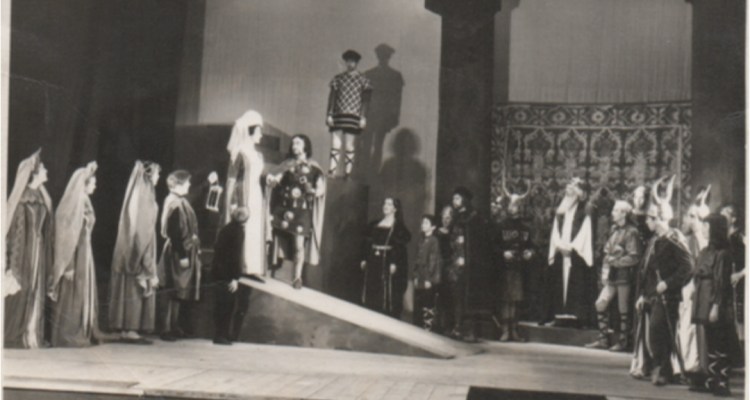
I began with a group interested in old Rhyl (see above: the Rhyl Pavilion in its glory days) which linked me to my childhood and early teens. Then I found the Rhyl Little Theatre group, which brought me back in touch with friends I made from 1963 to 1972. As a bonus they had lots of pictures from productions during that time, including some featuring my favourite amateur actor – ME.

Pictured below: Rhyl Little Theatre production of Macbeth and there I am, bottom right, horned helmet and hand on my sword.

Recently I was alerted to a site based on the Kings Liverpool Regiment which includes the four Liverpool Pals battalions which is the regiment my grandfather, Harry Lloyd, volunteered for in 1914. He is pictured below, front centre, with the pipe

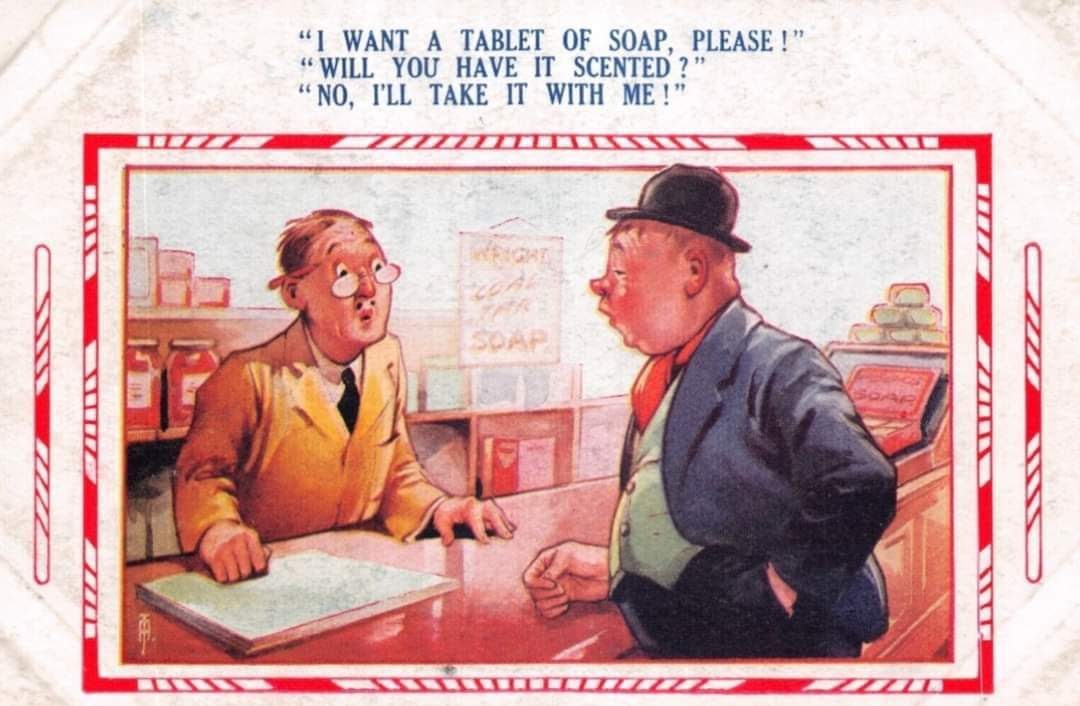
Soon after I was referred to sites about seaside postcards which, in the 1960s, I used to look at on the racks outside the amusement arcades and ice-cream and rock stalls on Rhyl promenade.

Initially the postcard group was good. Enthusiasts would post anything from one to five postcards at a time which mainly highlighted the 50s to 70s boom in saucy seaside postcards.

Postcards in the 20s and 30s were far from saucy and often showed suitably clad holidaymakers parading on a promenade with a message on the lines of: “Having a great time at Clacton” or: “It’s breezy but bright in Brighton”.

It was after the Second World War, late 40s and early 50s, that the postcards began to get saucier and saucier. There had been earlier saucy postcards, especially those of Donald McGill, but they began to push the boundaries in the 50s and eventually some authorities in seaside towns banned the sale of certain cards under the Obscene Publications Act.

In fact they were quite tame compared to postcards and even greetings cards from the 80s onwards.

The cheeky cards of the 60s were more in tune with the “Carry On” films of the time as compared to the mucky movies found in Soho.

Even the “Carry On” films began to outstrip the saucy postcards, especially “Carry on England” and then the disastrous “Carry on Emmanuele” which really left nothing to the imagination.

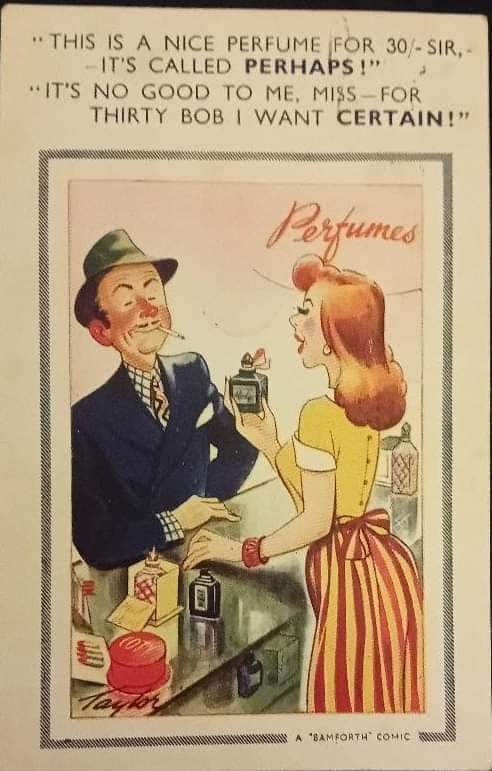
It’s easy to tell the CERTAIN he is after

The point is the McGill and Bamforth postcards were a bit of fun, the good old double entendre and the slightly smutty comment.

This shift from that cheeky age to the in your face crude humour which followed can also be seen on the saucy seaside postcard sites where people now put up blatantly sexy and sexist images many of which are really so-called humour greetings cards, or even “naughty” postcards with the caption altered to an in-your face unfunny quote which had nothing to do with the artists like McGill who always left something to your imagination.

I am not a prude, I grew up in the 60s after all, but I prefer some things be left to my imagination.