The Common Cold

by Ogden Nash

Go hang yourself, you old M.D.!

You shall not sneer at me.

Pick up your hat and stethoscope,

Go wash your mouth with laundry soap;

I contemplate a joy exquisite

I’m not paying you for your visit.

I did not call you to be told

My malady is a common cold.

By pounding brow and swollen lip;

By fever’s hot and scaly grip;

By those two red redundant eyes

That weep like woeful April skies;

By racking snuffle, snort, and sniff;

By handkerchief after handkerchief;

This cold you wave away as naught

Is the damnedest cold man ever caught!

Give ear you scientific fossil!

Here is the genuine Cold Collosal;

The Cold of which researchers dream;

The Perfect Cold, the Cold Supreme.

This honored system humbly holds

The Super-cold to end all colds;

The Cold Crusading for Democracy;

The Führer of the Streptococcracy.

Bacilli swarm within my portals

Such as were never conceived by mortals,

But bred by scientists wise and hoary

In some Olympic laboratory;

Bacteria as large as mice,

With feet of fire and heads of ice

Who never interrupt for slumber

Their stamping elephantine rumba.

A common cold, gadzooks, forsooth!

Ah, yes. And Lincoln was jostled by Booth;

Don Juan was a budding gallant,

And Shakespeare’s plays show signs of talent;

The Arctic winter is fairly coolish,

And your diagnosis is fairly foolish.

Oh what a derision history holds

For the man who belittled the Cold of Colds!

Fun and games at the seaside

I settled into the Rhyl Journal offices quite quickly as the rest of the editorial team were a friendly bunch.

Mind you the working move to Rhyl was very quickly followed by another move – except this was a very short trip.

When NWN bought out the Journal the red-brick building on Russell Road housed not only editorial and advertising staff as well as the newspaper presses but also ran as a jobbing printers running off stationery, fancy invitations and anything else people needed.

The presses were obviously not needed as all printing would be done at Oswestry and these were sold off. The jobbing printing also ceased operation.

This just left editorial and advertising rattling around in a great big Victorian building.

It wasn’t long before we moved 100 yards down Russell Road into bright new ground floor offices. In fact it was my first time in a ground floor office (except my part-time role at the Gazette). Even the Leader office at Mold had been on the first floor.

One of the perks of being a young, single junior reporter was that sometimes you got sent on the less important stories while the seniors were covering crime and politics.

One such job was covering the beauty queen contests at the open air swimming pool.

I often accompanied our photographer, Glyn Roberts, but the job wasn’t always just for a caption on the lines of a page three.

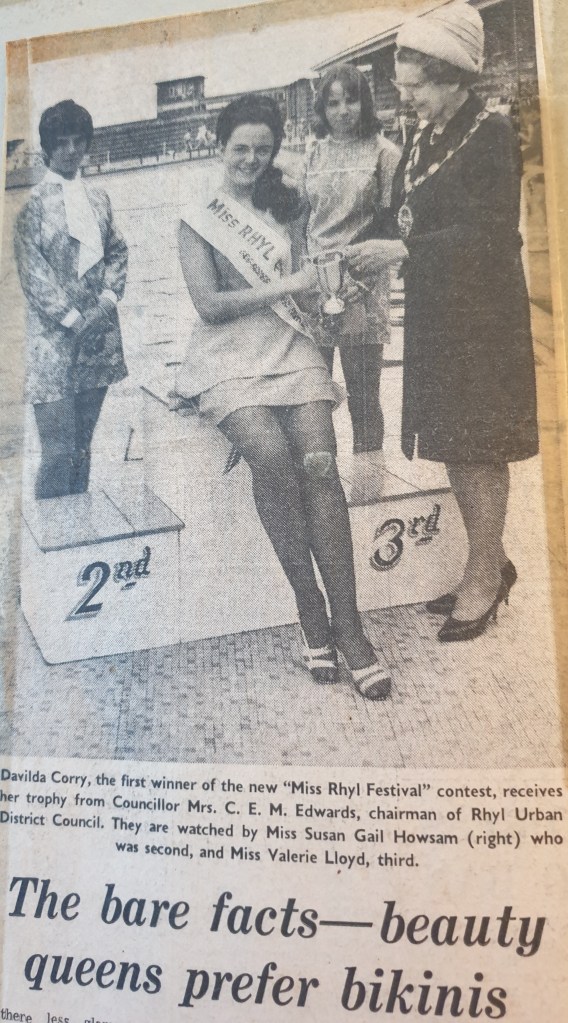
The beauty contest above was for a “Miss Rhyl Festival” and instead of the standard parade of contestants in bathing costumes this was “a thrilling contest for the Junior Miss”.

It was a contest for girls aged 14 to 17 and the dress code was afternoon frock or cocktail dress.

The previous day a “Miss Bikini” contest at the same venue had 12 contestants.

The “Miss Festival” contestants had just enough entrants to ensure all three prize slots were filled.

The story angle was based on the bathing beauties being considered more glamorous than those more fully-clothed.

All three were local girls and the winner, Davilda Corry, had previously won a “Miss Rhyl” contest and a “Miss Scene”.

All this and she was still only 16.

It wasn’t all beauty queens that summer in Rhyl

Fun as it was to spend half an hour or so each week watching all the girls go by there were more serious stories as well as the somewhat mundane ones.

There were also some good nights attending the opening of a new club, or a midnight entertainment show. As it happens both of these were at the same venue – Billy Williams’ Downtown Club.

Billy belonged to one of the main amusement business families in Rhyl and when he was just 27 he opened a brand new club for late night entertainment and dancing in the town.

My first visit was to the opening of the club and, as it was only a walk along the promenade from my home and all refreshments (including drink) were on the house, I felt it would be churlish to claim expenses for night working.

The next time was when it had been open for a few weeks and I did the editorial for an advertising feature about the club.

We always made sure pieces like this were clearly marked “advertising feature” but I never went over the top in the way I wrote the piece.

To be honest in its first year Billy’s club didn’t really need any advertising stunts as it was a top value venue.

The third visit was when Billy launched his midnight cabaret season and the first star was Ken Dodd.

Now I knew of Ken mainly from his Sunday radio show (one of his catch-lines was “where’s me shirt”) and his appearances on Sunday Night at the London Palladium.

Ken Dodd: a favourite family entertainer but more than a little blue once the clock strikes midnight.

His midnight cabaret act was quite an eye-opener. This was no panto-style, slightly risqué act keeping just on the right side of decency.

If I had known what to expect I certainly would not have taken my girlfriend. Even Billy appeared somewhat taken aback at the content. I think there might have been a few members of Rhyl’s social elite who would not have been invited if he had known Doddy’s act.

Even the Diddy Men would have blushed.

This was not the first time any of my comedy heroes turned out to have feet of clay. I caught a well-known comedy duo at another late-night cabaret only a couple of months after this and their act was even worse than Ken.

At least when I stood in the wings of a Morecambe and Wise show five years later I didn’t hear anything that would make even Mary Whitehouse blush.

That summer in Rhyl proved one of the most varied of my life up to then but I didn’t know what lay over the horizon.

Next time: Back to school — down South.

Bridal Ballad

by Edgar Allan Poe

The ring is on my hand,

And the wreath is on my brow,

Satins and jewels grand

Are all at my command,

And I am happy now.

And my lord he loves me well;

But, when first he breathed his vow,

I felt my bosom swell —

For the words rang as a knell,

And the voice seemed his who fell

In the battle down the dell,

And who is happy now.

But he spoke to reassure me,

And he kissed my pallid brow,

While a reverie came o’er me,

And to the church-yard bore me,

And I sighed to him before me,

Thinking him dead D’Elormie,

“Oh I am happy now!”

And thus the words were spoken,

And this the plighted vow,

And, though my heart be broken,

Here is a ring as token

That I am happy now!

Would God I could awaken!

For a dream I know not how!

And my soul is sorely shaken

Lest an evil step be taken, —

Lest the dead who is forsaken

May not be happy now.

Summer

by John Clare

Come we to the summer, to the summer we will come,

For the woods are full of bluebells and the hedges full of bloom,

And the crow is on the oak a-building of her nest,

And love is burning o in my true lover’s breast;

She sits beneath the whitethorn a-plaiting of her hair,

And I will to my true lover with a fond request repair;

I will look upon her face, I will in her beauty rest,

And lay my aching weariness upon her lovely breast.

The clock-a-clay is creeping on the open bloom of May,

The merry bee is trampling the pinky threads all day,

And the chaffinch it is brooding on its grey mossy nest

In the whitethorn bush where I will lean upon my lover’s breast;

I’ll lean upon her breast and I’ll whisper in her ear

That I cannot get a wink o’sleep for thinking of my dear;

I hunger at my meat and I daily fade away

Like the hedge rose that is broken in the heat of the day.

Getting back on the right track

Dear friends and readers – sorry that the blog part of this post has been somewhat erratic in recent weeks.

I have been keeping up with the poetry each day because I believe it would be discourteous to leave a void for those who visit daily.

This covid19 has been tragic for so many even though there have been the good news stories where people such as the brilliant author Michael Rosen have teetered on the edge but pulled through.

Some say the government should have acted sooner in getting people to isolate but is it possible they did not realise the danger we all face?

Should we give them the benefit of the doubt?

I remember at the beginning of March there was a lot of talk about avoiding direct contacts outside your home and people did start to panic buy (think of the lack of toilet paper) but the government didn’t appear to show much concern at that stage.

Where we blasé about it because the government seemed blasé or did the government try and play it down in an effort to stop panic-buying?

I had noticed shortages from the very beginning of March. I didn’t go filling my trolley with two or three times the amount I normally bought, but I did buy a few extra bits.

I think my wife Marion recognised the dangers more.

I had been for the normal Friday shop and said maybe I should go out in the morning and get more in case of a lockdown.

Marion said “No.”

When I said better safe than sorry and one more trip to the shops might see us through for a couple of weeks she was even more adamant with her response “NO”.

I will never forget what she said when I asked why not:

“Because I don’t want to die!”

That brought me up with a jolt.

Marion is a very levelheaded person and her concern at the situation made me realise how serious it was getting.

We started our lockdown on Monday 16 March, my 70th birthday. Our son had been working from home for a week by then, directed to do so by his bosses.

It did mean our household was properly shielded as nobody needed to go out.

On the downside we would not see our eldest daughter and our two grandchildren. At least we had Skype.

Our other daughter proved a godsend. As she was still working at the school, where she is assistant head, she was still going out and did a weekly shop for us.

To avoid any contact she would leave it inside the gate and then back off to a safe distance. Then we could at least wave and blow kisses.

A few weeks ago we did manage to get a weekly delivery slot, although it did mean using three different supermarkets depending on who had a delivery slot.

I know many more of you have seen a lot worse and suffered much more than us but the whole thing does prey on the mind.

We are still shielding because we don’t believe it when the PM says everything’s OK again and then the figures shoot up because people believed him and flocked to the beach.

This situation does weigh heavily but I didn’t intend to bother my readers with it. On the other hand it was unfair not to provide a reasonably ordered blog and I thought you deserved an explanation.

The poems will continue and I hope to get my life story back on the road with at least four updates a week.

If I do occasionally fall behind please forgive an old man who wants to keep his readers happy but sometimes finds he can’t concentrate.

Litany in Time of Plague

by Thomas Nashe

Adieu, farewell, life’s bliss;

This world uncertain is;

Fond are life’s lustful joys;

Deathe proves them all but toys;

None from his darts can fly;

I am sick, I must die.

Lord, have mercy on us!

Rich men, trust not in wealth;

Gold cannot buy you health;

Physic himself must fade.

All things to end are made,

The plague full swift must die;

I am sick, I must die.

Lord, have mercy on us!

Beauty is but a flower

Which wrinkles will devour;

Brightness falls from the air;

Queens have died young and fair;

Dust hath closed Helen’s eye.

I am sick, I must die.

Lord, have mercy on us!

Strength stoops unto the grave,

Worms feed on Hector brave!

Swords may not fight with fate,

Earth still holds open her gate.

“Come, come!” the bells do cry.

I am sick, I must die.

Lord, have mercy on us!

Wit with his wantonness

Tasteth death’s bitterness;

Hell’s executioner

Hath no ears for to hear

What vain art can reply.

I am sick, I must die.

Lord, have mercy on us!

Haste, therefore, each degree,

To welcome destiny;

Heaven is our heritage,

Earth but a player’s stage;

Mount we unto the sky.

I am sick, I must die.

Lord, have mercy on us!

And Death Shall Have No Dominion

by Dylan Thomas

And death shall have no dominion.

Dead men naked they shall be one

With the man in the wind and the west moon;

When their bones are picked clean and the clean bones gone,

They shall have stars at elbow and foot;

Though they shall go mad they shall be sane,

Though they sink through the sea they shall rise again;

Though lovers be lost love shall not;

And death shall have no dominion.

And death shall have no dominion.

Under the windings of the sea

They lying long shall not die windily;

Twisting on racks when sinews give way,

Strapped to a wheel, yet they shall not break;

Faith in their hands shall snap in two,

And the unicorn evils shall run them through;

Split all ends up they shan’t crack;

And death shall have no dominion.

And death shall have no dominion.

No more may gulls cry at their ears

Or waves break loud on the seashores;

Where blew a flower may a flower no more

Lift its head to the blows of the rain;

Though they be mad and dead as nails,

Heads of the characters hammer through daisies;

Break in the sun till the sun breaks down.

And death shall have no dominion.

Poverty

by Thomas Traherne

As in the house I sate,

Alone and desolate,

No creature but the fire and I,

The chimney and the stool, I lift mine eye

Up to the wall,

And in the silent hall,

Saw nothing mine,

But some few cups and dishes shine,

The table and the wooden stools

Where people used to dine;

A painted cloth there was,

Wherein some ancient story wrought

A little entertained my thought,

Which light discovered through the glass.

I wondered much to see

That all my wealth should be

Confined in such a little room,

Yet hope for more I scarcely durst presume.

It grieved me sore

That such a scanty store

Should be my all;

For I forgot my ease and health,

Nor did I think of hands or eyes,

Nor soul or body prize;

I neither thought the sun,

Nor moon, nor stars, nor people mine,

Though they did round about me shine;

And therefore was I quite undone.

Some greater things, I thought,

Must needs for me be wrought,

Which till my craving mind could see

I ever should lament my poverty;

I fain would have

Whatever bounty gave,

Nor could there be

Without or love or deity;

For should not he be infinite

Whose hand had created me?

Ten thousand absent things

Did vex my poor and wanting mind,

Which, till I be no longer blind,

Let me not see the King of kings.

His love must surely be

Rich, infinite, and free;

Nor can he be thought a God

Of grace and power, that fills not his abode,

His holy court,

In kind and liberal sort;

Joys and pleasures,

Plenty of jewels, goods and treasures,

To enrich the poor, cheer the forlorn,

His palace must adorn,

For till his works my wealth became,

No love or peace did me inflame:

But now I have a Deity.

Start from scratch to stay in touch

In the early years, when a young journalist is still in training, where they first work can make a great deal of difference.

I was raised in a large, busy, seaside town where my father was a businessman and one way or another I knew a good many of the people in Rhyl – the goodies and the baddies.

I started my proper newspaper training, however, in a small, inland rural town where I had to find my contacts from the base up.

If I had started in Rhyl I might have found it too easy to rely on people I knew already for my stories rather than building up my own network.

Obviously because I had attended a college in the area I did have a few contacts in Holywell, Dilys for one.

In the main, though, I was starting from scratch.

That is how you find the best contacts.

A reliable PC or police sergeant might tip you off to a good story which puts you in a strong position when you are talking to the inspector or chief inspector in charge of the district.

You don’t talk to the magistrates about upcoming stories – better to get your info from the magistrates’ clerk’s office. Not necessarily the actual clerk (who is normally a senior solicitor and far above talking to junior reporters) but one of the clerk’s juniors.

The bosses of these contacts don’t really mind basic information being passed on because it saves them time when you are really just asking for official confirmation.

At the end of the day, however, the real strength in your early days learning by experience is the type and measure of what is happening.

In Holywell it was quieter and more laid-back. Even crime was much more gentle. Very few armed robberies or political shenanigans.

At times the biggest thing to hit the news might be a row over who really should have won the prize for best giant marrow at the local vegetable show.

This time was not wasted, however, and at the end of the day what mattered most was reader interest and circulation.

A revelation about rates being frittered away on jolly jaunts (investigative studies in council parlance) for councillors and council officials would do less to sell papers than a report with pictures of the local school sports day.

A picture of the five winners of the major sports day events could add 30 or more to the circulation figures.

Each little Jack or Jill will have two lots of grandparents wanting a copy as well as: Uncle George who now lives down South; cousin Mary whose parents moved to Australia 30 years ago; godparents who now live in Scotland or England; and two or three spares in case somebody has been forgotten.

At the end of the day local papers serve local people and they tend to want local news.

There is only so much news in a rural township, however, although a bright spark did say, once upon a time: “Isn’t it amazing how there’s always just enough stories to fill a newspaper each week.”

If he only knew that sometimes there isn’t enough and what there is has been padded out, or “leaded”, to make the copy go further.

At other times there will be more than enough and some reports will be held over for a week but will still get in.

After all local newspapers are as much a matter of record as they are of news.

First Day at School

by Roger McGough

A millionbillionwillion miles from home

Waiting for the bell to go. (To go where?)

Why are they all so big, other children?

So noisy? So much at home they

Must have been born in uniform

Lived all their lives in playgrounds

Spent the years inventing games

That don’t let me in. Games

That are rough, that swallow you up.

And the railings

All around the railings.

Are they to keep out wolves and monsters?

Things that carry off and eat children?

Things you don’t take sweets from?

Perhaps they are to stop us getting out

Running away from the lessins. Lessin.

What does a lessin look like?

Sounds small and slimy.

They keep them in the glassrooms.

Whole rooms made out of glass. Imagine.

I wish I could remember my name

Mummy said it would come in useful.

Like wellies. When there’s puddles.

Yellowwellies. I wish she was here.

I think my name is sewn on somewhere

Perhaps the teacher will read it for me.

Tea-cher. The one who makes the tea.