The hard coal's called bituminous,
Or is that anthracite?
Stalactites grow down from caves,
Or do I mean stalagmites?
Those fluffy clouds are nimbus --
No -- wait -- they might be cumulus.
And that kid who was raised by wolves --
Was he Remus -- or Romulus?
The brothauruses ate no meat.
Does that mean they're carnivorous?
Or were they brontosauruses
And were they herbivorous?
A camel is a pachyderm --
Or do I mean a dromedary?
Is this match inflammable?
I thought it was incendiary.
Octagons -- no hexagons --
No, heptagons have seven sides.
And don't spray fruit with pesticides --
Or do I mean insecticides?
If I can see right through a thing,
Is it transparent -- or translucent?
These are just some of the things
I find confusing -- or confuscent.
It was built of bark and poles, and the floor was full of holes
Where each leak in rainy weather made a pool;
And the walls were mostly cracks lined with calico and sacks --
There was little need for windows in the school.

Then we rode to school and back by the rugged gully-track,
On the old grey horse that carried three or four;
And he looked so very wise that he lit the master's eyes
Every time he put his head in at the door.

He had run with Cobb & Co. -- "that grey leader let her go!"
There were men as knowed "the brand upon his hide".
And "as knowed it on the course." Funeral service "Good old horse!"
When we burned him in the gully where he died.

And the master thought the same. 'Twas from Ireland that he came,
Where the tanks are full all summer, and the feed is simply grand;
And the joker then in vogue said his lessons wid a brogue --
'Twas unconscious imitation, let the reader understand.

And we learnt the world in scraps from some ancient dingy maps
Long discarded by the public-school in town;
And as nearly every book dated back to Captain Cook
Our geography was somewhat upside-down.

It was "in the book" and so -- well, at that we'd let it go,
For we never would believe that print could lie;
And we all learnt pretty soon that when we went out at noon
"The sun is in the south part of the sky."

And Ireland that was known from the coast-line to Athlone:
We got little information re the land that gave us birth;
Except that Captain Cook was killed (and was very likely grilled)
And "the natives of New Holland are the lowest race on earth".

And a woodcut, in its place, of the same degraded race
Seemed a lot more like a camel than the blackfellas that we knew;
Jimmy Bullock with the rest, scratched his head and gave it best:
But his faith was badly shaken by a bobtail kangaroo.

But the old bark school is gone, and the spot it stood upon
Is a cattle camp in winter where the curlews cry is heard;
There's a brick school on the flat, but a schoolmate teaches that,
For, about the time they built it, our old master was "transferred".

But the bark school comes again with exchanges 'cross the plain --
With the Out-Back Advertiser, and my fancy roams at large
When I read of passing stock, of a western mob or flock,
With "James Bullock", "Grey", or "Henry Dale" in charge.

And I think how Jimmy went from the old bark school content,
With his "eddication" finished, with his pack-horse after him;
And perhaps if I was back I would take the self-same track,
For I wished my learning ended when the Master "finished" Jim.
I have a boy of five years old;
His face is fresh and fair to see;
His limbs are cast in beauty's mold
And dearly he loves me.

One morn we strolled on our dry walk,
Our quiet home all full in view,
And held such intermitted talk
As we are wont to do.

My thoughts on former pleasures ran;
I thought of Kilve's delightful shore,
Our pleasant home when spring began,
A long, long year before.

A day it was when I could bear
Some fond regrets to entertain;
With so much happiness to spare,
I could not feel a pain.

The green earth echoed to the feet
Of lambs that bounded through the glade,
From shade to sunshine, and as fleet
From sunshine back to glade.

Birds warbled round me -- and each trace
Of inward sadness had its charm;
Kilve, thought I, was a favoured place,
And so is Liswyn farm.

My boy beside me tripped, so slim
And graceful in his rustic dress!
And, as we talked, I questioned him,
In very idleness.

'Now tell me, had you rather be,'
I said, and took him by the arm,
'On Kilve's smooth shore, by the green sea,
Or here at Liswyn farm?'

In careless mood he looked at me,
While still he held me by the arm,
And said, 'At Kilve I'd rather be
Than here at Liswyn farm.'

'Now, little Edward, say why so:
My little Edward, tell me why.' --
'I cannot tell, I do not know,' --
Why, this is strange,' said I;

'For, here are woods, hills smooth and warm:
There surely must one reason be
Why you would  change sweet Liswyn farm
For Kilve by the green sea.'

At this, my boy hung down his head,
He blushed with shame, nor made reply;
And three times to the child I said,
'Why, Edward, tell me why?'

His head he raised -- there was in sight,
It caught his eye, he saw it plain --
Upon the house-top, glittering bright,
A broad and gilded vane.

Then did the boy his tongue unlock,
And eased his mind with this reply;
'At Kilve there was no weather-cock;
And that's the reason why.'

O dearest, dearest boy! my heart
For better lore would seldom yearn,
Could I but teach the hundredth part
Of what from thee I learn.
After my early initiation into the world of greasepaint and spotlights it is no surprise that I fell in love with the theatre.
Being a member of the Little Theatre in Rhyl certainly helped feed my passion.
I enjoyed being backstage, or up in the lighting box, or just as a member of the audience, as much as I enjoyed being onstage.
When I moved over to the Rhyl Journal I had more opportunities to indulge my passion.
As I have said before I had grown up with theatre and performers. In the summer it became quite normal to see comedians, musicians and other entertainers in our shop.
We were just a stone’s throw from the promenade and Dad stocked a full range of Leichner stage makeup (which came in handy when I started treading the boards).
A typical actor’s box of stage makeup
Heinz Burt, Harry Secombe, Morton Fraser’s Harmonica Gang, the Beatles and many more brought the magic of the stage into our shop.
But Rhyl had far more than the professionals at the established theatres, the Pavilion, the Queen’s, the Amphitheatre and the Coliseum.
It was a hotspot of amateur drama from am dram groups to operatic societies and even school drama productions.
I had plenty of opportunity to review professionals and amateurs during my three years in my home town.
At the Little Theatre Joe Holroyd and Angela Day always drilled into us that the only real difference between professional performers and amateurs was that amateurs did not have to make a living out of it.
I can still remember Angela saying: “If people pay to see you act then you have to give them their money’s worth.
“It’s no good saying ‘We’re only amateurs’ – you are actors and they are paying to see you.”
It is a maxim I have always gone by whether I have been onstage or in the audience.
As a reviewer I have always made allowances for the amount of experience the performers show. After all you could not judge a school’s nativity play on the basis of a West End production of Jesus Christ Superstar.
Even in professional theatre there are levels of performance. Actors such as Ian McKellen, John Thaw, Siân Phillips or Judi Dench will almost always outshine the juvenile lead in a touring weekly rep group.
It did mean that when I went to review Rhyl Liberty Players, or the Little Theatre’s Group 200 or the Rhyl and District Amateur Operatic Society I expected a certain standard of professionalism.
I proffered bouquets when they were deserved but I had brickbats to hand if the performance was below par.
I remember being particularly scathing about one amateur dramatic group when they performed an am-dram favourite (I think it was Blithe Spirit).
The play was poorly performed and poorly presented and I did not pull my punches.
From a stuttering star to lacklustre lighting I let rip.
Naturally I picked up on anything which was properly presented, even if it was just the character of a maidservant who did little more than bring in a tray of tea and sandwiches, or open the curtains to let the “sunlight” in.
When the paper was published that week I checked to see what the subs had done with my stories, after all that is how you learn.
Some had been tweaked to bring up a point I had not seen as important, others remained verbatim.
When I got to the review of the play, however, I was appalled to see that it bore little resemblance to the piece I had written and was now just an anodyne puff piece which did little more than say: “Didn’t they do well”.
I went straight to see Brian, the editor, a very affable man, and told him that I was annoyed because someone who clearly had no idea of the theatre had subbed my review into an almost unrecognisable piece of hagiography.
Once I had finished he said: “I changed it. After all they are just an amateur group.”
Naturally he had taken the wind out of my sails but I still managed to make my point about there being no real difference between amateur and professional.
Brian agreed with me but also pointed out that the actors were also readers and sometimes advertisers.
In the end we came to an agreement that I would tone down some of my harsher judgments in future but that if a review was dramatically changed then my name would not be pinned to it.
Brian and I remained friends and I made up to him for my comment about “having no idea of theatre” by giving him a dozen mackerel for his freezer when next we did some fishing from the Rhyl Yacht Club launch.
After that I did lighten up in my reviews and always looked for some good even if the majority was bad.
I still apply my thoughts about giving your money’s worth, however.
As far as I can tell my early involvement in theatrical productions, mainly as part of the audience rather than taking an active part, are linked to Wrexham, a place I have never lived.
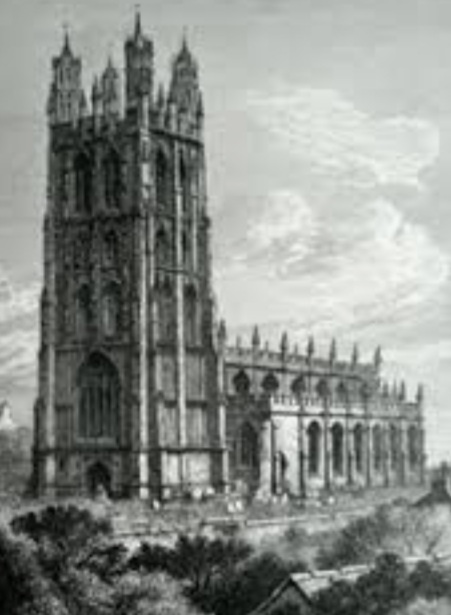
Mind you my first appearance in public saw me in the starring role with members of my family in the supporting cast and the venue was one of the finest in Wrexham — St Giles, the parish church.
A 19th century image of St Giles in Wreham.
I was a bit young, even for a juvenile lead, and I didn’t really have many lines.
The occasion was my baptism and I was only a few weeks old.
My father was managing a chemist shop in Liverpool at this time but had only taken the post two or three months before my birth. Before that the family had lived just outside Wrexham where he had managed a local pharmacy.
I have always said that I may have been born in England (at least it was in Liverpool which has always made me proud of that city) but I was conceived in Wales.
Another reason for the Wrexham venue was that my Lloyd grandparents were living there at the time (my grandfather was a civil servant and my grandmother had a stationery shop in Lampbit Street).
It was also where my father was born and grew up.
My next memory of a theatrical venue was again in Wrexham. I was only about six or seven (it was the late 50s a year or so after we moved to Rhyl).
The occasion was a performance by an amateur dramatic group which included my father’s cousin Raymond Morgan.
I don’t remember what the play was, although I seem to remember I enjoyed it.
The only true memory I have is that cousin Raymond played a character called the High Cockalorum and was in a bright, multi-coloured costume and I believe at one point he came into the audience and cavorted in the aisles.
It is strange that even at an early age some memories are embedded in your mind.
My theatrical links with Wrexham continued.
My grandfather (Lloyd) was an excellent violinist. He even took his violin with him to France when he went with the Liverpool Pals in World War 1.
He joined a concert party called the Verey Lights, and entertained many units just behind the front line. He also carried out his “daytime job” as a signaller.
After the war he set up his own little group (I think it was a quartet) and they played at tea dances and at dance halls.
He never turned professional but when he settled in Wrexham he used to play in the orchestra for the local amateur operatic society.
We went to at least three performances at the Wrexham college.
The one that sticks most in my mind is Oklahoma and to this day I can hear the mournful notes of Poor Jud is Dead, with the Surrey with the Fringe on Top providing a jaunty undertone.
I believe another performance was South Pacific and again I still know a number of the songs.
The third has slipped my mind.
We used to drive over from Rhyl, my brother, sister and I being smartly dressed for the occasion and seated in the back of the family car.
On the way back my parents folded up a travelling rug and laid it on the floor behind the front seats and, while my brother and sister curled up in the corners of the back seat I was quite happy as I fell asleep in the space between the front and back seats.
It is a knack I have always had, being able to drop off wherever I happened to be when I was tired.
I even slept at the office one night after a celebration to mark the end of a complete refurbishment of the editorial department.
Then again I am once more getting ahead of myself.
This early love of the theatre was then reinforced by my English teacher and I felt completely at home when I joined the Rhyl Little Theatre.
This also stood me in good stead on various newspapers when I used to do many of the theatrical reviews, professional and amateur.
In fact I went head to head with an editor over a somewhat less than kind review of an amateur drama group.

 Robin's Nest