How many T-shirts have you got?
Have you got any T-shirts at all?
Personally I have about 40, all have a nice soft cotton feeling which gets softer every time they are washed. Not a single one is plain white and all of them have some form of logo on them.
My oldest was added to my wardrobe (or rather chest of drawers) over 40 years ago and it is still in great condition.
If you are a T-shirt wearer do you know when the first one was created? I say “created” because that is how it came to be.
It made its first appearance in the late 19th century in New York. Workers, especially construction workers and dockers, used to wear an all-in-one set of underwear known as long johns or union suits.
These covered them from their shoulders to their wrists and ankles and had a flap at the back for when you needed to visit the loo (workers wouldn’t have time to strip the whole suit off which would have necessitated you taking off your outer garments as well).
In the heat of the summer manual workers would get hot and the itchy material of the union suit would prove very uncomfortable. Then in the 1890s one manufacturer came up with the idea of a two-part union suit, still ankle length and wrist length.
This meant you could wear the the separate parts but didn’t have to strip your upper half when you needed to relieve yourself.
Then one bright spark realised that on really hot days if you stripped to the waist the sun would still be too hot on your back but if you kept the top half of your union suit on the long sleeves were still uncomfortable.
His solution? Cut the sleeves short.
Voila! The T-shirt was born.
Not a very well made garment but it served its purpose.
Unintentional design can easily lead to manufacturers picking up the idea and creating a fashion. Look at designer jeans with rips already across the knees. This saved the wearer from having to do it themselves.
The “union suit T-shirt” went the other way with clothing firms cutting the length of the sleeves during the manufacture providing a neat design.
By 1913 not only were sales of T-shirts taking off but the US Navy added them to the official uniform.
It was the 1950s before the white T-shirt became a fashion icon.
The two most memorable film stars to wear it were Marlon Brando: The Wild One and A Streetcar Named Desire, and James Dean: Rebel Without a Cause.
Brando wore one under a black leather jacket as the leader of a biker gang in The Wild One and without any other covering in A Streetcar named Desire. James Dean teamed the white T-shirt with blue jeans and a red jacket.
As the 50s headed to the 60s manufacturers realised the white T-shirt was a blank canvas just waiting to host an advertising image or a film title or the name of a pop group.
Nowadays T-shirts can have anything on them from a Disney princess to Led Zeppelin, and from Teletubbies to vampires.
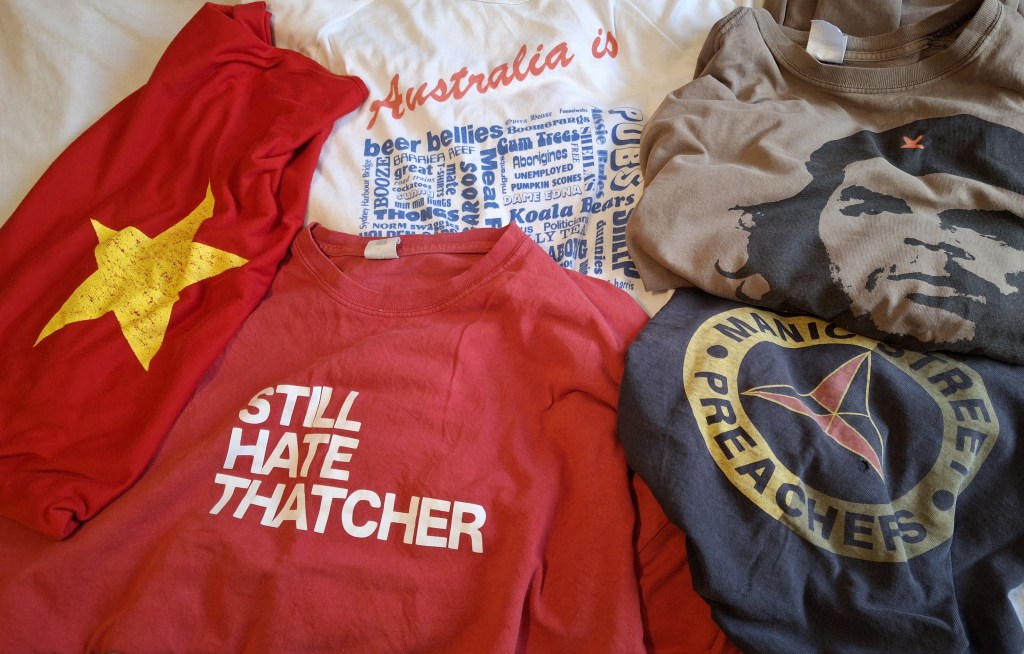
My oldest T-shirt dates back to about 1980 and was bought in Australia when we lived out there. It is designed in the format now used for word clouds and based on Australia is followed by words associated with the country, for example: thongs, barbies, stingers, Great Barrier Reef, booze, billabong, swagman, billy tea, Outback.
I also have a number of Welsh T-shirts, including two black ones each with a simple statement:
You can take the boy out of Wales but you can’t take Wales out of the boy
and:
Never forget you’re Welsh
The latter having two meanings when spoken.
I also have a number of political T-shirts one of which also highlights one of my musical tastes, a Manic Street Preachers souvenir of my trip to one of their concerts which bears the band name on the front and a quote on the back which states: If I can shoot rabbits I can shoot fascists – Anon, allegedly spoken by one of the British volunteers to the International Brigades in the Spanish Civil War.
Naturally I have not one, not two, not three but four Che Guevara T-shirts with the well-known image in black on a red T, a green T, a khaki one and a pale brown one.
Then there are the clearly political ones including one with the original Labour logo and Liverpool; another in red stating: It nothing goes right – go left; and the pride of my collection, bought in Burston, near Diss, at the Burston School Strike rally in 2015. It was just a few days before the Labour leadership vote was revealed in 2015 and Jeremy Corbyn was elected.
The T-shirt I bought at Burston has Team Corbyn on the back and Vote for Jeremy Corbyn for Labour Leader on the front.
The guest speaker at the rally that year was Jeremy Corbyn and it was the second time I had met him. He joins a very short list of people I admire almost as much as I admire my father.
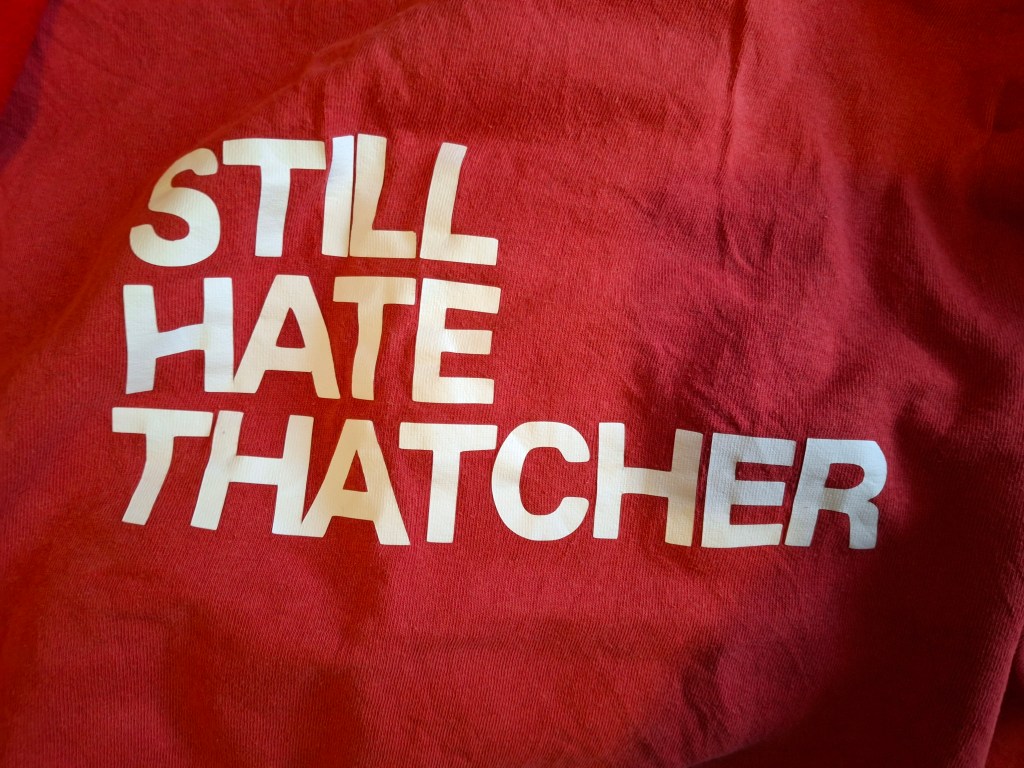
Today, however, I thought it appropriate to wear the T-shirt my daughter bought for me a few years ago:
 Robin's Nest